Skip to content
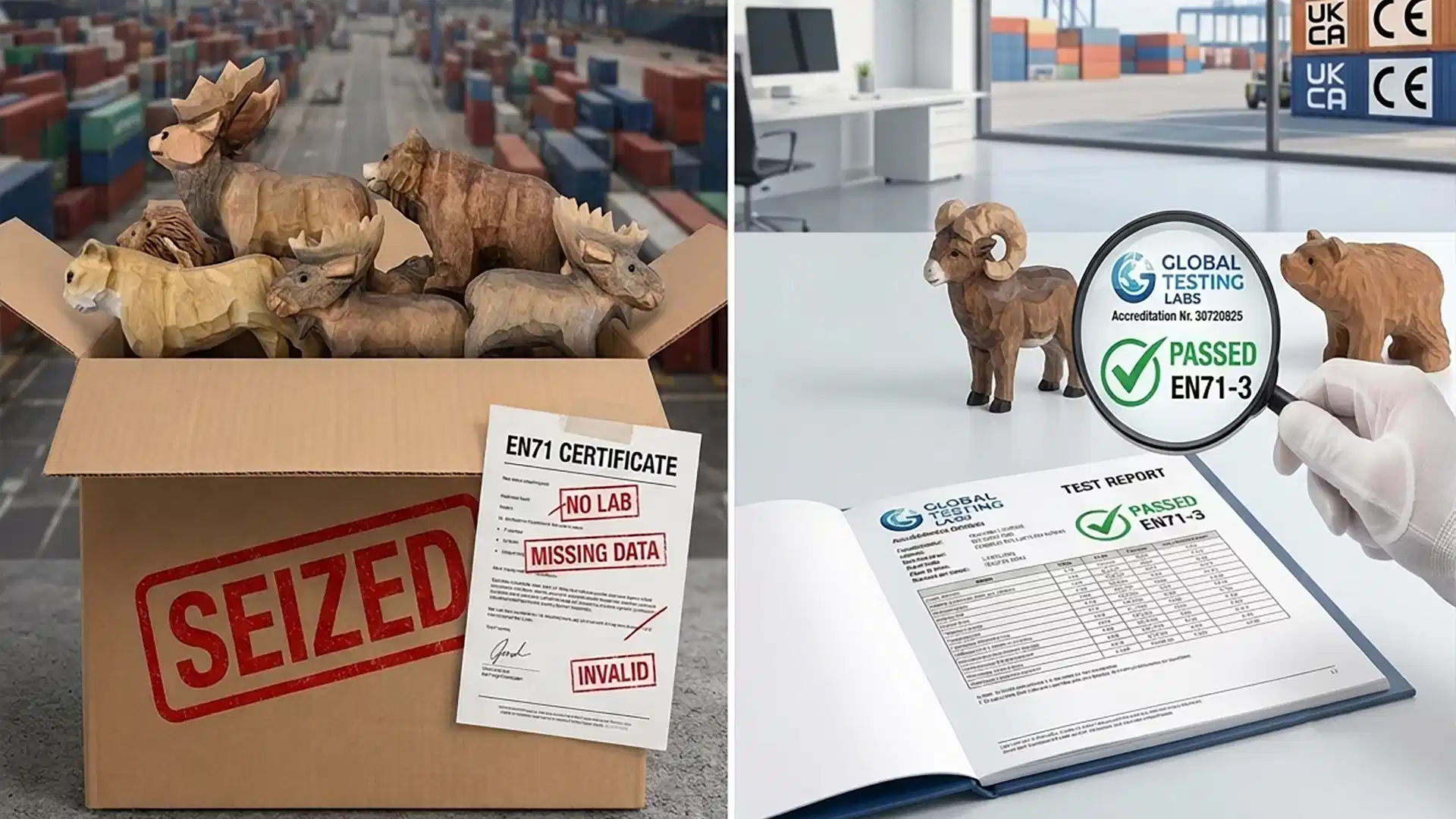
In 2024, a UK importer we know had 2,000 wooden animals seized at Felixstowe. His supplier had claimed compliance with EN71 non-toxic paint standards, but provided a fake “certificate” — a one-page PDF with a generic signature. No lab name. No raw test data. No accreditation number. UK Customs flagged it instantly. He lost the entire shipment, paid a £4,800 disposal fee, and lost three months of peak retail sales before supply could be replaced. That’s when he turned to us.
This guide is for B2B buyers who need to verify that a supplier’s EN71 non-toxic paint safety claims are bulletproof. We’ll break down what EN71 actually tests, how to read a legitimate test report line by line, and the crucial difference between “eco-friendly” and “non-toxic” (they are completely different standard metrics). If you’re importing painted wooden crafts into the EU or UK, this is the compliance roadmap that keeps your containers moving through customs.
What EN71 Actually Covers (And Why It’s Not Optional)
EN71 is the European harmonized standard for toy safety. It is not a voluntary quality badge or a decorative marketing seal. Under the EU Toy Safety Directive (2009/48/EC), any product that has play value or could reasonably be handled by a child under 14 must comply. Hand-carved decorative birds? Yes, they frequently fall into this scope. Regulators assume a child will hold, mouth, or chew the product.
The standard covers three core parts for carved wood products:
- EN71-1: Mechanical and physical properties. Tests structural integrity. Sharp edges, splinter risks, and small parts that could detach are prohibited. For wooden birds: beak and tail details must withstand mandatory tension and torque testing without breaking into choke hazards.
- EN71-2: Flammability. Measures burn rates. Solid natural basswood passes comfortably, but unvetted composite woods or chemical finishes can easily trigger flags.
- EN71-3: Migration of certain elements. The critical test for painted products. It simulates a child swallowing paint chips and measures the leaching levels of 19 heavy metals, including lead, cadmium, mercury, and chromium. Exceeding these thresholds makes the goods illegal to enter the market.
Without verified EN71 reports and a matching Declaration of Conformity (DoC), EU and UK (UKCA) customs authorities hold authority to confiscate the container immediately. You don’t receive a warning period — you receive a detention notice and destruction costs.
EN71-3 in Practice: What the Lab Actually Does
The heavy metal migration test is rigorous. Lab technicians scrape physical paint samples off the production batch, grind them into fine particles, and extract soluble elements using a hydrochloric acid solution formulated to match stomach acid chemistry. The liquid is then analyzed via ICP-MS (inductively coupled plasma mass spectrometry) to quantify exact element migration in milligrams per kilogram.
The regulatory thresholds leave zero room for estimation: Lead is capped at 23 mg/kg, Cadmium at 1.3 mg/kg, and Mercury at 7.5 mg/kg. Our water-based paint formulas test consistently well below these legal ceilings — frequently registering as non-detectable (ND). However, clean paint is only half the battle; having legitimate third-party lab documentation on file is what clears the port.

How to Spot a Fake or Useless Test Report
Virtually every supplier will promise “EN71 compliance.” Whether their paperwork holds up under customs scrutiny is a different matter. Use this verification checklist when reviewing safety documentation:
| Check Point | What a Valid Report Displays | Red Flag |
|---|---|---|
| Lab Accreditation | CNAS, CMA, or ILAC-MRA stamps complete with a traceable testing license number | Missing lab identity or unlisted testing entities outside accredited registries |
| Product Specificity | Clear photographs of the exact item, matching material notes, and paint colors tested | Generic descriptions like “wooden craft” without model numbers or batch references |
| Standard Version | Explicitly references the current active standard (e.g., EN 71-3:2019+A1:2021) | Outdated standard references (e.g., EN 71-3:2013) or missing part designations |
| Declaration of Conformity | A standalone legal DoC issued and signed by the direct manufacturer referencing the test report ID | Absence of a formal DoC, or substituting self-made marketing promises for lab reports |
| Report Age | Issued within the past 12 months or linked directly to the current raw material lot | Reports older than 2–3 years with unverified material updates since issuing |
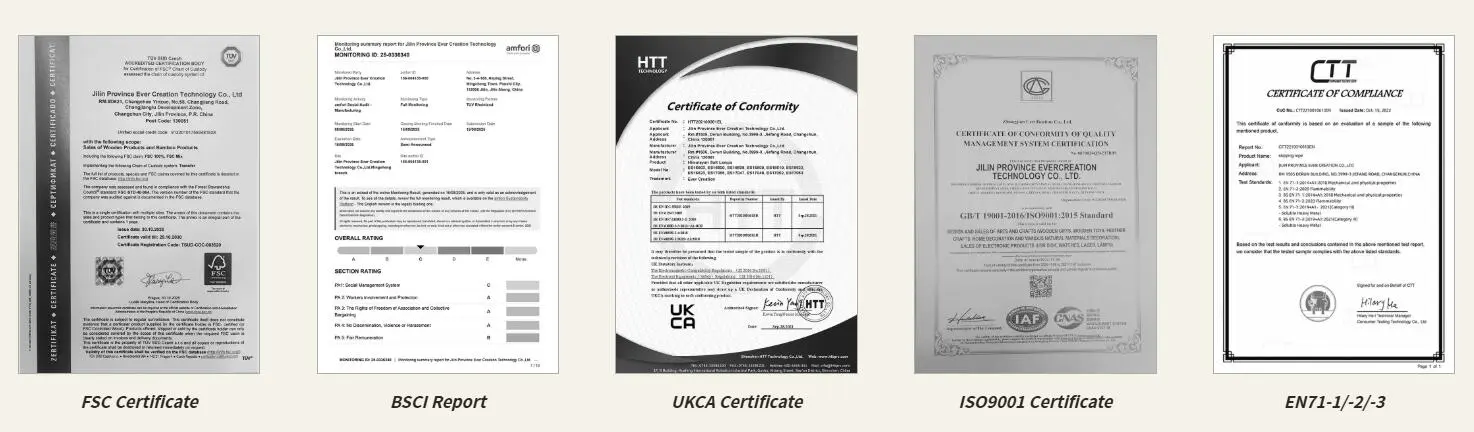
Our testing is conducted through internationally recognized, ILAC-MRA accredited laboratories such as SGS and Intertek. Each test report details our specific basswood substrate and water-based pigment pairings. We execute annual re-testing protocols or trigger fresh tests whenever raw material formulations change. Current compliance files are attached directly to our initial wholesale quotes.

“Eco-Friendly” Does Not Mean “Non-Toxic”
A frequent point of confusion in overseas sourcing: a factory claims “eco-friendly paint,” and the buyer assumes that covers child safety compliance. It does not.
Eco-friendly addresses environmental footprint: sustainable timber harvesting, low VOC emissions during manufacturing, or biodegradable packaging. These reflect environmental sourcing metrics.
Non-toxic addresses chemical safety: freedom from bio-accumulative heavy metals and compliance with EN71-3 migration thresholds. This is a consumer health metric.
A product made with organic timber can still fail EN71-3 if the pigment incorporates heavy-metal stabilizers for color intensity. Conversely, a synthetic material might pass chemical testing easily while lacking eco-credentials. Professional sourcing requires verifying both environmental and safety documentation independently.
When Do Compliance Reports Need Renewal?
While test certificates do not carry an explicit expiration date printed on the page, regulatory authorities treat outdated documents as invalid. Fresh documentation should be required under these conditions:
- Pigment or Coating Changes: Testing for a yellow paint batch does not cover a dark blue batch. Different paint shades rely on distinct chemical compounds. Every new color formulation requires verification.
- Regulatory Standard Updates: When the European Committee for Standardization updates test protocols (such as adding new element limits to EN 71-3), older reports lose valid status for new import entries.
- Annual Audit Cycles: Major EU retailers and e-commerce platforms (including Amazon EU) require testing documentation dated within 12 months of shipment arrival.
We maintain active EN71-1, EN71-2, and EN71-3 testing files as part of our ISO 9001 quality system. When directive updates occur, re-testing is scheduled immediately to ensure our retail partners maintain uninterrupted customs clearance.
Frequently Asked Questions
Is EN71 required for decorative items, or only toys?
If a product possesses play appeal or could reasonably be handled by a child under 14, regulators enforce the Toy Safety Directive regardless of marketing disclaimers. Labelling an item “for decoration only” does not exempt it if the design—such as a colorful carved animal—is attractive to children. For painted small wood crafts, maintaining EN71 compliance is standard risk management for importers.
Do you also meet US and UK safety standards?
Yes. Our standardized paint system complies with ASTM F963 (US toy safety standard), CPSIA Section 101 for total lead limits, and UKCA compliance requirements. We issue market-specific documentation suites matching your destination port.
Can I review full test reports before issuing a purchase order?
Yes. We attach current SGS or Intertek EN71 test reports alongside initial quotations. If your compliance team or customs broker requires specific documentation formats, we provide those during order setup.
What happens during a customs compliance inspection?
Customs officials verify the Declaration of Conformity against the test report ID and invoice details. Valid documentation matching the physical cargo allows immediate release. We attach the signed DoC to commercial shipping paperwork to ensure seamless port clearance.
Does natural wood require testing, or just the paint layers?
The testing protocol evaluates the finished item as presented to consumers. Untreated solid basswood naturally meets safety thresholds, meaning chemical risk is concentrated in surface paints and sealers. However, official test certificates must cover the complete, combined product assembly.