Skip to content
A disciplined Quality Control (QC) process is the only safeguard against the financial risks of importing handcrafted goods. Failure to manage ‘Artisanal Variance’ results in high defect rates from cracking or inconsistent painting, directly eroding the per-unit profit margin on bulk orders.
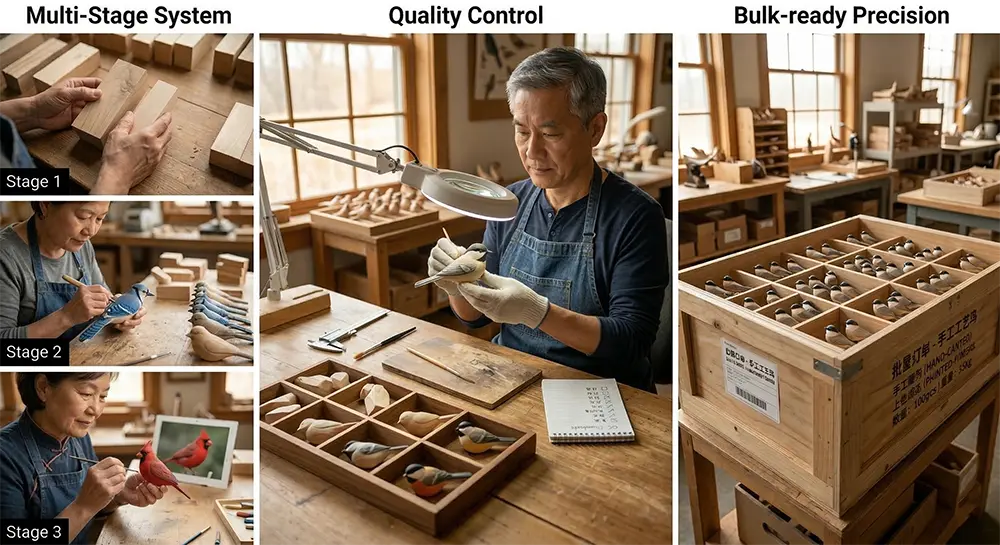
Our protocol breaks down the multi-stage inspection system designed to achieve ‘Bulk-ready Precision’. We verify raw material integrity, starting with ethically sourced Basswood, and implement humidity controls to guarantee the ‘Structural Resilience’ needed to withstand international shipping and protect your investment.
Why is QC for small crafts more difficult than large furniture?
QC for small crafts is harder than for large furniture because it relies on manual, piece-by-piece inspection, not automation. Hand-carved variability requires multi-stage checks for consistency.
Manual Production vs. Automated Consistency
Large furniture manufacturing uses automated systems like CNC routers to get consistent, repeatable results. Quality control can be systematized and errors minimized efficiently through technology. Small crafts, like our 100% hand-carved wooden birds, are a different story. The entire process depends on manual inspection, which is labor-intensive and cannot be automated.
This manual approach creates what we call ‘Artisanal Variance’—slight, unique variations that are the hallmark of a handcrafted product. But for a B2B buyer, that variance needs to be controlled. Each bird requires individual assessment, not the simple batch sampling used for mass-produced goods.
Our Multi-Stage System for Bulk-Ready Precision
To solve this, we developed a rigorous, multi-stage quality control framework. We inspect everything from the moment the raw basswood arrives, through the semi-finished carving stage, and up to the final hand-painted product. This system ensures we achieve ‘Bulk-ready Precision’—the handmade charm of each bird is preserved, but consistency across large wholesale orders is guaranteed.
Our protocols focus on the details that matter to retailers and their customers. We check for meticulous detailing, confirm the ornithological accuracy of each species, and ensure the structural resilience needed to withstand international shipping without damage.
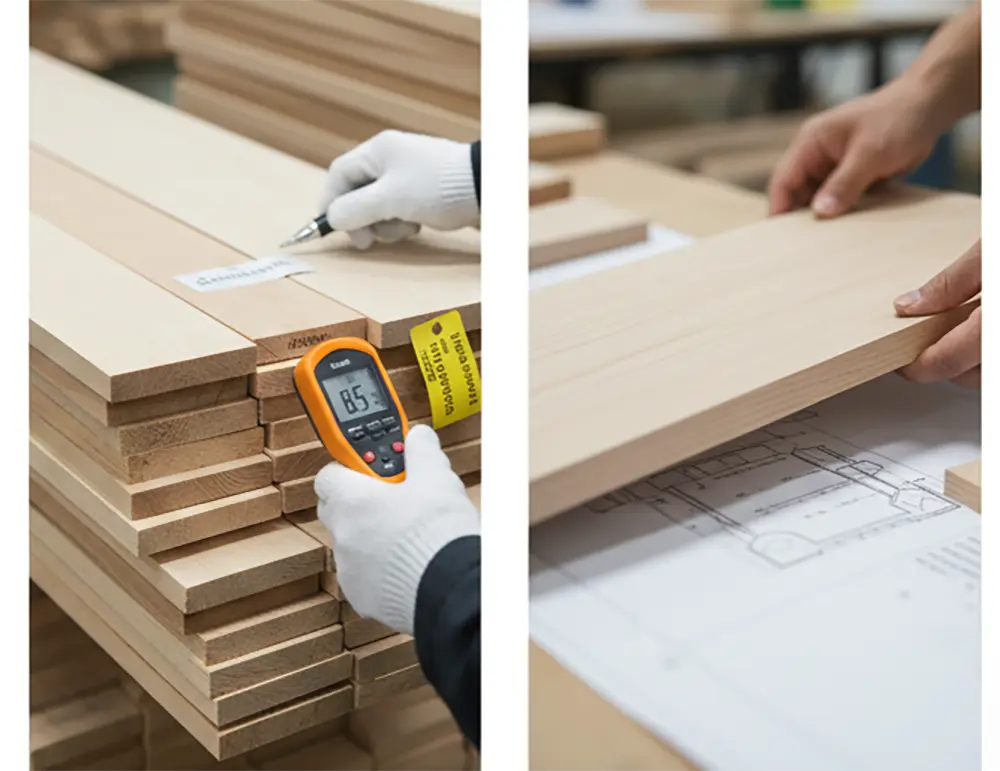
What happens during our “Premium Raw Material Sourcing” check?
Our sourcing check starts with supplier audits. Every wood batch is then quarantined and inspected for authenticity, structural integrity, and correct humidity before approval.
A product’s quality is decided long before the first cut. This process ensures that only compliant, high-grade materials enter our workshop. It’s a non-negotiable, multi-stage verification system that protects the final product’s integrity.
Supplier Qualification and Incoming Material Inspection
We treat material sourcing as the first and most critical stage of quality control. Before any wood is accepted, potential suppliers must pass our strict vetting process.
- Supplier Audits: We conduct audits to verify a supplier’s quality management systems. We don’t just take their word for it; we check their processes to ensure they meet our standards for consistency and reliability.
- Certification Review: Every supplier must provide current compliance documentation. For us, this means verifying their FSC (Forest Stewardship Council) certificates to confirm the timber comes from sustainable, responsibly managed forests.
- Incoming Quarantine: No material goes straight to production upon arrival. We place every incoming lot in quarantine where our QC team takes samples to test for identity, purity, and structural soundness.
Our Standard for Premium Basswood
General principles are one thing, but applying them to our core material is where it counts. We use these checks to guarantee the quality and integrity of the Basswood used for every carving.
- Source Selection: We exclusively use fine-grained Basswood sourced from the Changbai Mountain region. This specific timber is known for its smooth texture, making it ideal for the detailed, hand-sculpted work our artisans perform.
- Ethical Sourcing Confirmation: All our timber is confirmed to be ethically sourced from sustainable forestry operations. This isn’t just a marketing claim; it’s a core part of our supplier qualification backed by FSC certification.
- Physical Integrity Inspection: Each batch is meticulously inspected for structural integrity. We check for hidden cracks or weaknesses and verify optimal humidity levels to ensure the wood has the stability needed to prevent warping during shipment and display.
High-Quality Custom Wood Birds, Factory-Direct.
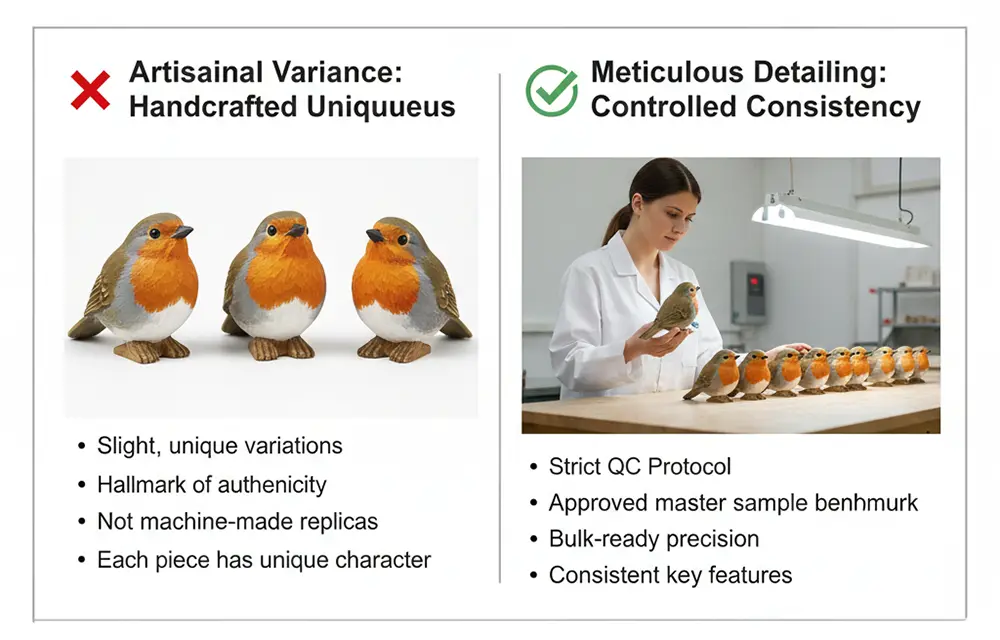
How do we ensure every bird’s facial expression matches the sample?
We balance handcrafted uniqueness with strict QC. Slight differences are a mark of authenticity, while key details are checked against a master sample for consistency across every order.
Maintaining consistency in handmade products is a common concern for wholesalers. Unlike automated production lines, every hand-carved item has inherent variability. We address this directly by defining what makes our products unique and implementing a process that guarantees quality at scale.
The Principle of Artisanal Variance
We don’t see slight variations as defects; we define them as “Artisanal Variance.” This is the hallmark of hand-sculpted authenticity that distinguishes our birds from uniform, machine-molded replicas. While the core design and emotion of the expression are always consistent, each artisan’s touch adds a unique character to the piece. This principle celebrates the human element, which is exactly what your customers are paying for.
Our QC Protocol for Meticulous Detailing
Our process centers on “Meticulous Detailing.” Artisans go through specific training modules for carving expressive eyes and achieving lifelike avian postures. For every order, we create an approved pre-production sample that serves as the benchmark. Each batch is then checked against this master sample to ensure “Bulk-ready Precision.” This system guarantees that the key features of the bird’s expression are consistent across the entire shipment, giving you a reliable and uniform product without losing its handcrafted integrity.
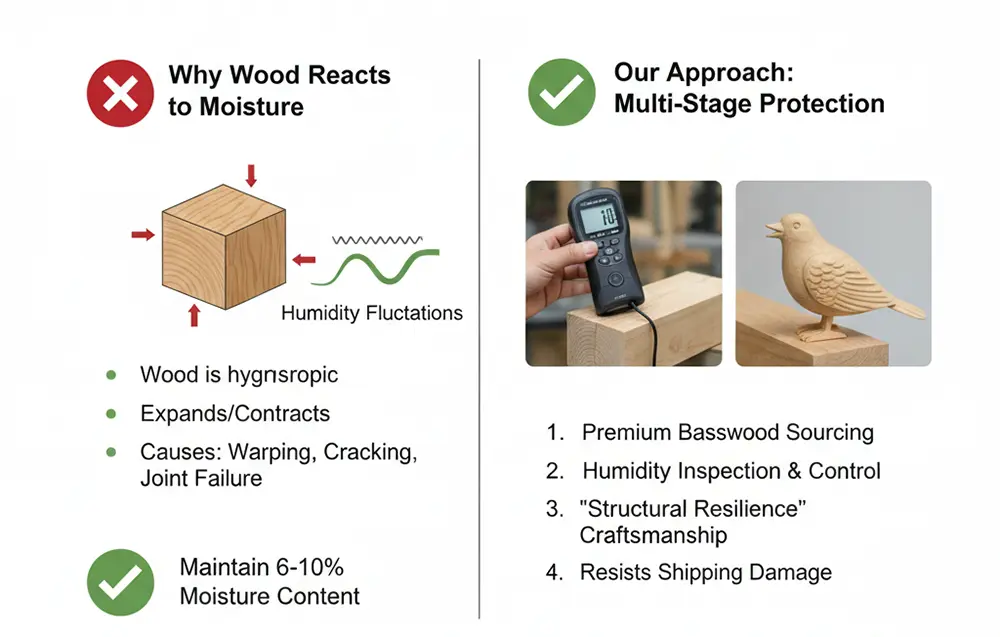
Is humidity control the most critical step in wooden craft QC?
Humidity control is essential for preventing warping and cracking in wooden crafts. But it’s one part of a quality system that also requires proper material selection and craftsmanship.
Why Wood Reacts to Environmental Moisture
Wood is a hygroscopic material, meaning it naturally absorbs and releases moisture to balance with the air around it. When humidity fluctuates, wood expands or contracts. This movement is the direct cause of defects that compromise the product’s integrity.
Common problems include:
- Warping
- Cracking
- Joint failure
For wooden crafts, maintaining a stable wood moisture content between 6-10% is key to preventing these issues from ever starting.
Our Approach to Structural Resilience
We begin with premium Basswood from Changbai Mountain. Each batch is inspected for optimal humidity levels before carving begins. This isn’t a step we can skip.
Our craftsmanship focuses on achieving ‘Structural Resilience’ to ensure our wooden songbirds resist warping and cracking during long-distance shipping. This rigorous inspection is a core part of our source-to-shelf quality control, guaranteeing consistency and durability for our wholesale partners.
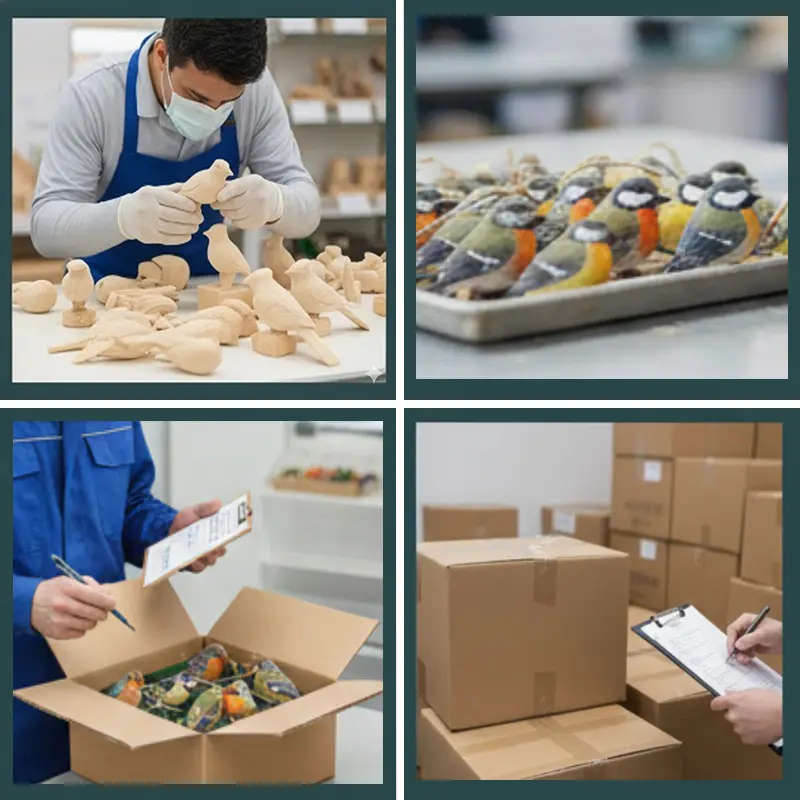
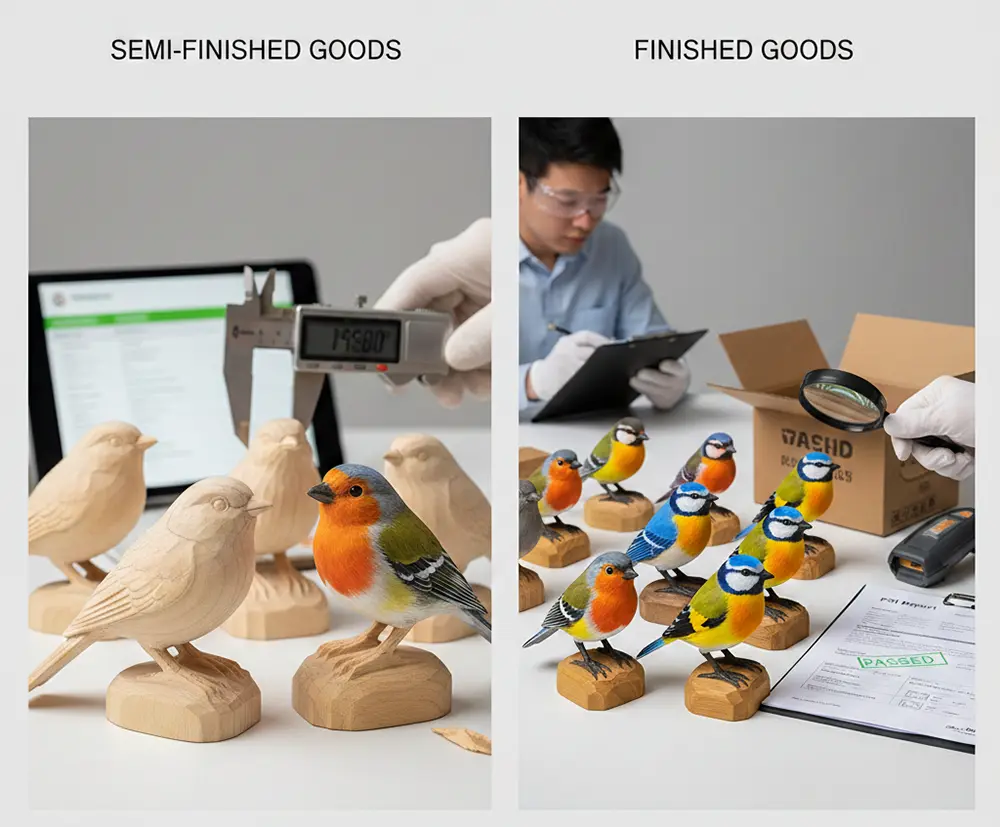
What are our protocols for inspecting semi-finished vs. finished goods?
Our protocols shift with the production stage. We inspect semi-finished goods mid-production to correct issues early. We inspect finished goods before shipment to verify final quality and specs.
| Inspection Stage | Semi-Finished Goods | Finished Goods |
|---|---|---|
| Timing | When 20-60% of the order is complete. | When 100% of the order is complete. |
| Primary Goal | Process control and early defect correction. | Final compliance and order verification. |
| Method | During Production Inspection (DUPRO). | Pre-Shipment Inspection (PSI). |
| Focus Area | Monitoring for recurring defects and ensuring consistency. | Conformity to specs, quantity, and packaging. |
Semi-Finished Goods: Focusing on Process Control
For semi-finished goods, our focus is on process control. We conduct a During Production Inspection (DUPRO) when 20-60% of your order is carved and painted. This isn’t about final judgment; it’s about early detection. The goal is to spot any recurring deviations in our hand-carving or painting processes and adjust immediately. This approach is critical for preventing large-scale rework and ensuring the consistency needed for bulk orders.
Finished Goods: Final Verification for ‘Source-to-Shelf’ Integrity
Once production is 100% complete, we shift to final verification. A comprehensive Pre-Shipment Inspection (PSI) confirms every aspect of the order—product quality, quantity, labeling, and packaging—meets your exact specifications. This final check is how we deliver on our ‘Source-to-Shelf’ Integrity promise. It’s the last step in our Rigorous Quality Control process, ensuring ‘Bulk-ready Precision’ before anything leaves our factory.
How do we handle “A-Grade” vs. “B-Grade” sorting?
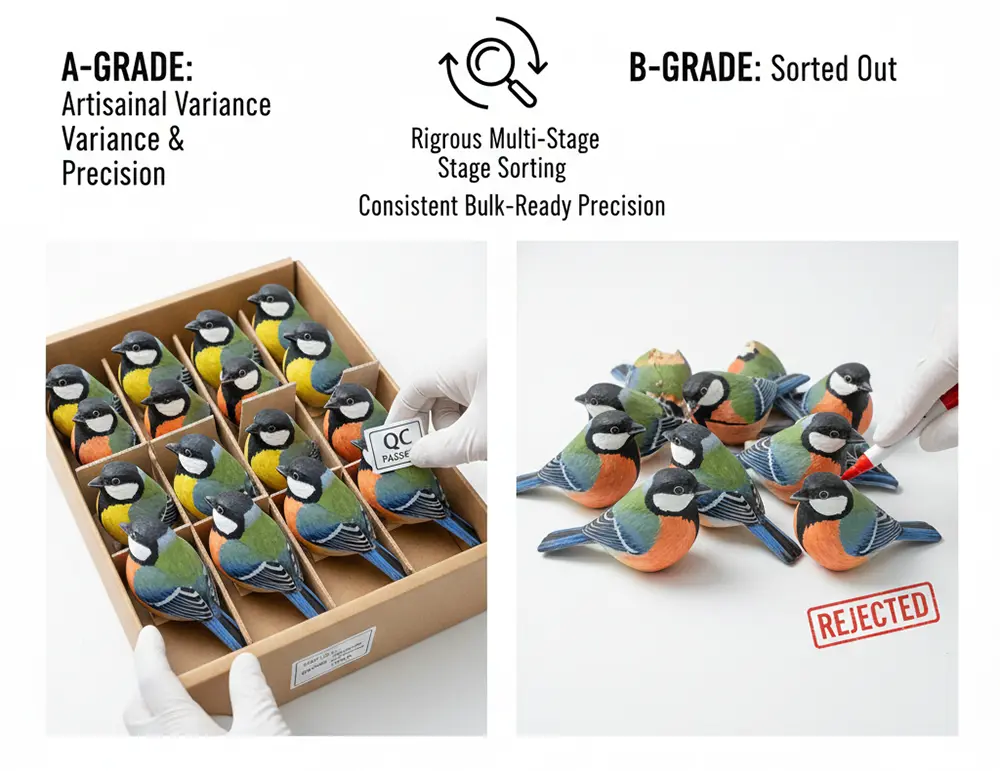
We define A-Grade products by our highest standards for craftsmanship and material integrity. Our process embraces “Artisanal Variance” as a mark of authenticity, not a defect.
Defining Quality Tiers in Manufacturing
In any production environment, a clear grading system is essential. It sets expectations for both the factory and the buyer. The distinction between A-Grade and B-Grade is a standard industry practice that separates premium products from acceptable ones.
- A-Grade represents the highest quality tier. These products are made with premium materials and pass through rigorous, multi-stage inspections to ensure they meet or exceed international standards.
- B-Grade refers to products that meet baseline acceptable quality for most markets but may have minor inconsistencies.
A disciplined sorting process with objective criteria is critical. It prevents mix-ups and ensures that every shipment aligns with the client’s quality expectations.
Our Standard: ‘Artisanal Variance’ as the Mark of A-Grade
Since our wooden songbirds are 100% hand-carved and hand-painted, a rigid, machine-like uniformity would be inauthentic. We embrace ‘Artisanal Variance’—the slight variations in carving or painting that serve as the hallmark of true craftsmanship.
Our ‘Rigorous Quality Control’ process ensures every A-Grade bird maintains ‘Bulk-ready Precision.’ This means the handmade charm doesn’t compromise the consistency needed for large wholesale orders. Any item with variations falling outside our accepted standards for aesthetics or structural integrity is sorted out and never shipped. You only receive products that meet our highest definition of quality.
Can you request a 3rd party inspection before the balance payment?
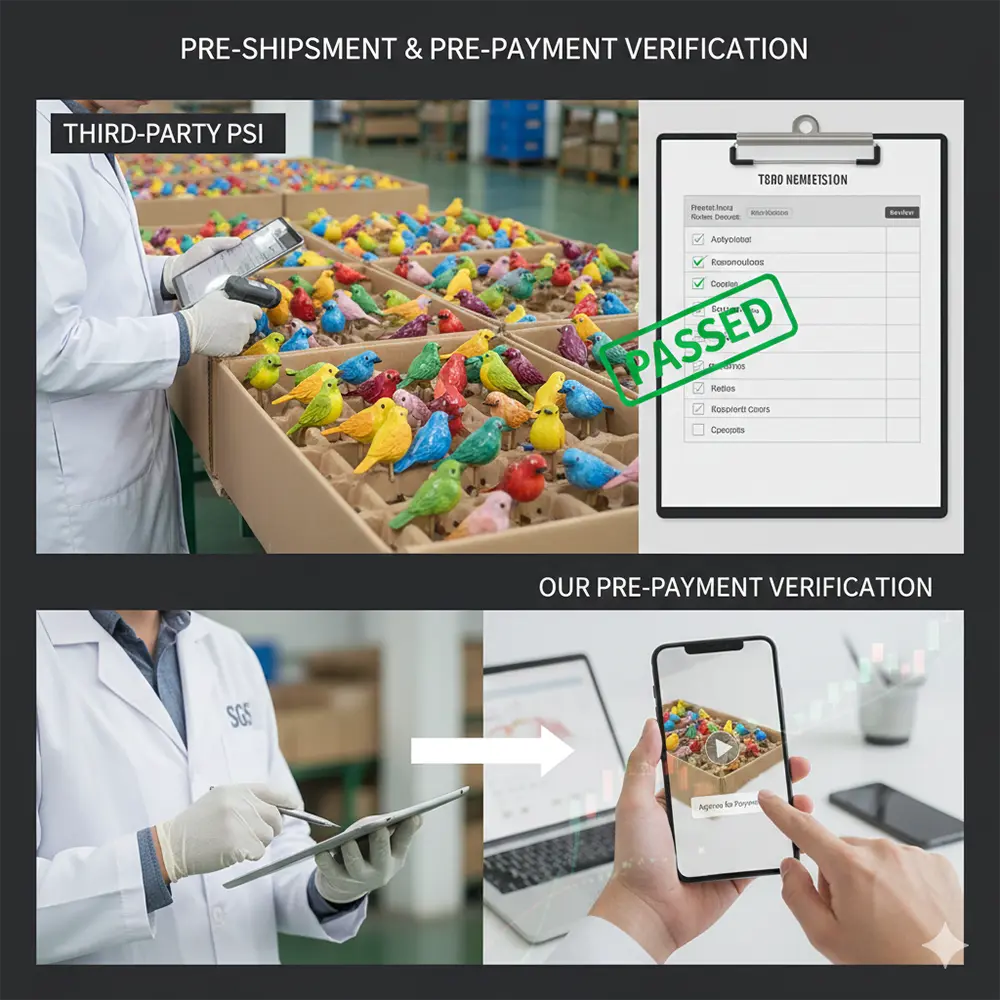
Yes, requesting a third-party inspection before your final balance payment is standard practice. It’s a smart way to verify quality and protect your investment before shipment.
Standard Industry Practice for Pre-Shipment Inspection
Arranging an independent inspection is a routine part of international trade that protects your interests. It gives you an unbiased assessment of product quality before the goods leave the factory floor. To make the process effective, there are a few standard procedures to follow.
- A Pre-Shipment Inspection (PSI) is usually scheduled once at least 80% of your order is finished and packaged, giving a realistic view of the final production run.
- To make it legally binding, you must state in your Purchase Order (PO) that the goods require a “PASS” result from your inspection agent before shipment.
- The buyer is responsible for the cost of the initial inspection. This ensures the report is impartial and serves your interests directly, not the factory’s.
Our Pre-Payment Verification Protocol
While we fully support third-party inspections, we also provide our own layer of verification to protect your cash flow. As part of our standard payment terms, we provide high-resolution photos and videos of your finished goods for you to review. This internal check happens before we ever request the 70% balance payment. This policy gives you complete transparency and reinforces our commitment to Source-to-Shelf Integrity, ensuring you know exactly what you’re paying for before the final wire transfer.
Frequently Asked Questions
What are the key quality control steps for wooden songbirds?
Our quality control is a multi-stage process. It begins with inspecting raw basswood for defects, followed by precise measurement and carving checks. We then dry-fit all pieces, prepare surfaces meticulously, and apply non-toxic, EN71-compliant finishes. A final visual inspection confirms aesthetic quality and structural integrity before packaging.
How do you prevent the wood from cracking during and after production?
To ensure structural resilience, we manage moisture content from the start. We use properly seasoned, kiln-dried basswood and apply end-grain sealers to raw materials to ensure slow, even drying. Our workshop maintains controlled humidity levels, and we allow the wood to acclimate properly before it is carved and finished.
Is your factory certified for quality management?
Yes, our facility is ISO 9001:2015 certified. This certification validates our commitment to a systematic approach to quality management. We also hold EN71, BSCI, and FSC certifications, ensuring our products consistently meet customer expectations and international regulatory requirements.
What is an acceptable defect rate for your handcrafted products?
For handcrafted items, we focus on minimizing defects at the source rather than relying on a fixed acceptance rate. We use a strict internal sorting process to separate ‘A-Grade’ products from those with minor ‘Artisanal Variances.’ Our goal is a near-zero rate for functional or major aesthetic defects on all shipped orders.
Final Thoughts
Sourcing generic crafts might seem cheaper, but it exposes you to the risk of inconsistent quality and cracked inventory. Our multi-stage QC system, from high-quality basswood to pre-shipment inspection, eliminates those variables. This is how you protect your brand from customer returns and build a reputation on quality.
Verify our ‘Bulk-ready Precision’ for yourself. Our trial order (100 pcs MOQ) is the best way to test our hand-carved quality before committing to a larger volume. Contact our team to get started or to discuss your custom packaging and OEM requirements.
While looking for specific styles, don’t forget to check our full catalog of [wholesale-wooden-songbirds] to see all available options.
As a comprehensive [Wooden Bird Factory], we also produce cardinals, owls, ducks and robins.