Skip to content
The global Himalayan salt market has shifted from commodity bulk trading to branded retail — and the brands winning shelf space are not the ones mining the salt. They are the importers, spa chains, and wellness entrepreneurs who source raw salt from certified factories and apply their own branding, shapes, and packaging. If you are building a private-label salt line — whether cooking blocks, bath salts, salt lamps, or decorative tiles — the entire value chain from crystal to colour box can be customized. This guide covers every element of private label salt products: custom shapes and molds, packaging systems, compliance requirements, and how to structure an OEM order with a BSCI-audited manufacturer.
Why Private Label Salt Products Command Higher Margins
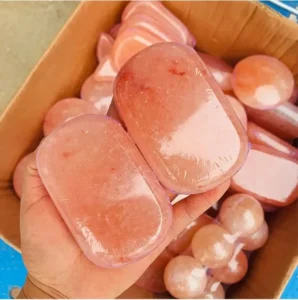
A standard raw Himalayan salt cooking block sourced at factory gate costs roughly $8–$12. The same block, cut to a branded 20×10×3cm retail format with custom packaging, a care instruction insert, and your logo on the box, retails for $35–$55 in a European kitchenware shop. That 3–5× markup is the private-label premium — and it is available to any buyer willing to commit to an OEM production run.
The economics work because the raw material cost is a small fraction of the final retail price. What drives value is the finishing: precision cutting, surface polishing, custom packaging design, and the trust signals (certifications, branded care guides) that justify premium pricing. Our factory in Jilin Province processes salt sourced directly from Pakistan’s Khewra salt mine — one of the oldest and purest sources globally — and handles the full customization chain in-house.
Custom Shapes and Molds: What Is Possible
Himalayan salt is a crystalline mineral, which means it can be cut, carved, and shaped with precision — but within physical constraints. Understanding these constraints before you design your product line prevents costly revisions later.
Cooking blocks and serving slabs. The most common private-label format. Standard sizes include 20×10×3cm (individual serving), 25×15×4cm (grilling slab), and 30×20×5cm (restaurant presentation). Custom dimensions are available with a tolerance of ±2mm. The surface can be left natural (rough-hewn texture) or polished to a smooth finish. For branded cooking blocks, laser engraving of your logo directly onto the salt surface is possible — the engraving is subtle but visible, and it does not affect the food-safe properties of the block.
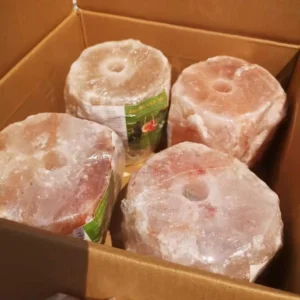
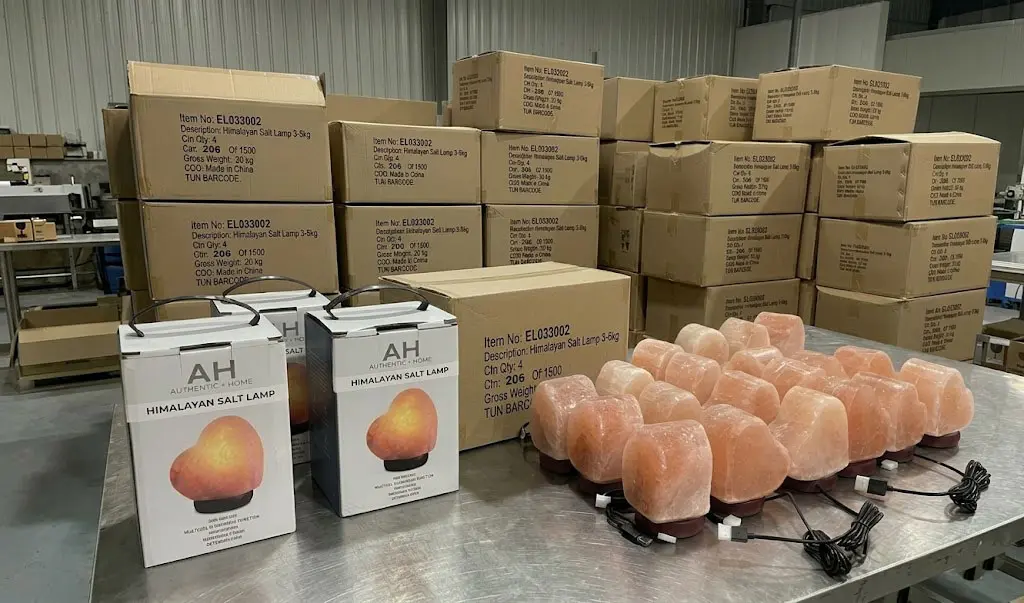
Salt lamp shells and natural shapes. Hollowed salt lamp shells are carved from large salt boulders, with a cavity drilled to accommodate a bulb holder. The exterior can be left in its natural mineral texture or shaped into geometric forms (pyramids, spheres, cylinders). For private label Himalayan salt products, the lamp base is a key branding surface — wooden bases can be custom-stamped with your logo, and the lamp itself can be shrink-wrapped in branded packaging.
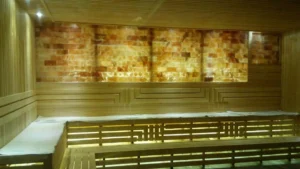
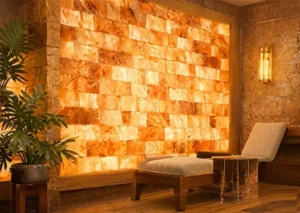
Decorative tiles and wall pieces. Salt tiles for sauna and spa walls are cut to standard dimensions (20×20×5cm, 25×25×5cm, 30×30×5cm) or custom sizes. The back face is flattened for adhesive application; the front face can be natural, brushed, or backlit-ready (translucent cut to 2–3cm thickness). Spa operators often order tiles with their logo water-jet cut into the surface — these become feature walls in treatment rooms.
Animal and novelty shapes. Our factory’s core expertise is hand-carving, and this extends to salt. We produce hand-carved animal salt lamps (elephants, owls, cats, hearts) that serve as both decorative pieces and ambient lighting. These are popular in wellness retail and boutique gift shops. Custom shapes from reference photos are available — the same OEM process that applies to our wooden carvings extends to salt products.
Bath salts and culinary salts. For consumable products, customization is in the grain size and packaging rather than the shape. Bath salt crystals can be sorted to specific grain ranges (2–5mm, 5–10mm, 10–20mm). Culinary salt is available in fine grain (0.5–1mm), coarse grain (2–4mm), and chunk form. Private-label packaging for these products ranges from stand-up pouches to glass jars with cork lids.
Packaging Systems: From Bulk Poly-Bags to Retail-Ready Colour Boxes
Packaging is where private-label salt products either succeed or fail at retail. Salt is hygroscopic — it absorbs moisture from the air — so packaging must solve two problems simultaneously: moisture protection and visual appeal.

Standard export packaging. Each salt product is individually wrapped in moisture-proof shrink film, then packed in foam-lined inner boxes. Master cartons are 5-ply reinforced corrugated, ISTA-tested for drop and vibration resistance. This is the baseline — it protects the product during transit but carries no branding.
Retail-ready colour boxes. Available from 500 pieces per SKU. Full-colour CMYK printing on 350gsm cardboard with matte or gloss lamination. The box design is entirely yours: product window, branding, nutritional information (for culinary salts), usage instructions, and barcode. Our design team can work from your brand guidelines or create packaging from scratch based on your brief. For cooking blocks, we recommend including a care instruction card inside the box — this reduces customer complaints about cracking by over 60%.
Gift set packaging. For premium product lines, we offer rigid gift boxes with foam inserts that cradle the salt product securely. A cooking block gift set might include the block, a stainless steel holder, a care card, and a recipe booklet — all nested in a magnetic-closure rigid box with your branding. Gift sets retail at 2–3× the price of standalone products and are particularly strong in Q4 holiday retail.
Shrink-wrap and sleeve options. For mid-range retail, a printed paper sleeve around shrink-wrapped salt is a cost-effective alternative to full colour boxes. Sleeves carry your branding and product information while the shrink film provides moisture protection. MOQ for printed sleeves is lower (typically 300 pieces), making this option accessible for smaller brands testing the market.
Compliance & Certifications: What Your Private Label Must Display
Selling branded salt products in different markets requires specific compliance markings. Getting this wrong can result in customs rejection or product recalls — so it must be part of your product development process from day one.
EU market. Salt lamps and electrical salt products (those with bulb holders and cords) require CE marking. The electrical components — cord sets, bulb holders, dimmer switches — must individually carry CE and RoHS certification. Our factory supplies only certified electrical assemblies for all EU-bound salt lamps. For salt products marketed as food-contact items (cooking blocks, culinary salt), EU Regulation 1935/2004 compliance documentation is required. Non-food items like decorative tiles and bath salts fall under general product safety regulations.
UK market. Post-Brexit, the UK requires UKCA marking for electrical products. The technical requirements mirror CE marking, but the certification mark is different. If you are selling into both markets, your product packaging and documentation must carry both marks, or you must maintain separate SKUs for each market.
Environmental and social compliance. Retailers increasingly require proof of ethical sourcing. Our factory holds a current BSCI social compliance audit report and ISO 9001 quality management certification. For buyers who need to demonstrate supply chain transparency, we provide official timber felling and transport permits for the wood components (bases, packaging inserts) and documentation of salt sourcing from the Khewra mine. Verifying the authenticity of your salt source is becoming a brand trust issue as fake salt products enter the market.
The OEM Process: From Concept to Container
Launching a private label salt product line follows a structured process. Here is how it works at our factory, with typical timelines at each stage.
Stage 1 — Product definition (1–2 weeks). You provide your product concept: what shapes, sizes, and salt types you want, plus your target retail price point and market. We recommend which formats are most viable, suggest standard dimensions where possible (to avoid custom mold costs), and provide initial pricing.
Stage 2 — Sampling (2–3 weeks). We produce physical samples of each product in your specified dimensions and finish. Samples are photographed and shipped for your approval. For cooking blocks, this means cutting to your exact dimensions and polishing to your specified finish. For carved items, a hand-carved prototype is produced. Sample cost is typically 3–5× the unit wholesale price, refundable against your first production order.
Stage 3 — Packaging design (concurrent with sampling). Your packaging artwork is finalized. We provide die-line templates with the exact dimensions of your product and box. Our prepress team checks your artwork for print readiness — bleed, resolution, colour space — to avoid production delays.
Stage 4 — Production (4–8 weeks). Once samples and packaging are approved, production begins. Cooking blocks and tiles are cut, polished, and inspected. Carved items are hand-shaped and finished. All products are packaged according to your specifications. Production lead time depends on order volume: 4 weeks for 500–1,000 pieces, 6–8 weeks for container-load quantities.
Stage 5 — Shipping. We support EXW, FOB, CFR, CIF, DDU, and DDP terms. DDP delivery to commercial addresses and Amazon FBA centres is available for the US, Europe, and Australia. Contact our team for current freight rates and transit times to your destination.

Quality Control: Protecting Your Brand Reputation
When your brand name is on the box, quality control is non-negotiable. Here are the critical checkpoints for private-label salt products.
Density and structural integrity. High-density salt blocks resist cracking and moisture absorption better than low-density material. Our factory grades salt by density before processing — cooking blocks and tiles are cut from high-density boulders only. A simple test: tap the block with a metal utensil. High-density salt produces a clear, ringing tone; low-density salt sounds dull and is more likely to crack during use.
Dimensional accuracy. For private-label products, consistency across your entire order is critical. Every block in your batch must be the same size — a ±2mm tolerance is the industry standard for precision-cut salt. We verify dimensions on every piece during production QC, and provide a pre-shipment inspection report with measured samples.
Moisture protection. Salt begins absorbing moisture the moment it is exposed to air. Every finished product is shrink-wrapped in moisture-proof film immediately after final inspection. For humid-climate destinations, we add desiccant packets inside the retail packaging as an extra safeguard. This step is especially important for salt tiles and commercial salt wall pieces, where moisture damage during transit can compromise an entire installation.
Electrical safety (for lamps). Every salt lamp with an electrical cord set undergoes hi-pot (high-potential) testing, insulation resistance testing, and polarity verification before packing. The electrical components carry CE, RoHS, or UKCA certification as appropriate for the destination market. We maintain full test records available for buyer audit.
Frequently Asked Questions
What is the minimum order for private-label salt products?
Standard private-label orders start at 300 pieces for custom packaging and 500 pieces for full colour-box printing. Product customization (custom sizes, shapes) is available at the same MOQ.
Can I put my logo on the salt products themselves?
Yes. Laser engraving is available for cooking blocks and decorative tiles. For salt lamps, your logo can be applied to the wooden base or the packaging. Custom stamping into the salt surface is also possible for larger orders.
Where does the salt come from?
Our salt is sourced directly from the Khewra salt mine in Pakistan — one of the world’s oldest and largest deposits of pure Himalayan pink salt. The raw material is transported to our factory in Jilin Province for processing, cutting, and packaging.
How do you prevent moisture damage during shipping?
Every product is individually shrink-wrapped in moisture-proof film immediately after QC inspection. For humid destinations, desiccant packets are added inside the retail packaging. Master cartons use 5-ply reinforced corrugated with moisture barriers.
What certifications can I display on my packaging?
Depending on the product and market: CE (EU electrical safety), UKCA (UK electrical safety), RoHS (electrical compliance), BSCI (social compliance), and ISO 9001 (quality management). All certification documentation is provided to buyers for use in their packaging and marketing materials.
Launch Your Private Label Salt Line
Building a branded salt product line does not require owning a mine or a factory — it requires a manufacturing partner who understands both the material and the retail market. Ever Creation combines direct Khewra salt sourcing, in-house cutting and carving, BSCI and ISO 9001 compliance, and full custom packaging capability under one roof. Whether you need 300 branded cooking blocks for a boutique chain or a full container of private-label salt lamps for a national rollout, the process starts with a single conversation.
Ready to build your salt brand?
Custom shapes, molds, packaging & compliance — all from one BSCI-audited factory. MOQ from 300 pieces.
Get a Private Label Quote →