Skip to content

Seasonal order planning fails in one direction only: forward. Teams start at today’s date, add production, add freight, and find out in October that the November window closed in August. A backwards calendar starts at the first day the goods must sell and subtracts each leg until the order date falls out. This guide builds that calendar for importers of carved wood decor.
Every duration quoted for production, freight legs we control and packing is our own first-party figure. Ocean transit, port handling and customs clearance times are yours to source from your forwarder, and the calendar has a named slot for each so they cannot be forgotten.
Key Takeaways
- Build the calendar backwards from the first selling day: subtract set-in, freight, production and samples, and the order date falls out. For a November window with sea freight at 60 to 90 days to port, that date lands in July or August.
- Samples come first and take real time: a new carved design needs reference photos, a carved first article and a painted revision, and 2 to 3 rounds is normal before the retained sample is signed.
- One calendar serves both tiers: the trial tier at 100 pieces and a USD 500 minimum order value bridges gaps air express DDP in 20 to 30 days, but only for in-stock designs; custom specifications ride the sea tier only.
- Put the compliance leg in the calendar, not in a footnote: wood packaging must meet ISPM 15, labels must match the destination market, and both are checked at loading rather than at arrival.
- Hold 10 percent of the order as spares inside the same master cartons; a 6-week season will break or lose pieces, and a top-up order cannot arrive inside the window it repairs.
- Freeze the specification at order date: paint families, sizes and marks change only by written amendment afterwards, because 4 species held at 8 to 12 percent moisture behave differently under a late change.
In This Guide
- Why the Calendar Runs Backwards
- Seasonal Order Planning: The Backwards Calendar
- The Sample Leg, Which Everyone Underestimates
- Production and the Quality Gate
- Freight, Wood Packaging and Labels
- Sea Tier Against Air Tier
- Where the Buffer Goes, and Where It Does Not
- What We Commit to by Date, and What We Do Not
- Best For / Not For
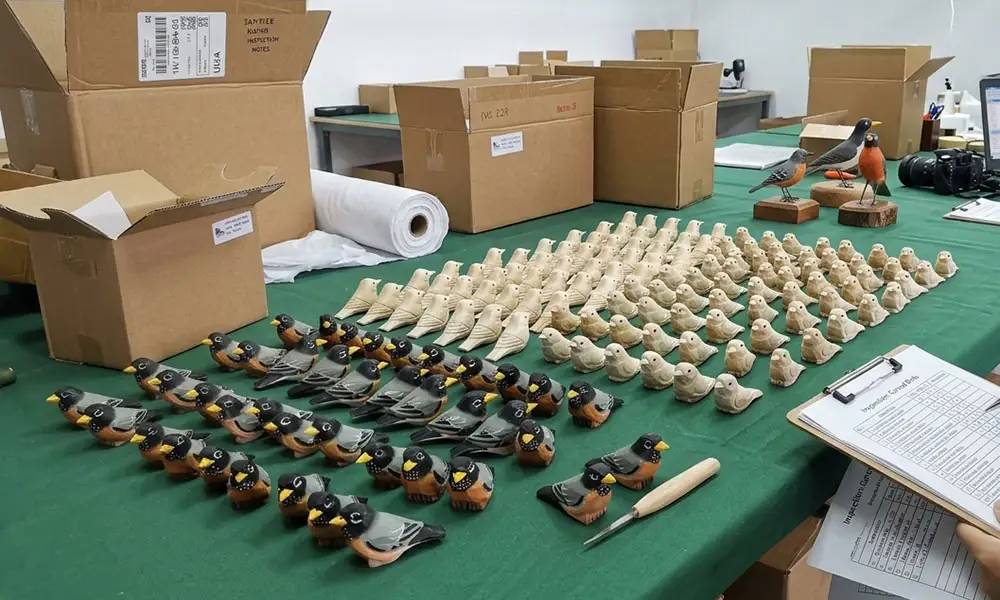
- What We Check Before a Carton Seals
- End to End: One Calendar, Two Windows
- Frequently Asked Questions
Why the Calendar Runs Backwards
A forward calendar hides the constraint that matters. Starting from today, every leg looks affordable, and the shortage appears only at the end, as a missed window. Starting from the window, the shortage appears immediately, as an order date that has already passed, which is exactly the information a buyer needs in time to act on: change the tier, change the range, or change the window.
The backwards method also forces the two legs buyers most often forget, samples and compliance, onto the page before any money moves. Both sit upstream of production, both take weeks, and both are cheap to schedule and expensive to leave unscheduled. The manufacturing side of that upstream work is described on our custom product manufacturing page.
Seasonal Order Planning: The Backwards Calendar
Five legs, subtracted in order from the first selling day: set-in and merchandising at the destination; inland movement and clearance; ocean or air transit to port; production and the quality gate; samples and specification freeze. Each leg gets a duration, an owner and one document that proves it finished.
| Leg | Duration we quote | Owner | Closing document |
|---|---|---|---|
| Set-in and merchandising | 1 to 2 weeks, yours | Retail or hospitality team | Dated set-in photos |
| Inland movement and clearance | Forwarder’s figure, yours | Your broker | Release notice |
| Transit to port | 60 to 90 days sea, our tier quote | Your forwarder | Bill of lading |
| Production and quality gate | Quoted per order, confirmed at PO | Us | Inspection report against retained sample |
| Samples and spec freeze | 2 to 3 rounds, weeks not days | Joint | Signed retained sample |
Write the calendar once per selling window and keep it as a living document: when a leg overruns, the date that moves is the order date of the next window, not the set-in date of this one. Protecting the window is the whole point of the exercise.

The Sample Leg, Which Everyone Underestimates
A carved sample is not a photograph approval. It is a physical object that must be carved, painted, dried and shipped, and each of those steps has a minimum time. Buyers who allow 1 week for samples learn that the first article answers questions they had not thought to ask: whether the painted detail survives at 8 cm, whether the grain reads on the underside, whether the base stands on linen.
Two to three rounds is normal for a new design, one round for a recolour of an existing carving. The retained sample from the final round becomes the quality reference for the whole run, which is why the sample leg sits upstream of production and cannot be compressed by paying more. What a sample does and does not lock down, including tooling where a mould or jig is involved, is set out in our guide to tooling and mould costs for custom wooden products.
Production and the Quality Gate
Production duration is quoted per order and confirmed at purchase order, because hand carving scales with bench time rather than with machine hours. What does not vary is the gate at the end of it: moisture measured at 8 to 12 percent, paint and finish checked against the retained sample under warm and cool light, thin points inspected, and a packing drop test on the made-up carton.
The gate is also where the payment structure meets the calendar: 30 percent deposit at order, 70 percent before shipment, and before that balance is due we provide photos and video of the finished goods. That video is a calendar document as much as a payment document, because it dates the quality gate for both sides.
Freight, Wood Packaging and Labels
Two compliance items belong on the calendar at loading, because they cannot be fixed at arrival. Wood packaging material in the shipment, crates, pallets and dunnage, must meet ISPM 15 as set out by the International Plant Protection Convention; non-compliant packaging is refused or fumigated at the destination’s discretion, on your clock. Destination labels and marks, including any language requirements, are checked at the same moment.
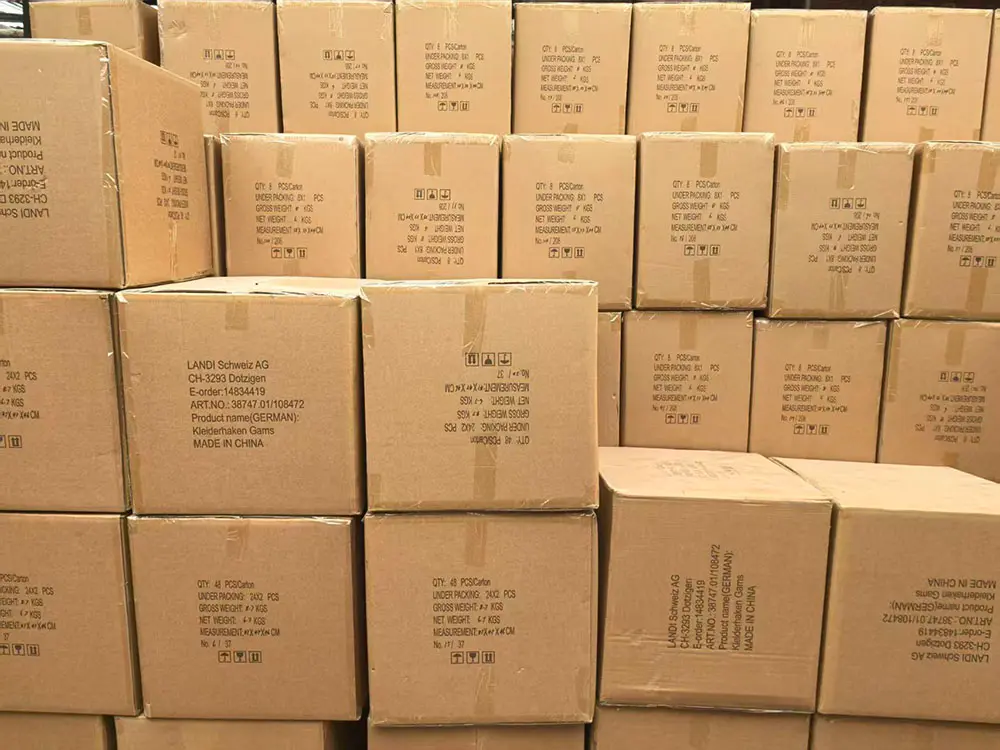
Our own packing is documented and repeatable: each piece wrapped in white paper, 6 to 12 pieces per 3-ply inner box of 21 by 11 by 14 cm, then 240 to 480 pieces per 5-ply master carton of 58 by 44 by 31 cm at 8.0 to 15.0 kg gross, made up to pass an ISTA 3A drop test. The destination-market label layer that sits on top of that packing is covered in our guide to EU packaging and labelling for wooden gifts.

Sea Tier Against Air Tier
| Dimension | Wholesale and custom tier, sea | Trial tier, air express DDP |
|---|---|---|
| Minimum | 300 pieces, USD 3,000 order value | 100 pieces, USD 500 order value |
| Transit quote | 60 to 90 days to port | 20 to 30 days |
| Specification | Full OEM and ODM, custom paint and marks | In-stock designs only |
| Calendar role | Carries the season | Repairs gaps inside the season |
| Wrong use | Ordering it after the window opens | Planning a custom specification on it |
Where the Buffer Goes, and Where It Does Not
Buffer belongs in two places: spares inside the shipment, and slack between the quality gate and the booking date. Spares at 10 percent of the piece count travel in the same master cartons at no extra freight line, and they are what lets a door replace a broken hero in week 3 without an order. Slack between gate and booking absorbs an inspection repeat without moving the vessel.
Buffer does not belong in the sample leg, where compressing rounds produces a retained sample nobody trusts, and it does not belong after arrival, where it is just late stock. A calendar with buffer in the wrong legs looks safe and behaves exactly like one with none.
What We Commit to by Date, and What We Do Not
- We commit: production duration in writing at purchase order, and the quality gate evidence, photos and video, before the 70 percent balance falls due.
- We commit: the packing specification above, made up to pass ISTA 3A, with custom labels and marks where ordered.
- We do not commit: ocean transit days, port dwell or clearance times; those are your forwarder’s and broker’s figures and they belong in your half of the calendar.
- We do not commit: a compressed sample leg; the retained sample is signed when it is right, not when the calendar is tight.
The range those dates attach to runs from carved animals and ornaments to coasters, puzzles and seasonal decor across 4 species, and the catalogue it draws from is in our wholesale wooden crafts guide.
Best For / Not For
| Importer situation | Best for | Not for |
|---|---|---|
| One big seasonal window | Full backwards calendar, sea tier, 10 percent spares | Starting samples inside 90 days of the window |
| Several small peaks | One sea run plus trial-tier repairs per peak | A separate sea order per peak |
| First-year importer | Trial tier first to prove the range, then sea | A custom specification on the first order |
| Late to the window | In-stock designs on the trial tier only | Paying air rates to rescue a custom run |
What We Check Before a Carton Seals
- Moisture at 8 to 12 percent on the packed pieces, recorded, because the destination winter will not forgive a wet packing.
- Likeness to the retained sample under two light temperatures, paint and carve detail, piece by piece on a sampling plan.
- Carton make-up: 6 to 12 pieces per inner box, 240 to 480 per master, gross within 8.0 to 15.0 kg, marks and labels as ordered.
- Drop test on the made-up carton to ISTA 3A, repeated whenever the pack configuration changes.
- Claims limited to what we hold: CE, UKCA, RoHS, EN71 where it applies, BSCI and ISO 9001; our facility holds an FSC chain-of-custody certificate, but certified basswood is not currently available, so goods are not marketed as FSC-certified wood.
Every figure above is first-party and checkable against an inspection report or a certificate we hold; transit and clearance durations are deliberately absent because they are not ours to quote. The company and its full specification library sit at ewoodarts.com.
End to End: One Calendar, Two Windows
A European importer runs a Christmas window opening 15 November and a spring gifting window opening 1 March, both fed by carved ornaments and small animals, with a custom paint family for the Christmas range.
Build both calendars in January. Counting back from 15 November: 2 weeks set-in, the forwarder’s inland and clearance figure, 60 to 90 days to port, production quoted at PO, and 3 sample rounds. The order date lands in early July, so samples must start in May at the latest. The March window’s calendar is built the same day, and its sea order consolidates with the Christmas run’s spare capacity rather than sailing alone.
Run the sample leg to a signed retained sample. Round 1 answers the carve questions, round 2 the paint family under warm light, round 3 the 8 cm size where detail is tightest. The signed sample from round 3 becomes the inspection reference, and the specification freezes at the July order date with amendments in writing only.
Repair inside the season on the trial tier. In week 4 the owl group sells through at two doors; a trial-tier top-up of 100 pieces at a USD 500 minimum order value flies air express DDP in 20 to 30 days, in-stock designs only, and lands before the peak. The March window sets in on time because its order date was protected in January, not rescued in December. Presentation and pack options for the gifting window are in our guide to ornament retail packaging.
Building next season’s order calendar?
Send us your selling windows and your forwarder’s transit figures. We will return the backwards calendar with our legs dated, the sample start date that protects them, and the tier each part of the range belongs on.
Frequently Asked Questions
Q: How far ahead of a selling window should the order be placed?
Far enough that the backwards calendar closes without borrowing from the sample leg. With sea transit quoted at 60 to 90 days to port plus production and samples, a November window usually means an order in July or August. If the backwards maths lands the order date in the past, change tier, range or window before spending anything.
Q: Can a late order be rescued with air freight?
Only for in-stock designs. The trial tier at 100 pieces and a USD 500 minimum order value flies air express DDP in 20 to 30 days, but it cannot carry a custom specification, so a late custom run cannot be rescued at any price. Air is a repair tool inside the season, not a planning tool for it.
Q: Why do samples take weeks rather than days?
Because a carved sample is carved, painted, dried and shipped, and each step has a minimum time. Two to three rounds is normal for a new design, and the final retained sample becomes the inspection reference for the whole run. Compressing the sample leg produces a reference neither side trusts at the quality gate.
Q: Which compliance items must sit on the calendar?
Wood packaging under ISPM 15 and destination labels and marks, both checked at loading because neither can be fixed at arrival. Non-compliant packaging is refused or fumigated at the destination’s discretion, on the importer’s clock. Everything else, including toy grading where a piece is a toy, is settled at specification freeze.
Q: How much spare stock should travel with the order?
Around 10 percent of the piece count, inside the same master cartons, so it costs no separate freight line. A six-week season breaks and loses pieces at doors, and a top-up order placed after the break cannot arrive inside the window it was meant to repair. Spares are the cheapest buffer in the whole calendar.