Skip to content
Basswood is the silent partner protecting the razor-thin margins of global wood craft exports. Unlike heavier alternatives that frequently fail during production or crack in transit, Basswood’s consistent performance mitigates the risks of warping and moisture damage. To avoid the hidden costs of excessive freight and reverse logistics, savvy exporters are prioritizing stable, low-density materials to secure their bottom line.
This guide analysis explores Basswood’s industrial advantages for the export market. We examine how its low density slashes shipping costs, why its fine grain excels in precision carving, and how its dimensional stability survives humid climates. By the end of this guide, you will have a clear operational standard for moisture content and material selection to ensure your products arrive in perfect condition.
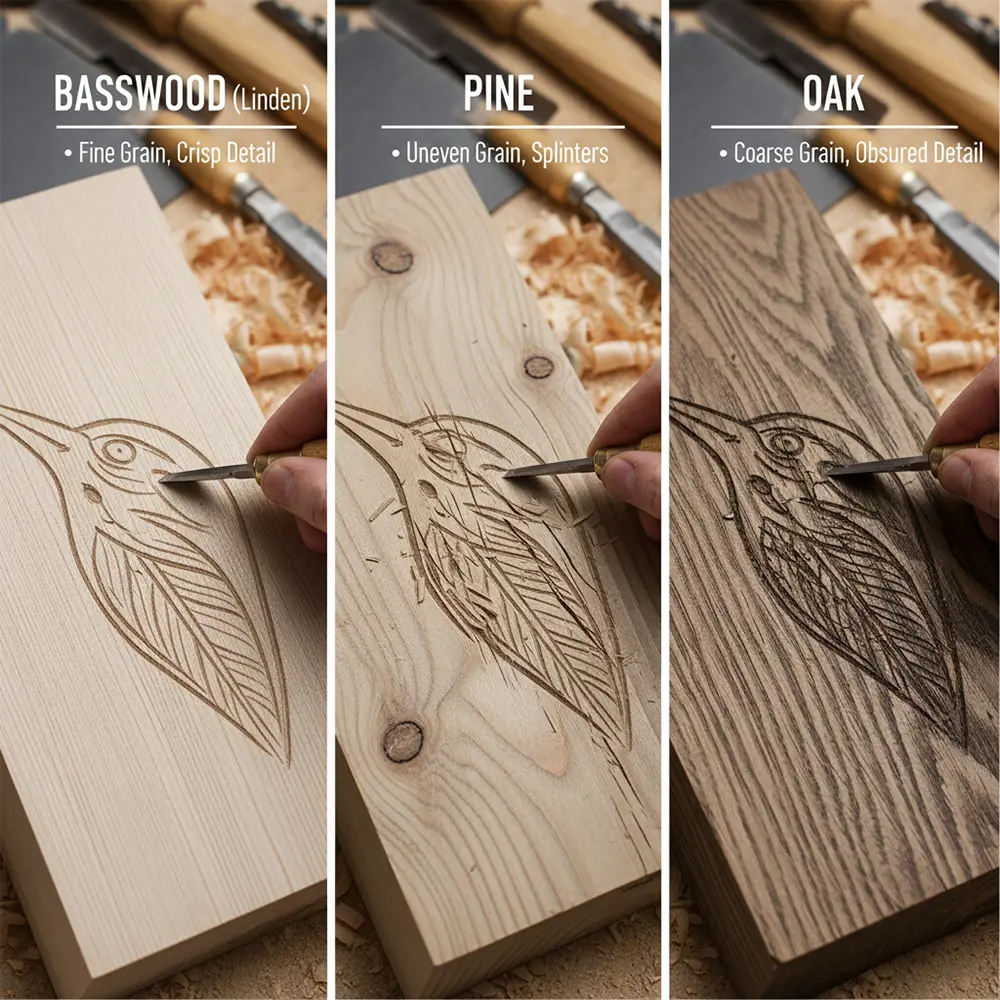
Why Basswood is preferred over Pine or Oak for intricate birds
Basswood is the industry standard for intricate carving because it uniquely balances a soft, workable structure with a hardness sufficient to hold fine detail, combined with a uniform grain that doesn’t interfere with precision.
Ideal Hardness for Fine Detail
Basswood offers a specific balance of softness and hardness that is critical for detailed work. With a Janka hardness rating of around 410 lbf, it is soft enough to carve smoothly with hand tools, which reduces artisan fatigue and minimizes tool wear. At the same time, it is firm enough to hold the most delicate designs, like individual feather barbs or the fine curve of a beak, without crumbling or splitting. This combination ensures that the artist’s vision is accurately captured in the final product.
| Attribute | Basswood (Tilia) | Common Alternatives (Pine & Oak) |
|---|---|---|
| Janka Hardness | ~410 lbf (Optimal balance for carving) | Pine: Varies, inconsistent. Oak: ~1290 lbf (Too hard for fine hand-tool work). |
| Grain Structure | Fine, uniform, and straight. Provides a smooth, predictable surface. | Pine: Uneven texture with resinous spots. Oak: Pronounced, streaky grain that interferes with carving. |
| Detail Retention | Excellent. Holds crisp lines without splitting, ideal for feathers and eyes. | Poor. Pine’s softness leads to mushy details. Oak’s overpowering grain obscures intricate work. |
Fine, Uniform Grain for Smooth Finishes
The fine-grained basswood provides a consistent and smooth canvas, which is essential for both intricate carving and detailed painting. Unlike oak, which has prominent grain lines that create a streaky or banded appearance, basswood’s uniform texture does not obscure the artwork. This allows carvers to achieve precision without fighting against a heavy grain pattern. For finishing, the smooth surface ensures that paint applies evenly, capturing the vivid feathering details that make wooden birds lifelike.
Affordability and Accessibility
From a commercial standpoint, basswood is a practical choice. It is widely available from most lumber suppliers, ensuring a consistent and reliable source for production. Compared to many other hardwoods suitable for carving, it is more cost-effective. This accessibility allows for larger production runs and makes the material viable for artisans at all levels, from master carvers producing high-end collectibles to workshops training new talent.

How does the low density of Basswood reduce your shipping costs?
Basswood’s low density directly translates to lower freight costs by allowing you to ship significantly more product volume within the same weight-based carrier limits.
For any business shipping physical goods, freight costs are a major factor in profitability. The choice of raw material can have a surprising impact on logistics overhead. Basswood provides a distinct advantage because of its low density, which reduces the weight of each finished product and allows for more efficient packaging and shipping, whether by parcel or bulk freight.
Maximizing Shipment Volume Within Weight Limits
Freight carriers like UPS or FedEx impose strict limits on shipments based on both dimensional size and gross weight. Basswood, with a density of about 2.3 pounds per board foot, allows you to pack a standard carton to its full dimensional capacity without exceeding common weight ceilings, such as the 150-pound limit for many services. This lets you consolidate more units into fewer boxes, which directly reduces the total number of shipments and lowers overall freight charges for a given order volume.
| Shipping Metric | Premium Basswood (Tilia) | Red Oak (for Comparison) |
|---|---|---|
| Average Density | ~2.3 lbs / board foot | ~3.7 lbs / board foot |
| Units per 150 lb Freight Limit* | ~130 Units | ~81 Units |
| Logistical Impact | Maximizes carton volume, reducing per-unit freight cost. | Hits weight limits faster, increasing the number of cartons needed. |
Lowering Per-Item Shipping Fees
Most shipping rates are calculated using weight as a primary variable. The lighter the package, the lower the cost. Because hand-carved basswood birds are inherently lightweight, the per-item shipping fee is minimized. This advantage is especially valuable for businesses with a direct-to-consumer model, where shipping individual orders economically is critical for maintaining healthy profit margins and offering competitive pricing to end customers.
Get Premium Hand-Carved Birds, Factory-Direct.

Is Basswood stable enough to resist warping in humid climates?
Basswood is inherently susceptible to warping in high-humidity environments, but its structural resilience can be assured through proper sealing and environmental controls.
Basswood’s Natural Vulnerability to Moisture
Basswood is a hygroscopic material, meaning it readily absorbs and releases moisture from the surrounding air. This characteristic, combined with its naturally low rigidity, makes it prone to warping, bending, and twisting when exposed to fluctuating humidity levels. The wood’s fibers expand and contract as moisture content changes, and this movement can be uneven across a single piece.
- The low rigidity causes the wood to deform unevenly as it gains or loses moisture.
- Thinner cuts of basswood are especially vulnerable to distortion in damp conditions.
Effective Methods to Prevent Warping
While basswood is sensitive to humidity, the risk of warping is manageable with proper industrial treatment and handling. These measures are critical for ensuring the dimensional stability of finished products, particularly those intended for export to varied climates. Maintaining structural resilience is a function of controlling moisture exchange.
- Applying a high-quality sealant or finish to all surfaces, including end-grain, creates an effective barrier against moisture absorption.
- Maintaining a stable indoor climate, ideally with a relative humidity around 50%, minimizes the moisture exchange that leads to warping.
- Proper air circulation and avoiding storage near direct heat sources also contribute significantly to the material’s stability.

Why is the fine grain of Linden wood better for detailed painting?
The fine, uniform grain of Linden wood (Basswood) provides a smooth, non-interfering surface, allowing for precise paint application and detail retention without visual distractions from the wood itself.
Creates a Smooth, Uniform Canvas
Linden wood’s primary advantage for painting lies in its exceptionally fine and even grain. When prepared, the wood sands to a smooth, uniform texture that functions like a prepped canvas. This quality is essential for high-detail work, as it allows for uninterrupted brushstrokes and prevents surface imperfections from disrupting the final artwork.
- The wood’s consistent texture ensures paint applies evenly across the entire surface without blotching or uneven absorption.
- It can be sanded to an ultra-smooth finish, a critical step for capturing the vivid feathering detail required in ornithologically accurate models.
Prevents Grain Interference
Unlike woods with pronounced grain patterns like Oak, Linden’s subtle texture does not visually compete with the painted design. The grain becomes nearly invisible under our non-toxic, water-based paints, ensuring the focus remains entirely on the artisan’s meticulous detailing and color application. For wholesalers and retailers, this translates to a premium finish where the artwork is the hero, not the underlying material.
- The lack of a heavy grain pattern eliminates visual noise that can detract from the delicate features of a hand-painted songbird.
- This quality makes it the definitive choice for products where a clean, flawless painted surface is a key selling point.
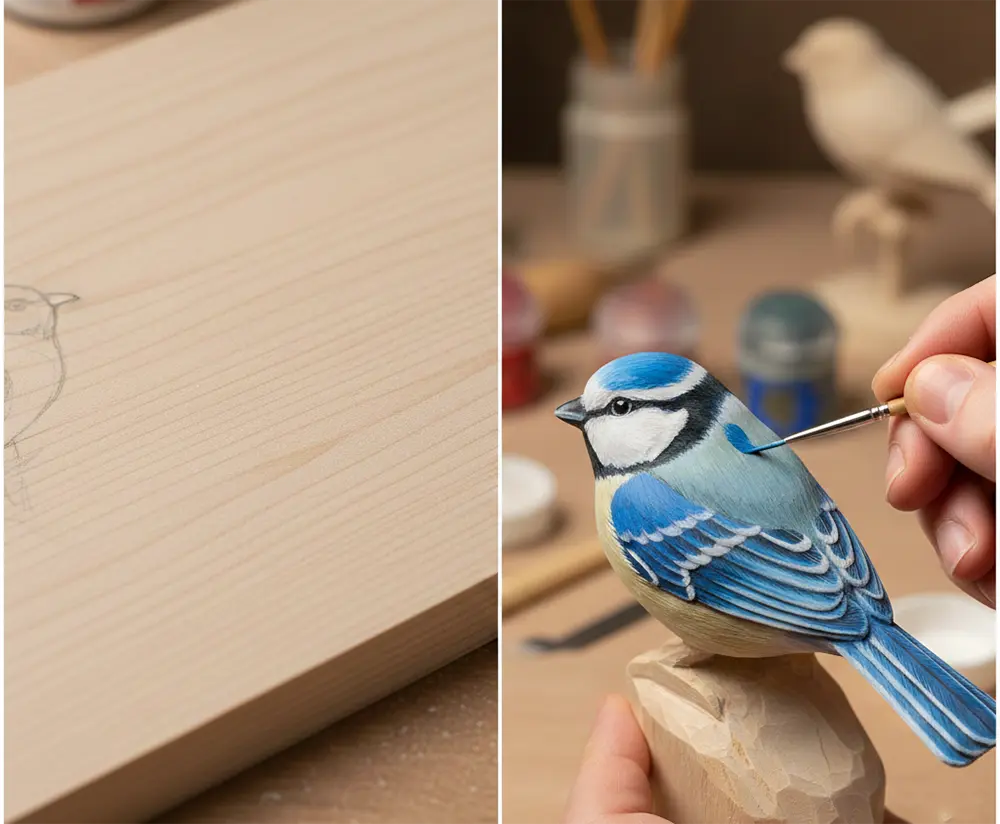
How does Basswood handle precision carving without splintering?
Basswood’s resistance to splintering comes from its unique combination of softness and a fine, uniform grain, which allows carving tools to slice through wood fibers cleanly rather than fracturing them.
For creating products that require meticulous detailing, like our hand-carved songbirds, material choice is non-negotiable. Basswood isn’t just a preference; it’s a technical requirement for achieving bulk-ready precision without compromising hand-sculpted authenticity. Its structural properties directly address the most common failure point in wood carving: splintering and tear-out.
Fine, Uniform Grain Structure
Basswood’s primary advantage lies in its fine, uniform grain. This consistent texture lacks the hard and soft spots found in woods like pine, allowing a carving tool to move smoothly and predictably across the surface. This predictability is essential for creating clean, crisp lines without the tool catching, which would tear or splinter the wood. The even distribution of fibers provides a stable medium that supports highly detailed work, ensuring the integrity of delicate features like feathering and beaks.
- The even grain supports highly detailed work, enabling intricate designs.
- It provides a stable medium that reduces the risk of unexpected splits during carving.
- The smooth surface ensures that fine details remain sharp and well-defined.
Softness and Workability
The softness of basswood (Janka hardness of 410) makes it exceptionally easy to work with. Artisans can achieve precise cuts with minimal pressure, which gives them greater control over the tool. This forgiving nature reduces the likelihood of the blade slipping or digging in too deeply—common causes of splintering in harder, less predictable woods like oak. Less physical effort also reduces carver fatigue, improving accuracy and consistency across large production runs.
| Carving Attribute | Premium Basswood (Tilia) | Pine & Oak (Comparison) |
|---|---|---|
| Grain Structure | Fine, uniform, and straight. Lacks hard spots. | Pine has uneven grain with knots; Oak has a coarse, pronounced grain that interferes with detail. |
| Splinter Risk | Very low. Fibers slice cleanly without tear-out. | Moderate to high. Unpredictable grain causes tools to catch and fracture fibers. |
| Detail Retention | Excellent. Holds crisp, fine lines for intricate features. | Poor. Oak’s heavy grain pattern obscures fine details; Pine is too soft for sharp lines. |
| Tool Pressure Required | Minimal. Allows for precise control and reduces fatigue. | High. Requires significant force, increasing the risk of slips and inaccurate cuts. |
Effective Use of Controlled Cutting Techniques
Basswood responds exceptionally well to controlled carving methods like stop cuts. A stop cut is a small incision made along a design’s boundary to prevent the main carving cut from extending too far. In basswood, these cuts create a clean break point, ensuring that wood chips release cleanly without pulling up surrounding fibers. This synergy between the material and proper technique is fundamental to maintaining the integrity of detailed patterns during mass production, ensuring each piece meets our rigorous quality control standards.
- Well-suited for techniques that define edges before removing material.
- Stop cuts act as a clear boundary, ensuring clean removal of wood within the design.
- This relationship helps maintain the integrity of detailed patterns consistently.

What is the optimal moisture content for exported Basswood crafts?
Controlling basswood’s moisture content to a 6-9% range is a critical quality control measure. It prevents warping, cracking, and joint failure in finished crafts during international shipping, particularly when products move between different climate zones.
Industry Standard for Maximum Stability
For maximum stability in finished basswood products, the industry standard is a moisture content (MC) between 6% and 9%. At Jilin Ever Creation, we condition our commercial kiln-dried basswood to a precise 6-8% target. This stringent control ensures structural resilience and prevents dimensional changes after export, which is a key factor for product longevity and reducing defects.
- The accepted MC target for most finished woodwork is 6-9%.
- Commercial kiln-drying typically aims for a 6-8% level to achieve the highest stability.
- This controlled range minimizes the risk of shrinkage, swelling, or joint failure during and after shipping.
Ideal Range for Carving Applications
While a low moisture level ensures stability, a slightly higher level is acceptable for items intended for further carving. A moisture content of 10-12% gives the wood enough flexibility to improve tool performance. This keeps the material from becoming too brittle during detailed handiwork, allowing artisans to execute fine details with less risk of material failure.
- For carving-specific projects, an MC of 10-12% is considered ideal.
- This slightly higher moisture provides basswood with some flexibility, which helps the carving process.
- It reduces the chances of the wood chipping or splintering when artisans create intricate designs.
Adapting Moisture for Export Destinations
A crucial step for ensuring export quality is aligning the wood’s moisture content with the Equilibrium Moisture Content (EMC) of its final destination. Wood naturally adapts to the ambient humidity of its surroundings. Pre-conditioning it for the destination climate is essential to prevent defects from developing weeks or months after delivery.
- Basswood shipped to humid regions, like coastal areas where the EMC is above 9%, will naturally absorb moisture.
- Products sent to arid climates, such as the southwestern U.S. where EMC is below 6%, need a lower initial moisture content to prevent cracking.
- We manage this conditioning process to ensure our crafts remain stable, no matter which global market they enter.

Conclusion
Basswood provides a strategic advantage for global craft exports due to its technical properties. Its fine grain and splinter-resistant structure allow for the detailed, artisanal carving that discerning markets demand. The wood’s low density reduces freight costs, while its stability ensures product integrity and minimizes defects from shipping or climate changes.
If you are looking to source handcrafted wooden decor that balances artistic quality with logistical efficiency, contact our team,we can provide our full catalog.
Frequently Asked Questions
Why is basswood considered the best wood for intricate bird carving?
Basswood is considered the best wood for intricate bird carving due to its unique combination of properties. It possesses a soft consistency that makes it easy to shape with hand tools, yet it is firm enough to retain crisp, fine details like feathers. Its fine, uniform grain structure provides a smooth, predictable surface, which is critical for achieving precision without the wood splitting or chipping.
What is the Janka hardness of basswood, and how does it affect carving?
Basswood has a Janka hardness rating of 410 lbf (pounds-force). This relatively low rating indicates it is a soft wood, which is highly advantageous for carving. It allows carvers to cut and shape the material smoothly with minimal effort, reducing tool wear and fatigue. Despite its softness, this hardness level provides the perfect stability to hold sharp, intricate details without crumbling or compressing.
How does basswood’s grain compare to oak or pine for detailed work?
Basswood’s grain is fine, straight, and uniform, which provides a consistent and predictable carving surface. This contrasts sharply with oak, which has a coarse, open grain with pronounced lines that interfere with and obscure fine details. Pine, while softer, often has inconsistent grain patterns and knots that can disrupt a smooth cut. Basswood’s subtle grain ensures that the focus remains entirely on the carved details, not on the wood’s texture.
Besides carving quality, what are other practical benefits of using basswood?
Beyond its excellent carving properties, basswood offers several practical benefits. It is widely available and relatively inexpensive, making it an accessible choice for both beginners and professionals. The wood’s softness is gentle on carving tools, reducing the need for frequent sharpening. Furthermore, basswood has a high resistance to splitting, which is crucial when working on delicate, thin elements of a sculpture.
How should basswood be finished to protect a completed carving?
To protect a completed basswood carving, the first step is to apply a sanding sealer. This prevents the porous wood from absorbing subsequent finishes unevenly and raises the grain for a final, light sanding. For a natural finish, multiple thin coats of a clear satin or matte polyurethane or acrylic varnish can be applied to protect against moisture and dust without adding a high-gloss shine. If the carving is to be painted, which is common for birds, acrylic paints are ideal after sealing. A final clear top coat is always recommended for long-term durability.
While looking for specific styles, don’t forget to check our full catalog of [wholesale-wooden-songbirds] to see all available options.
As a comprehensive [Wooden Bird Factory], we also produce cardinals, owls, ducks and robins.