Skip to content
Most sourcing guides will tell you the best way to prevent wood cracking is to reject shipments with high moisture content. That sounds logical, but in practice, it’s useless advice. The real culprit behind wood cracking isn’t the number on the moisture meter right before shipping—it’s what the factory did to the wood in the months before that meter ever touched it.
I know a veteran buyer who learned this the hard way on a $50,000 order of hand-carved birds. The pre-production samples were flawless. But when the mass production run arrived—carved from the exact same batch of basswood—40% of the units had hairline splits. The weirdest part? The moisture content at the port was perfectly within spec. The problem had been baked in months earlier during a rushed kiln-drying cycle. The factory skipped two time-consuming steps, locking fatal stress inside the wood.
This is the massive gap between “knowing the moisture standard” and “actually controlling internal wood stress.” For every hand-carved piece we produce, we strictly enforce an 8-12% moisture content (MC) standard. Not because hitting that number is hard, but because reaching it without damaging the wood requires a rigorous process that most mass-production lines simply won’t invest time in. For example, skipping the initial “air-drying” phase and forcing fresh basswood directly into a hot kiln causes thermal shock, creating invisible honeycomb micro-fractures inside the wood. Six weeks later, after resting in a climate-controlled warehouse, those fractures explode into visible cracks. To prevent this, buyers must audit the factory’s drying protocol, not just the final moisture reading.
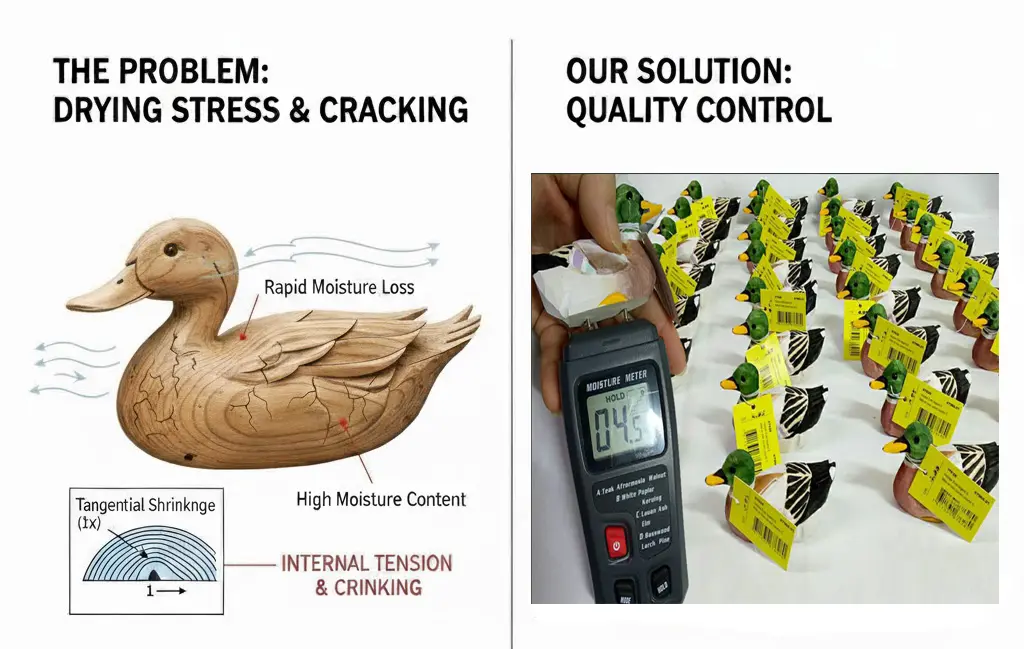
Why Wood Cracks in Transit
Most wood cracks don’t start because of ocean weather—they start because a factory shut off the kiln too early to save on gas bills.
Stop blaming ocean humidity swings. The real reason wood cracks in transit comes down to one thing: unresolved internal stress. Wood has “memory.” If you don’t release its internal tension during the drying process, that stress will eventually release itself in the form of a crack when it reaches your customer’s heated retail store or dry living room.
Basswood shrinks roughly twice as much tangentially (along the growth rings) as it does radially (across them). This means the wood is literally fighting itself as it dries. On a hand-carved duck with a thin beak and a thick body, stress concentrates right where the thickness changes. If the moisture isn’t drawn out slowly and evenly, that duck is doomed to crack.
- Thermal shock from skipped air-drying: Freshly sawn basswood forced straight into a hot kiln suffers from “case-hardening”—the outer shell dries and hardens while the core remains wet. You must air-dry the wood first to let free water evaporate naturally.
- Unequalized moisture gradients: When a kiln cycle finishes, the surface might be at 8%, but the core is still at 14%. Many factories cut the heat here to save money. Weeks later, that core moisture migrates outward, causing the product to warp and split.
In northern China, natural air-drying typically brings wood down to 15-18% MC. That’s fine for the domestic market. But if you export that wood to a heated mall in Minnesota in January (where indoor EMC drops to 6%), that 10-point gap guarantees cracking. This is why pre-production samples rarely crack (they are carefully air-dried) while mass production orders do (they are rushed through the kiln).

The Science of Kiln-Drying: The 4-Step Protocol
Factories that skip the equalization phase save a few hundred dollars on fuel, but cost you tens of thousands in damaged inventory.
True export-grade drying isn’t just about “baking wood.” It’s a strict four-phase protocol. Missing any step guarantees failure down the line.
- 1. Air-Drying (Mandatory Pre-Phase): Wood must sit under ventilated sheds with zero artificial heat. This prevents thermal shock and internal honeycombing. Skipping this is the #1 cause of latent cracking in export crafts.
- 2. Sensor-Monitored Kiln Extraction: Using real-time sensors, temperature and humidity are adjusted to slowly bring the entire batch down to the 8-12% target.
- 3. Equalization (Most frequently skipped): Boards in different parts of a kiln dry at different rates. Equalization holds the climate steady to ensure the wettest and driest boards converge. Without it, some birds in your shipment will be at 7% and others at 14%.
- 4. Steam Conditioning: High heat compresses wood cells. We inject low-pressure steam at the end of the cycle to relax these fibers and relieve internal stress. Conditioned basswood stays completely stable, whether shipped to humid Singapore or dry Scandinavia.
This full four-phase protocol adds less than 2% to the unit cost, but it eliminates over 80% of moisture-related returns. The next time you negotiate with a supplier, demand to see their batch moisture meter logs (showing 8-12% MC and equalization records). If they hesitate, walk away.

Climate Adaptation: Why Exactly 8-12%?
A single, arbitrary moisture target cannot survive both a heated apartment in Stockholm and a humid sunroom in Houston.
Wood breathes, constantly trading moisture with its environment. The 8-12% range isn’t a random guess; it’s the mathematical sweet spot designed to handle the Equilibrium Moisture Content (EMC) across US and EU markets:
- US Gulf Coast (e.g., Houston, Miami): Summer indoor EMC sits around 12-14%. If the wood is too dry (under 8%), it will suck in moisture, swell, and cause paint to peel or joints to distort.
- Northern Europe (e.g., Stockholm, Berlin): Winter heating drops indoor EMC to 6-7%. If the wood is too wet (e.g., 14%), it will rapidly lose moisture and shrink, snapping fragile details like beaks and tails.
- Western US (e.g., Denver, Phoenix): Year-round arid climates have an EMC of 5-8%. This is the ultimate stress test for wooden decor. Any internal stress left from a rushed kiln cycle will violently reveal itself here.
The 8-12% range brackets these extremes safely. Changbai Mountain Basswood has an inherently fine and even grain, making it far superior to pine or rubberwood in resisting cracks—but only if it undergoes the full drying and conditioning protocol. Factory shortcuts will ruin even the best timber.

Conclusion: 3 Questions to Ask Your Supplier
Before committing to your next bulk order, protect your brand by putting these three questions on the table:
- “Will you provide a pin-type moisture meter log for every production lot, dated within 48 hours of packing?”
- “Does your kiln cycle include a dedicated equalization phase and steam conditioning, or do you just cut the heat once it hits the target MC?”
- “If random sampling at my destination port shows MC levels exceeding 14%, what is your claim and rejection policy?”
If their answers are vague, walk away. Better yet, order a factory sample set and test it yourself with a calibrated meter. In cross-border B2B sourcing, real data is the only thing that protects your bottom line.
Frequently Asked Questions (FAQs)
Can kiln-dried wood still crack?
Yes, kiln-dried wood can still crack if the drying process was rushed, skipping the equalization and steam conditioning phases that relieve internal stress. Finishing strictly at 8-12% and executing full climate conditioning nearly eliminates this risk, which is our mandatory standard for US/EU exports.
How long does the full kiln-drying process take for small items like wooden ducks?
For basswood blanks used in duck carvings, reaching a stable, stress-free 8-12% moisture content typically takes 3 to 5 days in a controlled kiln (including the final steam conditioning stage). Exact cycle times depend on the specific blank thickness.
Is there an MOQ if I want custom designs using this strict drying standard?
Exact minimum order quantities depend on final product specifications, design complexity, and batch scheduling. Please contact us directly with your requirements, and we will calculate the most cost-effective solution for you.
What is the difference between air-dried and kiln-dried wood for export?
Air-dried wood rarely drops below 15-20% moisture and retains massive internal stress, making it highly prone to cracking during ocean transit. Kiln-dried wood is precision-controlled to 8-12% and stress-relieved for supreme stability. We exclusively use kiln-dried timber for all export orders to mitigate risk.
How can I verify the actual moisture content of my shipment upon arrival?
We highly recommend using a calibrated pin-type moisture meter during your unboxing inspection. Take readings from the core of several random pieces. We supply pre-shipment QC reports to match against, and we advise making moisture verification a standard part of your receiving checklist.