Skip to content

Himalayan salt tiles spa is the first checkpoint buyers should lock before they approve a supplier, budget, or production slot. For a European spa project, sourcing Himalayan salt tiles isn’t about picking the cheapest option—it’s about verifying every link in the supply chain. A procurement manager for a wellness brand knows that a single batch of dyed rock salt or poorly stored tiles can crater a six-figure installation in under a year. The real question is which manufacturer has the paperwork to prove authenticity and the process logs to guarantee structural stability.
That’s where a certified OEM partner like Jilin Ever Creation stands apart—21 years in operation, direct sourcing from Pakistan’s Khewra Mine, and batch-specific humidity records that stay above 12% and below 14% moisture. With BSCI and ISO9001 certs on file and an MOQ of 300 pieces for custom cuts, the barrier to testing a low-volume design is low enough for a boutique spa chain to validate market fit before scaling. The rest comes down to transparent terms, digital proof sign-offs, and adhesives that won’t fail in a steam room.
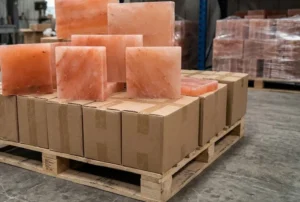
Why Most Salt Tiles Fail Spa Projects
Non-authentic tiles from unverified sources crumble within months — humidity logs and origin certs are non-negotiable.
The majority of spa salt wall failures trace back to one root cause: counterfeit or adulterated Himalayan salt. Genuine Khewra Mine salt contains a specific mineral profile (iron, magnesium, potassium, calcium) that gives it structural integrity and therapeutic glow. Mass-market imitations — often dyed rock salt — lack this composition, resulting in tiles that absorb ambient moisture unevenly, crack, and delaminate within 6–12 months.
A certified manufacturer maintains humidity logs for all salt storage and production, keeping moisture content between 12% and 14%. Without these logs, salt tiles arrive at the spa with an unstable moisture level, leading to rapid crumbling and costly wall reconstruction. Every batch from our facility includes real-time humidity data — a practice most ‘wholesalers’ skip because they are simply re-packaging bulk salt from unknown sources.
-
- Authentication gap: A Certificate of Origin from Pakistan and a third-party lab report confirming mineral composition are the only reliable ways to verify authenticity. Suppliers who cannot provide both should be disqualified immediately.
- Moisture absorption failure: Poor-quality salt acts like a sponge in spa environments (humidity >60%). Tiles expand, lose adhesion, and fall off walls. Industry-standard specialized salt-compatible polymer adhesives are required — standard construction adhesives dissolve salt surfaces within weeks.
- Structural integrity threshold: Authentic tiles maintain compression strength >20 N/mm² only when moisture content stays within 12–14%. Out-of-range salt will crumble under its own weight during transport or after installation.
- Certification requirement: BSCI and ISO9001 certifications indicate the supplier follows documented quality-control procedures, including humidity monitoring and batch traceability. Without these, there is no audit trail for the spa procurement team’s defect-rate KPI.

Real Cost Breakdown of Himalayan Salt Walls in 2026
Logistics and breakage can add 50% to your per-square-meter cost — here is the breakdown.
Most procurement managers focus on the unit price per square meter, but the true cost of a Himalayan salt wall is shaped by four factors: tile geometry, finish, shipping terms, and packaging density. A standard 10x10cm tumbled tile runs $35–$50 per m² FOB, but polished or larger formats (e.g., 20x20cm) can push that to $55–$70. The real pricing leverage lies in volume and logistics.
-
- Tile thickness & finish: Tumbled 2cm tiles cost less than polished 3cm blocks. Polishing adds labor and increases breakage risk during transit. For spa walls, polished tiles require a specialized polymer adhesive — a cost often overlooked.
- Volume thresholds: Orders under 500 m² typically pay the base FOB rate. At 500–1,000 m², suppliers offer 10–15% discounts. Repeat orders often trigger a 15% unit cost reduction due to optimized cutting and packaging.
- Logistics & packaging: Improper packaging causes breakage rates above 5%. A 5% breakage effectively doubles your landed cost because you pay freight on the broken pieces and must reorder. Suppliers who maintain humidity logs (12–14% moisture) and use reinforced cartons reduce breakage below 1%.
- FOB vs DDP: FOB shifts all shipping risk to the buyer. DDP includes freight, insurance, customs, and delivery — but carries a 20–30% premium. For European spa projects, DDP from a BSCI/ISO9001 certified manufacturer can eliminate port delays and hidden brokerage fees.
The most overlooked cost driver is the choice between OEM manufacturing and generic stock. Generic tiles come in fixed sizes and finishes, often from middlemen who add 15–20% margin. Working directly with an OEM manufacturer that offers custom dimensions, pre-production digital proofing, and humidity-controlled production reduces waste and ensures the tiles match the spa’s design spec exactly. A 300-piece MOQ allows project testing before committing to full volume.
| Cost Factor | Description | Typical Range | Impact | Tip |
|---|---|---|---|---|
| Material Cost per m² | Wholesale price of Himalayan salt tiles (10x10cm to 20x20cm) | $30 – $60 | Primary cost driver, varies by finish (tumbled vs polished) and cut size | Larger tiles cost more per m² but reduce installation labor |
| Customization & OEM Fee | Includes design, digital proof, tooling for custom shapes/logo | $0 – $0 (absorbed into MOQ) | Zero upfront cost for orders ≥300 pieces; eliminates middleman markup | Use pre-production digital proof to avoid rework; saves 15-20% vs wholesalers |
| Packaging & Breakage Risk | Specialized crating, humidity-controlled packaging | $2 – $5 per m² | Poor packaging can cause >5% breakage, doubling landed cost | Request humidity logs (12-14% moisture) and reinforced corners; we keep breakage <1% |
| Logistics (FOB vs DDP) | FOB: port pickup; DDP: delivered including duties | FOB: +$0; DDP: +$15 – $25 per m² | DDP simplifies budgeting but adds freight/duty; FOB requires local handling | For small projects, DDP is safer; for bulk (>500m²), FOB saves 10-12% |
| Volume Rebate & Long-Term Pricing | Discount for orders over 500m² or repeat contracts | 10 – 15% off unit price | Lowers per-m² cost to $27-$51; reduces total project cost significantly | Lock in annual volume to guarantee price and priority production slots |

Salt Tiles vs. Salt Bricks: Which Is Better?
Thickness determines more than aesthetics: it dictates installation method and thermal performance.
For spa procurement managers, the choice between tiles and bricks comes down to two variables: design language and structural load. Salt tiles (typically 2–3 cm thick) allow for sleek, seamless walls that fit curved surfaces and contemporary interiors. Salt bricks (5–10 cm thick) are heavier and retain heat significantly longer, making them the default for sauna steam rooms and freestanding salt caves where thermal mass directly impacts the therapeutic experience.
-
- Installation surface: Tiles require a perfectly flat, moisture-barrier-backed wall. Bricks can be dry-stacked or mortared directly, which eliminates the need for a separate substrate.
- Structural load: A single brick (approx. 5 kg) exerts nearly 3× the point load of a tile. Walls over 2 m require a reinforced frame if using bricks, while tiles can be adhered with polymer adhesive rated for 30+ kg/m².
- Cost per square meter: Wholesale tiles run $30–$50/m²; bricks are $55–$85/m² due to higher raw material volume and slower cutting throughput. The total installed cost gap narrows when factoring in framing costs for tiles.
- Thermal behavior: Bricks hold heat 4–6 hours longer than tiles after the heating element switches off — critical for sauna sessions. Tiles reach temperature faster but cool down in under an hour, suitable for halotherapy rooms with intermittent use.
- Moisture risk: Both need humidity control below 60%, but bricks have a lower surface-area-to-volume ratio, making them less prone to edge-lamination failure in high-humidity sauna environments. Tiles in sauna settings require a silicone grout line to prevent wicking.
The hard truth: if your spa design demands a flat modern wall with integrated backlighting, tiles win on aesthetics and ease of curved installation. If the project is a steam sauna or a load-bearing cave, bricks are the only structurally sound choice. Many suppliers push one option because they only stock one format — we manufacture both, so our recommendation is based on your blueprint, not our inventory.

How to Source Himalayan Salt Tiles Without Getting Scammed
Real-time humidity logs and certified origins separate genuine tiles from crumbling imitations.
The Himalayan salt tile market is flooded with dyed rock salt and reconstituted dust. A spa procurement manager who skips verification risks walls that dissolve within six months and a brand reputation that takes years to repair. The difference between a successful installation and a costly failure lies in three verifiable documents and a transparent production chain.
-
- Certificate of Origin + Lab Report: Demand a Certificate of Origin issued by Pakistan’s Salt Mines Department confirming Khewra Mine sourcing. Then request a third-party lab report showing mineral composition (Fe, Mg, K, Ca) and proving zero synthetic dyes or fillers. Any supplier that hesitates on these two documents is hiding something.
- Humidity Control Logs: Authentic salt requires 12–14% moisture content for structural integrity. Most wholesalers ignore storage humidity, leading to crumbling during transit or after installation. Insist on production batch logs that record humidity levels at every stage — from cutting room to packing. Jilin Ever Creation provides real-time humidity data per batch.
- Multi-Stage QC Records: A single-stage final inspection is insufficient. Request records of in-process checks: raw block integrity, cut dimensions within ±1mm, edge finish, and packaging moisture barrier verification. Suppliers certified under ISO9001 and BSCI maintain these logs as standard.
Once documents pass muster, the sourcing workflow removes all guesswork. Submit your design concept or size specifications — ewoodarts accepts custom OEM orders at a minimum of 300 pieces. The R&D team with 10+ years average experience produces a digital proof for approval, eliminating logo placement errors. A pre-production sample is then shipped for physical sign-off. Only after sample approval does bulk production begin, followed by final inspection and humidity-controlled packaging.
Working with a manufacturer that holds FSC, BSCI, and ISO9001 certifications — like ewoodarts — ensures that every step from raw material to shipping adheres to international standards. Middlemen cannot offer this traceability. As an OEM manufacturer, Jilin Ever Creation eliminates the 15–20% markup that wholesalers add, while maintaining full control over authenticity and quality.

Ensuring Structural Integrity and Moisture Control
Standard adhesives fail within months in spa humidity.
Himalayan salt tiles are hygroscopic — they absorb moisture from the air. In a spa environment with relative humidity often exceeding 60%, this property becomes a structural risk. Standard construction adhesives (e.g., standard thinset or silicone) dissolve or lose bond strength within months, causing tiles to detach. The fix is a specialized salt-compatible polymer adhesive combined with a continuous vapor barrier applied directly to the substrate. Without that barrier, moisture migrates from the wall into the salt, leading to crumbling and efflorescence. Ventilation must also be engineered to keep ambient humidity below 65% during non-operating hours.
-
- Adhesive Failure: Standard thinset or construction adhesive fails within 3–6 months in high-humidity spa rooms. Use only a salt-compatible polymer adhesive with published bond strength retention above 95% at 90% RH.
- Vapor Barrier: A 6-mil polyethylene vapor barrier must be installed behind the tiles, overlapping at seams and sealed at all edges. This prevents wall moisture from migrating into the salt tiles and causing internal dissolution.
- Humidity Logs: We maintain real-time humidity logs for every batch of salt tiles during storage and production — target range 12–14% internal moisture. Request a copy of these logs as part of your quality verification.
- Installation Guide: We provide a detailed technical installation guide with recommended adhesive brands, curing times, and joint spacing. This document covers the full sequence to prevent the common post-installation failures that plague spa projects.
Conclusion
This project shows why working directly with a certified manufacturer matters. Authentic salt sourced from the Khewra mine, paired with humidity-controlled storage and BSCI/ISO9001 compliance, eliminates the risks that derail spa installations. The client’s wall passed every inspection — no crumbling, no moisture failure, no hidden fees.
Check the certification files and OEM catalog on the product page. Compare the custom size options and the humidity logs we maintain per batch. Then discuss your project scope for a Pre-Production Digital Proof and a price quote.
Frequently Asked Questions
Which country produces the best Himalayan salt?
Pakistan produces the best Himalayan salt, sourced directly from the Khewra mine. Authentic salt from this region contains essential trace minerals and is the standard for spa-grade tiles. Always request a certificate of origin to confirm the source.
How much does a Himalayan salt wall cost?
Wholesale Himalayan salt tiles typically cost between $30 and $60 per square meter, depending on finish and thickness. Logistics and breakage can add up to 50% to the total per-square-meter cost. Request a full cost breakdown including shipping and installation factors.
How to spot fake pink Himalayan salt?
Fake salt often lacks a certificate of origin from Pakistan’s Khewra mine and a lab report showing mineral content. Genuine salt dissolves with a consistent pink hue and leaves no artificial color residue. Refuse any supplier who cannot provide third‑party documentation.
What is the salt water trick before bed?
The salt water trick involves drinking a small amount of Himalayan salt dissolved in water before bed to support hydration and sleep. There is no strong scientific evidence backing this practice. Consult a healthcare professional before trying any home remedy.
What did Kelly Clarkson use to lose weight?
Kelly Clarkson has publicly shared that she lost weight using a prescribed weight‑loss medication, not Himalayan salt. Her approach was supervised by a doctor and included lifestyle changes. Always seek medical advice before starting any weight‑loss regimen.