Skip to content
Wellness venues worldwide are investing in Himalayan salt environments to differentiate their offerings and attract health-conscious clients. Whether you are building a new salt cave from scratch or retrofitting an existing spa with a salt room, sourcing the right salt blocks, tiles, and accessories at wholesale prices is the foundation of a successful project. This guide covers everything B2B buyers need to know about salt room salt cave wholesale supply — from material specifications and construction methods to shipping logistics and ROI considerations.
Key Takeaways
- Salt rooms are bought as a material system. Bricks, alkali-resistant adhesive, backing board and concealed lighting are specified together; a brick-only quote hides most of the project cost.
- Two spec sheets decide quality. Purity and mineral composition on one side, dimensional tolerance and edge finishing on the other — require both in writing before deposit.
- Adhesive and moisture detailing drive lifespan. Ordinary cement-family mortars discolour salt; the install method and wall preparation are as load-bearing as the bricks.
- Venues judge ROI on capacity and downtime. Session throughput, backlit wall area and maintenance access shape the business case more than brick price per tonne.
- Ask for a build pack. Layout drawings, installation guide and a labeled spare-brick allowance separate project suppliers from brick traders.
- Humidity control is operation, not product. Dehumidification duty and runtime rules should be part of the handover, or the wall effloresces inside one season.
What Are Salt Rooms and Salt Caves?
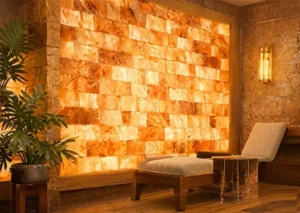
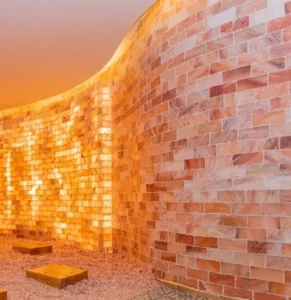
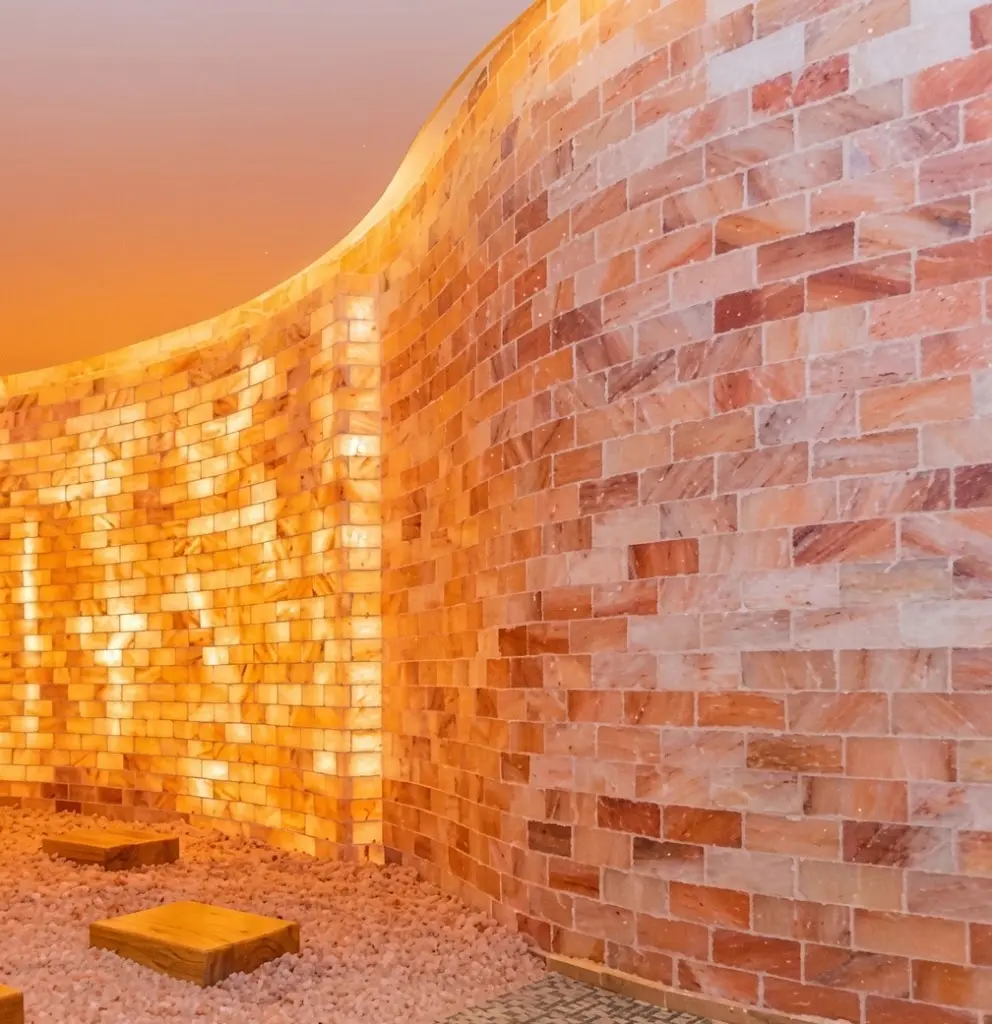
A salt room is a controlled indoor environment lined with Himalayan salt blocks, tiles, or panels, designed for passive halotherapy sessions. A salt cave (also called a salt grotto) is a more immersive version, often featuring a ceiling fully clad in salt, ambient lighting, and comfortable reclining seating. Both environments leverage the centuries-old practice of halotherapy — breathing air enriched with microscopic salt particles — which is associated with respiratory wellness, skin health, and stress reduction.
The key difference between a salt room and a salt cave lies in scale and immersion. Salt rooms are typically 10–30 m² and can be installed within an existing spa or clinic. Salt caves range from 30–100+ m² and are often standalone attractions. Both require wholesale Himalayan salt products sourced from verified suppliers who can guarantee mineral authenticity and structural integrity.
The Halotherapy Wellness Trend: Why Venues Are Investing Now
The global wellness economy surpassed $5.6 trillion in 2024, with spa and thermal/mineral spring segments growing at double-digit rates. Halotherapy has emerged as one of the fastest-growing modalities within this sector. According to the Global Wellness Institute, wellness tourism and in-facility wellness services are among the top growth categories, driving demand for differentiated experiences like salt therapy rooms.
For venue operators, a salt room or salt cave offers several strategic advantages: a unique selling proposition that competitors cannot easily replicate, a premium pricing tier for add-on sessions, and a low-maintenance attraction that operates with minimal staffing once installed. The capital outlay is recovered through session fees and the foot traffic a bookable wellness room brings the rest of the venue.

Himalayan Salt Specifications for Salt Cave Projects
Not all Himalayan salt is created equal. For construction-grade applications, buyers must specify the right dimensions, density, and finish. Here are the standard specifications used in professional salt cave installations:
Salt blocks for walls and ceilings: Typically 200 × 200 × 50 mm or 300 × 300 × 50 mm, with a density of 2.1–2.2 g/cm³. Blocks must be kiln-dried to below 2% moisture content to prevent weeping after installation. Backlit blocks (30–50 mm thick) are used for feature walls where LED panels are mounted behind the salt.
Salt tiles for floors and lower walls: Smaller format tiles (100 × 100 × 20 mm or 150 × 150 × 25 mm) with a honed or brushed finish for slip resistance. These are often used in high-traffic areas where larger blocks would be impractical.
Salt panels and prefabricated sections: For faster installation, some suppliers offer pre-assembled salt panels mounted on mesh or aluminum backing. These reduce on-site labor by 40–60% but come at a 15–25% premium over loose blocks. For a detailed comparison of formats, see our guide on salt blocks vs tiles for wellness projects.
All construction-grade salt should come from the Khewra Salt Mine in Pakistan — the world’s second-largest salt deposit and the primary source of authentic pink Himalayan salt. Reputable wholesale suppliers provide mine-origin certificates and batch-level quality reports.
Salt Cave Construction: Methods and Best Practices
Professional salt cave construction follows a systematic process. Understanding each phase helps buyers plan budgets, timelines, and supplier coordination effectively.
Phase 1 — Structural preparation: The room must be fully enclosed with moisture-resistant drywall or cement board. A vapor barrier is essential to prevent ambient humidity from degrading the salt. HVAC systems should maintain relative humidity below 50% and temperature between 20–24°C.
Phase 2 — Block installation: Salt blocks are laid using a food-grade salt mortar (crushed salt mixed with a small amount of water to form a paste). Each course must be leveled and allowed to cure for 24–48 hours before adding the next layer. For ceiling applications, mechanical anchors or stainless-steel mesh backing is required — adhesive alone is insufficient for overhead loads. Our detailed salt cave construction specifications guide covers load calculations, anchoring patterns, and curing timelines.
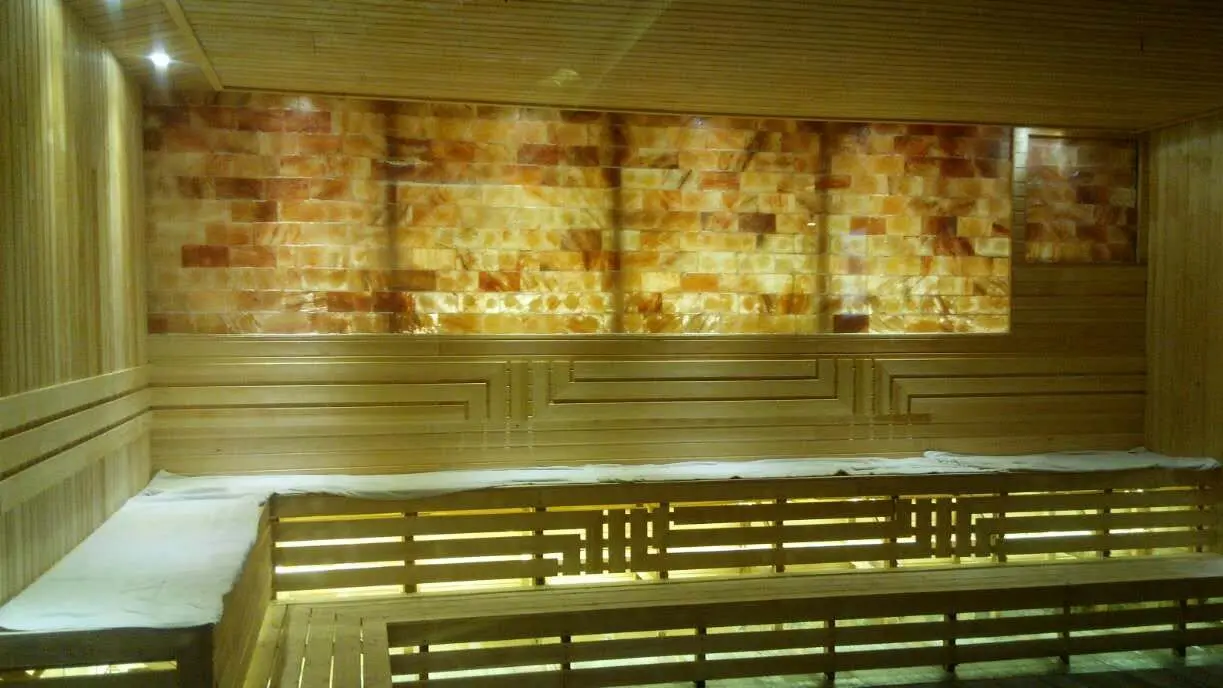
Phase 3 — Lighting integration: LED strip lights or panels are installed behind backlit salt blocks to create the signature warm amber glow. Color temperature should be 2700–3000K to complement the natural pink-orange hue of the salt. Dimmable systems allow operators to adjust ambiance for different session types.
Phase 4 — Halotherapy generator installation: A commercial-grade halogenerator grinds pharmaceutical-grade salt into micron-sized particles and disperses them into the room air. Units are sized based on room volume — typically 1 unit per 30–50 m³. The halogenerator should be installed in an adjacent service room with ducting into the salt cave.

Sourcing Salt Room Salt Cave Wholesale Materials
When sourcing salt room salt cave wholesale materials, B2B buyers should evaluate suppliers across four key dimensions:
1. Mine authenticity and certification: Request a certificate of origin confirming Khewra Mine sourcing. Reputable suppliers also provide ISO 9001 quality management certification and batch-level mineral analysis reports. See our overview of wholesale Himalayan salt blocks and slabs for sourcing fundamentals.
2. Dimensional consistency: Construction-grade blocks must have tight dimensional tolerances (±2 mm on length and width, ±1 mm on thickness). Inconsistent blocks create uneven joints, compromise structural integrity, and increase mortar consumption. Ask for sample blocks before committing to a full order.
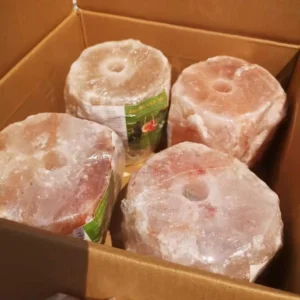
3. Moisture control and packaging: Salt is hygroscopic — it absorbs moisture from the air. Wholesale shipments must include moisture-proof packaging (shrink-wrap + desiccant packs) and be shipped in sealed containers. For logistics details, refer to our guide on shipping Himalayan salt in bulk.
4. Volume pricing and lead times: Most wholesale suppliers offer tiered pricing based on order volume. A typical salt cave project requires 3–8 tonnes of salt blocks and tiles. Trial orders run 20–30 days and bulk production 60–90 days to port, depending on specification and destination. For market context, our Himalayan salt market trends report covers current pricing dynamics and demand forecasts.
Best For / Not For: Which Build Suits Which Venue
Four configurations cover almost every wholesale enquiry we receive. The choice is driven by ceiling height, humidity control and how the venue sells the session.
| Configuration | Best For | Not For | Spec That Drives It |
|---|---|---|---|
| New-build salt room | Venues adding a bookable session to an existing timetable | Sites with no way to control humidity — the room will weep | Block thickness, and whether the ceiling is clad at all |
| Retrofit treatment room | Spas converting underused floor area from about 10 m² upward | Rooms sharing an uninsulated wall with a steam or wet area | Moisture-resistant enclosure and halogenerator ventilation |
| Immersive salt cave | Destination venues where the room is the ticketed attraction | Low-ceiling spaces — a clad ceiling needs height to read as a cave | Ceiling cladding, backlit sections and the lighting behind them |
| Feature wall or panel | Lobbies wanting the material without running sessions | Any wall in direct splash or steam contact | Tile flatness and adhesive compatibility, viewed close up |
What We Check Before a Salt Order Ships
Salt is dense, hygroscopic and unforgiving of a wall that does not close seamlessly, so the checks concentrate on dimensional accuracy and moisture protection.
- Cutting tolerance and flatness. Every brick and tile is checked against the specified tolerance. A wall that does not close seamlessly becomes labour cost on the installer’s side, and the defect is invisible in a shrink-wrapped pallet.
- Density against specification. Density is verified per batch, since low-density material erodes faster in a humid room and shows it as surface loss rather than as a crack.
- Moisture-proof wrap on every pallet. The shrink wrap is the moisture barrier, not a convenience; salt that takes on water in transit arrives wet and stays wet.
- Food-contact separation and loading. Where an order mixes cooking slabs with wall bricks, the two are packed and documented separately. Bulk salt shifts under its own weight, so containers are braced rather than filled to the door.
Buyers specifying a full spa build rather than a single room can work from our wholesale Himalayan salt solutions for spas guide, and the block-versus-tile decision is set out in our salt blocks versus tiles comparison.
ROI and Business Case for Salt Room Installations
Operators should build the case from their own numbers rather than from published averages, because ticket price and utilisation vary far more between venues than the salt specification does. Three inputs decide it.
- Clad area converted to tonnage. Multiply the wall and ceiling area you are cladding by block thickness and by the density of the brick you specify. That is the only part of the case a supplier can price firmly, and it is why two rooms both described as “30 m²” differ substantially once ceiling cladding and backlit sections are counted.
- Sessions per day × seats per session × your own ticket price. Use what your venue already charges for a comparable 45-minute session, and a utilisation rate you would defend to your accountant. Halving the utilisation assumption tests the case better than optimising it.
- Recurring cost, small but not zero. Halogenerator salt refills, modular replacement of any block whose surface erodes, and the humidity control that keeps the room dry. The salt lining is not a consumable while relative humidity stays under control.
Payback follows from those inputs, and any published payback range describes somebody else’s venue. What we can state firmly is the supply side. Trial orders run 100 pieces with a USD 500 minimum order value, shipped air express on DDP terms in 20–30 days. Project volumes run on the wholesale tier at 300 pieces with a USD 3,000 minimum order value, by sea freight, 60–90 days to port. Salt brick and block shipments classify under HS 2501.0019 / 2501.0020, and payment runs T/T at 30% deposit with 70% before shipment, photographs and video of finished goods supplied before the balance falls due.
Growth forecasts for the halotherapy market circulate widely, and we have not found one we can cite to a primary source, so we do not repeat one here.

Installation and Maintenance Best Practices
Proper installation and ongoing maintenance are critical to maximizing the lifespan and performance of a salt cave environment.
Humidity control is paramount. Salt begins to dissolve at relative humidity above 70%. Install a commercial dehumidifier sized for the room volume and monitor humidity levels continuously with a digital hygrometer. Target RH of 40–50% year-round.
Regular inspection schedule: Check block joints monthly for signs of moisture damage or mortar degradation. Replace individual blocks as needed — this is straightforward since blocks are modular. Clean salt surfaces with a dry brush only; never use water or chemical cleaners.
Halogenerator maintenance: Follow the manufacturer’s schedule for filter replacement and salt hopper refilling. Most commercial units require refilling every 2–4 weeks depending on usage. Use only pharmaceutical-grade halotherapy salt — construction-grade blocks are not suitable for the halogenerator.
Lighting upkeep: LED panels behind backlit blocks should be inspected annually. Replace any failed LEDs promptly to maintain uniform illumination. Dimmable drivers should be tested quarterly to ensure smooth operation.
Ready to Build Your Salt Room or Salt Cave?
Jilin Ever Creation supplies construction-grade Himalayan salt blocks, tiles, and panels for salt room and salt cave projects worldwide. From trial orders to full container loads, we provide mine-origin certification, moisture-proof packaging, and competitive wholesale pricing.
Frequently Asked Questions
How much does a salt room cost to build?
Build cost is driven mainly by local labour, the halogenerator and humidity control rather than by the salt, so treat any published range as a placeholder and get two local quotes. What a supplier can price firmly is the salt itself: clad area multiplied by block thickness and density gives the tonnage we quote against.
How long do salt blocks last in a salt cave?
With relative humidity held below 50%, salt blocks commonly last ten to fifteen years or more. A block whose surface erodes swaps out modularly rather than taking the wall with it. The halogenerator’s own salt supply needs refilling every two to four weeks.
Can I install a salt room in an existing spa without major renovation?
Yes. Rooms as small as 10 m² can be retrofitted into an existing space. The requirements are a moisture-resistant enclosure, humidity control and adequate ventilation for the halogenerator; many spas convert an underused treatment room with minimal structural work.
What is the minimum order quantity for wholesale salt cave materials?
Trial orders run 100 pieces with a USD 500 minimum order value and ship air express on DDP terms. The wholesale tier is 300 pieces with a USD 3,000 minimum order value, by sea freight. Project tonnage is calculated from your clad area rather than quoted as a fixed range. Trial lead time is 20–30 days; bulk production is 60–90 days to port.
Are your Himalayan salt bricks certified for authentic origin?
Yes, all our construction-grade salt blocks and tiles come with a Certificate of Origin verifying they are sourced directly from the Khewra Salt Mine in Pakistan. This documentation ensures you are receiving genuine mineral-rich Himalayan salt for your wellness project.