Skip to content
The Himalayan salt lick market has grown well beyond its agricultural roots. What was once a purely functional livestock supplement has evolved into a multi-segment product category spanning pet care, equestrian supply, wildlife feeding, and even artisan home decor. For wholesale buyers and retail brands looking to build a private-label program, sourcing custom salt licks is the key to differentiation. Whether you choose pressed salt licks for precise shape customization and embedded logos, or natural rock salt licks for an artisanal premium presentation, this guide breaks down the production differences, OEM customization capabilities, and ordering specifications needed to build a profitable branded line.
Key Takeaways
- Pressed salt licks = scalable customization. Hydraulic compression produces uniform blocks with precise weight control and cost-effective OEM options through custom molds.
- Natural rock salt licks = artisanal premium. Hand-cut from raw salt deposits, each piece is visually unique—ideal for boutique pet shops and premium private labels.
- Customization favors pressed format. Brand logos, custom shapes, and private-label packaging are highly cost-effective on pressed licks at 500+ pieces.
- Both start at MOQ 100 pieces. Trial orders let buyers test both formats before committing to full private-label production runs.
Production Methods: How Pressed and Natural Salt Licks Are Made
Understanding the manufacturing process behind each type clarifies why they differ in price, consistency, and customization potential for your brand.
Pressed Salt Licks: The Hydraulic Compression Process
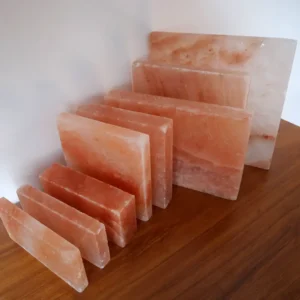
Pressed salt licks begin with raw Himalayan salt that is crushed into granules of a specific particle size. The granules are then loaded into steel molds and subjected to hydraulic pressure — typically 50-200 tonnes depending on the desired density and block size. The pressure fuses the salt crystals together without any binders or additives, producing a solid block that is 100% pure Himalayan salt. The key advantage of this process is control. Manufacturers can specify exact weights (e.g., 1 kg, 2 kg, 5 kg), dimensions, and shapes — from standard rectangles to circles, animal silhouettes, or branded shapes with embedded logos.
Natural Rock Salt Licks: Hand-Cut from Raw Deposits
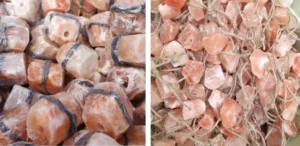
Natural rock salt licks are produced by cutting or carving directly from raw Himalayan salt deposits. The salt blocks are extracted from mines, then hand-shaped using chisels, saws, and grinding tools. Each piece retains the natural crystalline structure, color variations, and veining patterns that characterize authentic Himalayan salt. The result is a product that is inherently unique. This visual individuality is both the product’s greatest strength (artisanal appeal) and its primary challenge (inconsistent sizing and limited shape customization).

Customization Capabilities: Branding and Private Label
For wholesale buyers building their own brand, the ability to source custom salt licks is a critical differentiator. Here is how the two types compare for OEM projects.
Pressed Salt Lick Customization
Pressed licks offer the broadest customization options. Custom molds can incorporate brand logos, text, or specific shapes directly into the salt block during the compression process. This means the branding is not surface-deep — it is embedded throughout every unit. Available custom formats include:
- Custom shapes: animal silhouettes, geometric forms, logo shapes
- Embedded text or logos: raised or recessed branding on the block surface
- Weight and size specification: exact gram weight and dimension control
- Color layering: multi-layer pressed blocks with different salt colors (pink, white, orange) for visual appeal
- Custom packaging: branded boxes, shrink wrap with printed labels, barcode integration
The upfront investment is a custom mold tool, which typically costs USD 200-800 depending on complexity. At 500+ pieces, the per-unit mold amortization becomes negligible for your private label line.
Natural Rock Salt Lick Customization
Natural licks offer more limited but still viable customization. The primary branding method is laser engraving, which can etch logos or text onto the flat surface of a cut block. The irregular crystalline texture means the engraving has a distinctive organic quality, but fine detail is harder to achieve compared to pressed licks. Shape customization is limited to what can be hand-cut from the raw deposit. Custom packaging options are identical for both types: the factory provides branded boxing, labeling, and barcode services at 500+ piece order volumes.

Cost Comparison: Pressed vs Natural at Wholesale Scale
The cost structure of each type differs meaningfully, and the right choice depends on your volume and target price point. Pressed salt licks benefit from economies of scale. Once the mold is created, each production cycle produces identical units with minimal labor input. Material waste is low. The per-unit cost drops significantly at volumes above 500 pieces, making them the preferred choice for high-volume retail chains.
Natural rock salt licks carry higher per-unit costs due to the hand-cutting labor and material variability. However, the premium cost is often justified by the retail price. Boutique pet shops and natural-lifestyle retailers frequently price natural rock salt licks 30-50% above equivalent pressed licks. For wholesale buyers, the practical approach is often to stock both formats to serve both the volume-driven and margin-driven segments of the market. The wholesale salt lick catalog at Ewood Arts includes both options ready for your OEM branding.
Ordering Specifications: What to Include in Your RFQ
When requesting quotes for custom salt licks, providing detailed specifications upfront reduces sampling iterations and accelerates time-to-market.
- Product type & Application: Specify pressed or natural, and the end use (livestock, horse, pet, wildlife). Include target weight and dimensions.
- Quantity: MOQ for trial orders is 100 pieces or USD 500. Wholesale pricing activates at 300 pieces. Custom molds and private-label packaging are available at 500 pieces.
- Packaging: Standard packaging is individual white paper wrap → foam insert → 3-layer corrugated inner box → 5-layer master carton. Specify if you need custom retail-ready packaging.
- Certifications: Reputable factories hold BSCI (social compliance), ISO 9001, CE, UKCA, and RoHS compliance. The salt must be 100% natural Himalayan salt with no additives.
- Shipping: DDP (Delivered Duty Paid) shipping is standard for major markets, including customs clearance. Sea freight transit is 20-30 days. Production lead time is 60-90 days for custom OEM designs.
Source Your Custom Salt Lick Line from a Certified Factory
Pressed or natural — 100% pure Himalayan salt crafted by a factory with 20+ years of experience. BSCI, ISO 9001, and EN71 certified. OEM MOQ from 500 pieces. DDP shipping worldwide. Salt retail economics on the lighting side of the same material, including weight bands and breakage cost, is set out in the Himalayan salt lamps wholesale profit guide.
Explore OEM Capabilities →Frequently Asked Questions
What is the difference between pressed and natural rock salt licks?
Pressed salt licks are manufactured by crushing raw Himalayan salt into granules, then hydraulically compressing it into uniform blocks under high pressure. Natural rock salt licks are hand-cut directly from raw salt deposits. Pressed licks offer consistency; natural licks offer visual individuality.
Which type of salt lick is more cost-effective for wholesale buyers?
Pressed salt licks are generally more cost-effective for high-volume wholesale due to standardized production and lower material waste. Natural rock salt licks carry a price premium but command higher per-unit retail margins in boutique channels.
Can pressed salt licks be customized with logos or brand markings?
Yes. Pressed salt licks can be manufactured in custom molds that incorporate brand logos, text, or specific shapes. Custom molds require an upfront tooling investment (USD 200-800) but become highly cost-effective at OEM volumes above 500 pieces.
What certifications should wholesale salt lick suppliers hold?
Reputable suppliers should hold BSCI (social compliance), ISO 9001 (quality management), and food-safety-relevant documentation. For EU and UK export, CE and UKCA compliance is required. RoHS compliance covers packaging standards.
What is the minimum order quantity for custom salt licks?
The minimum order quantity for standard trial orders is 100 pieces. However, for fully custom salt licks with private-label packaging and specific mold designs, the MOQ is 500 pieces. Production lead time is 60-90 days for custom designs.