Skip to content
Key Takeaways
- Sourcing the right halotherapy salt room equipment requires four categories of materials: structural salt (bricks and tiles for walls and floor), decorative salt (backlit panels, carved features, loose salt for the floor bed), air treatment (halogenerator with adjustable output), and environmental controls (humidity and temperature management to prevent salt degradation).
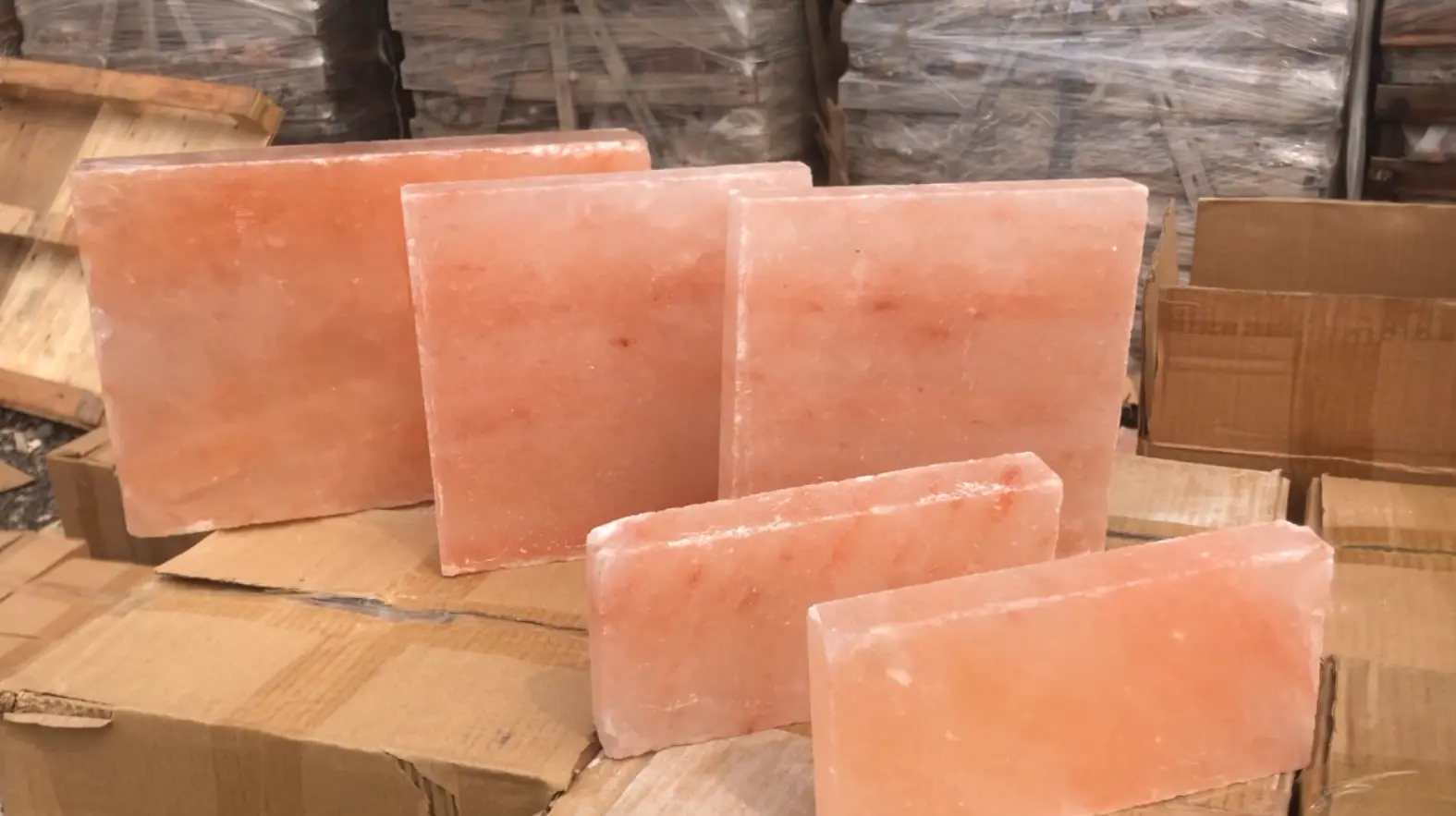
- The salt bricks and tiles are the largest material cost and the longest-lead-time item — Himalayan salt bricks for a full room require 8–12 weeks for production and shipping. Ordering early and verifying brick dimensions (standard 8″x4″x2″ for walls, 12″x12″x1.5″ for backlit panels) prevents construction delays.
- Supplier selection for salt room materials should prioritize food-grade or pharmaceutical-grade salt certification, consistent color matching across the entire order (pink-to-orange range with minimal white or grey variation), and dimensional tolerance within ±2mm for mortar-free dry-stack wall construction.
Salt Room Equipment Checklist: What You Need to Order
Procuring professional halotherapy salt room equipment is a construction project , not a retail purchase. The materials list must be complete before the first brick is ordered because Himalayan salt is a natural material with batch-to-batch color variation — you cannot order additional bricks six weeks later and expect them to match the first shipment. Order everything for a given room from a single production batch.
| Material | Standard Dimensions | Quantity for 100 sq ft Room |
|---|---|---|
| Wall Bricks | 8″ x 4″ x 2″ | 800–1,200 bricks |
| Backlit Panels | 12″ x 12″ x 1.5″ | 4–8 panels per feature wall |
| Floor Salt (loose) | 0.25–0.5 inch grain | 300–500 lbs for 2-inch floor depth |
| Halogenerator | Wall-mounted, 110–240V | 1 unit per 200 sq ft |

Supplier Questions: What to Ask Before Ordering Salt Room Materials
The difference between a salt room that glows with uniform pink light and one that looks patchy and inconsistent comes down to supplier quality control. Ask these specific questions before committing to a salt brick or tile order. Vague answers are a red flag — a quality supplier can answer every one with specific numbers and documentation.
Color Consistency and Grading
How do you grade salt bricks for color? What is the acceptable color range within a single order — and can you provide photos of the actual batch, not catalog photos? A professional salt supplier grades bricks into color bands (deep orange, medium pink, light pink) and ships from a single band per order. Mixed-color shipments create a patchwork wall that looks accidental rather than designed. Ewoodarts grades every brick visually before packing and provides batch photos with your proforma invoice so you see exactly what is shipping.
Dimensional Tolerance
What is your dimensional tolerance for bricks and tiles? For dry-stack wall construction (bricks placed without mortar, held by gravity and friction), the tolerance must be within ±2mm. Wider variation creates visible gaps that collect dust and compromise the seamless salt-wall look. For backlit panels, the tolerance is even tighter — ±1mm — because LED backlighting shines through any gap between adjacent panels. Ask for the factory’s cutting calibration records, not just a verbal guarantee.

Environmental Controls: Protecting Your Salt Investment
Himalayan salt is hygroscopic — it absorbs moisture from the air. In an uncontrolled environment, salt bricks slowly dissolve, develop white surface crystallization, or crumble at the edges. The solution is not to avoid humidity entirely (impossible in a spa environment) but to control it within a safe range: 40–50% relative humidity, with temperature maintained at 68–75°F. A dedicated HVAC zone for the salt room with humidity monitoring is not optional — it is the single largest factor in the room’s lifespan.
Maintenance and Longevity
With proper environmental controls, a Himalayan salt brick wall lasts 10–15 years before showing visible degradation. Without controls, surface erosion begins within 12–18 months. The floor salt (loose grain) requires topping up every 6–12 months as it compacts and erodes under foot traffic — budget for 50–100 lbs of replacement floor salt annually per 100 sq ft of floor area. Backlit panels need the LED array inspected annually for dark spots caused by salt dust accumulation on the light source. These maintenance items should be included in the spa’s operating budget from day one, not discovered as surprise expenses in year two.
Source Himalayan Salt for Your Salt Room Project
Food-grade Himalayan salt bricks, backlit panels, and loose floor salt. Batch-matched color, ±2mm dimensional tolerance, and full construction documentation. Order lead time 8–12 weeks.

Salt Bricks vs. Salt Tiles: Choosing the Right Format for Your Design
Salt bricks and salt tiles serve different aesthetic and structural purposes in a salt room, and using the wrong format in the wrong location is a costly mistake. Bricks (8″x4″x2″) are for structural walls where the depth creates a rugged, natural cave-like appearance. Tiles (12″x12″x1.5″) are for smooth feature walls and backlit panels where uniform surface and light transmission matter more than texture. Mixing formats within the same wall creates an unintentional patchwork effect that looks like a material shortage rather than a design choice.
Design Guidelines for Mixed-Format Rooms
The most visually successful salt rooms use bricks for three walls (creating the immersive cave environment) and tiles for one feature wall with backlighting (creating the focal point that draws the eye upon entry). The transition between brick and tile should occur at a corner, not mid-wall — a corner transition reads as intentional architecture, while a mid-wall transition reads as a material change you are trying to hide. The backlit tile wall should face the entrance so it is the first thing a client sees when the door opens. The brick walls should surround the seating or reclining area where clients spend the session, creating the enclosed, protective feeling that contributes to the therapeutic experience. This layout uses approximately 70% bricks and 30% tiles by surface area and produces the most consistent positive feedback from salt room visitors across the projects we have supplied.
Lighting the Salt Room: Backlit Panels and Ambient Glow
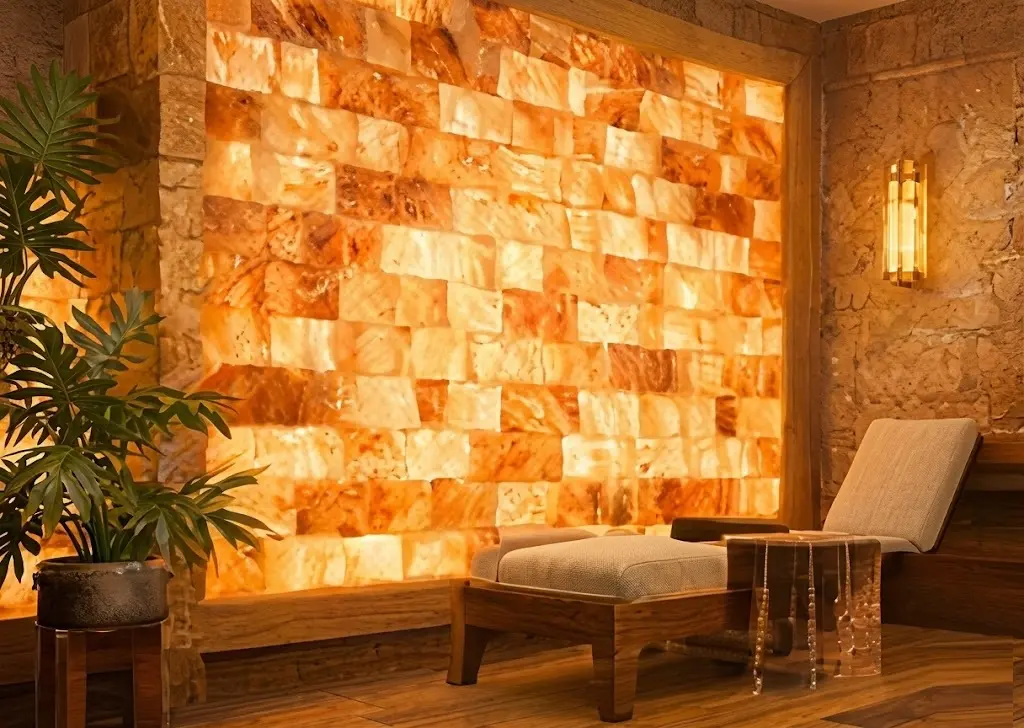
Backlit Himalayan salt panels are the defining visual feature of a premium salt room. When lit from behind with warm-white LED arrays (2700K–3000K), the natural iron-oxide bands in the salt create a gradient of pink, orange, and amber that no artificial material can replicate. The LED array should be positioned 4–6 inches behind the panel with a diffuser layer to eliminate hot spots. Standard configuration uses two LED strips per 12″x12″ panel — one at the top and one at the bottom — powered by a dimmable DC driver that lets the spa operator adjust intensity from soft ambient glow to full therapeutic brightness. The wiring must be rated for enclosed-wall installation and accessible for maintenance without dismantling the salt wall — a service access panel behind the salt tiles is essential and should be planned during the framing stage, not retrofitted after the salt is installed.
A well-built salt room is a long-term asset that generates revenue for a decade or more when properly maintained. The upfront investment in quality materials, precise dimensional tolerances, and professional installation pays back through client satisfaction, word-of-mouth referrals, and the premium pricing that a beautifully executed salt room commands in the competitive wellness market. The alternative — cutting costs on salt quality or skipping environmental controls — produces a room that degrades visibly within two years and damages the spa brand rather than enhancing it.
Studio planners sourcing salt rooms usually combine three lines: wholesale salt bricks for walls, the Himalayan salt products range for retail shelves, and spa salt solutions for project support; cut-to-size panels run through custom salt products. Halotherapy background: halotherapy. The margin economics of the wider salt category — landed cost per kilogram, weight classes and transit breakage — are worked through in our Himalayan salt lamps wholesale profit guide.
Frequently Asked Questions
What grade of Himalayan salt do you supply for salt rooms?
We supply food-grade Himalayan salt from the Khewra mine in Pakistan, the world’s oldest and largest Himalayan salt source. Salt is graded for color consistency (medium pink to deep orange bands), dimensional accuracy (±2mm for bricks, ±1mm for backlit panels), and structural integrity (no internal fractures visible under backlighting).
Do you provide construction documentation for salt room builders?
Yes. We provide a salt room construction guide covering wall preparation, brick stacking patterns, backlit panel framing, electrical specifications for LED arrays, floor base preparation, and environmental control calibration. The guide is designed for general contractors — no prior salt room experience required.
Can I order a sample brick before committing to a full room order?
Yes. Sample kits include 3 bricks and 1 backlit panel section showing the color range and dimensional accuracy of the current production batch. Sample cost is credited to your full order. Lead time for samples is 2–3 weeks via express shipping.
Do you supply halogenerators or just the salt materials?
We supply the salt materials (bricks, tiles, panels, loose floor salt). Halogenerators are sourced separately through medical device or wellness equipment suppliers. We can recommend compatible halogenerator brands based on your room dimensions and intended usage (commercial spa, private wellness studio, or medical halotherapy clinic).
What is the shipping process for heavy salt brick orders?
Salt bricks ship via sea freight in reinforced wooden crates (not cardboard) to prevent breakage. A full room order typically occupies 2–4 pallets at 500–800 kg per pallet. Shipping time is 6–8 weeks from our facility to most international ports, plus 1–2 weeks for customs clearance and inland delivery. We provide crate-level packing lists and pallet-dimension diagrams for your receiving warehouse.