Skip to content

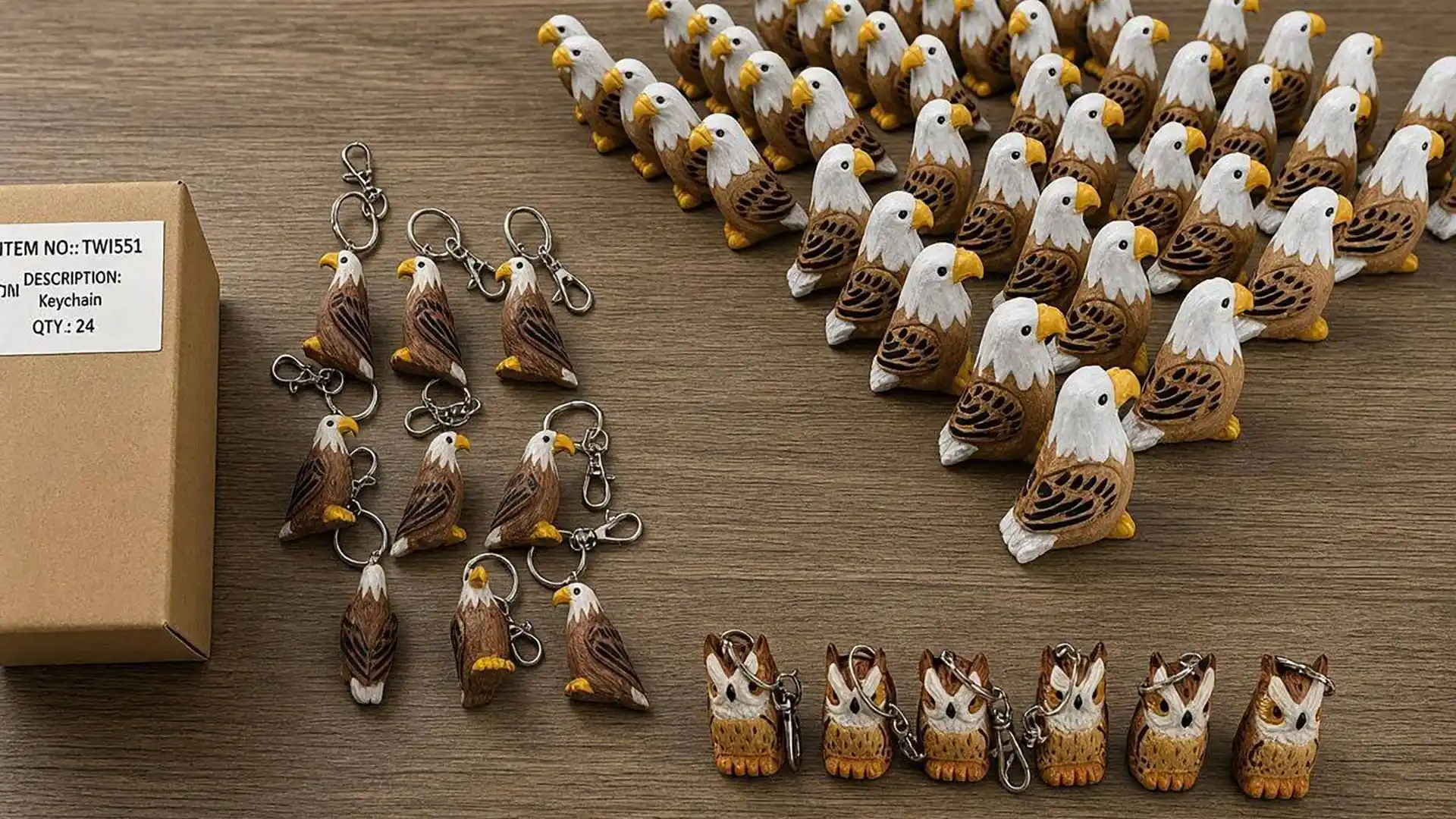
Wooden ornaments sell twice: once on the fixture, where a shopper picks them up, and once at the table, where they survive being handled, bagged and gifted. Display and packaging are one system, not two departments, and most ornament programmes leak money at the seam between them.
This guide walks retail buyers through both halves in order: zoning the fixture, facing by size run, then the two distinct packing layers, export pack and retail unit, that decide whether a piece reaches the gift wrap intact. Every production and pack figure is our own first-party number; fixture dimensions and reach bands are recommendations for you to test.
Key Takeaways
- Zone the fixture into 4 jobs: entrance announce, theme group, gifting price blocks and a service edge for tags and wrap; a fixture with one zone becomes a rummage by week 2.
- Face by size run, not by unit: 3 to 4 facings per design in graded sizes reads as a range; our ornament carving runs 5 cm to 40 cm, and singletons read as leftovers.
- Keep the price-block edge at 90 to 150 cm from the floor, the reach band where a gift decision is made; above it stock depth, below it carton bulk.
- Shelf pack and gift pack are different documents: our export pack is white paper per piece, 6 to 12 per inner box, while a custom colour retail box is a separate specification from 500 pieces.
- One hangtag carries 3 jobs: price, age or use line, and care; a tag that skips the age line pushes the compliance question to the checkout clerk instead of answering it at the shelf.
- Damage follows 2 paths, handling and humidity: pieces held at 8 to 12 percent moisture and wrapped per piece survive a season of shelf picks, while loose bins chip paint at the edges within weeks.
In This Guide
- Why Display and Packaging Are One System
- Wooden Ornaments: Display Zones That Sell
- Facing by Size Run and the Reach Band
- Two Packing Layers: Export Pack and Retail Unit
- Hangtags, Barcodes and the Age Line
- Zone Against Facings Against Pack
- The 2 Damage Paths and How Pack Stops Them
- What We Supply Into the Fixture and the Box
- Best For / Not For
- What We Check Before Ornaments Ship
- End to End: A 4-Metre Fixture, 60 Designs
- Frequently Asked Questions
Why Display and Packaging Are One System
An ornament’s life in store is a loop: it is picked up, examined, put back, picked up again, then bought, bagged, carried and unwrapped. Every one of those touches is either a display decision or a packaging decision, and the two trade against each other. An open bin invites touches but chips paint; a closed box protects paint but hides the carving that sells it.
The buyer’s job is to choose, per zone, where on that spectrum each design sits, and then to order the packing that supports the choice. The range those choices apply to, from blank-friendly classics to painted seasonal pieces, is described on our wooden ornaments wholesale page.
Wooden Ornaments: Display Zones That Sell
Four zones cover a working ornament fixture. The entrance announce carries 2 or 3 hero designs at their largest size, faced deep. The theme group carries the season’s story, Christmas, spring or coastal, in graded size runs. The gifting price blocks carry boxed units at 3 price points, because a gift decision is usually a budget decision first. The service edge carries tags, wrap and a mirror if the fixture allows one.
Zoning also fixes the reset problem: each zone has one owner and one trigger, so the fixture never waits for a consensus to be re-faced. The shelf-level mechanics inside each zone, sightlines, shelf strips and step heights, are covered in our guide to gift shop planogram basics.

Facing by Size Run and the Reach Band
Face each design in 3 to 4 graded sizes, smallest at the front edge and largest at the back of the shelf, so the eye reads a family rather than a remainder. A singleton facing is the most common ornament fixture mistake: it reads as the last one, and shoppers avoid the last one.
Height does the second half of the work. The 90 to 150 cm band from the floor is where hands actually reach and where gift decisions get made, so the price blocks live there. Above that band goes stock depth and the tallest heroes; below it goes carton bulk and refills, which is also where a grouped display of carved figurines earns its keep, as we set out in wooden animal figurines in retail display.
Two Packing Layers: Export Pack and Retail Unit
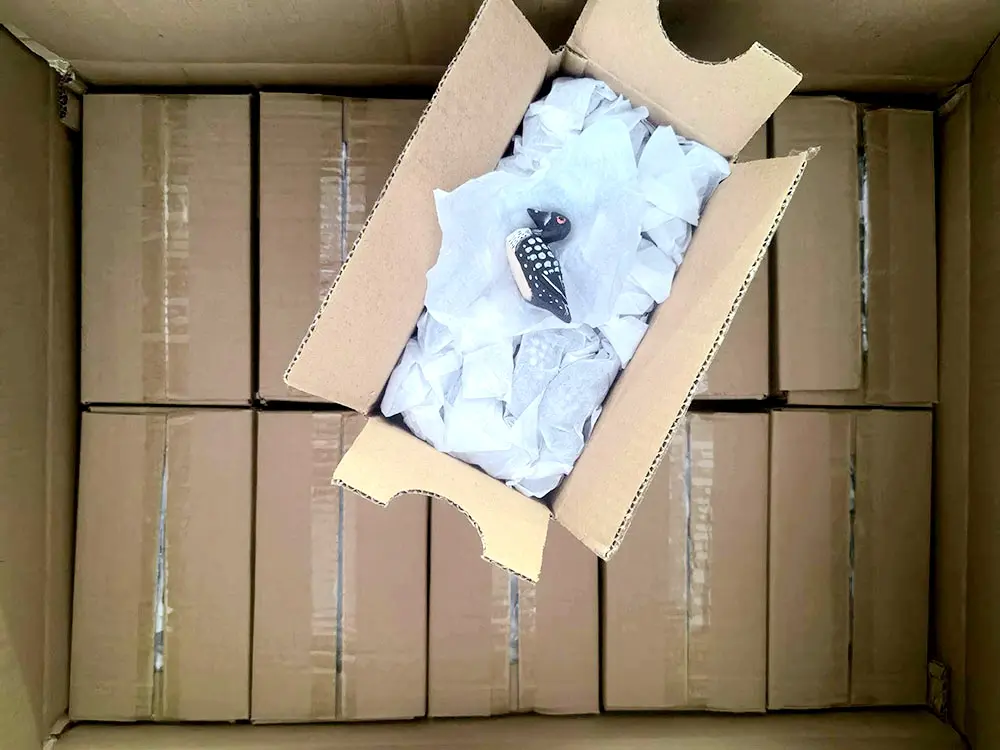
Buyers regularly conflate two different packs and then find the gap at set-in. The export pack is what protects the goods from our bench to your back door: each piece wrapped in white paper, 6 to 12 pieces per 3-ply inner box of 21 by 11 by 14 cm, then 240 to 480 pieces per 5-ply master carton of 58 by 44 by 31 cm at 8.0 to 15.0 kg gross, made up to pass an ISTA 3A drop test.
The retail unit is what the shopper carries: a per-piece box or sleeve that survives the bag and looks like a gift. That is a separate specification with its own minimums, because custom colour boxes are produced from 500 pieces, and the options and their cost logic are covered in our guide to ornament retail packaging.
Hangtags, Barcodes and the Age Line
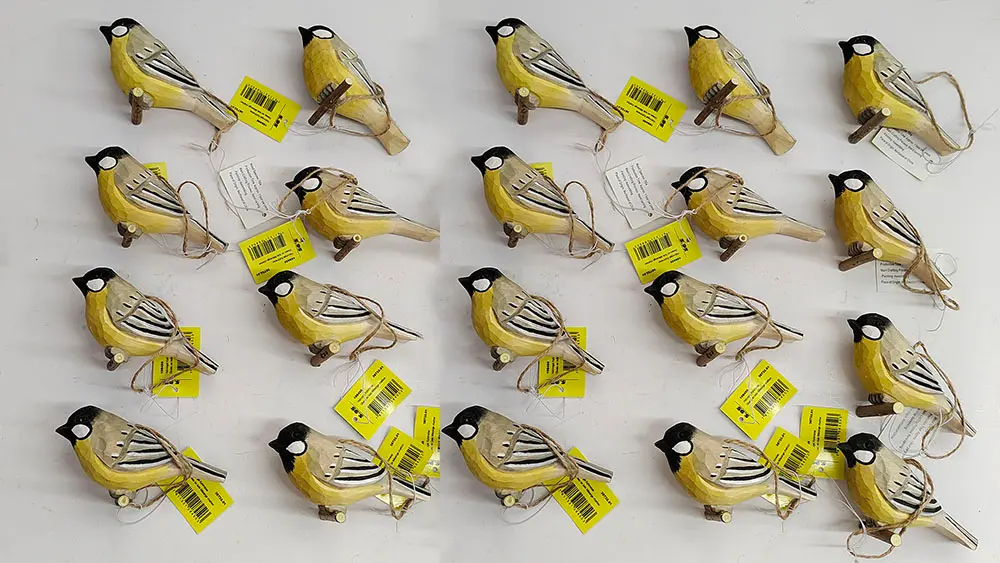
A hangtag on a wooden ornament carries 3 jobs: the price, the age or use line, and one line of care. The age line is the one teams skip, and it is the one that matters legally, because whether a carved piece is a toy or a decoration is decided by its intended age and marketing, not by its material. Where a piece is marketed to children, the EU toy safety framework applies and is summarised by the European Commission’s toy safety page; US doors answer to CPSC age grading on the same question.
Practically, write the age line on the tag at specification freeze, print it in the destination market’s language, and keep it identical on the unit box, because a tag saying 3+ beside a box saying decorative only is a contradiction a regulator will read as negligence. Destination-market label rules beyond the age line are covered in our guide to EU packaging and labelling for wooden gifts.
Zone Against Facings Against Pack
| Zone | Facings model | Pack presented | Reset trigger |
|---|---|---|---|
| Entrance announce | 2 to 3 heroes, deepest stock | Open, paper wrap hidden | Season set-in only |
| Theme group | 3 to 4 per design, graded sizes | Open, tag visible | Mid-season refresh |
| Gifting price blocks | Boxed units, 3 price points | Closed retail unit | After each gift peak |
| Service edge | Tags, wrap, ribbon, counted weekly | Consumables | Weekly count |
The 2 Damage Paths and How Pack Stops Them
Handling damage shows up as chipped paint on beaks, wings and edges, the points that meet a shelf lip or a neighbour piece when a shopper puts a piece back carelessly. The fix is display-side: room between facings, a lip or rail that stops slides, and a rule that open zones never carry the smallest painted sizes.
Humidity damage shows up later, as checking at thin points after a heating season, and it is decided long before the fixture, at packing moisture of 8 to 12 percent and per-piece paper wrap that lets a piece acclimatise slowly in store rather than in a shopper’s bag. Both paths are cheapest to stop at specification, which is why the pack drawing and the fixture plan get signed on the same day. In practice the two paths interact: a chipped piece pulled from an open zone is usually re-wrapped into the wrong inner box at reset, which is how handling damage becomes a shipping claim three months later.

What We Supply Into the Fixture and the Box
- We supply: carved and painted ornaments across 4 species, basswood, pinewood, rubber wood and birch, from 5 cm to 40 cm, wrapped per piece and boxed to the export specification above.
- We supply: custom labels and marks, hangtags included, and custom colour retail boxes from 500 pieces.
- We do not supply: fixture hardware, shelving, rails, mirrors or lighting.
- We do not supply: the retailer’s price tickets or POS printing, which sit on your side of the tag.
On sourcing claims printed on tags: our facility holds an FSC chain-of-custody certificate, but certified basswood is not currently available to us, so our ornaments are not marketed as FSC-certified wood, and no tag should carry that claim; we supply official timber felling and transport permits instead.
Best For / Not For
| Retail format | Best for | Not for |
|---|---|---|
| Independent gift shop | Open theme group, tag visible, service edge | Loose bins for painted small sizes |
| Garden centre gift shed | Boxed price blocks, humidity-tolerant species | Open display near an unheated door |
| Department store concession | Closed retail units, full gift presentation | Open handling of one-off painted pieces |
| Market stall or fair booth | Graded size runs on stepped boards | Any pack that needs a box to survive a day |
What We Check Before Ornaments Ship
- Paint adhesion and coverage against the retained sample, eco-friendly non-toxic paint, under warm and cool light.
- Moisture at 8 to 12 percent recorded per batch before wrapping.
- Thin-point integrity, beaks, wings, hooks and loops, inspected piece by piece on a sampling plan.
- Tag and mark proof, age line, care line and barcode position checked against the approved artwork before the run.
- Claims limited to what we hold: CE, UKCA, RoHS, EN71 where a piece is marketed to children, BSCI and ISO 9001.
Every figure above is first-party and checkable against an inspection report or a certificate we hold; the zone counts, facing counts and reach band are recommendations for your floor to test, not statistics. The company and its specification library sit at ewoodarts.com.
End to End: A 4-Metre Fixture, 60 Designs
An independent gift shop plans a 4-metre ornament fixture for the winter season, 60 designs across 3 price points, with a service edge for wrap and tags.
Zone first, then count. The team assigns 1 metre to the entrance announce, 2 metres to the theme group and 1 metre to gifting price blocks plus a 60 cm service edge. At 3 to 4 facings per design in graded sizes, the theme group carries 20 designs and the price blocks carry 30 boxed units per point, which totals near 900 pieces including 10 percent spares.
Order against the pack layers. At 900 pieces the run sits comfortably on the wholesale and custom tier at 300 pieces and a USD 3,000 minimum order value, sea freight 60 to 90 days to port, counted back from set-in. The boxed price points use a custom colour retail box, which at 900 units clears the 500-piece minimum in one specification across all 3 points.
Sign tag and fixture together. The age line, care line and barcode position are approved with the fixture plan, so tags arrive attached and the set-in crew faces shelves rather than printing tickets. After the peak, the clearance block regroups from the price points only, and the theme group’s survivors re-wrap in their original paper for next season.
Planning an ornament fixture and its packing?
Send us your fixture metres, your price points and your set-in date. We will return a zone plan with facing counts, the two pack specifications that support it, and the order date the freight legs allow.
Frequently Asked Questions
Q: How many facings should each ornament design get?
Three to four, in graded sizes, smallest at the shelf front and largest behind. A single facing reads as the last one left and shoppers avoid it, while a graded run reads as a range and invites comparison between sizes rather than doubt about the piece. Depth behind the facings is sized to the inner box, not to optimism.
Q: What is the difference between export pack and retail unit?
The export pack protects goods from our bench to your back door: white paper per piece, 6 to 12 per inner box, 240 to 480 per master carton, ISTA 3A rated. The retail unit is what the shopper carries and gifts, a separate specification, since custom colour boxes start at 500 pieces.
Q: Does a wooden ornament need an age line on its tag?
Yes, because whether a carved piece is a toy or a decoration is decided by intended age and marketing, not by material. Where a piece is marketed to children, toy safety rules apply in the EU and US alike. Writing the age line at specification freeze, identically on tag and box, answers it at the shelf.
Q: Which zones should stay open and which stay boxed?
Open display suits the entrance announce and the theme group, where touching the carving is what sells it, and suits larger sizes with robust finishes. Boxed units suit the gifting price blocks, where the box is part of the gift, and suit the smallest painted sizes that open handling would chip. The service edge stays open by definition.
Q: Can tags and retail boxes carry our own brand?
Yes. Custom labels and marks are part of our standard offering, and custom colour retail boxes run from 500 pieces, so a 900-piece programme can carry one box specification across three price points. Artwork is approved at specification freeze with the age and care lines already placed, because a late tag change re-opens the compliance question.