Skip to content
Key Takeaways
- A planogram is not a suggestion — it is a data-driven floor plan that assigns every product to a specific shelf position based on sales velocity, margin, and customer browsing patterns. Gift shops using planograms for wooden decor report 20–40% higher sell-through than shops using intuitive shelf arrangement.
- The impulse zone — the first 4–6 feet inside the store entrance and the 3 feet surrounding the checkout counter — is where wooden miniatures, small ornaments, and carved animals at $3–$15 perform best. These items convert browsing into buying because the price point requires no deliberation.
- A price ladder organizes products vertically by price band: impulse items at eye level ($3–$15), mid-range wooden birds and ornaments at chest level ($15–$30), and premium carved pieces at the top shelf ($30–$60). The eye naturally scans top to middle, encountering the mid-range “sweet spot” first.
Mastering gift shop planogram basics is the most effective way to turn static shelf space into a high-performing retail engine. When dealing with natural wooden decor—from tactile miniatures to premium carved centerpieces—layout strategy directly dictates whether products sit unnoticed or drive high-margin impulse sales.
The Impulse Zone: Where Small Wooden Items Do Their Best Work
The impulse zone is retail real estate that generates revenue without marketing cost. A customer who walked in to buy a specific item passes through the impulse zone twice — entering and exiting — and each pass is an opportunity to add $5–$15 to the transaction with zero sales-staff effort. Wooden miniatures are ideal impulse-zone products because they are small (high units per square foot), visually appealing (customers pick them up to examine), and priced for guilt-free purchase.
What Goes Where in the Impulse Zone
The entrance impulse zone (first 6 feet) should display seasonal miniatures — Easter chicks, Christmas ornaments, Halloween wooden pumpkins — rotated monthly. The checkout impulse zone (3 feet around the register) should display evergreen small items: carved wooden birds (2–3 inch), wooden keychains, mini animal figures. The checkout zone items should never rotate — customers who visit monthly should see the same “always available” impulse items so they become part of the store’s identity. The entrance zone items should change with the calendar to signal “we have new seasonal products” before the customer sees the main aisles.

The Price Ladder: Organizing Wooden Decor by Value Band
A price ladder organizes wooden products vertically by retail price, with the goal of guiding the customer’s eye from the affordable entry point to the premium aspiration piece. The psychological principle is anchoring: the customer sees a $35 hand-carved bird, then notices a $18 carved bird below it, and the $18 bird now feels like a value rather than an expense. Without the $35 anchor, the $18 bird feels expensive. With it, the $18 bird feels like a smart choice.
| Shelf Level | Price Band | Product Types |
|---|---|---|
| Top Shelf | $30–$60 | Large carved birds (8+ inch), premium nativity sets, collector pieces |
| Eye Level | $15–$30 | Life-size songbirds, 3D layered ornaments, wooden pen sets |
| Waist Level | $8–$15 | Flat ornaments, small birds (3–4 inch), mini decor items |
| Countertop Bins | $3–$8 | Mini birds, basket stuffers, keychains, impulse picks |

Reorder Points: Never Run Out of Your Best Sellers
The most expensive shelf in a gift shop is the empty one. When a best-selling wooden bird sells out and the shelf sits empty for two weeks waiting for a reorder, the retailer loses not just the two weeks of sales but the browsing momentum — customers who see an empty or thin display perceive the store as understocked and spend less time browsing overall. A simple reorder-point system prevents this.
The Two-Bin Reorder System for Wooden Products
For each wooden product SKU, maintain two bins in backstock: one bin on the shelf being sold, and one bin in storage representing your reorder trigger quantity. When the shelf bin empties and you pull the storage bin, that is your signal to reorder — not when both bins are empty. Set the reorder trigger quantity at 4–6 weeks of average weekly sales for that SKU (to cover the production and shipping lead time). For example, if a carved robin sells 5 units per week, keep 25–30 in the storage bin as the reorder trigger. When you pull that bin to restock the shelf, place a reorder that same week. This system requires no software — just two labeled bins per SKU and a weekly restock routine.
Stock Your Shelves with Handcrafted Wooden Decor
Seasonal Planogram Rotations: Adapting the Layout for Peak Selling Periods
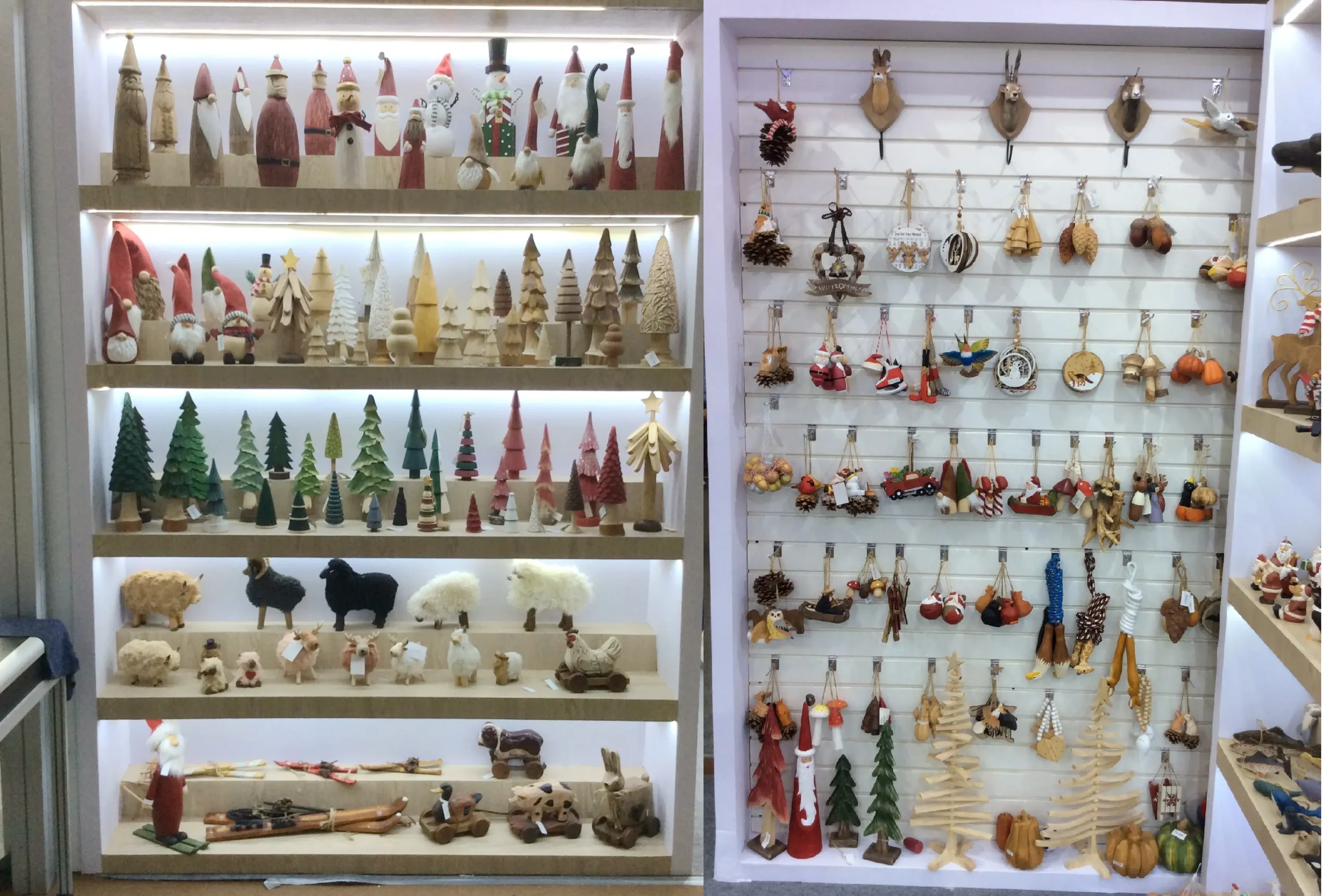
The base planogram serves as the default layout, but peak seasons demand temporary adjustments that prioritize seasonal products without disrupting the customer’s familiarity with the store’s organization. A Christmas planogram overlay, for example, moves ornaments and holiday decor into the prime eye-level positions while shifting (not removing) evergreen wooden birds and miniatures to secondary positions. The overlay should be reversible within a single shift of staff time — if a seasonal reset takes more than 4 hours for a 1,000 sq ft store, the planogram is too complex.
Christmas Planogram Overlay (November–December)
The Christmas overlay moves ornament displays to the front 40% of the store, occupying eye-level and waist-level positions across all fixture types. Evergreen wooden birds shift to the back 30% of the store or consolidate into a single “gift and collectibles” section that maintains their visibility without competing with seasonal items. The impulse zone doubles in size during the holiday season, with two additional countertop bins near the register for ornament impulse purchases. The overlay should go up the first week of November and come down the first week of January — a 9-week run that justifies the reset labor with holiday sales volume. The key rule: never remove evergreen products entirely during a seasonal overlay. The customer who came in specifically for a carved bluebird should find it, even if it has moved to a different location. A sign reading “Our wooden bird collection has moved to the back wall — ask us!” prevents the lost sale that happens when a customer assumes a product is gone.
Using Sales Data to Refine Your Planogram Quarterly
Every quarter, pull three data points per wooden SKU: units sold, gross margin dollars, and shelf position (which shelf level and which fixture). Sort by margin dollars per linear foot of shelf space — this is the metric that accounts for both sales velocity and profitability. Products in the top quartile earn their eye-level position. Products in the bottom quartile that have occupied their shelf position for two or more quarters without improvement should move to a lower shelf or reduce facing count. This quarterly review takes about 90 minutes for a store with 50–75 wooden decor SKUs and is the single highest-ROI hour a gift shop owner can spend on merchandising. No new fixtures, no additional inventory — just reorganizing what you already have based on what the sales data tells you.
A well-maintained planogram is the quiet engine of a profitable gift shop. It does the work of a full-time visual merchandiser for the cost of a few hours of quarterly attention. The wooden decor category — with its natural material, varied price points, and strong impulse-purchase characteristics — rewards planogram discipline more than almost any other gift shop category. A carved bird in the right place at eye level sells itself. The same bird on a bottom shelf in a back corner waits for a customer who already knows exactly what they want. The difference between those two outcomes is not the product, the price, or the customer — it is the planogram.
Planogram work sources from the live lines: wholesale wooden crafts, wholesale ornaments, custom programmes via customization and the wood carving factory overview. Merchandising background: planogram.
Frequently Asked Questions
How often should I rotate my planogram for wooden decor?
Rotate seasonal products monthly (Christmas in November–December, Easter in March–April, spring birds in April–June). Evergreen wooden products like songbirds and miniatures can stay in fixed positions year-round, with quarterly minor adjustments based on sales data.
What is the typical reorder lead time for wooden products?
Standard reorder lead time is 4–5 weeks for in-stock designs. Custom or personalized items require 6–8 weeks. We recommend maintaining 6 weeks of safety stock to cover lead time plus a 2-week buffer for shipping delays.
Can you provide planogram recommendations for my store layout?
Yes. For orders of 500+ pieces, we provide a store-specific planogram sketch based on your floor dimensions, fixture types, and product mix. This includes shelf-level placement, price ladder organization, and impulse-zone recommendations.
Do you offer display fixtures or merchandising materials?
We provide wooden display perches for bird products, tiered risers for ornament displays, and branded countertop bins for impulse items — all as optional add-ons with qualifying order sizes. Display materials are designed to match the natural wood aesthetic of the products.
What data should I track to optimize my wooden decor planogram?
Track three metrics per SKU: weekly unit sales, gross margin dollars per linear foot of shelf space, and stockout frequency (how often the shelf is empty). Move top performers to eye level, reduce facings for bottom performers, and increase reorder quantities for items that stock out more than twice per quarter.