Skip to content

Why Wholesale Wooden Crafts Still Earn Shelf Space
Retailers keep coming back to wooden crafts for the same 2 reasons: the material reads as honest in a store full of plastic, and a hand-finished piece holds its price better through a discount cycle than a moulded one does. What changed is the buying side. Procurement teams now have to clear compliance paperwork, survive 2 shipping methods and still hit a margin, all on a 100-piece or 300-piece order rather than a container.
This guide walks that path from the factory side of the table: how the product categories split, which design and material signals actually show up in a spec sheet, how to time a seasonal order, and the 5 checks that separate a supplier who can hold a line from one who cannot.
Key Takeaways
- Wooden crafts clear customs under 3 main HS codes: 4420.1990 for carved ornaments, 9505.1000 for Christmas articles and 9608.1000 for wooden pens.
- Every line is quoted on 2 tiers: 100 pieces at MOA USD 500 from in-stock items, or 300 pieces at MOA USD 3,000 for full-catalogue wholesale and custom work.
- Transit is the calendar: 20-30 days by air on a trial order, 60-90 days to port by sea on wholesale and custom runs.
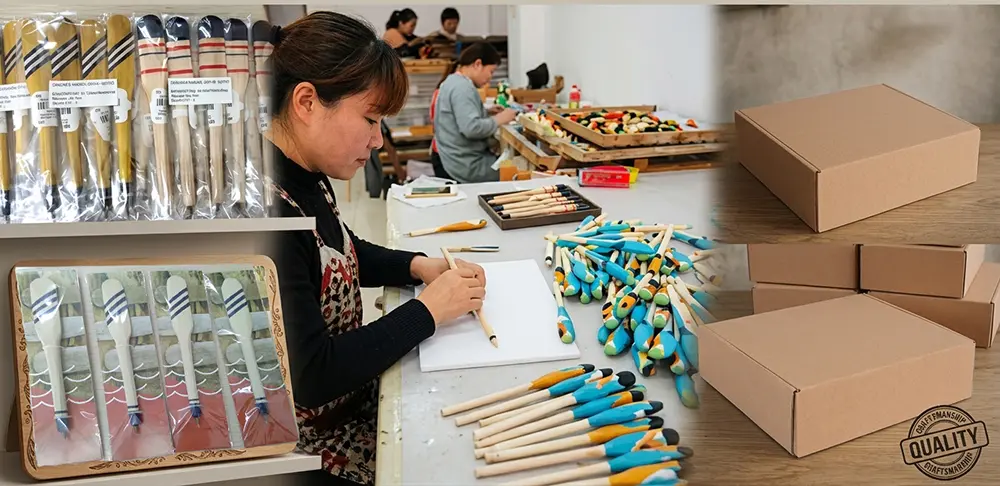
- Custom colour boxes or gift boxes start at 500 pieces; private labels and shipping marks are made to order.
- Carving range is 5-40 cm in 3D and up to 80 cm for 2D flat work, in basswood, pine, rubber wood or birch.
- Pack density sets your landed cost: 6-12 pieces per 3-ply inner box, 240-480 pieces per 5-ply outer carton at 8-15 kg gross.
In This Guide

Market Overview of Wholesale Wooden Crafts
The category is not one market but three buying jobs, and each one is quoted, packed and cleared differently. Treating them as a single “wooden crafts” line is where procurement teams get their landed cost wrong.
The three segments we manufacture against
1. Home decor and functional items – wall hangings, decorative storage, tableware, wood carving factory output and bookends with their weighted bases. Cork and solid-wood coasters sit here too.
2. Gift and novelty items – hand-carved wooden pens, family puzzles, piggy banks, keychains and slingshots, the lines retail buyers use for gift-with-purchase and corporate gifting.
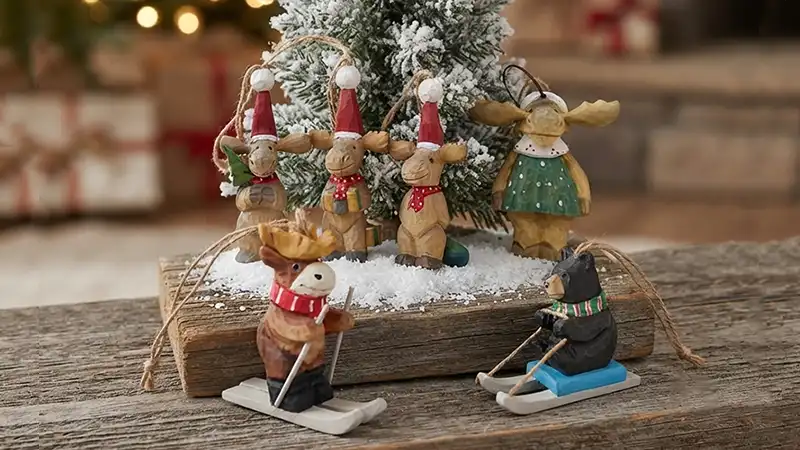
3. Seasonal products – Christmas-themed wooden decorations, Easter-themed decor and festival items, all time-boxed against a shipping window rather than a restock cycle.
Buyer decision factors
| Factor | What it changes in your PO | How it is verified at source |
|---|---|---|
| Material compliance | Species list, paint system and documentation attached to the shipment. | Timber paperwork (felling and transport permits) plus non-toxic, EN71-tested paint on toy and children’s lines. |
| Handcraft consistency | Whether one approved master sample governs the run. | During-production check at 20-60% completion and pre-shipment inspection at 100%; see quality control for hand carving. |
| Seasonal timing | Your order date, not your delivery date. | 60-90 days to port on sea freight means a holiday planogram is agreed the previous spring. |
| Margin structure | Pack quantity, carton weight and whether you pay air or sea. | Inner box 21x11x14 cm, outer carton 58x44x31 cm at 8-15 kg gross. |
Key challenges buyers actually hit
- Lead-time slippage compounding into a missed seasonal window, because 60-90 days at sea leaves no buffer.
- Raw material movement in species and grade, which is why a quote should name the wood, not just the item.
- Consistency across a large hand-painted run without a master sample on file.
- Shelf perception against cheaper printed-resin copies of the same silhouette.
Practical recommendations
- Buy direct from the manufacturer for anything you intend to restock, so the spec sheet and the shop floor stay connected.
- Put the inspection stages in the PO, not in an email thread.
- Hold 2 supplier relationships in the same segment and rotate the second one on the restock order.
- Ask for the material and paint documentation before the sample, not after.
- Plan the seasonal calendar backwards from port arrival.
Once the segments are clear, the useful question changes from what the market is worth to what buyers are specifying. That is the next section.

Current Trends in Wholesale Wooden Crafts
Trends are only useful to a buyer when they turn into a line on a spec sheet. These four do.
What buyers write into the requirement
1. Sustainable and legally sourced material – named species, traceable timber, paperwork with the shipment, and packing that survives inspection.
2. Simplified design language – clean silhouettes, visible grain, natural finishes. A wood species comparison matters more here, because a minimalist finish exposes every tool mark.
3. Customization – private labels, shipping marks, colour boxes and OEM shapes, which is the difference between a catalogue buy and a brand line.
4. Mixed material and function – cork, bamboo, plywood and metal components in an otherwise solid-wood piece, plus multi-functional items.
Trend translated into order terms
| Signal | Retail requirement it creates | Checkable spec |
|---|---|---|
| Natural, undyed finishes | Grain and tool marks become visible defects. | Basswood, pine, rubber wood or birch named on the PO; 5-40 cm 3D, up to 80 cm 2D. |
| Eco and plastic-free claims | Documentation must back the shelf card. | Felling and transport permits; non-toxic EN71-tested paint on children’s lines. |
| Personalised and branded gifts | Tooling and packaging minimums appear. | Colour or gift box from 500 pieces; custom labels and marks on request. |
| Multi-functional pieces | Mixed components in one SKU. | Cork, bamboo, plywood and metal parts are standard; other materials quoted on inquiry. |
Adjacent subcategories worth a line
- Wooden wall decor and hanging mobiles, which merchandise well in lifestyle stores.
- Desk and stationery gifts: carved pens, keychains, puzzle sets.
- Kitchen and table accessories in solid wood with a food-safe finish brief.
- Coasters in cork and solid wood, and bookends with weighted or anti-slip bases.
Strategic moves for buyers
- Verify documentation before you commit a shelf claim to it.
- Fund one custom line rather than four small catalogue lines, so the tooling cost is amortised.
- Keep 1 evergreen SKU from the hand-carved range next to the seasonal ones to smooth the restock cycle.
None of this replaces the seasonal curve, which is the single biggest driver of a wooden crafts buy plan. That is where the calendar gets tight.
Seasonal Trends and Their Impact on Wooden Craft Sales
Seasonal wooden product sells in short windows, but the constraint is not the shop floor. It is transit: 60-90 days to port on a wholesale or custom order, before any shelf time. A holiday planogram is agreed with the factory the previous spring, a spring Easter-themed decor order is placed the previous autumn, and a summer wedding-gift line is agreed in winter.
The four windows buyers stock for
- Holiday (October-December): ornaments, gift-oriented carvings, premium and colour-box packing.
- Spring refresh (March-May): garden and home organisation items, Easter decor.
- Wedding and gifting (June-August): personalised keepsakes and favour boxes.
- Year-round: the animal and bird carving lines that carry the baseline sell-through.
Seasonal order planning table
| Window | Line to stock | Order tier and transit fact |
|---|---|---|
| Holiday (Q4) | Christmas ornaments, gift carvings | 300 pcs or MOA USD 3,000, sea freight 60-90 days to port. |
| Spring (Q2) | Easter decor, garden and organiser items | Same wholesale tier; colour box adds a 500 pc minimum. |
| Summer (Q3) | Wedding favours, personalised gifts | Custom OEM line; prototype approval before the bulk run. |
| Baseline | Bird and animal carvings, coasters, pens | Trial tier of 100 pcs or MOA USD 500, air in 20-30 days. |
Procurement strategy
- Set the PO date from the port date, then add your own clearance and distribution buffer.
- Keep safety stock on evergreen SKUs so a missed seasonal container does not empty the shelf.
- Bring the supplier one design cycle ahead: the seasonal tooling conversation is cheaper in the off-season.
Planning tips
- Use your own sell-through data by season, not an industry average.
- Confirm which supplier can still take a custom order 60-90 days before your shelf date.
- Note regional variation: a southern-hemisphere buyer’s holiday window is a different quarter.
Seasonal discipline is worthless if the supplier behind it cannot hold quality across the run, which brings us to the selection criteria.
Evaluating and Choosing Suppliers for Wholesale Wooden Crafts
Five factors decide a wooden crafts supplier: production capacity, quality consistency, documentation, pricing structure and minimum order terms. Each one is testable in the sample stage, so none of them should be taken on a claim.
Essential evaluation criteria
- Manufacturing capability: does the supplier carve and paint in-house, or assemble bought-in parts?
- Written quality control process, including when during production the inspection happens.
- Material documentation available to a customs officer, not only to a marketing team.
- Pricing and payment structure, and what triggers the balance.
- Delivery reliability on both air and sea, quoted separately.
Assessment framework
1. Quality assurance: inspection stages, sample evaluation, finish consistency across the run, and how defects are graded and sorted.
2. Production capability: whether the same line handles a 100-piece trial and a 300-piece custom run, plus how custom tooling and colour-box jobs are scheduled.
Supplier evaluation checklist
| Criteria | Priority | Ask for this before the PO |
|---|---|---|
| Quality management | High | ISO 9001 certificate scope and the QC checklist for your SKU. |
| Production capacity | High | A named slot date for a 300-piece run, and what happens if it slips. |
| Material legality | Medium | Felling and transport permits for the batch; social compliance audit (BSCI) where the buyer requires it. |
| Lead time | Medium | Air 20-30 days and sea 60-90 days to port, quoted separately, not blended. |
| Payment terms | Medium | T/T 30% deposit, 70% balance before shipment, with photos and video of finished goods before that balance. |
Due diligence steps
- Request the company profile and the certificate scope, not just a logo.
- Verify the documents against the shipment paperwork you actually receive.
- Run a paid sample order and inspect it against your own tolerance list.
- Check references from buyers in your region and retail channel.
Key recommendations
- Write the quality benchmark into the PO in measurable terms: finish, dimension, pack.
- Document every supplier agreement, including the defect standard.
- Audit the supplier once per production year, before the seasonal run.
- Keep a qualified backup supplier in the same segment.

What Procurement Teams Should Plan For
Five pressures are already visible in the specs buyers send us, and each one has a cost you can budget for now.
- Automation where it helps, not everywhere: CNC roughing frees the carver for detail work, while the finish stays hand-painted.
- Digitised inspection records, so a pre-shipment report is a file rather than a visit.
- Material substitution under pressure: cork, bamboo and plywood in place of solid timber where the function allows, and reclaimed-wood requests rising.
- Shorter custom cycles: colour box, private label and shipping marks as standard line items instead of one-off projects.
- Compliance depth over compliance labels: whichever category you buy, the paperwork travels with the goods.
Packing is the quiet variable in all five. Our standard export build is a 3-ply BC-flute inner box inside a 5-ply BC-flute outer carton, validated against ISTA 3A drop and vibration testing, and it is the same build whether the goods arrive by air or by sea. Retail-side pressure is documented outside our factory: the National Retail Federation publishes the consumer and supply-chain research most US buyers use to frame their seasonal plans.
Stock a wooden crafts line without guessing.
Trial from 100 pieces at MOA USD 500 by air, wholesale and custom from 300 pieces at MOA USD 3,000 by sea, colour boxes from 500 pieces. Send us the item, the species and the shelf date and we will quote it against current stock.
Conclusions
Wholesale wooden crafts reward the buyer who treats them as manufacturing, not merchandising. The category splits into home decor, gift and seasonal lines with different HS codes (4420.1990, 9505.1000, 9608.1000), different pack densities and different order tiers, and the cost of confusing them shows up in landed margin months later.
Two tiers govern the whole plan: 100 pieces at MOA USD 500 from in-stock items by air in 20-30 days, and 300 pieces at MOA USD 3,000 across the full catalogue by sea in 60-90 days to port. Design and material trends only matter once they can be written as a checkable spec, and the supplier who survives the evaluation is the one whose inspection stages, permits and pack quantities are already on paper. Full product ranges, current stock and sample requests are on the Ewoodarts site.
Frequently Asked Questions
What should I check before ordering wholesale wooden crafts?
Name the wood species, the finish and the pack quantity on the PO, then check the supplier’s inspection stages against them. Ask for the material documentation and the paint test report before the sample, and confirm whether you are buying a 100-piece stock trial or a 300-piece wholesale or custom run, because the two move by different shipping methods.
How do I evaluate a wooden crafts supplier?
Test five things in the sample stage: whether carving and painting are done in-house, whether the quality control process is written down, whether material paperwork travels with the goods, how payment terms are structured, and whether air and sea lead times are quoted separately. A supplier who answers all five on paper is a manufacturer; one who answers in generalities is a trader.
How far ahead should seasonal wooden decor be ordered?
Set the PO date from the port date. Wholesale and custom orders ship by sea in 60-90 days to port, before your own clearance and distribution time, so a holiday shelf plan is agreed with the factory the previous spring. Colour-box packing adds a 500-piece minimum and another step to schedule.
Which wood is used for wholesale wooden crafts?
Basswood for fine detail carving, pine and rubber wood for heavier pieces, and birch where a harder surface is needed. Cork, bamboo, plywood and metal appear as components in mixed items. Materials outside that list are quoted on inquiry rather than promised up front.
What is the minimum order for custom wooden crafts?
A trial order is 100 pieces or MOA USD 500 from in-stock items, shipped by air with DDP terms in 20-30 days. Custom and OEM work starts at 300 pieces or MOA USD 3,000 with access to the full catalogue, and a printed colour or gift box requires 500 pieces. Terms are a 30% deposit with the 70% balance before shipment, after photos and video of the finished goods.