A low MOQ for variety is often the only barrier between launching a diverse product line and tying up all your capital in a single, high-risk bet. Most factories demand a minimum order of 1,000 units for one custom design, forcing small businesses into an all-or-nothing decision. This rigid model restricts your ability to test new products, react to market trends, and manage your inventory without risking a warehouse full of merchandise that might not sell.
This guide details the operational framework of a 300-unit ordering strategy. We will explain how you can mix different product types and designs within one small batch to minimize financial exposure. We will also cover how this model directly impacts your cash flow, what to expect regarding quality control on smaller runs, and how to scale production from 300 to 10,000 units once you have a winning product.
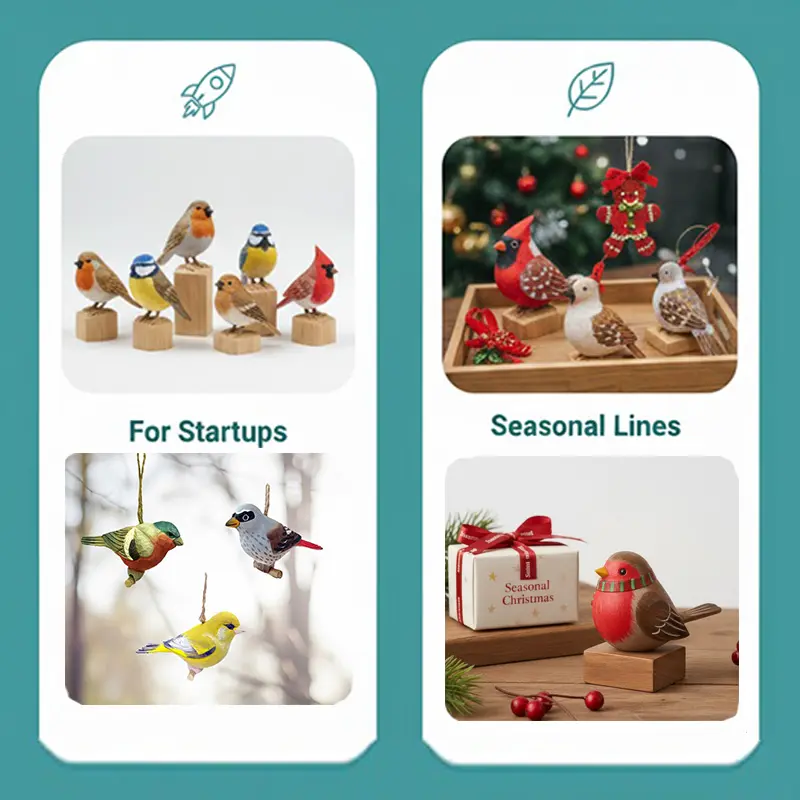
Why is a 300-piece MOQ a game-changer for niche gift shops?
A 300-unit minimum order quantity strikes the optimal balance between a manufacturer’s need for economies of scale and a boutique retailer’s need to minimize inventory risk.
Balancing Production Costs with Accessibility
A 300-piece threshold is the equilibrium point where production becomes efficient. It allows us to secure bulk pricing on raw materials like premium Basswood and run streamlined carving and hand-painting batches. This volume justifies the setup costs for a production run, significantly lowering the per-unit price compared to a smaller order. The resulting wholesale discount is accessible to boutique retailers who can’t commit to the 1,000+ unit orders demanded by larger factories. This structure makes a B2B partnership viable for both sides.
- Enables bulk purchasing of raw materials, which significantly reduces production expenses.
- Allows for streamlined fulfillment and efficient batch processing, maintaining healthy supplier margins.
- Makes wholesale partnerships viable for small businesses seeking quality products without overstocking.
Reducing Inventory Risk for Specialized Products
For a gift shop specializing in unique, artisanal goods, inventory is the biggest financial risk. A high MOQ forces a shop to tie up excessive capital in a single product line, leaving no room for variety or seasonal updates. Our 300-piece MOQ is large enough to secure a genuine wholesale discount but small enough to minimize financial exposure. Retailers can test new or localized songbird species with a modest investment, responding to market demand without the threat of unsellable dead stock. This flexibility is key to curating a diverse and profitable product catalog.
- Prevents retailers from tying up capital in excessive inventory.
- Allows shops to test new or seasonal products with minimal financial commitment.
- Helps retailers offer a wider variety of unique items without the pressure of a large stock.
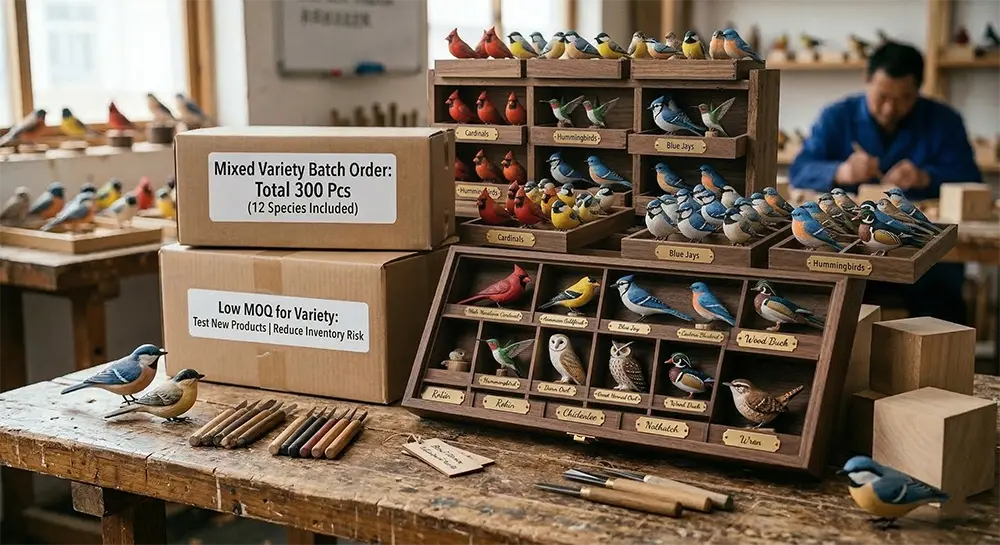
Can you mix different species within a single bulk order?
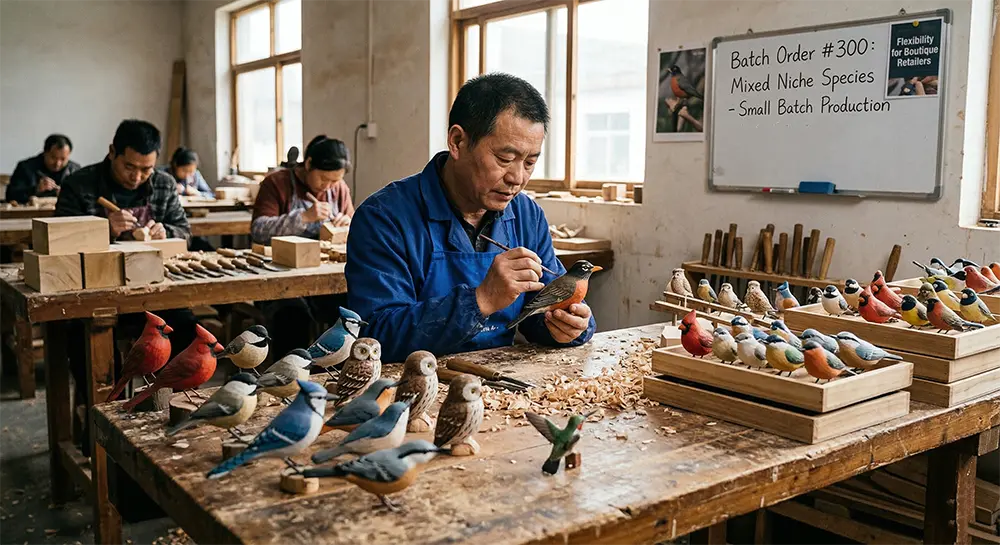
Yes, our production is built for high-mix, low-volume orders, allowing you to combine different hand-carved species and designs to meet the 300-piece minimum without compromising quality.
Flexibility in Product Assortment
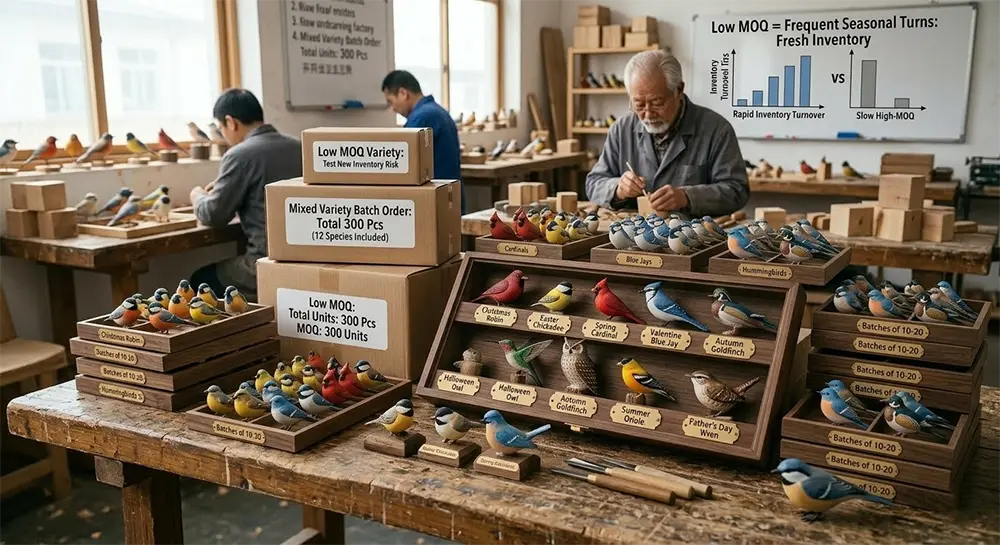
We structure our entire process to support mixing product designs within a single 300-piece wholesale order. This flexibility enables retailers to build a diverse inventory by combining various hand-carved bird species or other wooden items, rather than committing capital to a large volume of a single SKU. This high-mix, low-volume strategy is a practical way to test new products and discover what resonates with your customers before placing a larger, dedicated order.
- Combine multiple designs, such as different carved bird species, to reach the MOQ.
- This approach is ideal for testing new products without a large upfront investment.
- Retailers can offer a wider variety to customers, enhancing their store’s appeal and driving sales.
Maintaining Quality Across Mixed Batches
Managing product variety without sacrificing quality is a core part of our operational design. Our production lines are not rigid; they are built for adaptability, and our skilled artisans can switch between different carving and painting designs efficiently. This flexibility does not create a shortcut around our rigorous quality control. Each piece, whether it’s one of ten unique designs in a mixed order or one of 300 identical units, passes through the same multi-stage inspection. This system guarantees that every hand-carved item meets our standards for craftsmanship and material integrity, from initial wood selection to the final painted detail.
Source Unique, Proven Bestsellers Risk-Free.
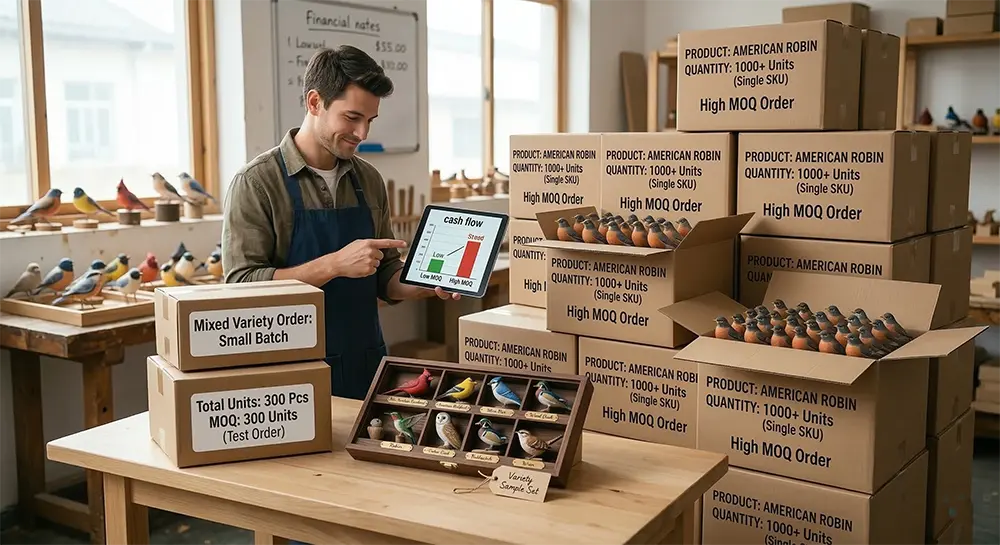
How does a low MOQ help you manage your cash flow better?
A low MOQ directly protects your working capital by reducing upfront inventory investment and minimizing the financial risk of unsold stock.
Lower Upfront Capital Investment
Ordering smaller batches with our 300-piece MOQ means you avoid tying up significant capital in a single product line. This is a practical strategy that frees up cash for other critical business areas instead of locking it into a massive inventory purchase.
- Test new designs without a major financial commitment.
- Allocate funds to marketing and operations instead of bulk inventory.
- Maintain financial agility, which is crucial for new or growing businesses.
| Financial Metric | Low MOQ Strategy (300 Units) | High MOQ Strategy (1,000+ Units) |
|---|---|---|
| Upfront Capital Investment | Lower, predictable investment. Preserves working capital for other needs. | High capital lock-up. Strains cash flow and limits operational spending. |
| Risk of Unsold Inventory | Minimal. Order closer to actual demand, reducing obsolescence. | Significant. Traps cash in slow-moving or underperforming stock. |
| Financial Flexibility | High. Funds can be reallocated to marketing or new product tests. | Low. Capital is tied to inventory, limiting operational agility. |
Reduced Risk from Unsold Inventory
High MOQs often force businesses to buy more inventory than they can confidently sell, trapping cash in products that might underperform. Our 300-unit threshold lets you order closer to actual demand, directly minimizing financial losses and preventing your capital from getting stuck in a warehouse.
- Minimize financial losses from products that underperform.
- Enable quicker inventory turnover, keeping your product offerings fresh and relevant.
- Avoid the long-term costs associated with storing and managing unsold items.
Is quality sacrificed when ordering smaller custom batches?
Contrary to common assumptions, smaller production runs enhance quality control. Tighter supervision and immediate feedback loops turn a low MOQ into a distinct manufacturing advantage.
Enhanced Oversight in Small-Batch Production
Quality isn’t just maintained in smaller runs; it’s amplified. Our process leverages the focused nature of small-batch manufacturing to provide closer supervision. With fewer units on the line at any given time, our master artisans can dedicate more detailed attention to each hand-carved piece. This direct oversight allows us to catch and correct any imperfections instantly, turning production into a dynamic, responsive process. It’s a key reason why many brands now view small-batch manufacturing as a competitive advantage for ensuring product excellence from day one.
- Closer supervision allows our teams to identify and correct imperfections immediately.
- Smaller batches enable faster design refinements and adjustments during production.
- This model aligns production with actual demand, reducing waste and ensuring every unit meets our quality standards.
Our Quality Framework: Consistent for Every Order Size
Our three-stage quality assurance framework is the operational backbone of our factory, and it is applied with the same rigor to every project. Whether an order is for 300 units or 10,000, your brand receives the same unwavering commitment to excellence. This consistency is non-negotiable and guarantees source-to-shelf integrity, regardless of your order volume.
- We source the same premium basswood for all production runs, large or small.
- Our multi-stage quality control checks are integrated throughout the entire manufacturing line for every batch.
- The same experienced artisans and R&D teams oversee both small and large-scale orders, guaranteeing consistent craftsmanship.
Can you scale from 300 to 10,000 units seamlessly with us?
Our production model is engineered for scalability, enabling a seamless transition from a 300-unit test order to a 10,000-unit production run while maintaining strict quality control and material consistency.
A Production Framework Built for Growth
Our operational model is designed for flexibility. It allows your brand to start with a manageable order of 300 units and expand to 10,000 or more as market demand increases. This structure supports gradual inventory buildup, helping you manage risk while scaling your business. Starting small allows you to validate market demand for new wooden songbird species or seasonal designs before committing significant capital to a large production run.
- We establish a strong supplier partnership from day one to facilitate smooth transitions between order volumes.
- Our system is built to handle increased capacity without creating production bottlenecks or extending lead times unnecessarily.
- This approach lets you test new products with a smaller initial investment before committing to larger production runs.
| Parameter | Trial Order (Start) | Wholesale Order (Scale) |
|---|---|---|
| Minimum Order | 100 pcs / USD $500 | 300 pcs / USD $3,000 |
| Product Access | In-Stock (Ready-to-Ship) Inventory | Full Catalog Access & OEM/ODM Services |
| Primary Shipping Method | Air Express (DDP) | Sea Freight |
| Lead Time | 15-20 Days | 60-90 Days |
Maintaining Quality and Consistency at Scale
Scaling production volume never involves compromising on quality. Our rigorous quality control protocols are embedded in the process, not just added at the end. These systems are applied consistently across all batch sizes, ensuring that the tenth-thousandth hand-carved bird is crafted to the same standard as the first. This bulk-ready precision guarantees that your brand’s reputation for quality grows along with your order size.
- We use the same master artisans and time-honored techniques for both small and large orders to guarantee product consistency.
- Our multi-stage inspections check for defects throughout the manufacturing process, from raw wood selection to final painting.
- We maintain direct relationships with sustainable forestry partners to ensure a steady supply of premium Basswood, even as order volumes grow.
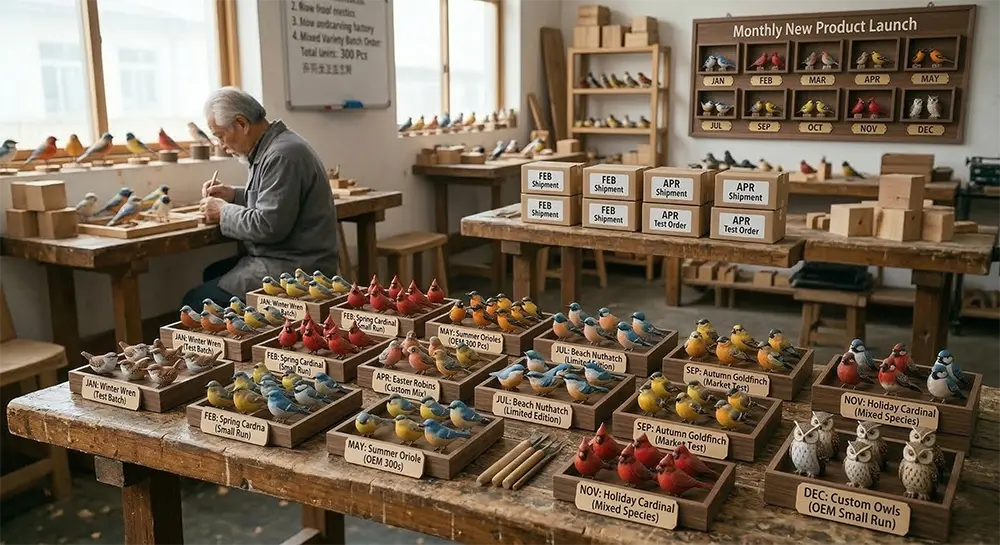
How do low MOQs allow for more frequent, seasonal inventory updates?
A low MOQ strategy allows retailers to align inventory directly with seasonal demand, turning potential obsolescence risk into a competitive advantage through agility.
Adapting to Seasonal Trends with Agility
Low minimum order quantities let you order smaller batches more frequently. This keeps your inventory fresh and precisely aligned with changing seasonal demand for products like Christmas or Easter-themed wooden songbirds. Instead of committing large amounts of capital to a single production run months in advance, you can react to real-time market signals. This approach prevents you from getting stuck with unsold, out-of-season stock once the sales window closes.
- Align inventory levels directly with real-time market needs instead of being locked into large production runs.
- Introduce new seasonal products quickly to test market response before committing to a larger order.
- Avoid the risk of obsolescence that comes from holding large quantities of products with short sales windows.
Reducing Risk and Improving Inventory Turnover
Ordering in smaller quantities directly protects your working capital. You can rotate products faster, turning stock into sales more efficiently and minimizing the financial burden of holding excess inventory. This lean approach is critical for seasonal items, where forecasting is notoriously difficult. A low MOQ model means you can pivot quickly if a particular design doesn’t sell as expected, freeing up cash for better-performing products.
- Free up cash that would otherwise be tied up in large, slow-moving seasonal stock.
- Increase the frequency of inventory turnover, a key indicator of business efficiency.
- Mitigate the financial risk associated with seasonal items that may not sell as well as projected.
Why do most other factories demand 1,000+ units for OEM?
High MOQs are a factory’s primary defense mechanism, designed to dilute substantial fixed costs—like tooling and setup—across a large production run to make each unit profitable.
The standard 1,000+ unit minimum order quantity (MOQ) isn’t an arbitrary number. It’s a calculated threshold rooted in the financial and operational realities of mass production. For most manufacturers, this volume is the minimum required to offset the significant upfront investment and achieve the economies of scale necessary for profitability.
Achieving Economies of Scale
Most factories structure their operations around large-scale efficiency. Every custom OEM order requires a unique production setup, which involves considerable fixed costs for machinery configuration, custom tooling, and dedicated labor. Spreading these initial expenses across a large run of 1,000 or more units dramatically lowers the cost per item. Without a high MOQ, the price to produce a single custom piece would be prohibitively expensive for both the factory and the client, as the setup costs would not be sufficiently diluted.
| Factor | Typical Factory Model (1,000+ MOQ) | Our B2B Model (300 MOQ) |
|---|---|---|
| Primary Goal | Maximize production efficiency and lower per-unit cost through sheer volume. | Enable market testing, protect client cash flow, and reduce inventory risk. |
| Fixed Costs (Tooling & Setup) | Spread across a massive run, making the order profitable for the factory. | Absorbed through optimized, flexible processes built for smaller batches. |
| Ideal Client | Large retailers and brands with established, high-volume demand. | Niche gift shops, e-commerce brands, and businesses needing inventory agility. |
Optimizing Material Procurement and Logistics
Factories secure better pricing from their own suppliers by purchasing raw materials like premium basswood and non-toxic paints in huge quantities. To make this model work, they need large client orders that consume these materials efficiently and justify the bulk buys. A high MOQ ensures that materials bought in large volumes are used effectively, preventing waste and storage costs. From a logistical standpoint, processing fewer, larger orders is far more efficient. It streamlines inventory management, simplifies shipping, and reduces the administrative overhead associated with managing many small, distinct orders.
Conclusion
Adopting a 300-unit MOQ allows you to introduce high-quality, artisan-carved products while protecting your cash flow. This approach minimizes risk, enabling you to test new species and seasonal collections without a large capital commitment. It provides the flexibility to refresh your inventory often and scale seamlessly when a product line succeeds.
Explore our full catalog to see which songbird species are right for your shop. When you are ready, contact our team to arrange a sample and experience our craftsmanship firsthand.
Frequently Asked Questions
Why is the MOQ set at 300 pieces?
A 300-piece Minimum Order Quantity (MOQ) creates an optimal balance, enabling us to achieve economies of scale and pass on volume discounts to our partners. This threshold lowers per-unit production costs through bulk material purchasing and streamlined fulfillment. For retailers, it’s a manageable quantity that secures better pricing while minimizing inventory risk on specialized items.
What are the typical lead times after an order is placed?
Our standard production lead time is approximately 4-6 weeks from the date of order confirmation. For orders that include custom branding or unique specifications, an additional 1-2 weeks may be required for design approval and specialized manufacturing. Shipping times will vary based on your location. A detailed delivery schedule will be provided with your final order quote.
What customization options are available for bulk orders?
We offer several customization options for bulk orders to align with your brand identity. These typically include custom logo application (printing or engraving), branded packaging solutions, and options for unique colorways or material finishes. For specific requests or to discuss creating custom product bundles, please contact our wholesale team directly to review the available possibilities.
While looking for specific styles, don’t forget to check our full catalog of [wholesale-wooden-songbirds] to see all available options.
As a comprehensive [Wooden Bird Factory], we also produce cardinals, owls, ducks and robins.