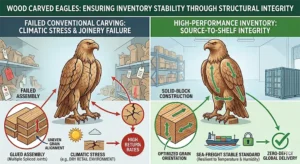
Shipping wooden coasters may look simple, but small dense items can easily crush packaging or exceed weight limits if not handled correctly. A set of four coasters can weigh over a pound, and even a 4×4×4 inch box might face edge stress when surrounded by lighter parcels. Without the right materials or packing method, these compact loads can shift, puncture, or arrive damaged—hurting both product margins and customer satisfaction.
This guide breaks down the key elements of shipping wooden coasters for Etsy and small e‑commerce sellers. It covers how to manage high‑density parcels around 10 lb per cubic foot, keep shipments under the 16 oz USPS First‑Class limit, choose between 4×4×4 boxes or mailers, apply the “burrito” wrapping method, and use eco‑friendly padding alternatives. Each section links design and carrier standards to help you pack efficiently and protect every order in transit.
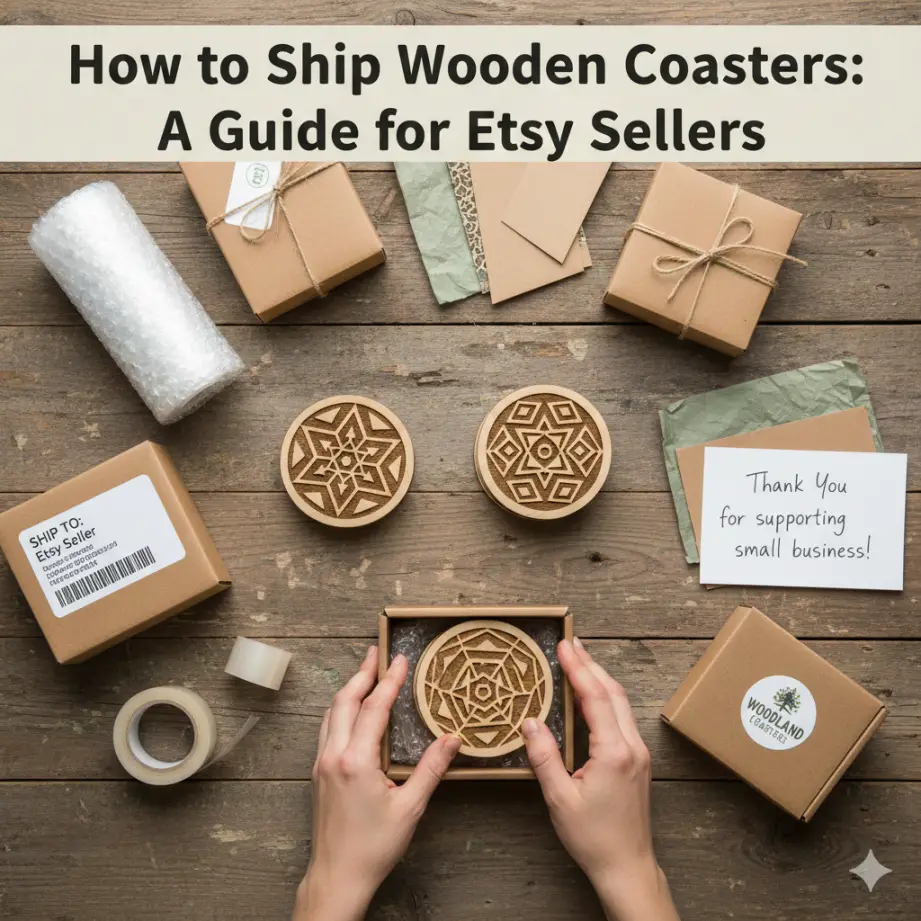
The Challenge of Shipping Heavy, Small Items
Small but heavy parcels often exceed the average density expected in parcel networks, creating concentrated pressure points that strain packaging strength and stability during transport.
Why Dense, Compact Items Are Hard to Ship
Parcel networks are built around an average load density of roughly 10 lb per cubic foot, but compact wooden products often surpass that. A bundle of solid wood coasters can exceed this benchmark easily, concentrating weight on a small footprint.
This high density channels stress onto limited box wall areas, making it easier for edges and corners to crush or puncture when surrounded by lighter parcels during sorting and shipping. Once the load concentration increases, package stability and stacking integrity drop sharply.
Packaging Limits and Handling Rules for Heavy Parcels
For items over 50 lb, Full Overlap Slotted Containers (FOL) are advised instead of standard RSC boxes. The FOL design resists wall breakout and better distributes load across the surfaces under high compressive force.
Major carriers have clear thresholds for what qualifies as heavy handling. FedEx and Canada Post identify parcels above 32–50 lb as requiring special labeling or manual handling. These indicators reduce injury risk for handlers while signaling denser loads in sorting systems.
Environmental and design factors add further constraints. Corrugated material loses nearly half its stacking strength at high humidity levels, while a misalignment of just half an inch between stacked parcels can cut that strength by around 30%. Such variability underscores the fragile margin of safety for dense wooden shipments.
Research Insights and Technical Context
Industry research shows that dense, small items produce localized compression that can distort or fail corrugated containers under vibration and moisture stress. The Institute of Packaging Professionals’ Guide to Packaging for Small Parcel Shipments finds that typical parcel systems assume an average density of about 10 lb/ft³. Compact items exceeding this benchmark behave as dense “point loads,” magnifying static and dynamic compression forces during transport.
Dynamic vibration around 6–12 Hz, typical of trucks and railcars, further worsens these stresses. This frequency coincides with natural resonance in boxes, causing flexing and edge loading that threatens structural integrity.
Carrier safety standards recognize these conditions. Canada Post requires an overweight sticker for anything above 22.7 kg (50 lb), while FedEx applies warning labels beyond 32 kg (70 lb). IoPP guidance aligns with this, recommending FOL boxes above the 50 lb level to prevent wall failures. With humidity cutting stacking performance by half and misalignment slicing another 30%, packing designs must anticipate real-world degradation, not ideal laboratory strength.
For small wooden coasters, these findings mean that even within normal parcel weight limits, packaging needs reinforcement against compression, puncture, and vibration. Treating them as structurally demanding loads helps prevent transit damage and keeps parcels stable under handling pressure.
Key Sources: Institute of Packaging Professionals (IoPP) – Guide to Packaging for Small Parcel Shipments; Canada Post – Overweight parcel labeling rules; FedEx – Heavyweight package handling and labeling standards.
The “Burrito” Method: Stacking and Wrapping
The burrito method involves rolling or wrapping stacked coasters tightly within an outer layer to enclose edges, distribute pressure evenly, and prevent chipping or abrasion during shipping.
| Parameter | Reference Value | Application to Coaster Packaging |
|---|---|---|
| Typical burrito roll diameter | 25–50 mm (from sewing applications) | Determines stable, compact wrapping diameter for evenly compressed stacks. |
| Seam/tape allowance | 10–16 mm (3/8–5/8 in) | Ensures clean enclosure zone and prevents bulky overlaps at the join. |
| Functional equivalence | “Enclosed seam method” / cocoon wrapping | Used to fully encapsulate all coaster edges against impacts and abrasion. |
Concept and Function of the Burrito Wrap
This approach adapts the sewing “enclosed seam method” to packaging wooden coasters. The main goal is to ensure all coaster edges are hidden inside a continuous protective layer so that corners and grain ends remain untouched by the outer environment. The wrapped form distributes pressure equally and functions like a flexible shell that absorbs external force.
A tight and even rolling process avoids bulges or gaps. Keeping the outer surface smooth minimizes internal shifting and abrasion between coasters. The method results in a compact cylindrical bundle with symmetric stress paths, ideal for shipments where vibration damping and impact spreading are needed.
Technical Guidelines and Application for Coaster Shipping
For stack stability, maintain a roll diameter of roughly 25–50 mm depending on coaster thickness and quantity. This size range ensures the layers can be pulled edge‑to‑edge without stress on the wrap. Use flexible wrapping films, paper, or thin foam sheets to conform around the stack tightly while keeping controlled compression.
Leave a seam or tape overlap of about 10–16 mm—close to the 3/8–5/8 inch standard seam from the sewing burrito method. This provides adequate spacing to make a secure seal without adding extra bulk. The goal is to maintain uniform density along the roll and prevent any noticeable step change at the bonded or taped section that might lead to stress concentration during handling or transport.
In sewing, professionals call this principle the “enclosed seam method,” which fully conceals fabric edges between layers. When transferred to packaging, the same geometry produces an encapsulated, cocoon‑like enclosure around wooden coasters. It guards every boundary against chipping and keeps mechanical shocks distributed uniformly across the outer shell.
References from sewing guides such as Friday Pattern Company, Seamwork, and Closet Core Patterns highlight exact diameter control and consistent seam allowance as the keys to smooth burrito wraps. By following matching metrics in packaging—tight rolling, balanced overlap, and smooth finishing—small wooden items can be secured efficiently without relying on bulky fillers.
Choosing the Right Box Size (4x4x4 vs. Mailers)
The 4x4x4 corrugated box suits delicate or stacked coaster sets needing cushioning, while thinner mailers work for single or low-profile coasters that stay under USPS flat or parcel thickness limits.
| Option | Intended Use | USPS Compliance & Material Notes |
|---|---|---|
| 4×4×4 Corrugated Box | Delicate or multiple coaster sets requiring padding and side clearance | Counts as parcel; meets 3×6×0.25 in minimum; ideal for cushioning and edge protection |
| Mailer (poly, kraft, rigid) | Single or thin coaster sets kept ≤ 0.75 in thick for flat-rate savings | Must meet film/paper specs (≥ 2 mil poly or 50 lb paper); treated as parcel if > 0.75 in thick |
Understanding the 4×4×4 Corrugated Box
The 4×4×4 inch cube, equal to 101.6 mm on each side, fits securely within USPS machinable parcel standards that start at 3 × 6 × 0.25 inches. This size is favored because it keeps the packed volume small while leaving room for padding such as bubble wrap, tissue, or kraft paper. For wooden coasters, that extra interior margin prevents edge chipping and distributes compression loads during transit.
Industry catalogs list the 4×4×4 model as a small shipping box for delicate goods. It stays far below the 108 in length+girth ceiling, so dimensional constraints are negligible even when stacking several coasters. The even cube geometry simplifies inventory shelving and carton sealing operations for small-scale sellers.
Mailer Options and USPS Compliance Thresholds
Mailers—rigid, poly, or kraft—offer savings for lightweight, low-profile coasters if packed thickness remains at or below 0.75 in. Staying under that limit allows them to qualify as flats, within the 12 × 15 × 0.75 in flat dimension window. Once thickness exceeds that threshold, USPS categorizes the package as a parcel, so the piece must meet the 3 × 6 × 0.25 in minimum just like a box.
Poly mailers must have film at least 2 mil thick for shipments up to 5 lb or 4 mil for 5–10 lb payloads, while paper mailers must use stock with a basis weight of 50 lb or greater to move reliably through automation. Common commercial mailer sizes—6×9 in, 7.5×10 in, 9×12 in, 10×13 in, and 12×15 in—cover most coaster shipments. Each piece must also meet the 0.007 in minimum thickness requirement to avoid machine jams.
For small sellers, the decision rests on the coasters’ packed thickness and fragility. Those shipping sets or engraved wood pieces typically benefit from a 4×4×4 box’s rigidity, while thinner, fully sealed coasters can move efficiently in poly or rigid mailers that meet USPS film and weight standards.
Elevate Your Brand with Custom Wooden Coasters in Bulk
Weight Classes: Staying Under 16oz for First Class
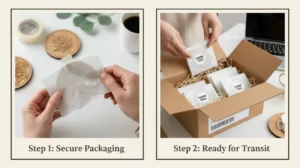
Staying under 16oz keeps your wooden coaster shipments eligible for USPS First-Class rates, offering faster delivery and lower costs. Any package weighing 16oz or more automatically moves to costlier Ground Advantage pricing tiers.
Understanding the 16oz Limit and Why It Matters
USPS First-Class Package Service applies to parcels weighing up to 15.999oz. This service provides 1–3 day delivery, includes tracking, and generally costs less than priority or ground options. The rate is designed for lightweight products, which makes it ideal for small handmade goods such as wooden coasters.
Once a package exceeds 16oz, it automatically shifts into USPS Ground Advantage pricing. That category is based on shipping zones and often results in higher costs. The difference can be several dollars per shipment, depending on the destination.
For small business sellers, keeping packaging light helps avoid higher fees while still benefiting from postal tracking and relatively fast delivery times. Lightweight shipments like wooden coasters can easily meet these limits by managing box and wrapping materials carefully.
Weighing, Measuring, and Packaging Strategies
Make sure the entire parcel—coasters, padding, and mailer—stays below 15.994oz. Postal systems round weights up, so leaving a safety margin prevents accidental reclassification into a higher rate tier. It’s best to test several packaging combinations before committing to a standard setup.
Acceptable dimensions for First-Class parcels start at 3×6×0.25 inches and go up to a total length and girth of 108 inches. Staying within these boundaries ensures the package qualifies for automatic processing and avoids non-machinable surcharges.
Choosing the right materials is key. Poly mailers or thin cardboard boxes keep weight down while still protecting the coasters. Adding only minimal fill material, such as crinkle paper or bubble wrap, balances protection and total weight.
For example, a 12oz parcel shipped to Zone 4 costs about $8.10. If that same package went slightly over 16oz, it would move into Ground Advantage pricing and cost more. Staying just below the threshold protects margins and supports lower retail shipping fees on platforms like Etsy.
Research Insights
According to USPS specifications, the First-Class Package Service limit is 15.999oz for domestic shipments. Crossing into 16oz or higher weight automatically triggers Ground Advantage, which covers parcels up to 70lbs. The First-Class category remains the most cost-effective for sub-1lb packages that still need tracking and 1–3 day delivery times.
A few related thresholds include 3.5oz for letters, 13oz for large envelopes, and up to 13oz for First-Class parcels under mail standards. International shipments under First-Class can go up to 4lbs, though domestic sellers gain the greatest savings by keeping weights under 16oz.
Even fractional differences matter. Postal systems round 15.995–15.999oz up to 16oz, which changes the class and cost instantly. That’s why many sellers aim for a 15.9oz maximum total weight. For handmade products like wooden coasters, this balance between protection and low weight supports better profit margins and competitive pricing on lightweight shipping tiers.
Using Branding Inserts in Your Shipment
Branding inserts are custom printed or designed inserts placed inside shipment boxes. They add protection, create a more memorable unboxing experience, and communicate key brand messages without adding much weight or cost.
Purpose and Design of Branding Inserts
Branded inserts enhance both presentation and practicality by acting as protective padding and a visual layer that reinforces a company’s identity inside the package. This balance between function and design ensures that every shipment reflects the same care placed into the product itself.
Common insert sizes include small message cards around 3×2 inches and larger branded labels at 4×3 or 4×6 inches to match standard box interiors. Maintaining these proportions helps inserts fit securely during transport while still giving enough space for brand visuals or short notes.
Short, handwritten or printed notes under 650 characters add a human touch, and are often used to share thank-you messages, care tips, or discount codes. This small personalization can greatly improve how customers perceive product authenticity and value.
Material selection matters because inserts should not raise shipping costs. Lightweight paperboard or kraft card provides sufficient rigidity and print quality without adding unnecessary mass. For brands shipping small goods, these materials maintain sustainability and smooth handling through standard courier systems.
Material Choices and Printing Techniques
Different materials support varied goals in branded insert manufacturing. Paperboard is ideal for lightweight products, corrugated cardboard offers impact cushioning for bulk or heavier goods, and foam inserts provide secure placement for delicate items such as glass or jewelry. Each option can be tailored to balance strength, recyclability, and cost.
Printing method selection depends on production scale and visual requirements. Digital printing works best for small batches requiring photo-quality color, flexographic suits large-volume runs on corrugated surfaces, and lithographic provides sharp precision for high-end labels or rigid cards.
Brand customization often includes embossing or debossing to create tactile effects, or die-cut edges and shapes that align with brand logos. These details not only attract attention but also improve the perceived craftsmanship of the product presentation.
All materials should meet EU and UK safety requirements using chemical-free coatings and recyclable fibers. Manufacturers normally verify compliance through ISO9001-certified quality systems to ensure inserts meet both environmental and performance standards in shipment environments.
Research Insights
Packaging inserts are designed to secure items tightly during movement and impacts. Corrugated options are often favored in e-commerce because they combine effective protection with recyclability, while foam variants deliver full-side support for fragile goods. Adopting standard dimensions simplifies logistics and keeps packaging lightweight.
Small businesses, like those shipping handmade or boutique items, benefit from using test prototypes to confirm fit and durability before scaling production. Lightweight paperboard or corrugated choices help maintain low costs while adding visual consistency across all shipments.
Responsible production also involves selecting safe materials, verifying recyclability, and avoiding designs that could resemble barcodes or contain personal identifiers. Manufacturers often offer double-sided printing for care details or return instructions, combining function with brand storytelling. This approach allows even small e-commerce sellers to deliver professional results without major increases in production costs.
Eco-Friendly Padding Alternatives
Eco-friendly padding options include paper-based and bio-based materials that offer protective cushioning, recyclability, and compostability without relying on petroleum foams.
Paper-Based Structures for Cushioning
Recyclable paper-based materials can deliver high mechanical strength and reliable protection for small, rigid goods like wooden coasters. Molded paper pulp and corrugated cardboard inserts use recycled fibers and can achieve compressive strength of about 300 kPa at densities of 30–100 kg/m³. They are formed with custom cavities to cradle products securely during transport.
Paper honeycomb cores, produced by manufacturers such as AXXOR, create a lightweight and strong structure that maintains rigidity under pressure while offering stackability and edge reinforcement. The honeycomb’s open cell geometry distributes load efficiently, reducing the need for thick petroleum foams and keeping all packaging materials within a single recyclable paper stream.
Bio-Based and Compostable Foam Options
Bio-based foams made from renewable materials are designed to mimic the cushioning and energy absorption of EPS or EPE while avoiding plastic waste. Mycelium foam is grown from fungal mycelium combined with agricultural waste, producing molded shapes that are fully compostable, lightweight, and durable enough for protective packaging. It breaks down naturally after use, leaving no microplastic residue.
Cruz Foam’s ASTM D6400‑certified bio‑foam decomposes about 99% faster than conventional EPS while maintaining comparable shock absorption and compressive properties. These foams offer an approachable path for small-scale shippers aiming to eliminate synthetic padding — they can be sourced as pre‑molded shells or padding components that fit directly into common e‑commerce packaging sizes.
Research Summary
Across packaging research, molded pulp, corrugated inserts, and paper honeycomb are consistently cited as technical equivalents to EPS/EPE for products requiring moderate impact protection. Tests show honeycomb cores delivering up to 300 kPa compressive strength within 30–100 kg/m³ density, more than adequate for parcel stacking, while remaining fully curbside‑recyclable. Corrugated trays and sleeves can be tuned through flute profiles to balance cushioning and stiffness, with multilayer configurations meeting higher drop‑resistance requirements.
On the bio‑foam side, mycelium and materials like Cruz Foam provide the same basic protective behavior but with complete biodegradability and compostability. These innovations allow home or industrial composting instead of landfill disposal. Similar fibrous options, such as flax or wool cords used in sustainable construction, show that natural fibers can replace synthetic foams for gap‑padding and insulation, achieving measurable thermal and mechanical performance.
Understanding Postal Zones and Costs
Postal zones are distance-based categories defined by the first three digits of ZIP Codes. They determine shipping costs in combination with package weight across carriers like USPS, UPS, and FedEx.
How Postal Zones Work
Postal zones represent defined distance tiers that carriers use to determine how far a package travels from its origin to its destination. The USPS assigns zones through a system known as the National Zone Charts Matrix, which compares the first three digits of the origin and destination ZIP Codes. This process results in an assigned zone number that typically ranges from 1 to 9.
Each zone corresponds to a band of miles between the origin and destination locations. Zone 1 is local, covering roughly 1–50 miles, while Zone 9 represents remote or territorial deliveries such as those to Alaska, Hawaii, or U.S. territories. The approximate distance bands used by shippers are: Zone 1: 1–50 miles, Zone 2: 51–150 miles, Zone 3: 151–300 miles, Zone 4: 301–600 miles, Zone 5: 601–1,000 miles, Zone 6: 1,001–1,400 miles, Zone 7: 1,401–1,800 miles, Zone 8: 1,801+ miles, and Zone 9 for territories.
The USPS National Zone Charts Matrix forms the foundation of their domestic rate charts. Every service that uses zone-based pricing—like Priority Mail or Parcel Select Ground—relies on these zone designations to determine the base rate. For shipping wooden coasters or other small goods, this means that the farther the delivery destination, the higher the assigned zone and corresponding postage cost.
How Zones Affect Shipping Cost
Shipping cost is primarily a function of distance and weight. USPS and commercial carriers like UPS and FedEx use formulas derived from official zone-rate tables. In general terms, a zoned shipment cost is calculated using a model such as: Shipping Cost = Zone Rate × Charged Weight + Surcharges. The charged weight is determined as the higher value between the actual scale weight and the dimensional weight (DIM), which reflects package volume. For carriers such as UPS and FedEx, the DIM weight divisor is currently 139, meaning bulkier packages are billed as heavier than their physical weight suggests.
USPS adds further adjustments when packages exceed standard dimensions—items longer than 22 inches or larger than 2 cubic feet trigger nonstandard or oversize fees. These surcharges compound the costs tied to higher zones, making size management and packaging efficiency essential for businesses that ship regularly.
In practical terms, a shipment from Zone 2 might cost substantially less than the same package sent to Zone 7 or 8. Longer distances not only increase cost but can also extend transit time. Businesses shipping items like wooden coasters can use USPS’s Domestic Zone Chart to identify exact 3-digit ZIP‑to‑zone relationships, allowing more accurate cost forecasting. Updates like the UPS realignment on June 2, 2025—which increased surcharges on high zones—illustrate how dynamic the zone-based rate landscape can be. Maintaining an updated zone reference in pricing tools helps shippers manage these factors efficiently.
Handling Returns and Broken Items
Handling returns and broken items involves strict timelines, documentation, and restocking policies. Responsibility for damage usually transfers to the buyer upon delivery, making inspection and proof of defect vital for successful claims or replacements.
Return Windows and Buyer Responsibilities
Buyers must file any claim for defects, shipping errors, or shortages in writing within thirty days of receiving their wooden coasters. The claim must be submitted before the items are used or altered. This written claim helps establish a record for return authorization and identifies the order involved.
Items are eligible for return only if they remain unused and in their original packaging as defined by the Return Window policy. Standard stocked parts returned within thirty days may incur a restocking fee ranging from fifteen to twenty-five percent, depending on inspection results and condition at receipt. For goods returned between thirty-one and one hundred eighty days, the fee can increase to fifty percent because of the extended time frame and potential reconditioning requirements.
Special order or non-stock items cannot be returned under any circumstance. No returns are accepted after one hundred eighty days from delivery. These restrictions align with industry practices to manage inventory stability and production scheduling. Buyers should always confirm item eligibility and request a return authorization number before shipping products back to the warehouse.
Final Thoughts
Shipping wooden coasters requires more than simply putting them in a box — it’s about managing density, cushioning, and carrier rules to keep every set protected from workshop to doorstep. A careful combination of dense load handling, proper box sizing, and lightweight materials helps sellers stay under cost thresholds and minimizes the risk of breakage during transit. Treating each shipment as a structured design problem leads to more consistent deliveries and fewer customer issues overall.
For Etsy sellers, mastering these details means lower shipping costs, stronger customer feedback, and a smoother fulfillment routine. Thoughtful choices — from burrito wrapping to eco‑friendly padding — align efficient logistics with sustainable branding. By following tested packaging standards and postal rules, each small shipment stays both professional and dependable, supporting the long‑term growth of a handmade business.
Frequently Asked Questions
Can I ship wooden coasters in a bubble mailer?
Yes, wooden coasters can be shipped in a padded or bubble mailer if each coaster is wrapped for protection and the mailer meets mailing size and weight rules. For example, bubble mailers thicker than three‑quarters of an inch or heavier than 2.5 oz are treated as packages instead of letters.
How much does a set of four coasters weigh?
A set of four wooden coasters usually weighs between 0.45 and 0.6 kilograms, or about 1 to 1.3 pounds, depending on the wood type such as pine, walnut, or acacia.
How can I prevent moisture damage during shipping?
Choose kiln‑dried wood with moisture below 15 percent, seal it with vapor barrier bags or shrink wrap, and include desiccants such as Container Dri II. Hanging desiccant bags in containers and placing absorbent blankets on the ceiling helps prevent condensation and ‘container rain.’
Where can I get boxes that fit coasters perfectly?
Ideal coaster boxes have inside measurements around 105 × 105 × 35 mm to 133 × 133 × 51 mm, fitting standard four‑inch coasters about 9.5 mm thick. Suppliers like My Chip Carving, The Box Man, and Clear Bags carry ready‑made box options.