Skip to content

A buyer in the UK learned this the hard way after opening a container of hand-painted songbirds packed by a generic bulk-pack supplier. Beaks snapped. Paint scratched where birds rubbed together in transit. He’d used a generic bulk-pack supplier for the carton. That single packing decision cost him write-offs and an awkward conversation with his retail buyers. He switched to our packaging system the next order. Breakage stopped being a recurring line item.
This guide covers how we pack wooden birds and crafts so they arrive shelf-ready: individual protection, custom retail boxes with your branding, eco-friendly materials, and the carton math that saves you money on freight. If you’re tired of opening cartons and wincing, read on.
Key Takeaways
- Individual protection is layered: kraft or silk-paper wrap, a 3-ply inner box or molded pulp cell, then a 5-ply master carton.
- Trial orders start at 100 pieces (minimum order amount USD 500); wholesale and custom runs start at 300 pieces / USD 3,000.
- Full-colour printed gift boxes start at 500 pieces per design; kraft box plus custom sticker carries no minimum.
- Air express lands in 20-30 days; sea freight runs 60-90 days to port, so artwork sign-off must precede production.
- Every crate and pallet is ISPM 15 heat-treated and IPPC-stamped, with the documents in the shipment.
- Master carton designs are drop-tested to the ISTA 1A protocol before we commit to production.
Table of Contents
- What Goes Around Each Piece
- Which Packaging Fits Which Order
- Papers That Travel With Your Carton
- Retail Shelf or Single-Unit Ship-From-Store?
- Why Bulk Pack Fails for Hand-Carved Wood
- Custom Retail Boxes: How Packaging Raises Your Selling Price
- Eco-Friendly Options (Without the Greenwashing)
- Carton Math: How We Save You Freight Costs
- Barcodes, Labels, and FBA-Ready Packing
- What About Drop Testing?
- Frequently Asked Questions
What Goes Around Each Piece
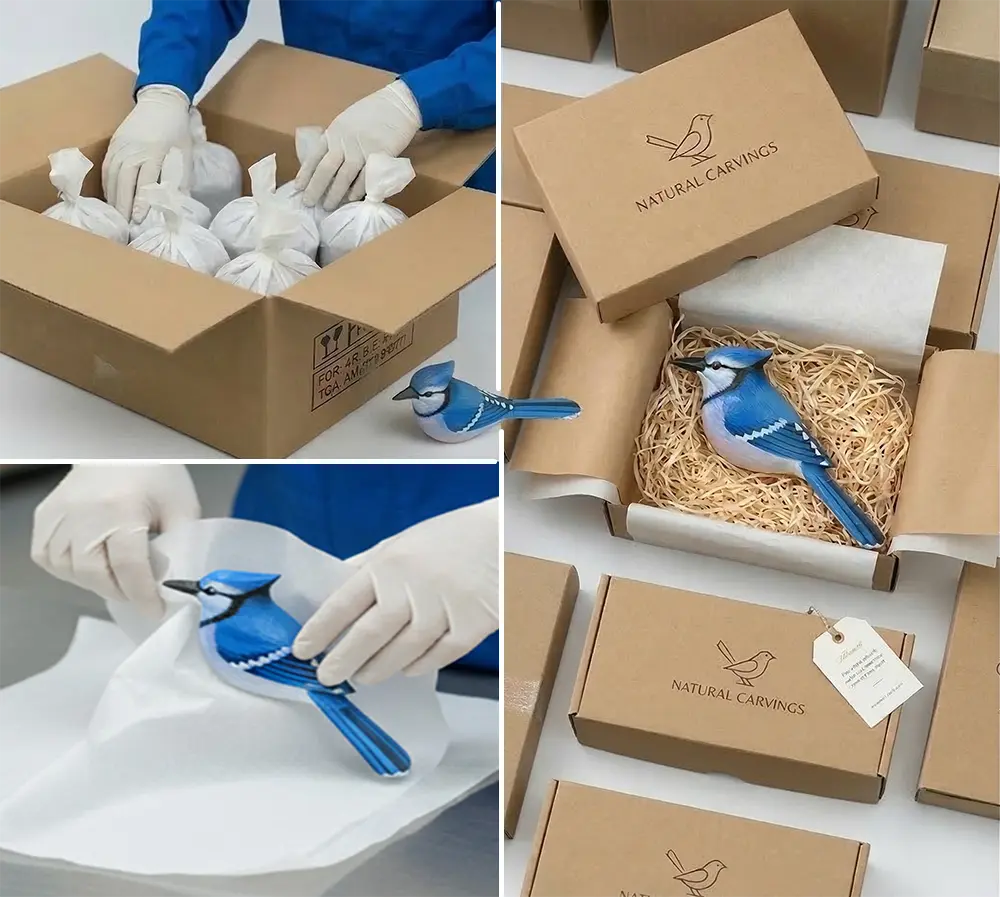
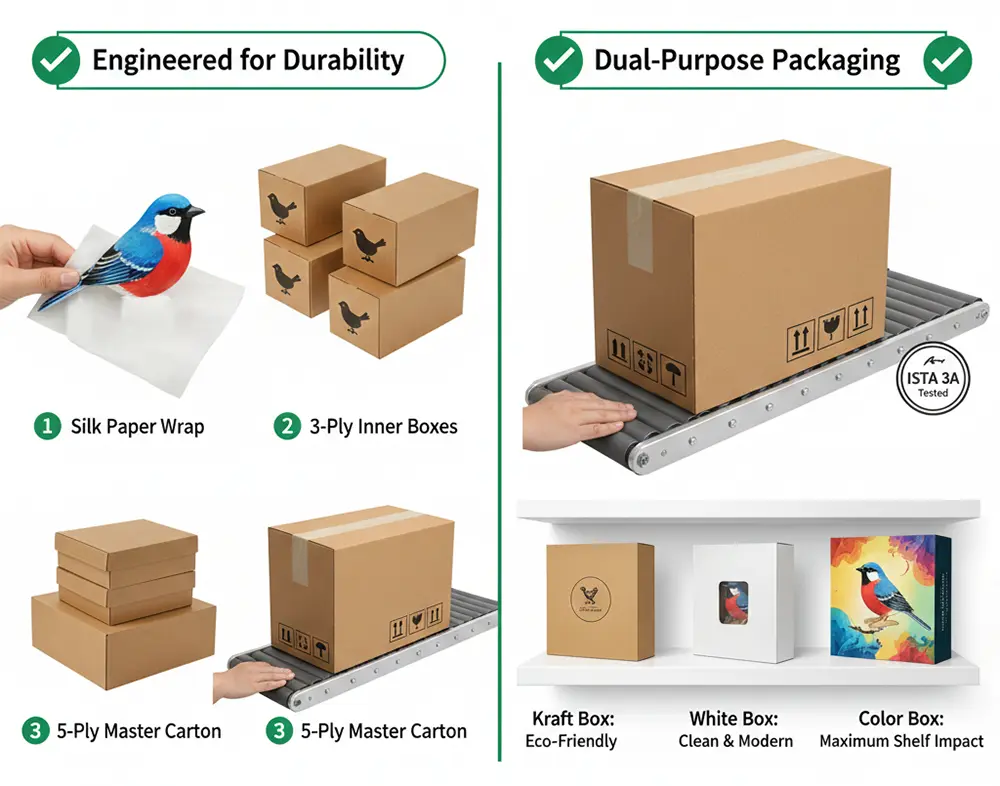
Protection is built in layers, and every layer has a job. The first wrap is unbleached, acid-free kraft or silk paper: it stops painted surfaces from touching anything else, which matters because two birds rubbed together in transit will scratch each other. The wrapped piece then sits in its own 3-ply inner box or a die-cut molded pulp cell, so no piece can shift or lean on a neighbour. Larger carvings get corner protection inside the master carton instead of a fitted cell.
Those inner boxes go into a reinforced 5-ply master carton, voids filled, strapped and labelled. That structure is why we can offer both retail-ready presentation and a carton your warehouse can stack: the selling unit is the inner box, the shipping unit is the master carton, and neither one is asked to do the other’s job.
Which Packaging Fits Which Order
Match the packaging to the order size, not to the brochure:
- Trial order (100 pieces, USD 500 minimum order amount): kraft inner boxes with a custom sticker label. No print minimum, so you can evaluate finishes and shelf look before committing artwork.
- Wholesale or custom production (300 pieces, USD 3,000 minimum order amount): printed inner boxes, window cutouts and story cards move into scope; full-colour printed gift boxes start at 500 pieces per design.
- Marketplace sellers: FNSKU labels printed on the inner box, suffocation-warning bag where needed, carton content list ready for the platform.
Timing belongs in the packaging conversation too. Air express on a trial kit is typically 20-30 days door to door; sea freight on a production order is 60-90 days to port, so print artwork has to be signed off before that window opens, not after. A box that arrives with the goods is packaging; a box that arrives six weeks later is a problem.
Papers That Travel With Your Carton
Every shipment carries the documents your broker will ask for: ISPM 15 heat-treated wood packaging with the IPPC stamp on each crate and pallet, a packing list showing carton count and gross and net weight per carton, and the compliance paperwork for the finishes used on your pieces. If a carton is opened at a port and the paperwork is missing, the packing was only half finished — so we treat the document set as part of the packaging line, not as an email after the fact.
The paperwork also protects the resale side. A gift shop that receives a carton with the SKU list, the material description and the finish documentation on paper can put the stock on the floor the same day, answer a customer question about the wood without guessing, and pass the same file on to its own buyer. Ask for the document set at quotation stage and we send you the blank versions first, so your import broker can confirm what your port actually requires before production starts.
Retail Shelf or Single-Unit Ship-From-Store?
Two selling patterns need two different packings, and it is worth deciding which one you are buying before the artwork is made. Shelf-ready means the inner box carries your branding and barcode, master cartons are packed by SKU, and your warehouse opens a carton and puts the stock straight out. Ship-from-store means the inner box has to survive one more handling step on its own: it gets a fuller wall, a tighter cell around the carved piece, and a mail-order outer that is not the display box.
Most clients end up doing both, so we quote them as one job: the same carving, the same insert tooling, two carton specifications. Tell us which SKUs sell from a shelf and which ship singly, and the packaging plan follows the channel instead of forcing your team to repack on arrival.
Why Bulk Pack Fails for Hand-Carved Wood
Two reasons, and both are expensive:
1. Customs risk (ISPM 15). If your supplier uses untreated wooden crates or pallets, customs can reject the entire shipment. International regulations require all wood packaging material to be heat-treated and stamped with an IPPC mark. Generic suppliers skip this. Your shipment gets fumigated or destroyed at port. We use only ISPM 15-compliant materials — every crate, every pallet, stamped and documented.
2. Physical damage. Tossing hand-carved birds into a big box with minimal separation is how you get broken beaks and scratched paint. Wing tips, tails, and hand-painted surfaces need individual protection. We wrap each piece in foam, seat it in a die-cut insert, and seal it in its own inner box. No bird touches another bird. Period.
Custom Retail Boxes: How Packaging Raises Your Selling Price
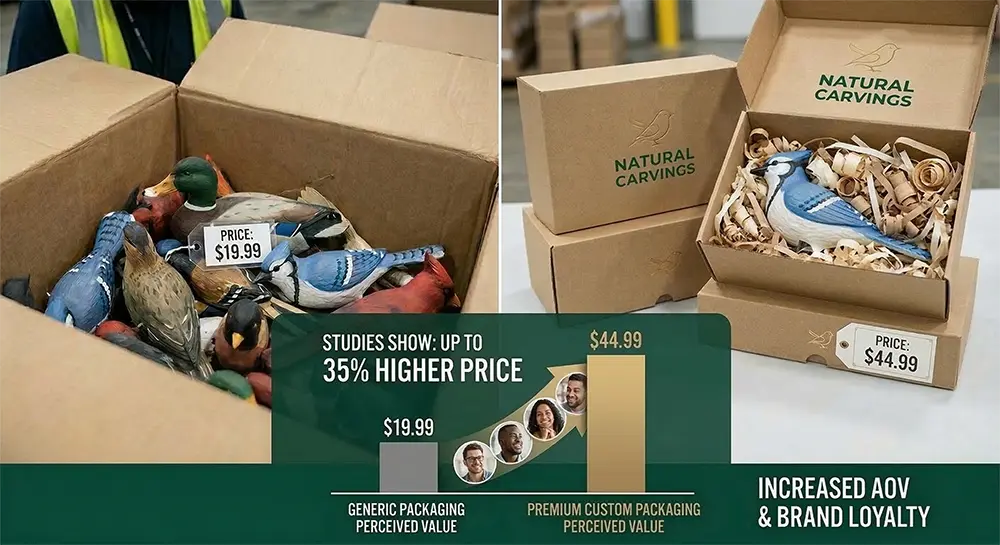
Retail buyers judge a hand-carved piece by how it presents. The same bird in a printed box with a window and a story card reads as a gift rather than a market-stall item, so it can carry a higher shelf price and a better margin for you. We have watched that shift happen with our own clients.
One of our Etsy sellers was shipping our hand-painted robins loose in a poly bag. We made her a kraft gift box with a window cutout, her logo, and a “hand-carved in Jilin, China” story card inside. She then re-listed the same bird at a higher retail price. Same bird. Same factory. Different box. Sales went UP because the unboxing felt like a gift.
What we offer:
- Custom inner boxes — 2-pack, 3-pack, or individual gift box with your logo and barcode printed
- Window cutouts — customer sees the product without opening (huge for gift shops)
- Story cards and inserts — “hand-carved,” “ethically sourced,” species info. Adds perceived value at negligible unit cost once the run is large
- Branded tissue and stickers — for smaller runs where a full printed box doesn’t hit MOQ
Eco-Friendly Options (Without the Greenwashing)
Some of our UK and German clients can’t use plastic foam anymore — their retail buyers won’t allow it. Fair enough. Here’s what we actually use:
- Molded pulp inserts — recycled cardboard, die-cut to hold each bird. Replaces foam entirely. Compostable.
- Kraft paper wrapping — unbleached, acid-free. Won’t transfer color onto painted surfaces.
- Bagasse containers — sugarcane fiber, fully biodegradable. Works for smaller items like keychains and ornaments.
The trade-off: molded pulp costs slightly more per unit than polyfoam inserts, and the gap narrows as the run grows. If your retail buyer requires plastic-free, quote both and compare on the landed number rather than the unit sticker.
Carton Math: How We Save You Freight Costs
UPS, FedEx, and every sea freight forwarder charges by dimensional weight — whichever is bigger, actual weight or volume weight. Ship air in an oversized box and you pay for that air. Here is the worked example we use when quoting (final carton sizes are confirmed per SKU before production):
| Parameter | Standard Carton | Our Optimized Carton |
|---|---|---|
| Actual Weight | 8.0 kg | 8.0 kg |
| Dimensions (cm) | 58 x 44 x 31 | 45 x 35 x 30 |
| DIM Weight | 15.86 kg | 9.45 kg |
| You’re billed for | 15.86 kg | 9.45 kg |
The billable weight falls because the carton now matches the product instead of the air around it. Same birds, same protection, smaller box — multiply that across a multi-carton order and freight becomes a real saving. We calculate optimal dimensions for every SKU before production — it’s built into our quoting process, not an afterthought.
Barcodes, Labels, and FBA-Ready Packing
Selling on Amazon? Tell us upfront. We’ll print your FNSKU barcode on each inner box, add the suffocation-warning poly bag, and pack to Amazon’s carton content requirements. You receive a shipment you can send straight to FBA without repackaging. For brick-and-mortar retailers, we print EAN/UPC labels and include shelf-ready price stickers if you want them.
What About Drop Testing?
Every master carton design we produce passes the ISTA 1A drop test protocol — 10 drops across corners, edges, and faces before we commit to production. If a design fails, we redesign the insert. You can read the full SOP on our ISTA packaging page. The short version: your birds survive the repeated corner, edge and face drops the protocol requires.
Frequently Asked Questions
What’s the MOQ for custom printed retail boxes?
500 units per box design for full-color printing (covers the plate cost). For smaller runs, we do kraft boxes with a custom sticker label — no minimum. Most first-time buyers start with stickers and upgrade to printed boxes on their second order once they know what sells.
Can you pack to Amazon FBA requirements?
Yes. We apply FNSKU barcodes, add suffocation-warning poly bags, and pack to Amazon’s carton content limits. Your shipment goes straight to FBA without repackaging. Just send us your FBA shipping plan and we’ll match it exactly.
Is plastic-free packaging really protective enough?
Yes. Molded pulp inserts hold each piece as securely as foam — we’ve drop-tested both to the same ISTA 1A standard. The pulp costs slightly more per unit but meets UK and German retail buyer requirements for plastic-free supply chains.
How much does custom packaging add to my unit cost?
It depends on the format. A kraft box with a custom sticker label is the cheapest route and carries no minimum; a full-color printed gift box with a window cutout costs more per unit and starts at 500 pieces per design. We quote the exact packaging adder with your sample order, because it moves with board grade, insert complexity and print run.
What happens if goods arrive damaged?
Photograph the carton exterior and the damaged pieces within 48 hours of delivery. Send us the photos. If the damage is due to our packaging failure (not carrier mishandling), we replace the pieces free on your next order or issue a credit. We would rather give you a written response than a damage statistic: photograph inside 48 hours and we replace or credit.