Skip to content

Retailers and wholesale buyers face increasing pressure from global mandates like the Corporate Sustainability Reporting Directive (CSRD), which makes environmental metrics as vital as financial audits. Brands now need materials that offer both visual appeal and supply chain tracking a buyer can actually audit. Moving beyond voluntary green initiatives is now a necessity for staying compliant and maintaining consumer trust in a competitive market.
We analyze why basswood (Tilia) works as a reliable choice for sustainable decor, balancing a lightweight profile of 26.0 lbs/ft³ with a 410 lbf Janka hardness rating for detailed carving. This guide covers what timber-legality paperwork can and cannot prove, the role of low-emission water-based paints in indoor air quality, and a practical comparison between natural timber and synthetic resin decor. By understanding these technical specifications, businesses can make informed decisions that support both circular economy goals and long-term product durability.
- Basswood (Tilia) carves cleanly at a light weight, takes paint evenly, and is the default species for detailed hand-carved songbirds and figurines.
- Drying and seasoning, not the species name, decide whether a carving stays stable through a showroom winter or a humid coastal summer.
- Timber legality is a document set: felling permits, transport permits and mill records per consignment. A facility certificate is not a product claim.
- We do not label our carvings as FSC-certified wood, because certified basswood is currently unavailable; the permit file is what we pass on instead.
- Coating safety is proved on the finished painted surface, with EN71-3 migration records where children handle the piece.
- Wood decor is repairable where resin decor is replaceable, which changes how a retailer prices damage and end-of-life stock.

The Shift to Sustainable Retail
Retailers are moving toward circular models and auditable supply chains, driven by disclosure rules and by buyers who ask for documentation rather than adjectives. Chain-of-custody timber is one sourcing model inside that shift, not a substitute for it.
Regulatory Mandates and Disclosure Standards
New legal frameworks force retailers to move beyond voluntary green initiatives toward standardized environmental disclosure. The Corporate Sustainability Reporting Directive (CSRD) requires brands to provide granular data on carbon emissions, energy consumption, and waste management. This mandate ensures accountability across the organization by making sustainability metrics as critical as financial reporting.
The Corporate Sustainability Due Diligence Directive (CSDDD) focuses on supply chain integrity. Companies must identify and mitigate human rights and environmental risks throughout their entire production network to avoid significant fines and reputational damage. Extended Producer Responsibility (EPR) laws add further complexity by requiring retailers to verify the recyclability and compostability of their packaging based on regional collection systems.
Circular Material Targets and Resource Efficiency
Operational strategies prioritize circularity and the measurable reduction of resource footprints. Many retailers set multi-year goals to raise the share of certified, reclaimed or lower-impact inputs in a product line while cutting emissions from fixtures and packaging.
Material selection for physical infrastructure also undergoes scrutiny. Specifying documented chain-of-custody timber for store fixtures is one way to evidence that the wood came from legally harvested, managed forests. Retailers implement AI-driven energy optimization and IoT systems for real-time resource monitoring to support these targets.
What is Basswood (Tilia)?
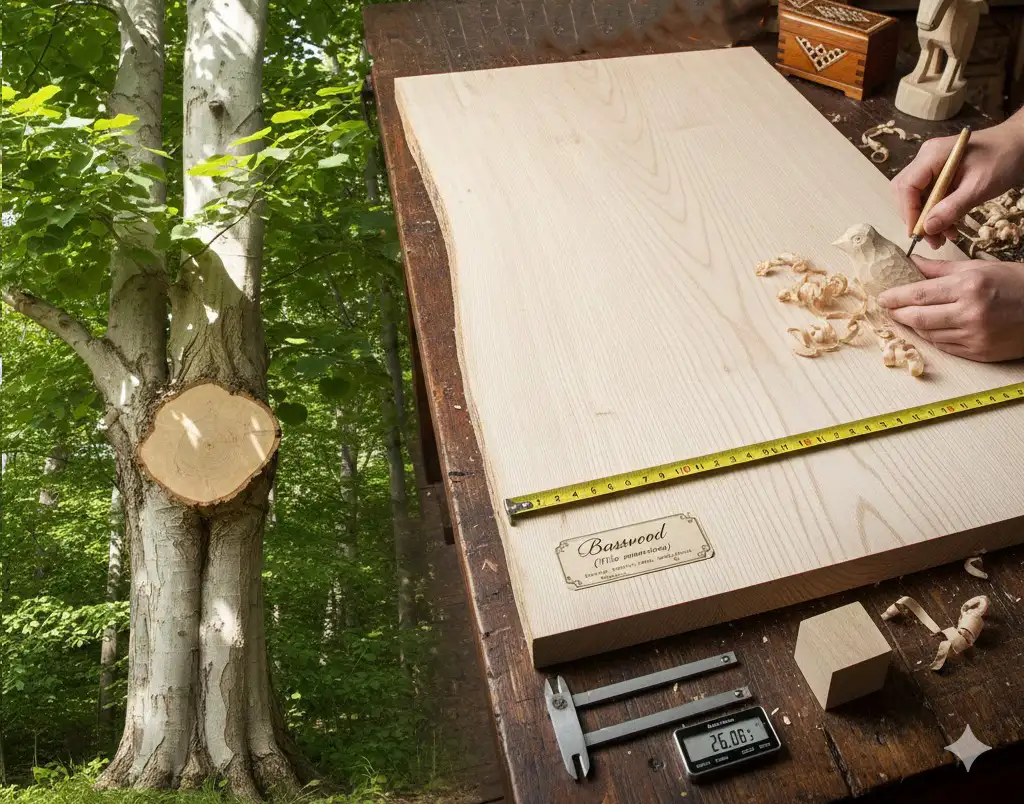
Basswood, derived from the Tilia genus, is a soft-textured hardwood prized for its lightweight profile and fine, straight grain. It typically grows to heights of 130 feet and offers a creamy, pale aesthetic. Its unique physical properties make it the primary choice for intricate hand-carvings and high-quality sustainable wooden decor.
Physical Characteristics and Botanical Identity
Tilia americana, commonly known as American basswood, linden, or lime wood, originates from eastern North American forests. Mature trees reach heights between 65 and 130 feet with trunk diameters measuring up to 4 feet in primeval environments. The wood features a creamy white sapwood that transitions into a pale brown heartwood with a fine, even texture. Straight grain patterns provide a moderate luster that enhances the appearance of finished handcrafted items without the need for heavy staining.
Technical Specifications and Material Performance
The material averages a dried weight of 26.0 lbs/ft³ (415 kg/m³), offering a lightweight profile that improves shipping efficiency for large-scale decor. A Janka hardness rating of 410 lbf (1,820 N) keeps it soft enough for intricate manual carving while maintaining sufficient durability for indoor applications. Mechanical properties include a modulus of rupture of 8,700 lbf/in² and an elastic modulus of 1,460,000 lbf/in². Radial and tangential shrinkage are moderate for a wood of this density, which is why seasoning, not species alone, decides dimensional stability.
Timber Legality And Sourcing Paperwork
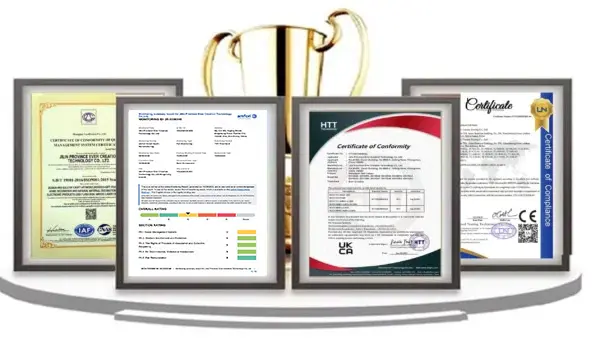
Chain-of-custody schemes exist to prove that timber was harvested legally and tracked through purchase, production and sale. Our own position is narrower than the scheme: because certified basswood is currently unavailable, we do not sell or label our carvings as FSC-certified wood, and we rely on official felling and transport permits per consignment instead.
| Document | What It Proves | Who Issues It |
|---|---|---|
| Timber felling permit | The log was harvested under a legal allotment | Regional forestry authority |
| Timber transport permit | Movement from forest to mill was authorised | Regional forestry authority |
| Purchase and mill records | The buyer of the roundwood matches the seller of the lumber | Supplier and factory files |
| Scheme certificate (facility) | The audited site operates under a certification system | Certification body, not the product |
Chain of Custody and Material Traceability
A credible traceability file follows the material rather than the marketing. It starts with verification of the upstream seller, keeps certified and uncertified stock physically separated where a scheme requires it, and records what was bought, what entered production and what was sold, so the volume of claimed output can never exceed the volume of claimed input.
Buyers should expect that file to survive a spot check. Audit bodies test internal controls, not intentions; a factory that cannot show purchase, usage and wastage records should not sign a legality declaration. Our own wood-selection notes are published at wood materials, and the procurement walkthrough sits in the guide for procurement of wooden crafts.
Compliance Modules and Labeling Standards
Regulation has pushed this paperwork from voluntary to expected. Importers placing wood products on the EU market face due-diligence duties that require geolocation of harvest, risk assessment and documentation of legality, a framework summarised by the European Commission forestry and deforestation pages, with global context maintained by the Food and Agriculture Organization forestry programme.
On-product wording is the second trap. A scheme claim must match the material actually used, and a factory that cannot prove it should print nothing. Compare the claim class a supplier states for your order against the documents delivered with it; where the two disagree, the documents are the safer basis for your compliance statement.
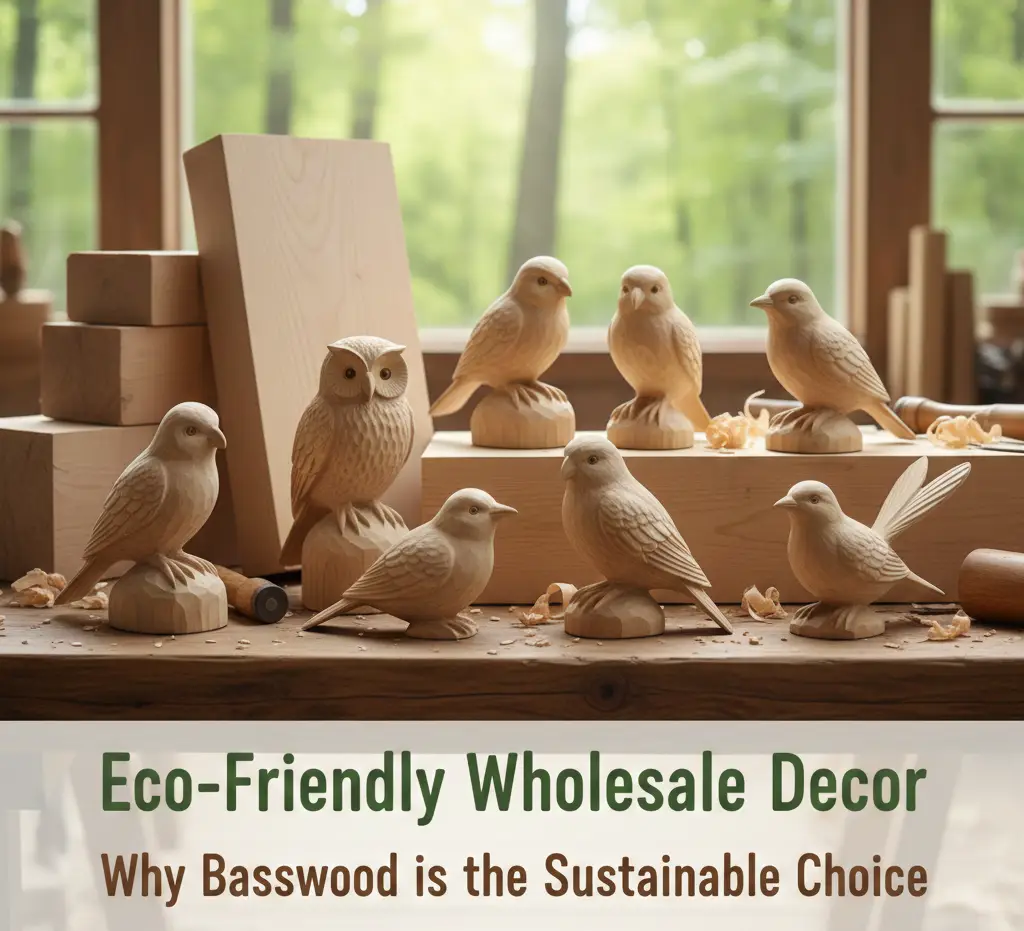
Premium Hand-Carved Wooden Birds for Your Wholesale Needs
Non-Toxic Paints & Finishes
Non-toxic paints for carved decor are defined by what they leave out: no added lead, mercury or phthalate plasticisers, low emission solvents, and a coating system that can be tested against a migration limit rather than described in a brochure.
Zero VOC Limits and Chemical Safety Requirements
Water-based paint systems are the working standard for indoor wooden decor, because they carry far less solvent load than solvent-based equivalents and clean up without thinners. Formulations for hand-painted carvings exclude the restricted metal-organic driers and phthalate plasticisers that older coating families relied on, and pigment pastes are batch-matched so a re-order paints to the same colour.
What a buyer should request is the test record, not the brand name: a migration report on the finished, painted surface, and a declaration from the paint supplier covering the restricted substances relevant to the destination market. Where a piece is handled by children, EN71-3 migration limits are the reference file, and they apply to the coating after it has cured on the wood, not to the paint tin.
Technical Performance and Compliance Standards
Durability is a separate test from safety. On a soft, fine-grained substrate such as basswood, a decorative finish has to resist handling abrasion, avoid blocking between tissue-wrapped pieces in the inner box, and hold colour through ocean transit. Adhesion and wear are therefore checked on painted samples from the production run, not assumed from the coating datasheet.

Durability: Wood vs. Resin
Resin decor trades upkeep for replaceability: it shrugs off moisture and needs almost no maintenance, but a cracked or faded resin piece is usually discarded. Wood trades upkeep for repairability, since a carved piece can be sanded, resealed and repainted instead of thrown away.
| Performance Factor | Resin (HDPE/Polypropylene) | Natural Wood (Treated/Cedar) |
|---|---|---|
| Expected Lifespan | Low intervention, then replacement | Long service life with periodic refinishing |
| Maintenance Needs | Low (Occasional washing) | High (Sealing/Staining every 2-3 years) |
| Primary Vulnerability | Extreme cold (brittleness) | Moisture, rot, and pests |
Material Resilience and Environmental Tolerance
Resin formulations using HDPE or polypropylene naturally resist mold, rust, and pest infestations without chemical treatments. In contrast, untreated wood remains susceptible to moisture absorption, which leads to warping and rot in humid or coastal climates. Pressure-treated wood provides a barrier against decay but maintains a higher risk of insect damage compared to synthetic alternatives.
Lifecycle Maintenance and Technical Constraints
Wood rewards a light upkeep cycle: dust, keep it out of sustained direct sun, and reseal a piece that stands in a humid room. Resin is a lower-intervention material that needs only washing, but it can stiffen and crack in severe cold, and standard resin carries no inherent fire behaviour, whereas some treated timbers do.

Marketing “Green” to Consumers
Environmental marketing is tightening from adjectives into evidence. Retail buyers now ask which document supports which sentence, and a claim that cannot be traced to a test report, a permit or an audited system is a liability rather than a label.
Third-Party Validation and Ethical Sourcing Standards
Credibility comes from independent records that survive a customer query. For wood, that means sourcing documents tied to the consignment you bought, not a certificate hanging in a lobby. For coatings and finishes, it means test reports against a recognised limit on the finished article, and for social claims, audit reports naming the site where the work happened. Ask for the artefact that matches each sentence on the shelf talker; the gap between what retailers claim and what suppliers can produce is where retail compliance conversations stall.
Quantifiable Metrics for Emissions and Lifecycle Impact
Indoor-air performance is the part buyers most often guess at. Emission behaviour depends on the coating system, how long it has cured, and how the piece is packed while still off-gassing slightly, so a factory conversation is more useful than a generic label: which paint system, what cure window before boxing, and what test file exists for the finished, painted surface. Our notes on non-toxic paint and EN71 cover how those records are assembled for carved decor.
Our Commitment to Nature
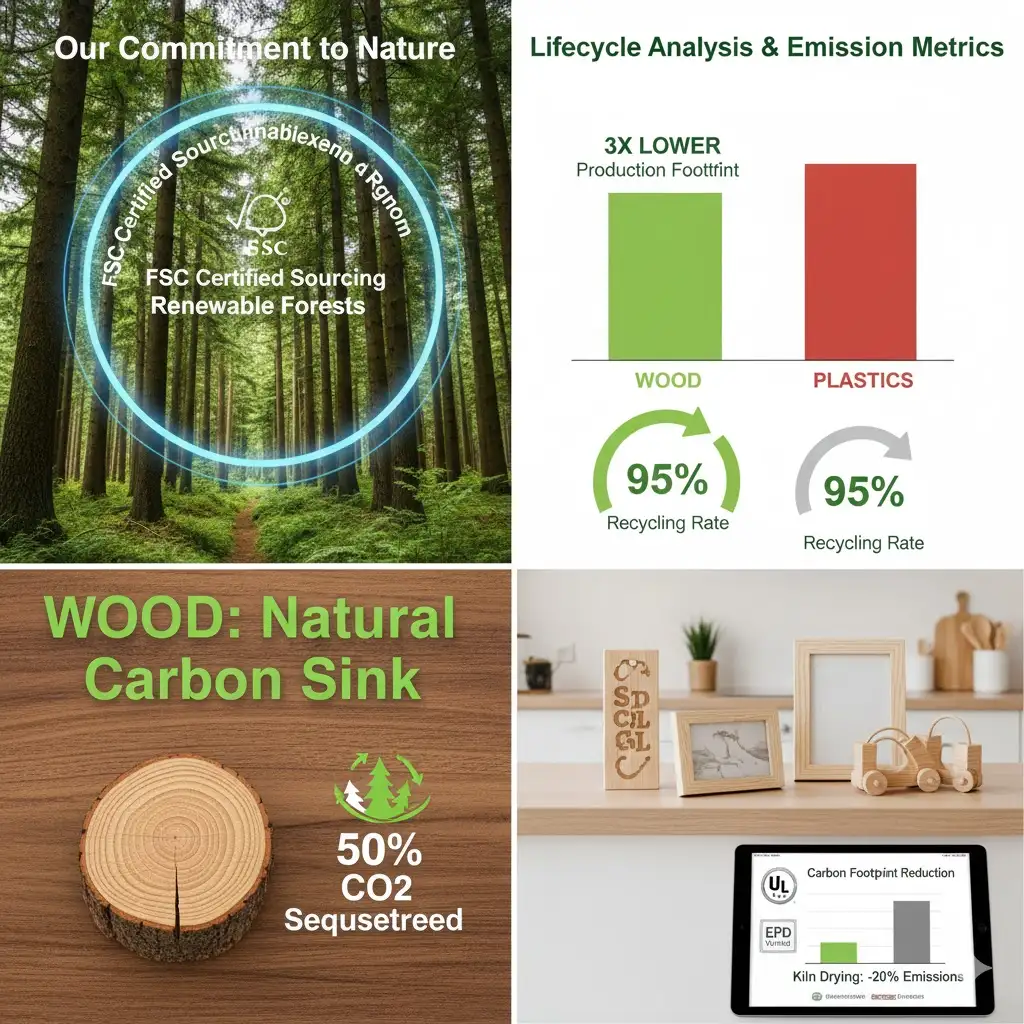
Wood stores carbon while it stands and keeps storing it after it is carved, which is the honest environmental argument for timber decor. It is a renewable material only when harvesting is documented, and that documentation is the part a retailer can actually verify.
Renewable Sourcing and Carbon Sequestration
Basswood used for our carvings comes from managed stands in the Changbai Mountain region, where the species regenerates reliably under regular cutting cycles. Carbon stays locked in the wood for the life of the product, and a solid carving displaces a moulded plastic one on the same shelf. What we do not do is transfer a forest certificate onto the piece itself: certified basswood is currently unavailable, so the paperwork we pass to customers is the felling and transport permit set for the delivery, not a label claim.
Lifecycle Analysis and Emission Metrics
Kiln drying is the stage where most of the difference is made. Properly seasoned lumber moves less in service, so fewer pieces are rejected after packing, and offcuts from the carving stage are collected for chipping or fuel rather than sent to landfill. Buyers who want environmental product data should ask for the factory waste record and the drying method, which are measurable, instead of a footprint figure that no one can trace to a batch.
Final Thoughts
Choosing basswood helps retailers meet strict environmental targets while providing high-quality, handcrafted decor. This material stores carbon naturally and grows as a renewable resource, offering a functional alternative to synthetic resins. Brands that switch to these sustainable options align with upcoming regulatory changes and fulfill the growing demand for supply chain transparency.
Long-term growth in this category rests on paperwork a retailer can reprint and on pieces that survive a season on the shelf. Documented timber legality, water-based coatings with a test file, and cartons built for ocean transit are the three practical proofs behind a sustainability sentence; without them the sentence is decoration.
Frequently Asked Questions
Is basswood a sustainable choice for large-scale manufacturing?
Basswood grows back reliably under managed cutting cycles, and a solid carving stores carbon for as long as it is kept. It is a renewable option rather than a certified-green one: the environmental value depends on documented harvesting and reasonable drying, not on the species name alone.
Do you supply FSC-certified wood products?
No, and we do not sell our carvings as FSC-certified wood. Certified basswood is currently unavailable, so the certificate held at facility level cannot be transferred onto the product. What we supply instead is the legality paperwork for the wood we actually buy, meaning official felling and transport permits per consignment, alongside our ISO 9001, BSCI and EN71 audit records.
Are the paints and finishes lead-free and safe for home use?
We paint with eco-friendly, non-toxic water-based systems and keep the migration test file for the finished painted surface on request. Where a line is handled by children, EN71-3 migration limits are the relevant reference, and we quote from the report rather than from a paint brochure.
How do you manage industrial wood waste during production?
Offcuts from carving and blank preparation are collected at the bench and sent for chipping or use as fuel biomass rather than landfill, and drying schedules are set to cut rejects after packing. Waste volumes are logged by production stage, and a buyer can ask for that record.
Is the packaging built for export transit and retail display?
Each piece is tissue-wrapped, packed 6 to 12 into a three-ply BC flute inner box, then 240 to 480 into a five-ply outer carton sized for ocean transit. Custom colour or gift boxes start at 500 pieces, and printed labels and shipping marks are produced at the factory.