Skip to content
If you’re buying wholesale wooden bird carvings through a trading company, you’re likely paying a 5% to 20% hidden markup. That’s money coming right out of your net profit.
For overseas dealers and wholesalers, cutting out the middleman is the fastest way to lower your cost of goods sold (COGS). But it’s not just about the price tag—buying direct from a source factory means you finally get 100% control over the quality, the materials, and the packaging.
We are Jilin Ever Creation (Ewoodarts). We offer you direct access to an ISO 9001:2015 certified manufacturing line. Here is a straight-talking guide on how to source hand-carved wooden birds, avoid common traps, and secure quality from our workshop to your retail shelves.
Trading Company vs. Source Factory: How to Spot the Difference
Many suppliers claim to be factories, but they are actually trading companies sitting in an office. If you want serious quality control and lower costs, you need a real factory.
Here is how you can quickly spot the difference:
- Look at their catalog: Does the supplier sell wooden birds, plastic toys, and electronic gadgets all at once? That’s a trading company. A true source factory specializes in one deep category.
- Ask for a specific custom change: If you ask to change the beak shape or painting style and they say “let me check with my engineer” and take three days to reply, they don’t own the production line.
- Request a live video call: A real factory will happily jump on a WhatsApp or Zoom call to show you their production floor, raw materials, and workers in action.
As a reliable global B2B supplier and source factory, we only manufacture for dealers, retailers, and wholesalers. We never sell directly to retail consumers, which means we will never be your competitor.

3 Quality Checkpoints for Sourcing Wooden Bird Carvings
As a buyer, what should you look for when inspecting wooden crafts? Here is the factory standard we use:
1. The Right Timber (Preventing Cracks)
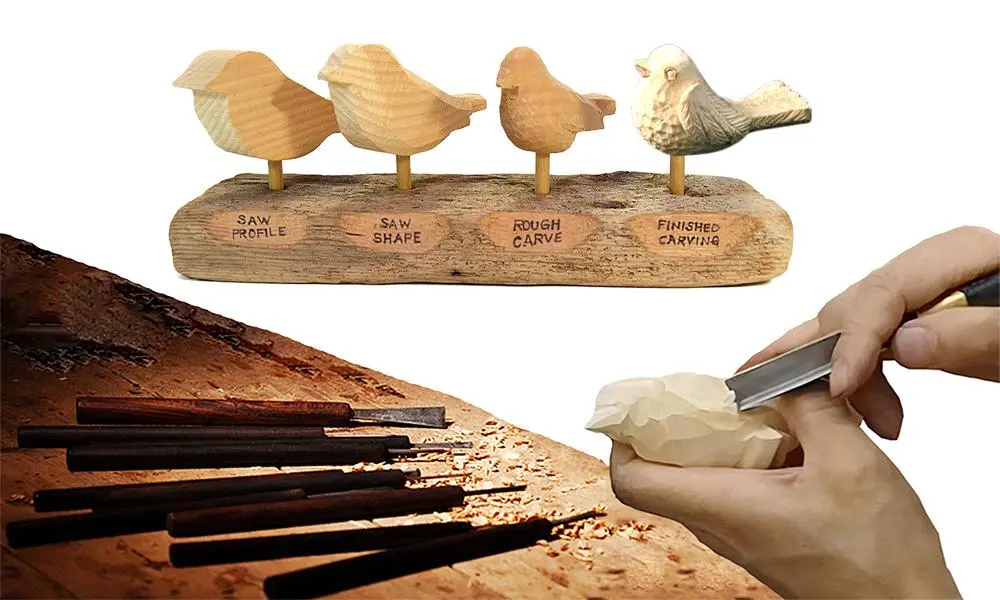
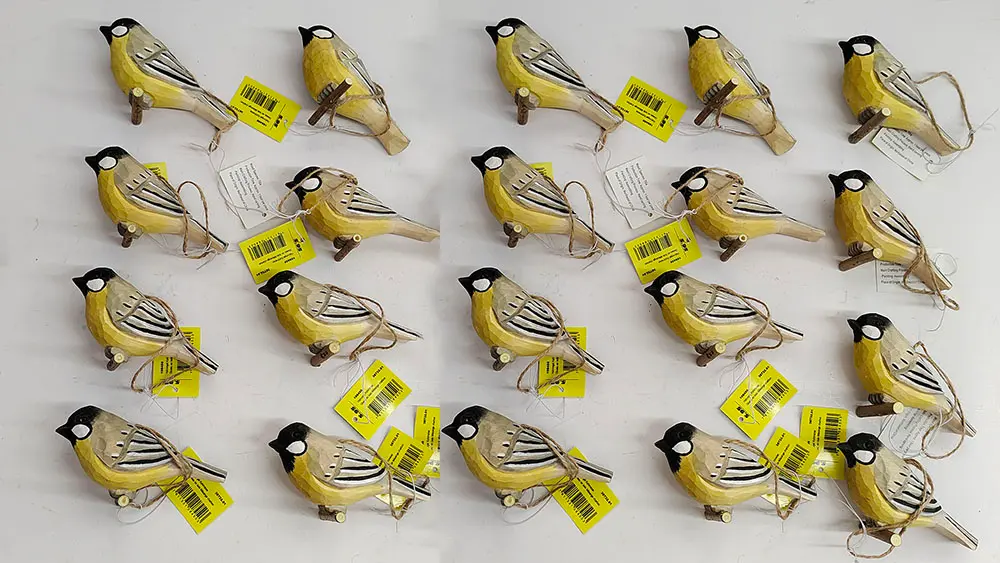
Not all wood is created equal. We insist on using Basswood from the Changbai Mountains in Northeast China. Because of the cold climate, the trees here grow slowly. This results in a dense, fine-grained timber that holds incredibly sharp carving details. More importantly, we strictly control the moisture content before carving to ensure your birds won’t crack when shipped to drier climates.
2. Safe & Compliant Painting
For markets in the EU, UK, and North America, compliance is everything. The paint used on the birds must be water-based, non-toxic, and strictly comply with safety standards like CE, RoHS, UKCA, and EN71. If a supplier can’t provide these certificates, your shipment might get stuck at customs.
3. The “Satin-Smooth” Sanding Finish
The difference between a cheap craft and a premium retail product is the sanding. Every bird we produce goes through multiple rounds of manual sanding before any paint is applied. This creates a satin-smooth finish that feels premium in your customer’s hands.
Real Transparency: Virtual Audits & Certifications
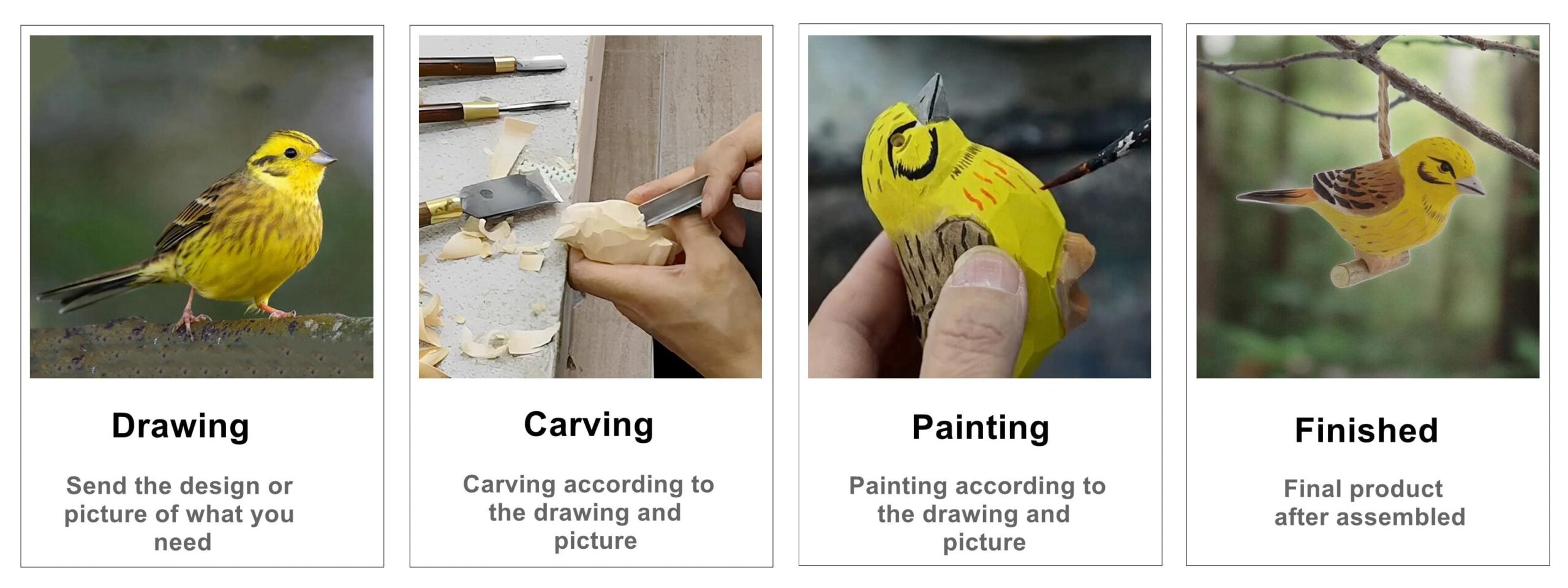
We know that trusting a supplier halfway across the world is hard. Here is how we prove our reliability before you spend a dime on flights:
- Remote Video Audits: We regularly conduct live virtual tours. You can see our raw material warehouse, carving stations, and quality control lines directly from your office.
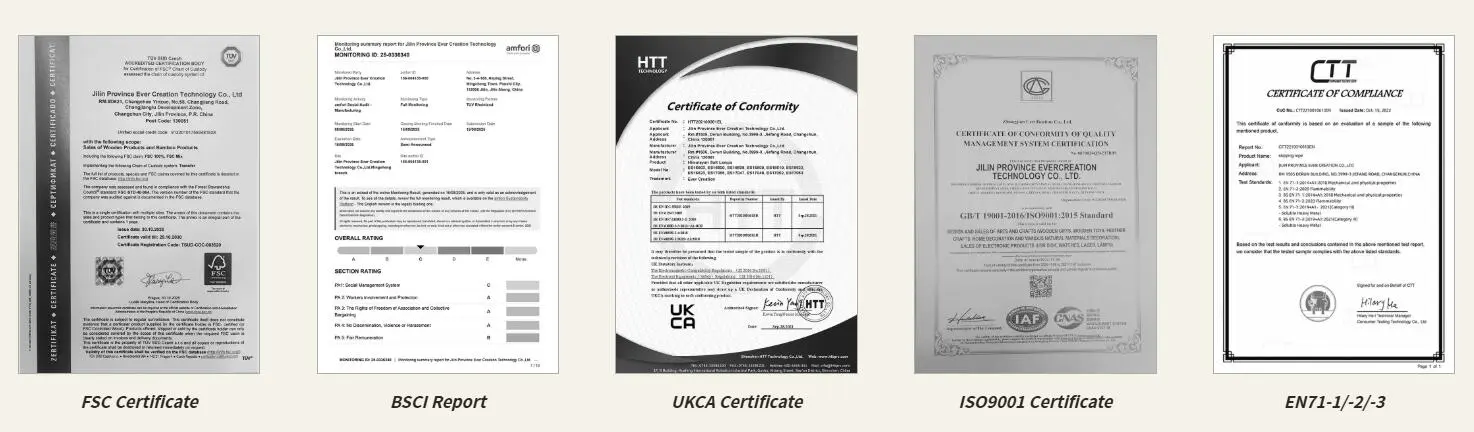
- Active Certifications: We don’t just talk about quality; we have the paperwork. Our factory is audited for BSCI (ensuring ethical working conditions). Regarding timber compliance, we provide official harvesting and quarantine certificates to support your documentation needs
- Clear English Support: No “lost in translation” headaches. Our English-speaking account managers reply within 3 to 7 hours, ensuring your custom OEM/ODM specs are executed perfectly.
How We Handle Wholesale Orders (MOQ & Terms)
We like to keep business straightforward and transparent. Here is what you can expect when partnering with us:
- MOQ (Minimum Order Quantity): Our standard MOQ is 300 pcs per design. This allows us to set up the production line efficiently and keep your unit costs low.
- Lead Time: Depending on the order volume and customization level, our standard production lead time is 45 to 90 days.
- Payment Terms (30/70): You pay a 30% deposit to secure raw materials. The 70% balance is only due before shipment.
- Pre-shipment Verification: Before you pay the final balance, we will send you high-resolution photos and videos of your actual finished and packed goods. You can also arrange third-party inspections (like SGS or BV). We make sure you get exactly what you ordered.
Packaging That Survives Global Shipping
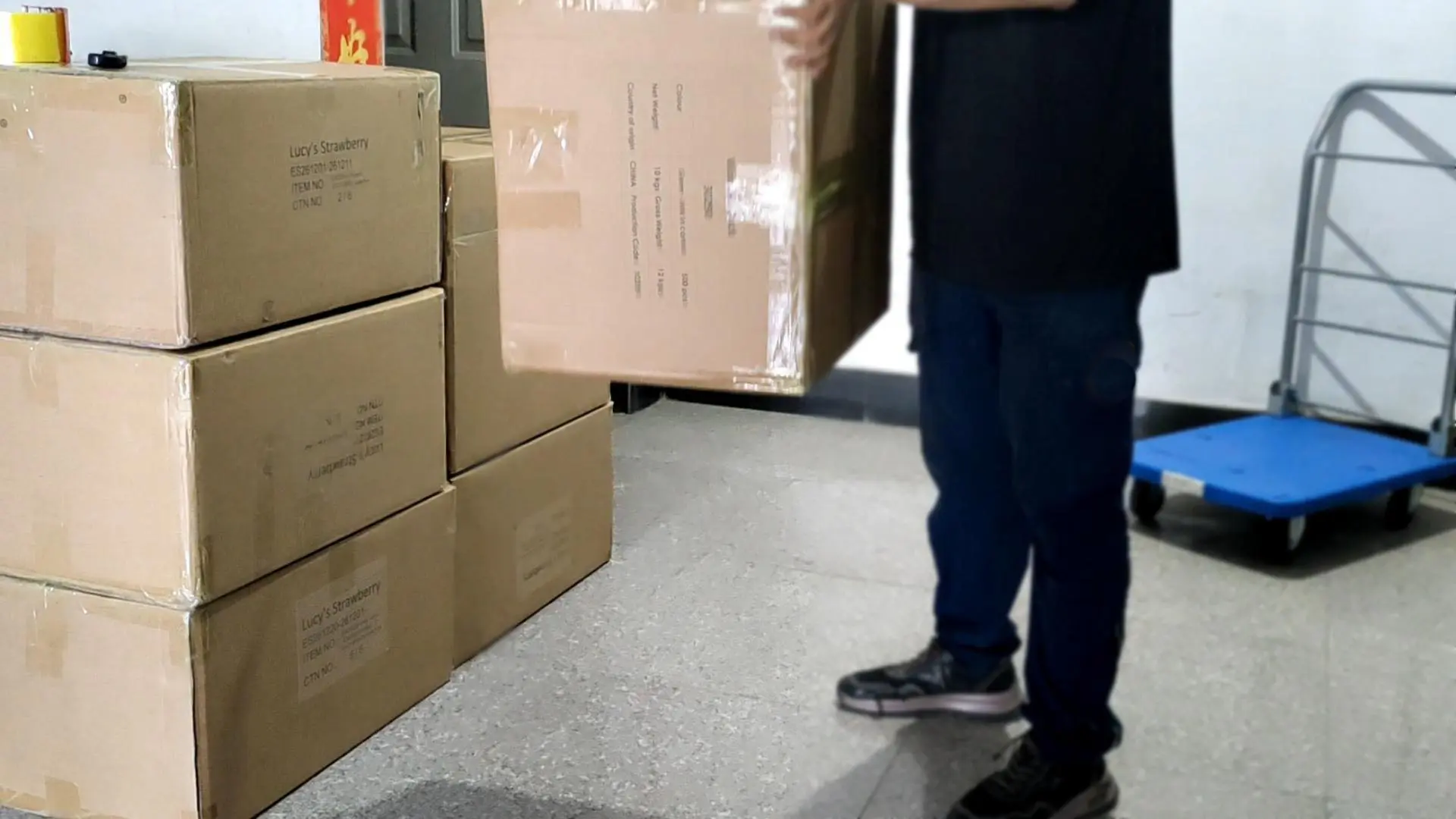
There is no point in carving a beautiful bird if it breaks during sea freight. We use a heavy-duty, multi-layer system. Your carvings are wrapped in silk paper, put into 3-ply inner boxes, and then packed into a 5-ply reinforced master carton. Our packaging passes the ISTA 3A Drop Test to survive rough international handling.Duck lines for garden and display retail are documented separately on the hand-painted wooden ducks and garden duck pages. For the retail side of the same line, our wooden bird gift sets, handcrafted bird gifts and carving design ranges pages cover set structures, finish options and current design directions.
Frequently Asked Questions
What is the standard drop test for packaging?
The standard we strictly follow for international bulk shipping is ISTA 1A. For handcrafted wood carvings, this involves a rigorous sequence of manual drops designed to test the outer carton’s structural integrity and verify that our targeted inner bubble wrap protects fragile extremities like beaks and tails.
How is drop test height determined for packaging?
Drop height is determined by the total gross weight of the carton per ISTA guidelines. For standard B2B wholesale orders weighing between 11 kg and 19 kg (24 to 42 lbs), the mandatory drop height is exactly 61 cm (24 inches), simulating a fall from a worker’s waist or a warehouse pallet.
Why are drop test standards important in packaging quality control?
Following strict standards provides undeniable video proof of packaging integrity. If a carrier mishandles a container, having documented ISTA 1A drop test results prevents insurance companies from denying your freight claim due to “insufficient inner packaging,” thereby protecting your profit margins.
What is a drop test in packaging?
A drop test is a physical simulation of the severe impacts a package might endure during cross-border transit and rough warehouse handling. It involves dropping the fully loaded carton onto a hard concrete surface to expose and fix weak points in the inner cushioning before mass production begins.
How many drops are in a standard packaging test?
The standard ISTA 1A manual drop test consists of exactly 10 consecutive drops. The sequence is rigorous: 1 drop on the weakest corner, 3 drops on the edges, and 6 drops flat on all faces. If a wooden carving survives this entire sequence without damage, the packaging SOP is approved.
Ready to Source Smarter?
Stop paying trading company markups and start securing your Source-to-Shelf quality. By choosing documented factory production over unpredictable intermediaries, you protect both your brand reputation and your profit margins.
Contact our team today to request our full catalog or ask for a localized bird species sample.