Skip to content
Wooden keepsake boxes are the quiet workhorse of gift wholesale: an object whose entire job is to hold something else, and whose value is judged by the lid lift rather than the contents. Buyers across five very different segments order them, and each segment believes it is buying a different product, which is exactly why one generic box line serves none of them well.
This guide maps the segments that buy keepsake boxes in wholesale volume, the construction and closure choices each segment actually needs, and the specification lines that let a buyer price the box honestly before the lid is ever lifted. Every production and pack figure is our own first-party number.
Key Takeaways
- Keepsake boxes sell into 5 segments, not one: gift retail, wedding and event, corporate commemorative, memorial and nursery memory; each buys a different construction and a different closure.
- Construction follows use: a carved-lid box reads as heirloom and costs carve time, while a joined box with an engraved plate reads as programme stock and repeats cleanly across 300 pieces.
- Closure is the warranty line: magnets and hinges are hardware we do not make, so a box needing them is a 2-supplier product, and the contract should name who owns the hardware failure.
- Lining decides the content: felt or paper liner for jewellery and paper keepsakes, bare sealed wood for textiles, and acid-free paper specified from day 1 where photographs will live inside.
- Size families keep the range sane: 3 standard footprints cover most segments, and a custom footprint is a new drawing, a new cavity gauge and a new first article, not a variant row.
- Order per segment like any custom run: the trial tier at 100 pieces and a USD 500 minimum order value proves a segment, and the wholesale and custom tier at 300 pieces and USD 3,000 carries the programme.
In This Guide
- Why One Box Line Serves No Segment
- Wooden Keepsake Boxes: The Segments That Buy Them
- Construction: Carved Lid, Joined Body, Engraved Plate
- Closure and the Two-Supplier Problem
- Lining: What the Content Decides
- Segment Against Construction Against Closure
- Corporate and Commemorative Programmes
- What We Supply Into a Box Programme
- Best For / Not For
- What We Check on a Box Run
- End to End: A Registry and a Retirement Programme
- Frequently Asked Questions
Why One Box Line Serves No Segment
A wedding favour box, a corporate service-award box and a nursery memory box share a silhouette and nothing else. The favour box must cost per piece and pack flat; the award box must carry a plate and survive a stage handshake; the memory box must open thousands of times over twenty years and hold acid-free paper. One construction cannot honour all three price points and lifecycles.
The practical consequence for a wholesaler is range architecture: three footprints, two constructions, and a closure menu, from which every segment’s box is configured rather than designed. The manufacturing route that holds those configurations is described on our wood carving factory page, where a configured box is a drawing revision and a designed box is a new product.
Wooden Keepsake Boxes: The Segments That Buy Them
Gift retail buys the configured box with a generic interior and lets the customer assign the purpose; volume is steady and personalisation is rare. Wedding and event buyers buy per-piece cost and pack-flat behaviour, with a name or date on the lid and nothing inside. Corporate commemorative buys the plate, the mark and the reorder guarantee across years. Memorial buys weight, quiet finish and a lid that closes without a click. Nursery memory buys the hinge cycle, the acid-free liner and a name carved where a sticker would peel.
Naming the segment at quotation time prevents the classic failure: a favour-price expectation attached to an heirloom-construction spec. The segment line on the purchase order is what fixes the construction, the closure and the inspection plan, and it is the first line we ask a buyer to write.
Construction: Carved Lid, Joined Body, Engraved Plate
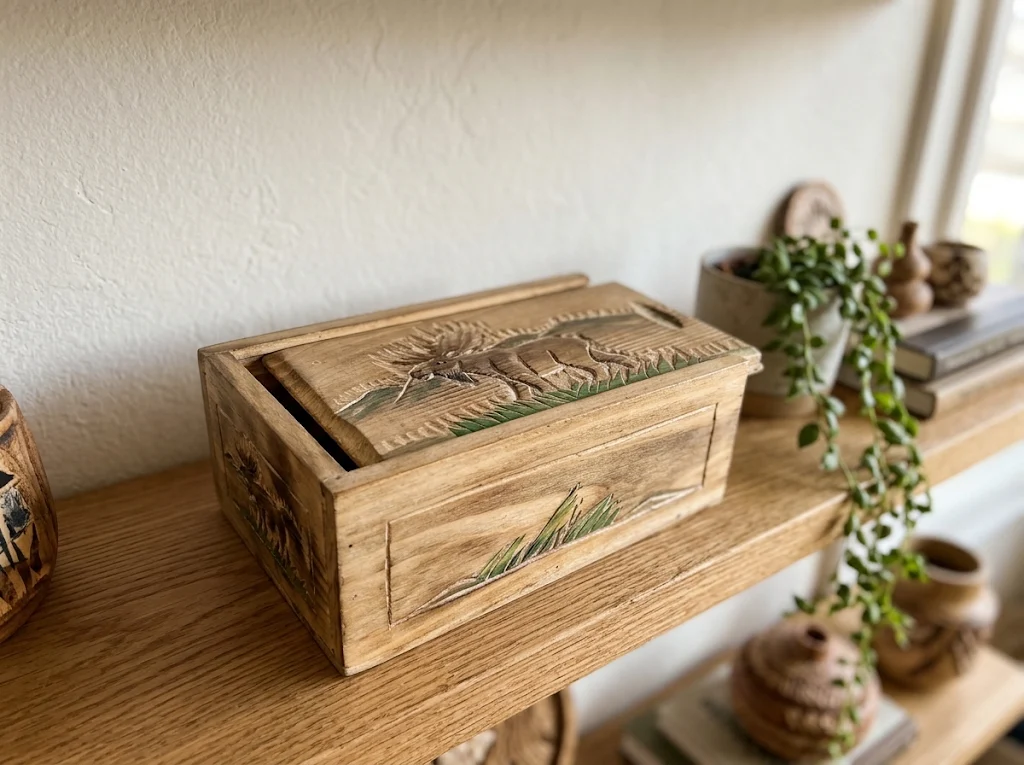
Two constructions cover the range. The carved-lid box takes its story on the lid: relief carve, shaped edge, or a carved mark, and it reads as heirloom at arm’s length. The joined box takes its story on an applied or engraved plate: cleaner, faster, and repeatable across a programme without drift between units, which is what a corporate reorder actually needs.
The plate route also isolates personalisation: names and dates engrave on a plate that can be replaced or reordered separately from the box, so a year-3 reorder for a new retiree does not reopen the box drawing. Where a design needs a jig or fixture to hold a joint tolerance across a run, that tooling is quoted at first article, as set out in our guide to tooling and mould costs for custom wooden products.
Closure and the Two-Supplier Problem
A keepsake box closes in one of four ways: friction fit, a carved or turned wooden catch, a metal hinge, or a magnet. The first two are wood work and stay inside one supplier’s warranty. The second two are hardware, and hardware we do not make: a box specified with hinges or magnets is a two-supplier product, and the purchase order should name who supplies the hardware, who fits it, and who answers when it fails in year 2.
Memorial and nursery segments should default to wood-only closures, because both are opened often and quietly, and a magnet’s click or a hinge’s squeak is exactly the detail a grieving or sleeping household notices. Friction and wooden catch closures also survive the pack: no metal to corrode in a humid carton, no spring to set under stack weight.

Lining: What the Content Decides
Lining is a content decision wearing a material costume. Jewellery and paper keepsakes want felt or soft paper that stops movement and scratching. Textiles want bare sealed wood, because a liner that off-gasses or holds moisture is worse than none. Photographs and documents want acid-free paper, specified at order date rather than added later by the owner, because migration stains appear years after the gift and blame lands on the box.
We kit liners to specification, felt, paper or acid-free, cut to the cavity and fitted at packing; what we do not do is choose the liner for a content we cannot see. The buyer’s segment line and content note decide it, and the decision is written on the drawing with the cavity dimensions. The unit-box layer that carries the configured box to retail follows the same gift-pack logic as any retail unit, covered in our guide to ornament retail packaging.
Segment Against Construction Against Closure
| Segment | Construction | Closure | Lining default |
|---|---|---|---|
| Gift retail | Joined, generic interior | Friction fit | Paper |
| Wedding and event | Joined, lid mark only | Friction or ribbon | None or paper |
| Corporate commemorative | Joined with engraved plate | Wooden catch | Felt |
| Memorial | Carved lid, quiet finish | Friction, no click | Felt or acid-free |
| Nursery memory | Joined, name carved on lid | Wooden catch, hinge-cycle tested | Acid-free paper |
Corporate and Commemorative Programmes
Corporate boxes are bought against a calendar of events, retirements, service anniversaries, programme completions, and the calendar repeats yearly with different names on the plate. That repetition is the specification: the box drawing freezes once, the plate artwork freezes once, and each year’s order is a name list against frozen tooling, which is why the plate route beats the carved lid here.
The gifting side of these programmes sits inside a tax framework with per-recipient limits and record expectations, and the US rules are set out in IRS Publication 463; a box programme that knows its per-recipient ceiling prices its construction accordingly, and the finance team reads the plate line as confidently as the recipient does. The plate and mark work itself runs through our custom product manufacturing route, where the name list freezes with the order.

What We Supply Into a Box Programme
- We supply: joined and carved-lid keepsake boxes in 4 species, three standard footprints, with liners kitted to specification and plates engraved or applied at packing.
- We supply: the configuration drawing per segment, with cavity gauge, liner note and closure type, revised only in writing.
- We do not supply: metal hinges, magnets or springs, and no box of ours carries hardware whose failure we cannot inspect at packing.
- We do not supply: food-safe or airtight certification; a keepsake box is a dry-goods container and the tag should say so.
Best For / Not For
| Programme | Best for | Not for |
|---|---|---|
| Wedding and event favour | Joined box, lid mark, pack-flat | Heirloom construction at favour price |
| Corporate annual award | Plate route, frozen drawing, yearly name list | Carved lid that drifts between years |
| Memorial and hospice | Carved lid, friction closure, felt liner | Any hardware click |
| Nursery registry | Name-carved lid, acid-free liner, cycle-tested catch | Magnet closures near the room |
What We Check on a Box Run
- Lid fit and closure feel, sampled per batch, friction seated by hand pressure and wooden catch engaging without play.
- Cavity gauge against the liner note, liner seated flat with no lift at the corners, checked with the gauge not the eye.
- Plate legibility and position, engraved depth readable at arm’s length and aligned to the drawing datum.
- Moisture at 8 to 12 percent recorded per batch, because a lid cut wet will bind or gap after the first heating season in the owner’s home.
- Claims limited to what we hold: CE, UKCA, RoHS, EN71 where it applies, BSCI and ISO 9001.
Every figure above is first-party and checkable against an inspection report or a certificate we hold; the segment map and closure menu are configuration method, not standards. The company and its specification library sit at ewoodarts.com.

End to End: A Registry and a Retirement Programme
A baby-goods retailer wants a nursery memory box on its registry, and a professional services firm wants a retirement box for forty partners a year; both arrive asking for the same carved lid they saw online.
Split by segment first. The registry box takes the joined construction with a name-carved lid, acid-free liner and a cycle-tested wooden catch, configured from the standard footprint. The retirement box takes the plate route: frozen joined drawing, engraved plate per recipient, felt liner, and a name list delivered with each annual order.
Prove each on the trial tier. Both programmes start at 100 pieces and a USD 500 minimum order value, air express DDP in 20 to 30 days, with lid-fit and plate-legibility samples photographed for approval before the sea-tier commitment.
Consolidate the season. The retailer’s registry replenishment and the firm’s annual run consolidate on the wholesale and custom tier at 300 pieces and a USD 3,000 minimum order value, sea freight 60 to 90 days to port, sharing carton configuration while keeping separate drawings, plates and liners; year 2 reorders against frozen revisions, and both boxes open identically to the ones photographed at first article.
Configuring a keepsake box programme?
Send us your segment, your content note and your closure preference. We will return the configuration drawing, the liner and plate specification, and the tier maths that carries the programme across years.
Frequently Asked Questions
Q: Which construction suits a corporate award box?
The joined box with an engraved plate, because the programme repeats yearly with different names and the plate route freezes the box drawing once. A carved lid drifts between carve batches, and drift is visible when year-1 and year-5 boxes sit on the same shelf, which is exactly where award boxes end up.
Q: Can you supply hinges or magnets for keepsake boxes?
No. Metal hinges, magnets and springs are hardware we do not make, and a box specified with them becomes a two-supplier product whose failure ownership must be named in the contract. Our range closes with friction fits and carved or turned wooden catches, which stay inside one warranty and survive the pack.
Q: What lining should a photograph keepsake box carry?
Acid-free paper, specified at order date rather than added by the owner years later, because migration stains appear long after the gift and blame lands on the box. Felt suits jewellery and small hard keepsakes, bare sealed wood suits textiles, and the liner note sits on the configuration drawing with the cavity gauge.
Q: How many box sizes should a wholesale range carry?
Three standard footprints cover most segments, because size families keep cavities, liners and cartons repeatable. A custom footprint is a new drawing, a new cavity gauge and a new first article, which is a product decision with a cost, not a variant row added at quotation.
Q: Is a keepsake box suitable for food or airtight storage?
No, and the tag should say so. A keepsake box is a dry-goods container: no food-safe certification, no gasket, no airtight claim. Buyers who need tea, spice or confection storage should source a certified food-contact container elsewhere and keep the keepsake line honest about its one job.