Skip to content
When importing hand-carved wooden ducks or hunting decoys manufactured in China into US or European markets, the line between a smooth 48-hour clearance and weeks of costly port detention often comes down to a few digits in your HTS/HS customs code declaration.
Last year, a Midwest US home decor retail chain paid a steep price on a $50,000 order. Their pre-production golden sample was a smooth, solid basswood duck without moving parts. The customs broker pre-reviewed the product as a wooden decoration under HTS code 4420.19.00 with a 3.2% duty rate.
However, during mass production and packaging, “Suitable for kids’ rooms” and “Ages 3+” promotional text were printed on the hangtags and outer packaging.
Upon arrival at the destination port, customs inspectors reclassified the shipment as “Toys” under HTS code 9503.00.00. While toys carry a low or 0% base duty rate, the “toy” classification triggered stringent children’s product safety testing regulations (such as CPSC/ASTM F963 in the US or CE EN 71 in Europe). Because the bulk production lacked proper testing certificates, the importer had to hastily arrange third-party laboratory testing—costing between $500 and $1,500 per SKU (and even more if multiple colorways or styles were involved). During the 2 to 4 weeks spent sending samples, waiting for lab reports, and re-submitting documentation, demurrage and storage fees mounted rapidly at the port. Under FOB terms, all testing fees, detention charges, and port fees fell entirely on the buyer, turning a profitable order into a substantial loss.
This incident highlights a crucial rule for importers: mass production and packaging must 100% mirror the approved sample, as any unreviewed wording or detail change can trigger a forced customs reclassification.
To ensure your wooden decoys clear customs seamlessly, inspect these four critical compliance checkpoints before container loading.
Checkpoint 1: Distinguishing Ornaments from Toys (HTS Codes & Testing Standards)
Importers and factories frequently confuse the boundary between wooden crafts and toys. Customs authorities and product safety regulators evaluate four main criteria when classifying a carved duck as a wooden ornament (HTS 4420.19.00) versus a children’s toy (HTS 9503.00.00):
| Evaluation Dimension | Ornament / Craft (4420.19.00) | Children’s Toy (9503.00.00) |
|---|---|---|
| Functional Features | Solid, static display pieces; non-floating; detailed paint finishes not designed for rough play. | Interactive features (e.g., floating bases, detachable parts); rounded edges; child-safe non-toxic finishes. |
| Packaging & Labeling | Labeled “Hand-Carved Collectible” or “For Decoration Only”. | Labeled “Ages 3+”, featuring child-oriented graphics or cartoon gift boxes. |
| Retail Channel & Price | Sold in home decor, giftware, or hunting/outdoor sections at higher price points. | Sold in toy aisles or children’s departments with emphasis on play value. |
| Testing & Certification | Cleared as standard wooden handicrafts; no toy safety testing required. | Mandatory toy safety testing ($500–$1,500/SKU): • US: CPC (Children’s Product Certificate), ASTM F963 testing • EU: CE Mark, EN 71-1 (Physical/Mechanical), EN 71-2 (Flammability), EN 71-3 (Heavy Metals Migration) |
Practical Action Items:
1. Ensure mass production 100% matches the approved golden sample in structure, finish, and packaging.
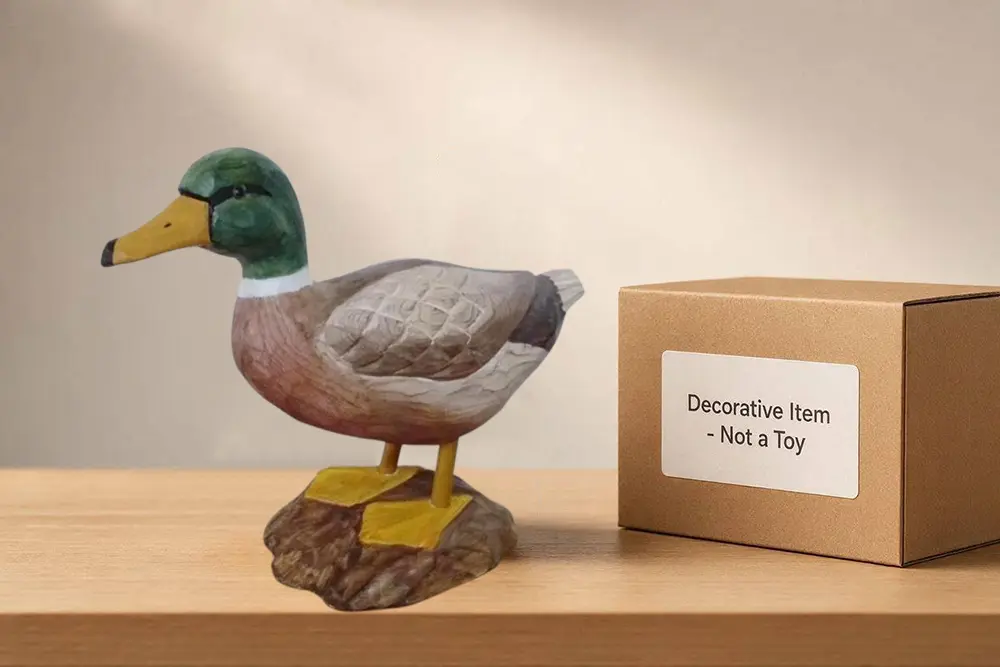
2. Avoid any child-related terminology on hangtags or outer packaging. Print “Decorative Article – Not a Toy” clearly on artwork.
3. Never use generic descriptions like “Wooden items” on commercial invoices. Use precise descriptors such as Hand-carved wooden decorative craft to speed up entry.

Checkpoint 2: Phytosanitary Certificates & Moisture Content Control
Customs and agricultural authorities (such as the USDA) strictly monitor solid wood imports for pests and invasive species. While bulk shipments typically rely on paper carton packaging rather than solid wood pallets, the wooden product itself requires strict health inspection and drying controls.
1. Phytosanitary & Fumigation Certificates
Prior to export, the manufacturer or exporter must obtain an official Phytosanitary Certificate or Fumigation Certificate from the local inspection authority. This verifies that the raw timber and finished carvings have undergone proper pest-control treatments, preventing cargo rejection or destruction at the destination port.
2. Moisture Content (MC) Management
Uncontrolled wood moisture is a major source of quality defects. If timber is insufficiently kiln-dried before carving and sealing, trapped moisture evaporates inside ocean containers during a 30-day transit, causing mold, warping, or severe cracking upon opening.
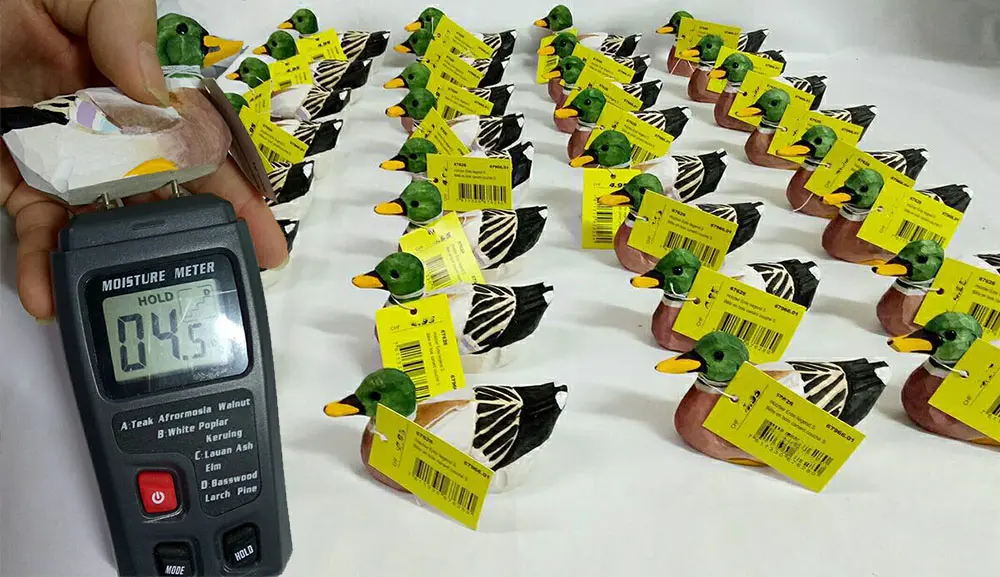
- Kiln-Drying Standard: Raw timber blanks (basswood, pine, birch, etc.) must undergo strict kiln-drying to achieve a core moisture content of 10% (±2%) prior to carving.
- Pre-Painting Check: Unfinished wood absorbs ambient workshop humidity easily. Moisture levels must be re-tested right before primer or topcoat application. If MC exceeds 14%, delicate features like duck beaks and tail feathers are prone to cracking within 48 hours in dry climate warehouses.
Additionally, when submitting species declarations (e.g., USDA Lacey Act declarations), declare the exact scientific botanical name (such as Tilia amurensis for basswood) rather than generic trade names to reduce automated entry flags.
Checkpoint 3: Document Consistency & Declaration Accuracy
Before vessel arrival, ensure all information across the Commercial Invoice, Packing List, and Bill of Lading matches perfectly:
- Commercial Invoice: Must include detailed material descriptions (e.g., Hand-carved wooden decorative crafts, Tilia amurensis), the correct 10-digit HTS code, unit price, currency, and country of origin. For FOB shipments, separate product value from freight/insurance to avoid inflated tariff bases.
- Packing List: Net weight, gross weight, carton dimensions, and piece counts must align exactly. Weight discrepancies are a primary trigger for physical customs examinations.
- Plant Species & Treatment Declarations: Provide signed manufacturer declarations confirming the timber species along with the official phytosanitary/fumigation certificate. If decoys feature hardwood bases or inlays, confirm those accent woods are non-CITES restricted species.
Checkpoint 4: Protective Packaging & ISTA Drop Testing
Hand-carved features such as slender beaks and tail feathers are fragile. Loose or inadequate master packaging often leads to transit breakage.
Validate carton packaging integrity prior to mass production:
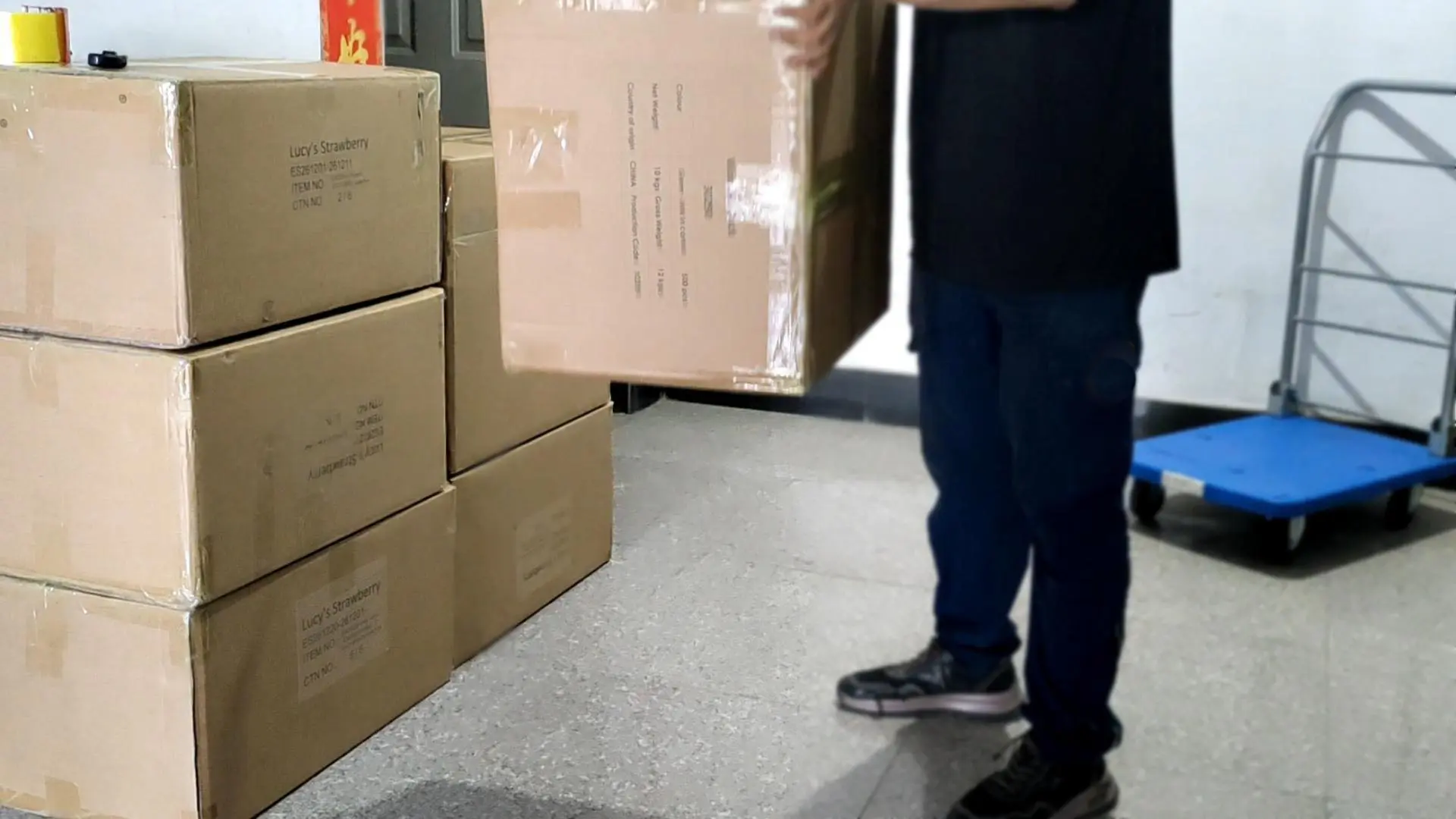
- Drop Test Standard (10–19 kg Master Cartons): Fully packed master cartons must undergo a 10-point free-fall drop test from 61 cm (24 inches), covering 1 most vulnerable corner, 3 adjacent edges, and 6 flat faces (ISTA 1A standard).
- Pass Criteria: Minor outer corrugated carton denting is acceptable, provided internal products show zero structural damage, paint chipping, or loosened joints.
Keep internal carton void space below 20%. Excessive internal space leads to carton collapse during pallet stacking and increases dimensional weight charges.
Summary & Purchase Order (PO) Recommendations
Importing wooden decoys successfully requires embedding compliance and packaging standards directly into your procurement contracts.
When issuing Purchase Orders (PO) to your suppliers, incorporate these standard clauses:
- Sample Consistency Clause: “Bulk production and product packaging must 100% match the approved Golden Sample in structure, materials, finishes, and printed artwork.”
- Quarantine & Moisture Clause: “Supplier shall provide an official Phytosanitary/Fumigation Certificate and kiln-drying logs confirming wood core moisture content is maintained at 10% (±2%) prior to carving.”
- Packaging Drop Test Clause: “Master cartons must pass a 61 cm (24 in) 10-point drop test (ISTA 1A) with complete test video documentation provided prior to container loading.”
Frequently Asked Questions
What HTS code covers hand-carved wooden ducks?
They usually fall under HTS 4420.19 (wooden ornaments) or 9503.00 (toys) depending on design features, target age, and packaging claims. Misclassification can trigger customs delays or severe penalties, so always verify product descriptions and classification with a licensed customs broker before shipping.
Do wooden ducks need a phytosanitary certificate?
Yes, solid wood crafts require official phytosanitary/fumigation certificates to prove pest control. Our basswood, pine, and birch products are strictly kiln-dried to safe moisture levels (10% ±2%) before carving, and complete treatment certificates and species declarations are provided prior to shipment to ensure smooth clearance.
What packaging standards apply to prevent customs issues?
Our products are exported using standard heavy-duty paper cartons, avoiding ISPM 15 wooden packaging requirements. However, if your order requires solid wood pallets or dunnage, all wood packaging materials must be ISPM 15 heat-treated and officially stamped to prevent port rejections.
Which customs documents are mandatory for wood craft imports?
Mandatory clearance documents include a Commercial Invoice, Packing List, Bill of Lading, Phytosanitary/Fumigation Certificate, and a Plant Species Declaration (e.g., USDA Lacey Act declaration specifying scientific botanical names like Tilia amurensis).
How do you prevent damage to carved ducks during ocean freight?
Each piece is individually wrapped with protective padding and packed in double-wall cartons with custom internal dividers. We perform 10-point drop tests (ISTA 1A standards) on packed master cartons before mass shipment to guarantee delicate features like beaks and tails arrive intact.