Skip to content
For business owners running commercial spas, wellness centers, or handling architectural projects, deciding between Himalayan salt blocks and salt tiles is a critical choice. Making the wrong call can lead to budget overruns, structural failures, or severe moisture damage. Operating as a source manufacturer since 2004, Jilin Ever Creation has seen too many buyers confuse these two products, resulting in collapsed walls or melting salt. This is not just about aesthetics; it involves structural load-bearing, logistics costs, and material lifespan, directly determining whether your project succeeds or fails.
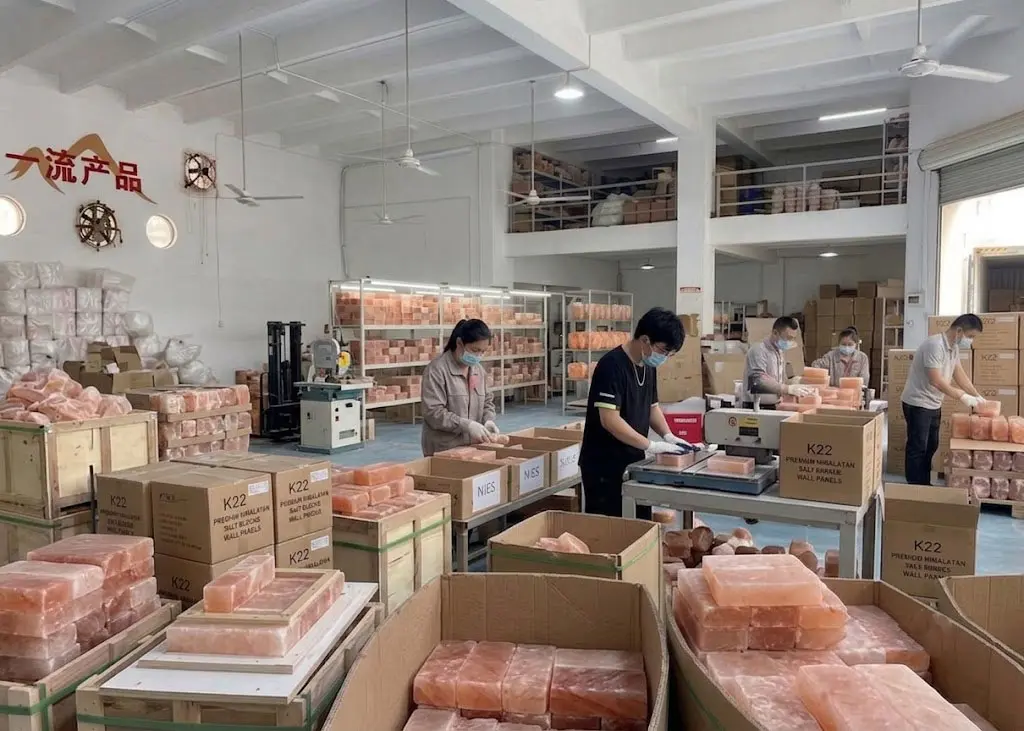
Simply put: salt blocks are dense and heavy, designed primarily for “thermal mass,” while salt tiles are lightweight and engineered for wall cladding. Authentic Himalayan salt is extremely dry, but the inferior rock salt on the market easily absorbs moisture, often cracking and melting within a year of installation. Understanding this distinction will not only save your budget but also ensure your project meets strict commercial acceptance standards.
Why Salt Wall Projects Fail: The Hidden Risks
Choosing the wrong thickness directly leads to structural failure, moisture damage, or a massive waste of your budget.
The primary reason salt wall projects fail is a fundamental mismatch between material thickness and the actual construction scenario. Many buyers select salt bricks based purely on unit price, completely ignoring long-term structural loads and humidity effects—the true factors that dictate wall longevity.
- Structural Load Issues: Blocks are typically 2 inches thick and weigh approximately 10 lbs per square foot. This immense dead weight requires reinforced heavy-duty metal framing. If applied directly to standard drywall or light steel keels without structural upgrades, the wall will eventually collapse.
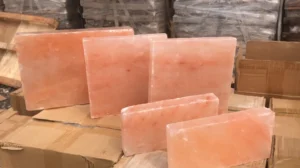
- Weight & Moisture Risks: Tiles are usually 0.75 to 1 inch thick, weighing only about 4 lbs per square foot. Because they are lightweight, standard commercial framing can support them. Crucially, thinner tiles expose less surface area to ambient air, significantly reducing the risk of moisture absorption and subsequent cracking.
- Application Mismatch: 2-inch blocks are designed for heavy-duty cooking, grilling, or saunas where high “thermal mass” is required. Using them for decorative spa walls is a waste of performance. Conversely, using thin tiles for a grilling stone results in rapid heat loss, defeating the purpose.
Selecting materials strictly by unit price is a recipe for disaster. While a single block might not seem much more expensive, the cost of structural reinforcement is substantial. Thin tiles eliminate the need for heavy-duty mounting hardware. Always calculate the total installed cost, not just the material price.

The Real Cost Breakdown: Blocks vs. Tiles
Under the same weight limits, a single 20ft container of salt tiles covers a much larger square footage, drastically reducing the shipping cost per square meter. Meanwhile, buying blocks requires a hefty budget for wall reinforcement.
The cost difference extends far beyond the FOB price. The real financial risks lie in “structural reinforcement” and “ocean freight allocation.” For commercial salt walls, selecting the wrong material and its corresponding specialized hardware can inflate your total costs by 40%.
- Wholesale Price (FOB China): We offer strict tiered pricing based on order volume and specifications. Salt tiles typically range from $3.00–$10.00/sq ft. Heavy salt blocks range from $8.00–$15.00/sq ft (excluding shipping). If you are building a standard decorative wall, tiles save you substantial money right from the source.
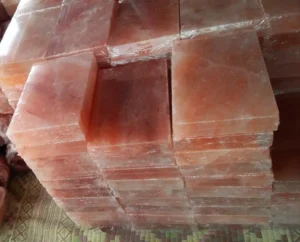
- Container Loading Efficiency: Salt products are high-density heavy cargo. For international shipping, whether blocks or tiles, you must use a 20ft container (20GP) due to strict shipping line weight limits; 40ft containers cannot be used. However, because tiles are lighter, the total square footage you can fit into a single 20ft container is vastly greater than blocks, drastically lowering the average ocean freight cost per square foot.
- Low MOQ Customization: We support OEM/ODM projects with a highly accessible MOQ of just 300 pieces. This allows brands to test the market with custom packaging and sizes without committing to massive inventory.
| Key Metric | Specifications | B2B Buyer Advantage |
|---|---|---|
| Thickness & Load | Tiles: 0.75–1″ (~4 lbs/sq ft) Blocks: 2″ (~10 lbs/sq ft) | Tiles mount on standard framing; Blocks require expensive structural steel reinforcement. |
| Tiered Pricing (FOB) | Tiles: $3.00–$10.00/sq ft Blocks: $8.00–$15.00/sq ft | Tiles offer lower initial material costs and maximize 20ft container coverage to slash shipping rates. |
| Chemical Composition | H2O (Residual Moisture) tested at 0.023% | Ultra-low moisture prevents cracking and melting, ensuring a 10+ year lifespan for commercial walls. |
| Customization MOQ | 300 Pieces (OEM/ODM) | Low barrier to entry for testing new product lines with custom specs and branding. |
Ready to Source Commercial-Grade Salt Bricks?
Get direct factory tiered pricing, verified 0.023% moisture reports, and optimized 20ft container shipping solutions for your next project.

How to Source Safely and Avoid Scams
Always demand a “Certificate of Origin” and a “Chemical Composition Analysis Report” to prevent highly hygroscopic fake rock salt from ruining your high-end commercial project.
Many commercial salt wall projects fail because buyers trust sales pitches without demanding hard testing evidence. Inferior rock salt lacks the structural integrity of authentic Himalayan crystal salt; upon contact with humidity, it rapidly absorbs moisture, cracks, and ruins the entire investment within months.
- Certificate of Origin (CO): Demand traceable documentation from authentic mining regions like Khewra in Pakistan. Without this, you risk buying generic surface salt.
- Chemical Composition Analysis Report: Professional contractors prioritize overall chemical stability. A reputable source manufacturer will provide a detailed “Chemical Composition Analysis” proving mineral compliance and showing that residual moisture (H2O) is strictly tested at 0.023%. If a supplier cannot produce this professional report, moisture levels are likely too high, guaranteeing the salt will melt over time.
- Vacuum-Sealed Packaging: Ocean freight humidity is brutal. Products must leave the factory with industrial desiccants, fully vacuum-sealed in shrink wrap, and palletized. This strictly blocks marine moisture, ensuring the materials arrive ready for immediate installation.

The Bottom Line for Buyers
Choosing between salt blocks and tiles dictates the safety and longevity of your project. If you are building large-scale saunas, salt caves (Halotherapy), or cooking surfaces requiring thermal mass, choose 2-inch blocks—but remember to reinforce the walls. For standard commercial SPA decorative cladding, thin salt tiles are the most cost-effective and structurally sound choice. Ultimately, demand a professional Chemical Composition Analysis Report verifying moisture levels as low as 0.023% to prevent future liability.
Commercial Sourcing FAQ (B2B)
How do you ensure a low breakage rate during international shipping?
High breakage is the biggest pain point in shipping salt products. We use industrial-grade moisture-proof vacuum shrink wrap, heavy-duty corrugated boxes, and fumigation-free wooden pallets with shock-absorbing layers. Our standardized container loading protocol reduces physical breakage and moisture damage to industry minimums.
How can we control the overall budget for commercial salt projects?
For bulk orders, we offer tiered pricing. For standard wall decor, we highly recommend our thin tile series, offering an incredibly competitive FOB price of $3.00-$10.00/sq ft. For heavy-duty thermal applications like saunas or salt caves, our 2-inch blocks ($8.00-$15.00/sq ft) are required. Selecting the right material and maximizing 20ft container coverage will save you over 30% on your total landed budget.
How do you guarantee production capacity and lead times for urgent engineering projects?
Backed by a mature ISO9001 quality management system and robust production lines, we maintain substantial semi-finished inventory for standard sizes of both tiles and blocks. Orders can be rapidly cut, vacuum-sealed, and palletized to ensure your overseas construction schedule is never delayed by material shortages.
Can you provide the necessary origin and quality certificates for customs clearance?
Absolutely. As an experienced source exporter, we provide a complete set of clearance documents with every bulk shipment. This includes the authentic Certificate of Origin (CO) from Pakistani mines and a comprehensive Chemical Composition Analysis Report (explicitly listing H2O at 0.023%), ensuring compliance with global customs and commercial building material standards.
Do you support OEM/ODM and small batch trial orders?
We welcome long-term commercial partnerships. For new custom shapes or specific packaging, we support a low trial MOQ starting at just 300 pieces. This allows regional wholesalers and SPA brands to test market feedback with minimal risk before committing to full container load (FCL) replenishments.