Skip to content
For independent coastal boutiques, souvenir shops, and mid-sized home decor retailers, dead stock is the ultimate cash flow killer. I have spent over two decades working directly with European and North American buyers, manufacturing and exporting hand-carved wooden crafts. Every buying season, I see the same recurring mistake: retailers purchasing inventory based purely on personal aesthetic preference rather than a disciplined financial model.
They over-invest in massive, expensive centerpiece carvings that gather dust on the top shelves, while completely running out of small, fast-moving items by the second week of the summer rush. The result? A storefront that looks beautiful, but a balance sheet that suffers.
To fix this, highly profitable coastal retailers rely on a proven procurement matrix: The 20/60/20 Merchandising Rule. This strategy dictates exactly how you should allocate your purchasing budget across different price tiers to guarantee high inventory turnover, protect your margins, and ensure your shelves constantly drive revenue. Here is exactly how to structure your next bulk wooden shorebird order.
The Psychology of the Coastal Souvenir Buyer
Before allocating your budget, you have to understand why tourists and local shoppers buy coastal decor in the first place. Shoppers in beach towns or nautical-themed stores are rarely making planned, rational purchases. They are buying a physical reminder of a relaxed, coastal memory.
Why Wood Consistently Outperforms Plastic
Modern consumers suffer from plastic fatigue. Mass-produced resin or plastic seagulls feel cheap and industrial—they belong in a discount bin, not a premium vacation home. Natural basswood, with its visible grain texture and hand-painted distressed finishes, carries an inherent “authentic” value. Even if the item is small, the tactile feel of carved wood justifies a higher retail markup because the customer perceives it as artisan craftsmanship, not a factory mold.
Navigating “Impulse” vs. “Destination” Purchases
Only a fraction of your foot traffic walks in intending to drop $150 on a massive wooden pelican sculpture (Destination Purchase). However, 80% of your foot traffic can be convinced to add a $12 wooden sandpiper or a $5 wooden whistle to their basket on the way out (Impulse Purchase). Your store’s inventory must capture both the high-margin whales and the high-volume daily transactions.

The 20% Budget: Stocking $1-$3 Impulse Buys
Allocate 20% of your total wholesale purchasing budget to entry-tier, low-cost items. Think hand-carved wooden whistles, small seagull keychains, wooden nautical pens, and miniature magnets.
The Cash Register Cash Cow
These items are not meant for your premium glass display cabinets. They belong in dump bins, woven baskets, or spinning racks placed precisely 3 feet from your checkout register. The strategy here is friction-less purchasing. If a family is buying a t-shirt, the kids will grab a wooden seabird whistle, and the parents will say “yes” because it’s cheap and made of natural wood rather than noisy plastic. These items boast the fastest inventory turnover rate in your entire store, providing a steady stream of daily cash flow.
Diluting Ocean Freight for Importers
If you are an international B2B buyer bringing in Full Container Loads (FCL) or large LCL shipments, these small items serve a critical logistical function: they are “CBM Gap Fillers” (Cubic Meters). Large wooden decor items ship with a lot of empty air in the cartons. By packing thousands of $1-$3 wooden keychains into the dead space of your container, you effectively bring their shipping cost down to nearly zero. This drastically increases your landed margin once the goods hit your warehouse.
Ready to Optimize Your Coastal Inventory?
Skip the middleman and source direct from our factory. Download our latest wholesale catalog to see our full 70+ SKU matrix of hand-carved shorebirds, designed specifically for Western retail margins.

The 60% Core: Maximizing the $3-$8 Sandpiper Tier
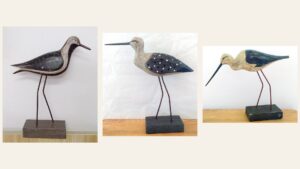
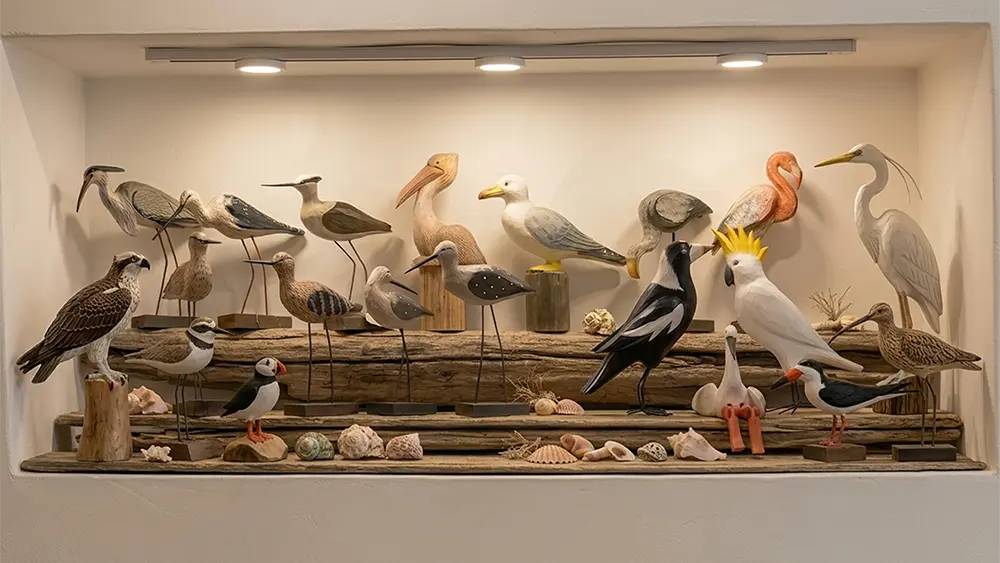
This is where the battle for profitability is won or lost. 60% of your budget must go toward mid-tier items—the bread and butter of coastal decor. The absolute king of this category is the wooden sandpiper (and its variations like small egrets or plovers). They are universally recognized, fit beautifully on standard bookshelves, and hit the perfect retail price point of $15 to $25.
The Bundling Strategy: The Power of “Sets of Three”
Here is the most important retail secret for wooden shorebirds: Never let a customer buy just one. Sandpipers naturally travel in flocks. If you put a single bird on a shelf, it looks lonely. If you group them, they tell a story.
As a retailer, you should source these birds in three distinct heights (e.g., 5-inch, 7-inch, and 9-inch). If your landed factory cost averages $5 per bird, your cost for the trio is $15. By merchandising them closely together with a single price tag as a “Family Set,” you can easily command $45 to $55 for the group. You have just tripled your Average Order Value (AOV) simply by changing how they sit on the shelf.
Authenticity in Detailing Drives the Markup
Consumers will not pay $45 for a set of poorly painted wood. To justify this margin, the finish must be flawless. We utilize specific distressed paint techniques—layering Navy Blue, Deep Forest Green, or Walnut Brown under a dry-brushed whitewash. This creates a weathered, “beach-found” aesthetic that fits perfectly into modern high-end coastal interiors. Furthermore, the integration of rust-resistant metal legs ensures the birds look delicate but stand rock-solid on your store’s glass shelves.

The 20% Anchor: Using $8-$15 Pelicans for Display
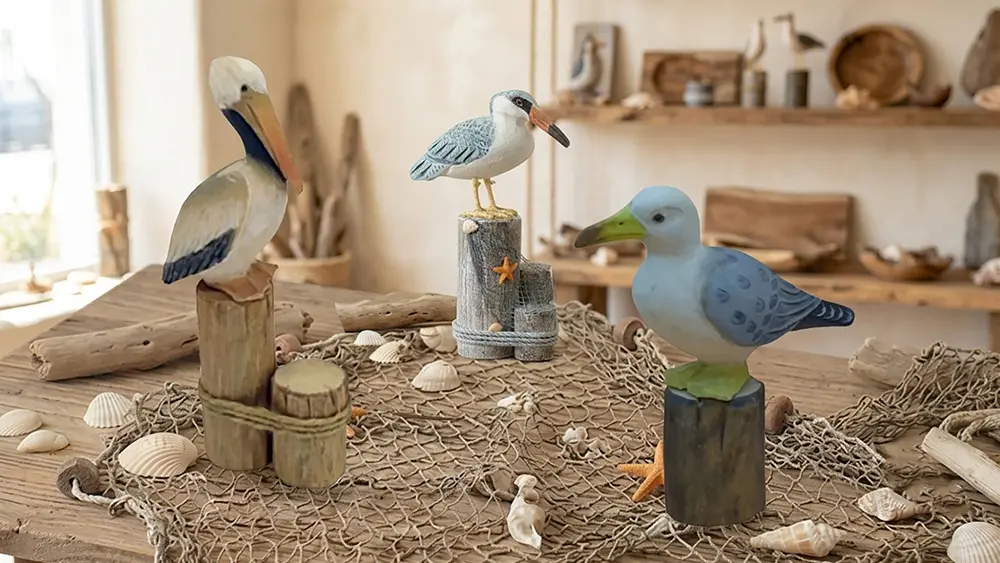
The final 20% of your budget is reserved for premium, high-impact statement pieces. These are our largest 30cm (12-inch) hand-carved wooden pelicans, sculpted with solid wooden pilings and rustic rope details. They are designed to draw the eye and elevate your entire coastal product line.
The Retail Counter Magnet
These premium pieces are your silent salespeople. Positioned on an eye-level shelf, a display table, or near the checkout counter, a beautifully carved 30cm pelican instantly commands attention. Its primary role is to elevate the overall aesthetic of your store and showcase the highest level of craftsmanship your shop offers.
Setting the Price Anchor
Larger statement pieces serve a vital psychological purpose: Price Anchoring. When a shopper sees a detailed 30cm wooden pelican priced at $55–$65, their budget perception calibrates to that higher value. Suddenly, when they look over at your $15–$25 sandpipers or sets of three, those core items feel like an irresistible deal. The high-tier anchor drives sales across your entire coastal display.

Visual Merchandising: Grouping by “Flocks”
How you place the product dictates how fast it sells. Do not line your wooden birds up in straight, military-style rows on a flat shelf. It looks unnatural and commercial.
- The Asymmetry Rule: Always group items in odd numbers (threes or fives). Create depth by placing the tallest bird in the back center, with smaller birds flanking it slightly forward and angled inward, as if they are interacting.
- Color Blocking for Impact: Do not mix every color together in a chaotic mess. Dedicate one table to a “Warm Cream and Muted Gold” theme, and another wall to the “Navy and Distressed White” theme. This makes your store look like a curated boutique rather than a discount warehouse.
Utilizing Driftwood, Nets, and Shells in Displays
You want to elevate the perceived value of the woodcrafts. The easiest way to achieve the “Silent Luxury” coastal aesthetic is through aggressive cross-merchandising with cheap, raw materials.
Drape heavy, authentic cotton fishing nets (not cheap plastic ones) over standard retail risers. Use locally sourced driftwood logs as organic pedestals to elevate the sandpipers. Scatter large, unbroken seashells around the metal bases of the wooden birds. By wrapping the product in a rugged, natural environment, you remove the “manufactured” stigma. Customers feel like they are buying a piece of coastal art, making them much less likely to haggle over the price.
Testing the Matrix: The 300pcs Mixed-Finish Strategy
If you are a first-time buyer transitioning from domestic wholesalers to direct factory importing, committing to huge volumes can feel risky. We understand that. That is why our factory operates on a highly pragmatic, retail-friendly minimum order structure.
THE FACTORY MOQ ADVANTAGE
Our Minimum Order Quantity (MOQ) is strictly 300 pieces per carving shape (e.g., 300 units of the 7-inch sandpiper). However, to help you test local market preferences, we allow you to split those 300 pieces across 3 different distressed color finishes (e.g., 100 Navy, 100 Warm Cream, 100 Walnut Brown).
This policy is a game-changer for independent retailers and mid-sized distributors. It allows you to hit the factory-direct pricing tier and fulfill the 20/60/20 matrix without drowning your stockroom in a single, untested colorway. You can build a visually diverse, high-conversion display with minimum upfront capital exposure.
Frequently Asked Questions (B2B Sourcing)
How do you make sure these tall wooden shorebirds don’t tip over easily?
Because every bird is hand-carved, balance is key. Our craftsmen fix sturdy metal legs deep into heavy, solid wooden bases. Every completed piece is checked manually on a flat surface before painting to make sure it stays completely steady on your retail shelves.
How do you ensure the wood used for your products is legally and safely sourced?
We accompany every shipment with official, government-issued Wood Logging Certificates and Phytosanitary/Quarantine Certificates. These documents verify that our timber originates strictly from legal harvesting operations and has undergone full health inspection prior to shipment.
How do you prevent the wood from cracking after shipping overseas?
Wood cracks when it dries out too fast. Before our carvers start shaping the wood, all raw timber planks go through a thorough kiln-drying process to bring internal moisture down to a safe 8%–12%. This ensures the wood stays stable whether your store is in dry desert heat or damp ocean air.