Skip to content
There’s a shop in Lancaster County, Pennsylvania, that sells nothing but primitives. Hand-dipped tallow candles, wrought-iron hooks, worn wooden bowls, and birds. Dozens of birds. Stick bird decoys — shorebirds on rough sticks, perched on worn shelves, clustered on a mantel like they wandered in from the marsh and froze. The owner — a quiet woman named Ruth who’s been doing this for thirty years — told me something I’ve never forgotten: “My customers don’t want a decoration. They want an artifact. Something that looks like it was here before them and will be here after.”
That’s the primitive market in one sentence. It’s not “coastal decor.” It’s not “nautical theme.” It’s an aesthetic rooted in 18th and 19th-century American folk craft — the era when a shorebird decoy was carved from a single block of pine by a hunter who needed it to float, not to look pretty. The beauty was accidental. The form was pure function. And that functional purity is exactly what today’s primitive collector pays a premium to reproduce.
We’ve been making decoy-style shorebirds for this market for over a decade. Not hunting decoys — nobody’s taking these to a blind on the Chesapeake. Decorative reproductions that capture the spirit of the originals: the simple carved bodies, the stick legs, the deliberately rough finish, the muted earth-tone paint worn thin by imaginary decades. Here’s what sells, who buys them, and what makes a reproduction convincing versus cheap.
Stick Bird Decoys: What Sells in Primitive Shops
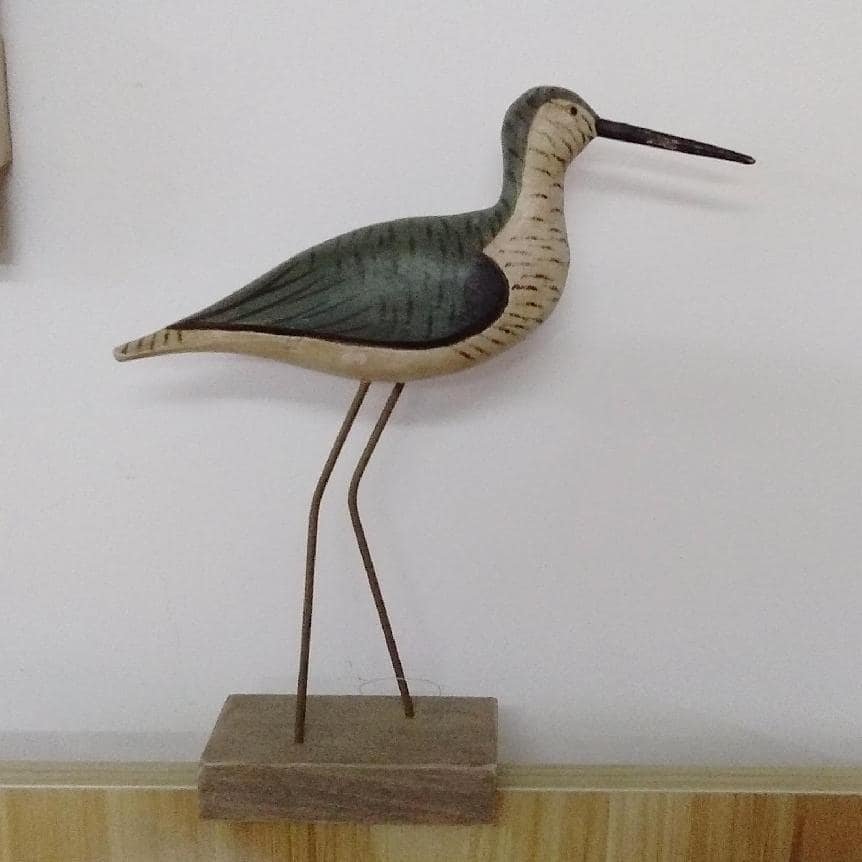
The “Stick Bird” Sandpiper
If you’ve been to a primitive show in New England or browsed the “country folk art” section of an antique mall, you’ve seen these. A simple carved body — teardrop-shaped, slightly elongated for the sandpiper’s profile — mounted on two thin wire rods (the “sticks”) stuck into a small flat base or a chunk of rough wood. Wire legs, bent by hand. Metal on wood. The paint, if there is any, is a single muted color — barn red, mustard, charcoal, cream — applied thin and then sanded back so the wood shows through at the high points.
This is the piece that defines the category. We sell more of these than any other decoy style by a factor of three. The reason is versatility: they work on a shelf, a mantel, a windowsill, a tabletop vignette. They group beautifully — five or seven at staggered heights on a long shelf creates that “collected over years” look that primitive buyers crave. And they’re small enough (6–9 inches total height including sticks) that a shop can display thirty of them in a three-foot space.
One thing to watch: The stick bird decoy is the easiest to get wrong. If the carving is too smooth, too symmetrical, too “finished,” it reads as a craft-fair trinket rather than a folk-art reproduction. The form needs slight irregularity — one wing a fraction higher than the other, the head tilted two degrees off axis. That’s not a defect. That’s the hand of the maker, which is the entire point.


The Plover — Rounder, Quieter
Where the sandpiper is elongated and elegant, the plover is round. Plump body, short beak, almost egg-shaped. It reads less as “bird” and more as “wooden object that suggests a bird.” This is the piece for the ultra-minimalist primitive buyer — the one whose shelf has three objects on it, total. One plover. One worn book. One iron candleholder. Done.
We make these in two versions: painted (thin wash of color, heavily sanded) and raw (just stained wood, no paint at all, sealed with a matte wax). The raw version has been gaining ground. There’s a subset of the primitive market moving toward “unfinished” — objects that look like they were carved yesterday and never got around to being painted. It’s a more Scandinavian-inflected take on the style, and it’s growing.
The Curlew — Long Beak, High Drama
The curlew is the showpiece. That absurdly long, downcurved beak makes it instantly distinctive — there’s no mistaking it for a generic “bird shape.” In the antique decoy world, curlew carvings command premiums because the beak is fragile on originals and many have broken over 150 years. A clean, intact curlew decoy at auction is an event.

Our reproduction captures that drama. The beak is carved as part of the body block — not a separate piece glued on, which would be the weak point. We elongate the form to about 11 inches total, which gives the beak proper proportion. On a shelf, the curlew is the exclamation point. You put a row of five stick bird decoys and one curlew at the end, and the eye goes straight to the curlew every time.
The “Family Group” — Five Birds, One Board
Five stick birds of varying species and heights (sandpiper, plover, two sizes of gull, one curlew) mounted together on a single rough-edged board. About 18 inches wide. This is the “mantel piece” — the one object that fills the space above a fireplace without needing any styling. It reads as a collected group, a little flock frozen on a driftwood shelf. Very giftable. Very photogenic. Sells strongly in the $40–$60 retail range, which is the sweet spot for primitive gift buyers.

This is our best “first order” item for a shop new to primitives. One SKU, one display footprint, immediate visual impact. No merchandising creativity required. Put it on a shelf at eye level. It sells itself.
What Makes a Reproduction Convincing
The primitive buyer is educated. They’ve handled real 19th-century decoys. They’ve been to the Shelburne Museum, they’ve read the auction catalogs, they know what a century of wear looks like on pine and pine. A reproduction that looks “new” is dead on arrival in this market. Here’s what separates a piece they’ll pick up and hold from one they’ll walk past:
The distressing has to be specific, not random. Real wear happens at contact points — the breast where a hand would grip, the tail edge where it rubbed against a shelf, the bottom where it sat on rough wood. We sand those areas more aggressively. The top of the head, the back — less wear. Random orbital-sander distressing (which is what most factories do) looks fake immediately. The eye knows where wear should be, even if the buyer can’t articulate why something looks “off.”
The paint has to be thin. Original decoys were painted with whatever was available — milk paint, house paint, leftover barn red. It went on thin, it wore off in patches, and what remained was a stain more than a coating. Our finish is a diluted acrylic wash rubbed into the grain, then sanded back. It’s not a “paint job.” It’s a tint. You can still see every tool mark, every grain line, through it. Thick opaque paint kills the primitive look instantly.
The form should be slightly “wrong.” Machine-perfect symmetry reads as factory. A real folk carving has a personality — the maker’s hand was steady on one side and slightly less steady on the other. We train our carvers to leave subtle asymmetries. Not sloppiness. Character. It’s the difference between a photocopy and a letterpress print. Both reproduce the same image. One has a soul.
Who Buys This (And Where)
The primitive market is geographically concentrated and demographically specific. If you’re outside it, it can seem invisible. Inside it, it’s a passionate, loyal, repeat-buying community.
Geography: New England (especially Vermont, New Hampshire, Maine, coastal Massachusetts), Pennsylvania Dutch Country, the Shenandoah Valley, parts of the Midwest (Ohio, Indiana, Iowa). Also a surprising pocket in the UK Cotswolds and rural France, where the “French country” aesthetic overlaps heavily with American primitive.
Channels: Independent primitive shops (there are maybe 200–300 significant ones in the US), antique malls and shows, Etsy sellers specializing in “primitive folk art,” and a handful of catalog/online retailers (think the Vermont Country Store aesthetic). Very little Amazon presence — this buyer doesn’t shop there. They want a story, a maker, a sense of place.
The buyer: Typically 45–70, female-skewing, homeowner, values authenticity over novelty. Buys fewer things but better things. Will pay $45 for one perfect stick bird if it feels right, and will walk past a $12 one that feels “off.” Loyalty to shops that curate well is fierce. They’ll drive two hours to a primitive show and spend an afternoon.
If you’re stocking for this market, the finish is everything. Browse our full wooden bird factory collection for more decoy styles. A perfectly carved bird with the wrong paint treatment won’t sell here. And a slightly rough carving with the right worn finish will fly. Prioritize accordingly.
Ordering Notes
Colorways. We work in a fixed palette for primitives: barn red, mustard yellow, charcoal black, cream white, sage green, and natural (unstained). You can mix freely within an order. Most shops order 60% natural/cream and 40% colored, because the neutrals sell faster. But the colored ones are what catch the eye in a window display, so don’t skip them entirely.
No two are identical. This is a feature, not a bug. Because the distressing is hand-done, every piece varies slightly. If you’re an online seller, photograph a representative piece and note “each bird is individually finished — yours will vary slightly.” Primitive buyers expect and want this. Uniformity is the enemy.
These are NOT hunting decoys. I put this in bold because we get the question every month. These are decorative objects. They are not waterproofed for outdoor use. They are not weighted for floating. They are not sized to fool a real sandpiper at forty yards. If a customer asks “can I use this in my duck blind?” the answer is no. They’re for a shelf, a mantel, a table. They’re art that references a functional tradition.
Lead time and MOQ. Same as our full catalog: 300 pieces total across all styles and colors, 60–90 days for production. The family group boards count as one unit each. For a first order, I’d suggest 150 stick birds (mixed species), 50 plovers, 30 curlews, and 70 family boards. That gives you breadth without overcommitting to any single form. Send us your mix and we’ll confirm availability and timing.
Spec Reference
| Detail | Spec |
|---|---|
| Styles | Stick bird sandpiper, plover, curlew, gull, family group board (5 birds) |
| Sizes | Stick birds: 6–9 in total height. Curlew: 11 in. Plover: 5–6 in. Family board: 18 in wide. |
| Material | Kiln-dried pine. Wire legs (hand-bent metal rods). Rough-cut base or natural slab. |
| Finishes | Hand-rubbed paint wash (barn red, mustard, charcoal, cream, sage) or natural raw wax. All sanded back for worn appearance. |
| Intentional variation | Each piece individually distressed. No two identical. Slight asymmetry in carving is by design. |
| MOQ | 300 pcs total, mix styles and colors freely. |
| Lead time | 60–90 days. Partial stock possible on standard stick birds in natural/cream — ask. |
| Packaging | Individual tissue wrap. Curlew beaks protected with internal cardboard cradle. Family boards boxed flat. |
| Use | Decorative only. Not waterproof. Not for outdoor or hunting use. Indoor display. |
Vintage-style stick bird decoys occupy a fascinating niche within the 20/60/20 merchandising framework — they’re premium statement pieces for antique and primitive decor shops, not volume sellers. The distressed and aged finishes are what make or break the illusion of authenticity. For shops wanting exclusive designs, custom carving with your own patterns creates a product line no competitor can match.
Stock Decoys That Pass the “Ruth Test”
Hand-carved. Hand-distressed. Slightly imperfect on purpose.
The stick birds, plovers, and curlews that primitive buyers pick up and hold.
Frequently Asked Questions
Are these shorebird decoys meant for actual outdoor hunting use?
No. These are decorative reproductions inspired by the form of traditional hunting decoys. They are not waterproofed, not weighted for floating, and not finished to withstand outdoor weather. They’re designed for indoor display — shelves, mantels, tabletops, window vignettes. The aesthetic references the 19th-century shorebird decoy tradition, but the function is purely decorative. Think of them as folk art objects, not sporting equipment.
How do you create the antique, vintage finish on the pine?
A two-step hand process. First, a diluted paint wash (acrylic, thinned to a stain consistency) is rubbed into the grain — not brushed on thick. Then, while it’s still slightly tacky, we hand-sand the high-wear areas: breast, wing edges, tail, base contact points. The result is color in the grain and recesses, bare wood on the raised surfaces. It mimics decades of handling and shelf wear. No two pieces come out identical because the sanding is done by feel, not by machine. For the “raw” versions, we skip paint entirely and use a tinted wax that darkens the grain without adding color.
What exactly is a “stick bird” style shorebird decoy?
A stick bird is the simplest form of shorebird decoy: a carved body (usually teardrop or elongated egg shape) mounted on two thin wire rods that serve as legs, bent and stuck into a small base. No carved feet, no elaborate detailing — just the body and the wire legs. It’s the form most associated with American primitive folk art. Original 19th-century examples were carved by hunters from whatever wood was available, with minimal tooling and a quick dash of paint. Our reproductions honor that simplicity: pine body, wire legs, hand-rubbed finish, rough base.
Can I order shorebird decoys without any paint, just raw stained wood?
Yes. Our “natural” finish is raw pine sealed with a clear matte wax — no paint, no stain, just the wood’s own color and grain. We also offer a lightly tinted wax (very pale amber) that warms the tone slightly without looking “finished.” The raw/natural versions have been growing in demand, especially from buyers who lean toward the Scandinavian-minimal end of primitive style. You can mix painted and natural freely within your 300-piece order.