Skip to content
Christmas decor shipping deadlines decide who sells at full margin in December and who pays peak-season premiums for the same cartons. The freight problem is seasonal by design: carriers announce peak surcharges, port and warehouse capacity tightens on the main Asia-to-Europe and Asia-to-North-America lanes, and every day of delay in Q4 costs more than the same delay in August. None of that is controllable from a factory in Jilin — which is exactly why the controllable parts matter so much: the production lead times, the export packaging that survives peak handling, and the incoterms that decide who owns a delay. Here is the deadline logic our Christmas buyers use, with the numbers from our own shipping setup.
- Count backwards from your shelf. Production (7–90 days depending on tier) plus four to six weeks of ocean transit sets your hard order date.
- Packaging is your best freight insurance. ISTA 3A drop-tested 5-layer cartons are built to survive peak-season handling without a damage claim.
- Choose incoterms deliberately. DDP puts door-to-door delivery, including customs, on the supplier — useful for FBA and first-time importers.
- Air is the rescue lane, not the plan. A 100-piece DDP air trial from USD 500 covers testing and late-season gaps.
- Verify before you pay. Finished-goods photos and videos arrive before the final balance — the checkpoint that stops freight from shipping surprises.
Why Christmas Freight Is Different
Ocean freight is a seasonal market. As retailers across Europe and North America pull holiday inventory forward in Q3, carriers respond with peak-season surcharges, rolling bookings become common, and transit times stretch as every port in the chain absorbs more volume than it was built for. For a hand-carved ornament, the consequences are concrete: a container that would sail within days of booking in March can wait weeks for space in October, and a missed connection in a transshipment port can add another week that December never gives back. Blank sailings — scheduled departures carriers cancel outright — cut capacity without warning in the same window, and the space that does sail is allocated to contract customers first.
The defense is not cleverness; it is slack. Build the full pipeline into your calendar — production, booking, sailing, customs, drayage — and treat the freight leg as the part with the widest variance. Our own contribution to that slack is a production schedule that is fixed and visible: ready stock in 7–15 days, trial orders in 20–30 days, bulk hand-carved custom work in 60–90 days. When production is predictable, freight variance is the only variable left, and it is much easier to manage one variable than three. In practice, that is what Christmas decor shipping deadlines are: a fixed production promise with a padded freight leg, so the only open question is when the cartons reach the origin port.
The Deadlines That Actually Matter
Four dates rule a Christmas import program, and none of them is the day you want the goods:
| Date | What it is | Rule of thumb |
|---|---|---|
| Order date | Volume order confirmed with deposit | August for hand-carved volume; September is the last sea-freight call |
| Production complete | 7–90 days after order, by tier | Confirm via pre-shipment photos and videos |
| Container sailing | Vessel departure from origin port | Before mid-October to stay clear of the worst congestion |
| Door delivery | Customs cleared, at your warehouse or FBA center | Count four to six weeks from sailing, with buffer |
One planning habit does more than any deadline table: split your Christmas program into the part that must arrive early (your core assortment, ordered by August) and the part that can arrive late (reorders of proven sellers, placed against ready stock in November). The split converts freight risk from a program-wide threat into a small, hedged exposure — ready-stock lines carry the late season, while the hand-carved volume booked in August is already on the water — and the ornament catalog is structured to support exactly that.

Packing That Survives Peak Handling
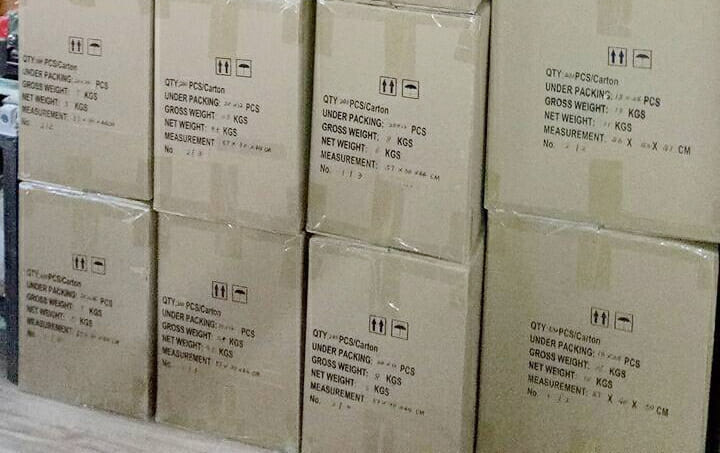
Peak season is when packages get treated worst, and a damage claim in December is worse than an empty shelf — the goods are unrecoverable and the customer relationship pays for it. Our export packing is engineered for that reality rather than for the brochure photo: every piece is individually paper-wrapped, inner boxes hold 6–12 pieces in 3-layer corrugated cartons (21 x 11 x 14 cm), and master cartons hold 240–480 pieces in 5-layer reinforced board (58 x 44 x 31 cm, 8.0–15.0 kg) that has passed ISTA 3A six-side drop testing.
The details matter beyond the drop test. Consistent carton dimensions make palletizing and container stowage predictable, which is why our container loading guide treats packaging as a CBM decision as much as a protection decision. Custom color boxes, gift boxes, labels, and shipping marks are all available from 500 pieces — but they must be approved before production locks, because a packaging change in October is a delay, and a delay in October is air freight.

Incoterms: Who Owns the Delay
Incoterms are where shipping deadlines become contractual. We support the full set — EXW, FOB, CFR, CIF, DDU, and DDP — and each one answers the same two questions: who books the freight, and who owns the risk when the container sits an extra week in Rotterdam or Long Beach. Under FOB the factory delivers to the origin port and the buyer owns the ocean leg; under DDP the supplier carries the shipment door-to-door, customs included, with no hidden charges at destination.
For Christmas decor, DDP tends to win for two buyer profiles: Amazon sellers who need goods delivered into FBA centers without handling clearance themselves, and retailers running their first import season who prefer one accountable party for the whole journey. It is available to commercial warehouses and Amazon FBA centers across the US, Europe, and Australia. Whatever term you choose, agree it in writing before production starts — switching incoterms mid-order is how deadlines quietly die.
One structural trick is worth knowing: split the shipment. Buyers with tight calendars sometimes fly the fast-moving portion of the assortment while the balance sails — the container carries the bulk at full margin, and a small air parcel covers the store’s opening weeks. It is not free, but it converts a binary risk (everything late) into a tiered one (a small part arrives early, the rest when the water allows). The incoterms above stay the same; only the split of modes changes, and it is a conversation worth having with your forwarder before peak season closes the options.
The Air-Freight Rescue Lane
Air freight is the wrong base plan for ornaments — it costs multiples of sea freight per kilogram — and the right tool for two specific jobs. The first is testing: a 100-piece trial order from USD 500 ships DDP by air with customs included, which lets a buyer validate a design in weeks rather than waiting for a container. The second is rescue: when a November reorder of ready-stock designs (7–15 days production) must reach shelves before the season ends, DDP air is the lane that can actually do it.
Used as the plan instead of the exception, air freight quietly erases the margin the season was supposed to create. The discipline is to price it once, keep it reserved for trials and true emergencies, and protect the sea-freight program with the buffer it needs. For a fuller look at how packaging and testing standards fit into that program, our ISTA packaging SOP covers the drop-test protocol we run on export cartons.
One cost rule keeps the rescue lane honest: compare the air premium against the margin of the goods, not against the sea quote in the abstract. For a 100-piece trial the air cost is absorbed by the value of the market test — you are buying information about a design, not just freight. For an entire assortment the same premium multiplies across thousands of pieces and quietly erases the season’s margin. Run the per-piece number once and the air-versus-sea decision becomes arithmetic instead of panic.
Build Your Christmas Decor Shipping Deadline Calendar Backwards
Deadlines only work when they are derived, not guessed. Start from the date your assortment must be in place — say, November 1 for a store display or an FBA check-in. Walk backwards: subtract one to two weeks for domestic distribution and final prep, then four to six weeks of ocean transit and clearance, and you land on the sailing date — mid-September to early October for that November 1 door date. Subtract the production tier on top — 60–90 days for bulk hand-carved custom work, 20–30 days for trials, 7–15 days for ready stock — and you reach your true order date, which is the only number in the whole chain you actually control.

Run that arithmetic for your own calendar and Christmas decor shipping deadlines stop being dates you react to and become dates you set. Two habits make the difference in practice. First, write the dates down: a one-page calendar with order date, production-complete date, sailing date, and door date per line, shared with your supplier, turns vague promises into a schedule either side can be held to — and when something slips, a missed date on paper is a fact to solve, not an argument to have. Second, hold buffer on the only leg with real variance — the ocean. Padding your sailing date by two weeks costs nothing in August and buys everything in October.
A Shipping Deadline Checklist
| Checkpoint | Done when | Failure looks like |
|---|---|---|
| Incoterm agreed | Before the 30% deposit | Mid-order renegotiation, missed bookings |
| Packaging spec approved | Before production locks | October change orders, delayed sailing |
| Pre-shipment media reviewed | Before the 70% balance | Paying for goods you have not seen |
| Sailing date confirmed | Bill of lading issued | Rolled bookings discovered late |
Run these four checkpoints and Christmas freight stops being a bet and becomes a schedule — which is the entire point of treating Christmas decor shipping deadlines as a calendar exercise rather than a fire drill. The Christmas crafts collection ships on exactly the terms described here — deadlines included, surprises excluded.
Frequently Asked Questions
When should my Christmas container sail to arrive on time?
Aim for departure by mid-October at the latest. Count four to six weeks from sailing to door delivery with buffer, and remember that peak-season congestion stretches transit times. Earlier sailing is always cheaper than a faster ship.
Which incoterm is best for Christmas decor imports?
DDP is the safest for first-time importers and Amazon sellers, because the supplier carries the shipment door-to-door with customs included to US, European, and Australian warehouses and FBA centers. We also support EXW, FOB, CFR, CIF, and DDU.
How is the packaging tested for peak-season handling?
Master cartons are 5-layer reinforced board holding 240 to 480 pieces at 8.0 to 15.0 kg, and pass ISTA 3A six-side drop testing. Pieces are individually paper-wrapped inside 3-layer inner boxes of 6 to 12 pieces.
Can air freight save a late-season reorder?
Yes. Ready-stock designs ship in 7 to 15 days, and trial orders from 100 pieces at USD 500 go DDP by air express with customs included. Air is the rescue lane for late-season gaps, not the base plan.
What do I check before releasing the final payment?
You receive finished-goods photos and videos before the 70% balance is due. Review them against the approved sample, confirm carton quantities and markings, then release payment so the shipment is not delayed at origin.
Ship Christmas decor on a deadline you control
ISTA-tested cartons, DDP door-to-door, and a schedule that keeps your peak season off the air-freight lane. Browse the full catalog or lock your production slot now.
Plan Your Christmas Shipment →