Skip to content
Personalized Christmas ornaments are the one holiday SKU where the retailer’s data discipline matters more than the product. A carved ornament sells on craftsmanship; a named one sells on getting a household’s spelling right, across a list of two hundred names, under a deadline that does not move. Every failure mode here is a data failure mode.
This guide is for gift shops, garden centres, boutique chains and corporate-gift resellers carrying personalized Christmas ornaments as a programme rather than a seasonal favour. It covers the three tiers and what each costs operationally, factory versus in-store personalization, how per-unit variation changes MOQ and lead time, and the proofing step that prevents the category’s most expensive mistake.
Key Takeaways
- Three tiers, three different operational problems: logo-or-year only is a tooling decision, per-recipient names are a data-verification decision, and family sets are an assembly and packaging decision.
- Misspelling a customer’s own name on their own gift is the most expensive error in the category, because the piece cannot be sold to anyone else. Proof the actual name list back to the buyer in writing before production.
- Per-unit variation does not change the minimum order, but it changes the lead time and the inspection. A 300-piece run with 300 different names is not the same job as 300 identical pieces.
- In-store engraving and factory engraving are different businesses. One buys you margin and turnaround at the cost of equipment and staff time; the other buys you consistency at the cost of a longer, earlier order.
- Packaging is part of the product here. A named ornament is a gift before the customer wraps it, so the insert card and the box do selling work that a poly bag cannot.
- Order against the production calendar, not the display date. Trial orders run 20–30 days; bulk production runs 60–90 days to port before freight and clearance.
In This Guide
- The Three Personalization Tiers
- The Name-List Problem and How to Proof It
- In-Store Engraving Versus Factory Engraving
- Family Sets and Multi-Piece Programmes
- How Personalization Changes MOQ, Lead Time and Inspection
- Best For / Not For: Which Tier Fits Which Retailer
- What We Check Before a Personalized Order Ships
- End to End: A 400-Name Personalized Programme
- Frequently Asked Questions
The Three Personalization Tiers
“Personalized” covers three levels that have little in common operationally. Naming them separately stops a quote turning into an argument in November.
| Tier | What Varies Per Unit | The Real Constraint | Typical Buyer |
|---|---|---|---|
| Tier 1 — shared mark | Nothing; one logo, one year, one message across the run | Artwork viability — thin strokes and reversed type vanish at ornament scale | Retailers stocking a branded seasonal line, corporate buyers gifting one mark |
| Tier 2 — per-recipient text | A household name, sometimes a year or an address | Data quality and written proofing, not the machine | Agents, agencies and schools sending to a known list |
| Tier 3 — family set | Multiple pieces assembling into one story, each marked | Assembly, piece count and packaging — a short set is a total failure | Premium gift retail, milestone and keepsake programmes |
The tiers are also a price ladder, which is why retailers who understand them quote confidently rather than defensively. Tier 1 is a tooling decision, Tier 2 a verification decision, Tier 3 an assembly decision — and a buyer asking “how much extra for names?” is asking about Tier 2 while thinking of Tier 1. The construction choices underneath are set out in our comparison of hand-carved versus laser-cut ornaments.
The Name-List Problem and How to Proof It
A per-recipient order turns one production decision into several hundred, none of them made by the person holding the carving. The list arrives as a spreadsheet assembled from a CRM export, a notebook and a memory of what a client’s child is called. Diacritics get stripped, hyphenated surnames split across two columns, “The Johnsons” and “Johnson Family” appear as separate households, and a nickname lands in a field expecting a legal name.
Four rules keep that from becoming a write-off. Ask for one column per engraved line with nothing else in it — no notes, no gift text, no internal codes. Require a stated character limit per line, because a 22-character surname on a 7 cm ornament is a design problem, not a typing problem. Proof the parsed list back rather than the file they sent: a rendering of exactly what will be engraved, line by line, approved in writing. And freeze the list at a stated date, because “two more names” in week six is a new production slot.
The proofing step is the one retailers skip under pressure and the one that always comes back. A misspelled name cannot be re-engraved over, cannot be sold to anyone else, and reaches the recipient with the retailer’s name attached to the mistake.
In-Store Engraving Versus Factory Engraving
Two models; the right one depends on your traffic pattern rather than your margin target.
- In-store, at the counter. You buy blanks unengraved and personalise on demand: zero name-list risk, no minimum on variation, and a customer who watches their own name go on. The cost is equipment, staff minutes at the busiest moment of the season, and a December queue.
- Factory-engraved to a list. You send names and receive finished pieces. The advantage is consistency, speed at the register and no equipment on site. The cost is the proofing cycle, a longer and earlier order, and no recovery when a name changes after the list is frozen.
- Hybrid, which is what most good programmes actually run. Factory-engrave the predictable volume — corporate lists, school orders, repeat households — and hold blanks for counter personalisation and late names. The blank side is a separate buying decision, covered in our guide to unfinished wooden Christmas ornament blanks.
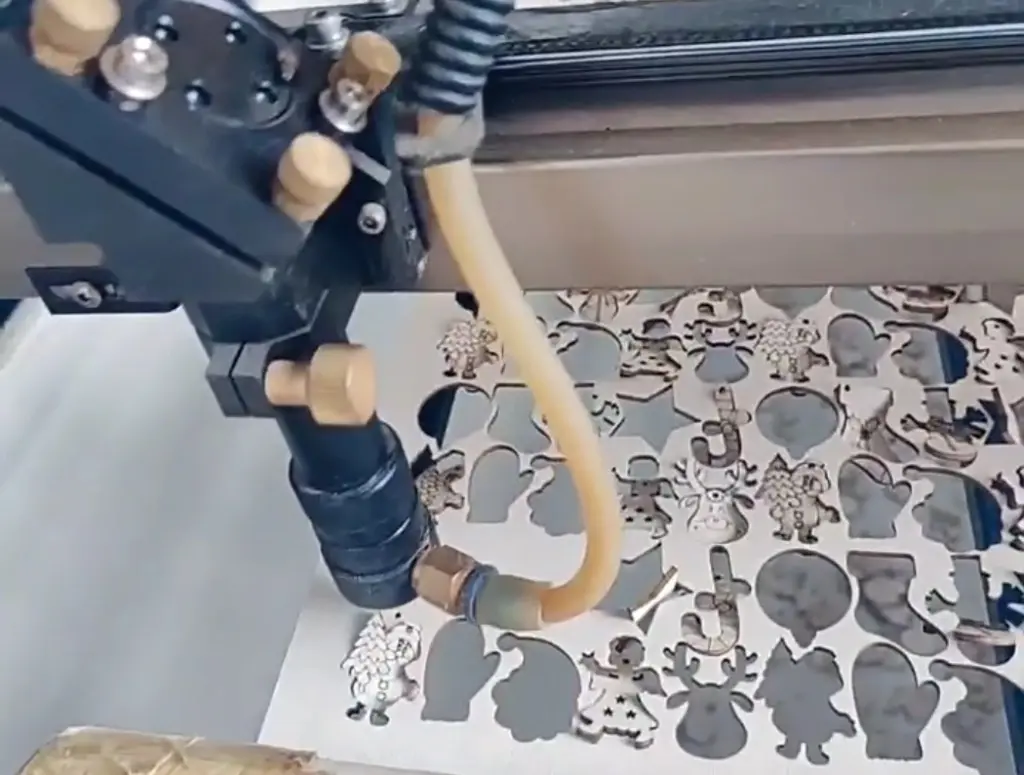
Whichever model you run, the method must suit the material: laser gives a permanent high-contrast mark on pale woods with no consumables, while hand-painted names read as premium and cost artisan minutes per piece. That choice belongs in the specification.
Family Sets and Multi-Piece Programmes
A family set is one SKU of several marked pieces, and it fails in ways a single ornament cannot. Three problems are specific to it:
- Piece count is a completeness check, not a quantity check. A four-piece set that ships three pieces is not 75% delivered; it is undeliverable. Sets are counted per box against that household’s configuration sheet.
- The set has to read as one design. Scale, finish and palette must hold across the pieces, or the grouping looks like leftovers from three product lines — a batch-consistency requirement, not a styling preference.
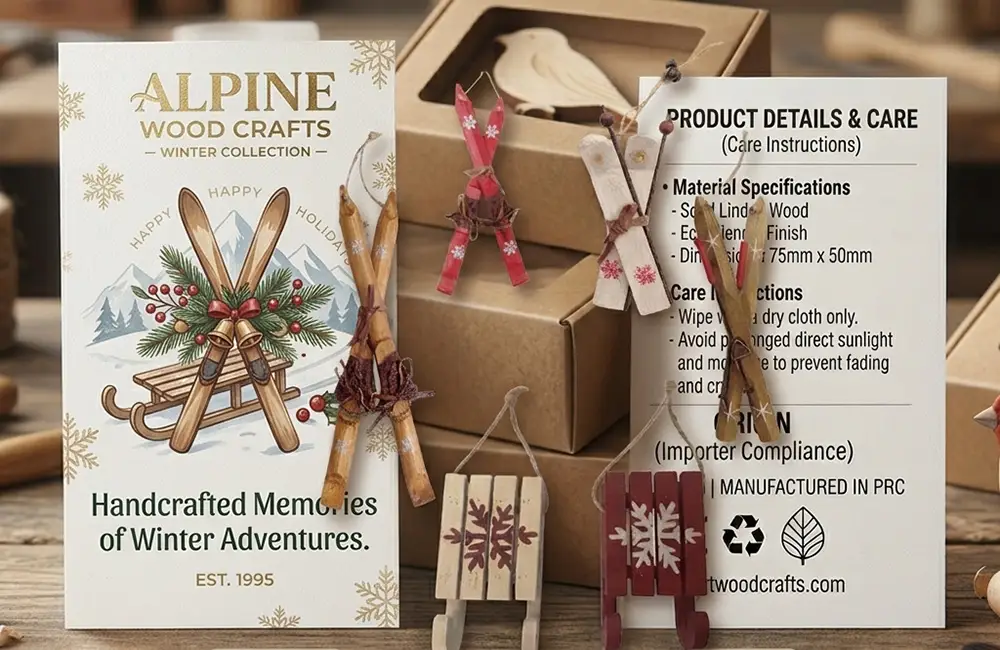
- Packaging carries the gift. A set with an insert card, a household name on the box and a place for each piece is a present; the same pieces in a poly bag are components. Our guide to packaging wooden crafts covers the tiers and what each adds to unit cost.
How Personalization Changes MOQ, Lead Time and Inspection
Per-unit text rarely changes the minimum; it changes everything around it.
- Minimums stay per design, not per name. Our trial tier is 100 pieces with a USD 500 minimum order value on in-stock designs; wholesale and custom run 300 pieces with a USD 3,000 minimum order value. Three hundred pieces carrying three hundred names still count as one design commitment, and a custom printed box is a separate 500-piece minimum.
- Lead time absorbs the proofing cycle, not the engraving. Engraving a name takes seconds; getting written approval on a parsed list takes as long as the buyer takes, and it sits on the critical path. Trial orders run 20–30 days and bulk 60–90 days to port — add the proofing round in front of that, not after it.
- Inspection changes from sampling to matching. A shared-mark run can be sampled; a per-recipient run must be verified against the list, piece to name, because the defect that matters is unique to each unit.
- Freight is decided by the delivery term. Trial orders ship air express on DDP terms so duty and clearance are handled for you; bulk moves by sea freight, where who carries cost and risk is set by the term you agreed, per the ICC Incoterms rules.
The full commercial detail, including how design count multiplies commitment, is in our MOQ and cost guide and the seasonal calendar in our guide to 2027 Christmas decor trends.
Best For / Not For: Which Tier Fits Which Retailer
| Retailer | Best For | Not For | Start With |
|---|---|---|---|
| Independent gift shop, high footfall | Counter personalisation on blanks; the demo sells itself | Long pre-committed name lists it cannot staff in December | Blank stock plus one engraved sample set for the display |
| Boutique chain, planned seasonal buy | Factory-engraved Tier 1 and Tier 2 against a known list | Late additions — the list has to freeze before the slot books | Trial tier to validate artwork, then wholesale tier |
| Corporate and agency reseller | Tier 2 at volume for client lists, boxed with an insert card | Walk-in retail — this is a programme sale, not a shelf sale | One shared mark plus a named tier for top clients |
| Museum and heritage store | Tier 3 family sets with provenance-led packaging copy | Volume impulse pricing — the set cannot carry it | A small set programme with a written naming convention |
Where personalised volume comes from agency client lists, the recipient-tier logic is in our client-appreciation Christmas gifts guide and the fixture side in our ornament retail display guide.
What We Check Before a Personalized Order Ships
Per-unit marking moves inspection from sampling to matching, so the checks are ordered around the list, not the batch.
- Name-to-piece match against the approved proof. Every engraved line is checked against the written proof, not against the original spreadsheet the buyer sent, because parsing is where errors enter.
- Diacritics, hyphens and character limits. Accented characters and hyphenated surnames are verified as rendered, since a font substitution here is invisible until the piece is in a customer’s hand.
- Engraving contrast after finish. Marks are inspected once the topcoat has cured, because a finish can drop contrast below legible on pale woods.
- Set completeness per household. Multi-piece sets are counted against their configuration sheet and boxed as a unit, so a short set cannot leave the line.
- Moisture content and packing. Blanks are verified against our wood moisture content standard; pieces are white-paper wrapped, 6–12 per inner box and 240–480 per five-ply master carton at 8.0–15.0 kg gross, rated for an ISTA 3A drop test.
- Evidence before balance. Photographs and video of the finished goods are supplied before the 70% balance falls due on our T/T 30/70 terms, so the buyer sees the run they are paying for.
End to End: A 400-Name Personalized Programme
A three-store boutique group runs a December programme: 400 household names across two designs plus 60 family sets, sold in store and shipped direct to a corporate client list.
July — tier split and artwork. The group splits the programme into Tier 1 (a shared seasonal mark on open-stock designs), Tier 2 (household names on the corporate list) and Tier 3 (the 60 family sets). Artwork is assessed for engraving viability at ornament scale; thin strokes are redrawn now, not discovered in October.
August — list intake and written proof. Names arrive in the agreed format: one column per engraved line, stated character limit, freeze date on the file. The parsed list is rendered back and signed off in writing; nothing enters production before that signature, because after it the slot is booked.
September to November — production. The order sits on the wholesale tier — 300 pieces, USD 3,000 minimum order value per design, sea freight, 60–90 days to port — which is why an August proof is the last comfortable date for a December shelf. Sets are counted per household; single pieces are matched name to unit at inspection.
Late November — landing and floor set. Goods clear, corporate allocations are separated from retail stock, and the display is built with engraved samples beside a bin of blanks for counter personalisation. Photographs and video of the finished run were supplied before the balance was paid.
December and after — the reorder conversation. Names arriving after the freeze go on the in-store blanks. Next season the artwork and naming convention are already on file, so the programme restarts with a list rather than a project. The wider assortment sits in the wooden Christmas ornament buyers catalog and the ordering sequence in our procurement guide for wooden crafts.
If you are building a personalized Christmas ornament programme and want the tier split, engraving method, proofing cycle and carton plan quoted against your actual name count, our team will put that sheet together with you.
Frequently Asked Questions
Q: Can every ornament in an order carry a different name?
Yes. Per-unit engraving is standard for this category, and the minimum order applies per design rather than per name. What changes is the process: the parsed list is proofed back in writing and every piece is matched to it at inspection, rather than the run being sampled.
Q: How do I stop names being spelled wrong?
Control the intake format and proof the output. Ask for one column per engraved line with a stated character limit, require a freeze date, and approve a rendering of exactly what will be engraved rather than the spreadsheet you sent. Most errors enter during parsing, not during engraving.
Q: Is in-store engraving better than ordering them pre-engraved?
They solve different problems. In-store removes name-list risk and adds a demo that converts, at the cost of equipment and December staff minutes. Factory engraving gives consistency and fast checkout, at the cost of an earlier order and no recovery once the list freezes. Most strong programmes run both.
Q: What is the minimum order and lead time for personalized ornaments?
Trial orders start at 100 pieces with a USD 500 minimum order value on in-stock designs, air express DDP, 20–30 days. Wholesale and custom run 300 pieces with a USD 3,000 minimum order value, sea freight, 60–90 days to port; custom printed boxes require 500 pieces. Add the proofing round in front of those figures.
Q: How should family sets be packed and counted?
As one unit against a configuration sheet, not as loose pieces. Sets are counted per box at packing, boxed with an insert card and the household name on the outside, and separated from single-piece stock so store staff are not assembling gifts at the register.
Sources
Freight cost and risk transfer are defined by the ICC Incoterms rules. Where a personalized ornament could reasonably be treated as a child’s article, finish safety is governed by the EN71 toy safety standards. Minimums, order values, lead times, payment terms and packaging specs above are our published first-party terms; no per-unit engraving surcharge is stated, because personalized programmes are quoted against the specification.