Skip to content
When sourcing custom salt slabs wholesale, project buyers—such as spa contractors building salt walls, restaurant suppliers stocking cooking slabs, and animal nutrition companies distributing lick blocks—know that incorrect dimensions are the single most common source of cost overruns. A salt wall designed for 200 × 100 × 50 mm slabs that arrives at 203 × 102 × 52 mm simply does not fit. Gaps widen, alignment fails, and the contractor faces either expensive on-site re-cutting (salt is abrasive and destroys standard saw blades) or a full reorder from 5,000 km away. This guide explains how to specify, source, and verify cut-to-size Himalayan salt slabs so that every piece arrives perfectly dimensioned for your project.
Types of Cut-to-Size Himalayan Salt Slabs
Himalayan salt slabs are not a single product—they are a family of cut forms, each serving a distinct application. Understanding the differences before specifying dimensions prevents ordering the wrong product type.
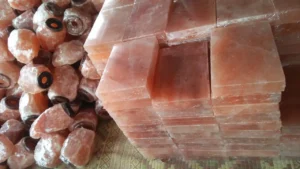
Salt bricks for wall assembly. Standard salt bricks are rectangular blocks designed to be stacked and mortared (or dry-fitted) into salt walls for halotherapy rooms, spa caves, and decorative feature walls. Common dimensions include 200 × 100 × 50 mm and 250 × 125 × 75 mm, but project buyers frequently require non-standard sizes to match architectural plans. These bricks are classified under HS Code 2501.0019 or 2501.0020 depending on the destination market.
Food-grade cooking slabs. Thicker, denser slabs designed for grilling, serving, and food presentation. Typical thickness ranges from 20 mm to 50 mm, with surface dimensions customized to fit commercial ovens, grills, or serving platters. Food-grade slabs must meet purity standards for direct food contact and are classified under the same HS Code heading as salt bricks.
Animal lick blocks. Compressed or cut salt blocks formulated for livestock and wildlife nutrition. These are typically larger (often 5–25 kg) and prioritized for mineral content and durability rather than surface finish. Dimensions are specified to fit standard mounting hardware or trough holders used in agricultural settings.
How to Specify Dimensions and Tolerances
The gap between a successful custom salt slab order and a failed one almost always comes down to tolerance specification. Salt is a natural mineral with variable density and cleavage planes—it does not machine with the precision of metal or plastic. Understanding realistic tolerances prevents disputes and ensures the slabs fit their intended application.
For salt wall bricks: The critical tolerance is face flatness and edge straightness, not absolute dimensional accuracy. When assembling a salt wall, the visual gap between bricks matters more than whether each brick is exactly 200 mm long. Specify a maximum gap tolerance (e.g., ±2 mm on face dimensions) rather than an absolute dimension. The factory’s cutting team can then optimize their blade paths to maximize yield from each raw block while staying within your gap tolerance.
For cooking slabs: Thickness tolerance is the critical parameter. A cooking slab that is too thin will crack under thermal stress; one that is too thick will not heat through evenly. Specify thickness as a fixed dimension with a ±1 mm tolerance, and allow face dimensions to vary within ±3 mm. For slabs designed to fit specific equipment (commercial grills, oven racks), provide the exact equipment cavity dimensions so the factory can cut to fit.
For animal lick blocks: Dimensional precision is less critical than weight consistency. Specify a target weight per block (e.g., 10 kg ±5%) rather than exact dimensions, since the natural density of Himalayan salt varies slightly between batches. The factory cuts to approximate dimensions that achieve the target weight range.
Factory Cutting Capabilities and Limitations
Understanding what a salt slab factory can and cannot do helps buyers set realistic specifications and avoid designs that are impossible to manufacture consistently.
Himalayan salt is cut from large raw blocks quarried at the Khewra Salt Mine in Pakistan. The raw blocks are transported to processing facilities where they are sawn into slabs using diamond-tipped wire saws or gang saws. The cutting process generates significant heat and dust, requiring water cooling throughout. Each raw block has natural cleavage planes, fossil inclusions, and density variations that the cutting operator must navigate—cutting against a dense fossil inclusion can chip the slab face, while cutting along a natural fracture line can cause the slab to split unpredictably.

At Jilin Ever Creation (brand: ewoodarts), the factory’s cutting capability covers salt bricks from 25 mm to 150 mm thickness, cooking slabs from 15 mm to 60 mm, and large-format blocks up to the maximum raw block size. The factory controls three quality parameters during cutting: dimensional accuracy (verified against the buyer’s specification), surface flatness (critical for wall assembly where uneven faces create visible gaps), and density consistency (high-density slabs are sorted for cooking and wall applications; lower-density pieces are diverted to animal lick block production).
For buyers who need very thin slabs (under 20 mm) or very large format pieces (exceeding 500 × 300 mm face), the factory will advise on feasibility before accepting the order. Thin slabs are more fragile during shipping and may require reinforced packaging; large-format pieces are limited by the natural size of available raw blocks.
Quality Control: Density, Flatness, and Visual Grading
Not all Himalayan salt slabs are equal. The raw material from Khewra varies in color intensity, crystal structure, density, and purity. A professional factory grades slabs before shipment to ensure each batch meets the buyer’s application requirements.
Density sorting. High-density slabs (typically deeper pink/red color, tighter crystal structure) are preferred for cooking slabs because they withstand thermal cycling without cracking and provide even heat distribution. For salt walls, consistent density across the batch ensures uniform translucency when backlit—a key aesthetic requirement for spa and hospitality projects. The factory sorts each cut slab by density and groups them into grade categories before packing.
Surface flatness. For salt wall bricks, surface flatness directly affects the quality of the finished wall. Bricks with warped or concave faces create visible gaps that cannot be closed by mortar or adhesive. The factory checks flatness using a straight-edge during quality inspection and rejects pieces that exceed the specified tolerance. For cooking slabs, flatness ensures even contact with grill surfaces or food items.
Visual grading. Himalayan salt’s natural color variation—from pale pink to deep amber to occasional white crystal veins—is part of its appeal. However, project buyers often require color consistency across a batch, especially for salt walls where mismatched colors break the visual flow. The factory can sort slabs into color grades (light pink, medium pink, deep red, mixed) at the buyer’s request, though tighter color specifications reduce yield and increase per-unit cost.

Moisture-Proof Packaging for International Shipping
Himalayan salt is hygroscopic—it absorbs moisture from the air and can begin to dissolve (deliquesce) in high-humidity conditions. For slabs shipped internationally, particularly to tropical or coastal destinations, moisture-proof packaging is not optional; it is essential to prevent the slabs from arriving damaged.
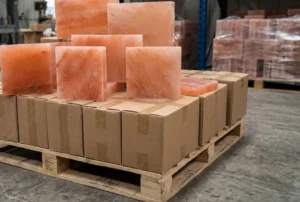
The factory’s standard packaging protocol for cut-to-size salt slabs includes vacuum-sealed POF shrink film for each individual slab, creating an impermeable moisture barrier during ocean transit. Slabs are then packed in partitioned inner boxes that prevent slab-to-slab contact. For high-value cooking slabs or precision-cut wall bricks, custom-molded EPE foam inserts provide superior protection against impact damage and vibration.
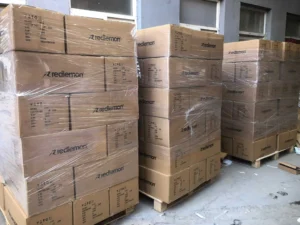
The outer packaging utilizes reinforced 5-ply BC flute corrugated master cartons, specifically designed to withstand the heavy density of salt and meet rigorous ISTA 3A drop-test standards. For large orders shipped by sea freight, cartons are palletized and stretch-wrapped to prevent shifting during container transit. The factory’s packaging team has extensive experience shipping to humid climates across Southeast Asia, the Middle East, and tropical regions where moisture damage risk is highest.
Buyers should specify their destination climate when ordering, as the factory adjusts packaging intensity accordingly. A shipment going to dry continental Europe requires different moisture protection than one going to Singapore or Dubai.
Application-Specific Sourcing Guidance
Spa and Halotherapy Salt Walls
Salt walls and salt caves are the largest-volume application for cut-to-size salt slabs. A typical commercial salt room requires 800–2,000 bricks depending on wall dimensions. The key sourcing requirements are dimensional consistency, color uniformity, and high density. For buyers planning salt room or salt cave projects, the factory provides dimension-specific cutting, color sorting, and project-volume pricing.
Commercial Cooking and Serving Slabs
Restaurants, catering companies, and gourmet retailers use Himalayan salt cooking slabs for grilling, chilling, and presenting food. The sourcing priority is high-density material that withstands repeated thermal cycling. Thickness must be specified precisely—too thin risks cracking under heat, too thick prevents efficient heat transfer.
Animal Nutrition Lick Blocks
Livestock and wildlife nutrition companies use Himalayan salt lick blocks as mineral supplements. The sourcing priority here shifts from visual quality to mineral content and physical durability. Density requirements focus on weather resistance. For buyers in this segment, Himalayan salt licks for livestock are sourced from the same Khewra mine material but graded and cut for durability rather than appearance.
Ordering Process and Lead Times
The ordering process for custom-dimension salt slabs follows a structured workflow designed to eliminate specification errors before production begins:
- Step 1 — Specification submission: The buyer provides cut dimensions, tolerance requirements, target application, density preference, color grade, and destination climate.
- Step 2 — Feasibility review: The factory reviews the specifications against available raw block inventory and cutting capability.
- Step 3 — Sample cutting: For first-time orders or new dimensions, the factory cuts 3–5 sample slabs to the specified dimensions and photographs them for buyer approval before mass cutting begins.
- Step 4 — Mass production: Once samples are approved, the factory cuts the full order. Standard lead time is 20–30 days for trial quantities and 30–45 days for full-container volumes.
- Step 5 — Packaging and shipment: Slabs are packed per the buyer’s destination climate. Sea freight to North America takes 25–35 days; to Europe, 20–30 days.
For wholesale salt brick orders using standard dimensions (200 × 100 × 50 mm or similar), the factory often has stock available for faster dispatch—typically 7–15 days from order confirmation.
Container Loading and Freight Optimization
Salt is heavy. A 20-foot container can carry approximately 20–25 tonnes of salt slabs before reaching weight limits. Smart container loading maximizes the value shipped per container and reduces per-unit freight cost.
The factory’s loading team plans container layouts to distribute weight evenly across the container floor. For mixed orders, the loading plan groups heavier items (thick cooking slabs, large lick blocks) on the bottom layer and lighter items (thin wall bricks, small-format pieces) on upper layers.
For buyers who import both salt products and wooden crafts, the factory can consolidate both product lines into a single mixed container. This approach is particularly cost-effective for buyers who need salt slabs and wholesale wooden decor for the same retail channels, as it eliminates the need for two separate shipments.
Working with a Source-to-Shelf Salt Manufacturer
The advantage of sourcing custom salt slabs from a factory that controls the entire chain—from raw material procurement at Khewra through cutting, grading, packaging, and shipping—is accountability. When a single manufacturer handles every step, specification errors are caught before they compound. A dimension that is uncuttable in the raw block stage is flagged before the blade touches the material, not after 5,000 bricks arrive at the job site.
Jilin Ever Creation sources raw salt from the Khewra Salt Mine in Pakistan and processes it at dedicated cutting facilities. The factory holds ISO 9001 quality management certification and BSCI social compliance audit reports. Since 2004, the company has served importers across North America, Europe, and Asia-Pacific with trade terms from EXW to DDP.
For project buyers who need salt slabs cut to specific dimensions, the ewoodarts team provides feasibility review and sample cutting within one business day of receiving specifications.
Request Custom-Cut Salt Slabs
Send your dimensions, application, and destination. Sample cutting available before mass production.
Explore Custom Salt Products →Frequently Asked Questions
What is the minimum order for custom-cut salt slabs?
Trial orders start at 100 pieces with a USD 500 minimum. For standard-dimension salt bricks, stock quantities may be available for smaller orders. Custom packaging (branded boxes, labels) requires a minimum order quantity (MOQ) of 1000 pieces per SKU.
Where does the raw Himalayan salt come from?
All raw salt is sourced from the Khewra Salt Mine in Pakistan—the world’s second-largest salt mine. The salt is natural, unrefined, and contains the trace minerals that give Himalayan salt its characteristic pink-to-red color spectrum.
What thickness range can the factory cut?
Salt bricks from 25 mm to 150 mm thickness; cooking slabs from 15 mm to 60 mm. For thicknesses outside these ranges, the factory will advise on feasibility during the specification review stage.
How are salt slabs protected from moisture during shipping?
Each slab is vacuum-sealed in POF shrink film, then packed in partitioned inner boxes with custom EPE foam protection for high-value pieces. Outer cartons are reinforced 5-ply BC flute corrugated master cartons meeting ISTA 3A standards.
Can I mix salt slabs and wooden crafts in one container?
Yes. The factory supports mixed container loading, combining salt products with wooden crafts and other product lines. This reduces total freight cost per unit and simplifies receiving for buyers who stock multiple categories.