Skip to content
Key Takeaways
- Classify the piggy bank as a toy and request EN71 parts 1-3 test reports for the wood, the paint, and the coin slot.
- Avoid small detachable parts under 3cm; a coin that fits through the slot is expected, a loose ear that falls off is a hazard.
- Label the age grade, the CE mark, and the importer details on the packaging before the product reaches a shelf.
A wooden piggy bank is charming, tactile, and giftable. It is also a product that children handle, mouth, and drop, which makes it a regulated toy under EU and US law. Wooden piggy bank kids safety compliance is not optional for importers serving the children’s gift market. This guide explains the safety standards, the testing requirements, and the labelling rules that wholesale buyers must meet before a piggy bank reaches a child’s hands.
The piggy bank sits at the intersection of toy, gift, and decor, and how the buyer classifies it determines which safety rules apply. A bank marketed as a toy for children falls under the toy-safety directives. One marketed as a decorative item for adults falls under general product-safety rules. The classification must be decided before production, and it must be consistent on the packaging, the product page, and the compliance documentation. A bank that is marketed as decor but looks like a toy will be treated as a toy by regulators regardless of how it is labelled.
EN71 Parts 1-3: The Three Tests
The EN71 toy-safety standard has three parts that apply to a wooden piggy bank marketed to children. Part 1 covers physical and mechanical properties: the bank must not have small detachable parts that could be a choking hazard, sharp edges, or points. The coin slot is an expected opening, but any other hole or gap that could trap a child’s finger must be avoided. Part 2 covers flammability: the wood and any paint or finish must meet the flammability limits for toys. Part 3 covers migration of certain elements from the paint: the paint must meet the heavy-metal migration limits, and the test report must be for the exact paint system used on the bank. The U.S. CPSC has comparable requirements under ASTM F963 for products sold in the US market.
Designing for Child Safety
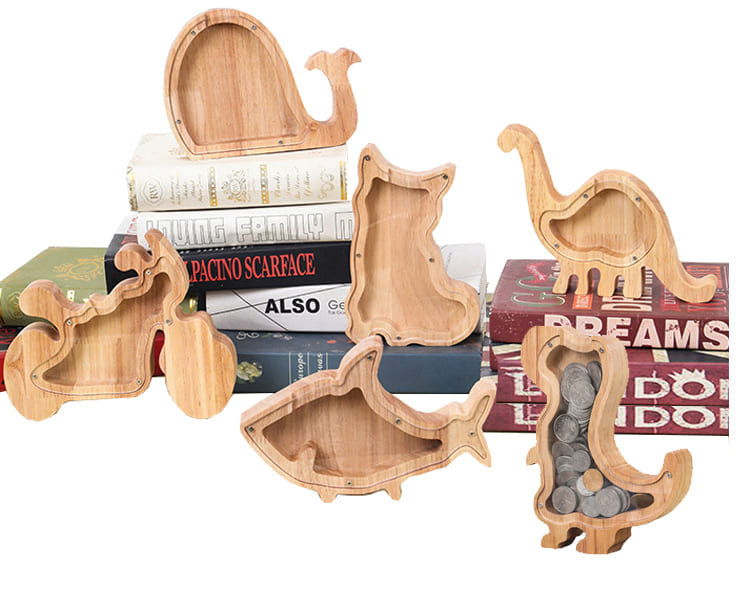
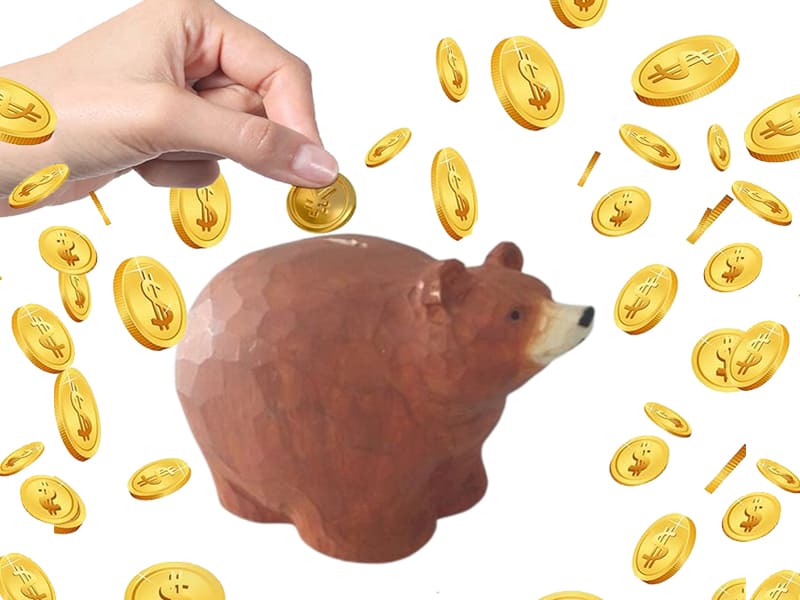
The safest piggy bank design is a single piece of solid wood with a coin slot cut into it and no detachable parts. Ears, tails, wings, or other decorative elements that are glued on can detach and become choking hazards. The safest design is a carved shape where all the features are part of the single piece. If the bank has a removable stopper for emptying coins, the stopper must be large enough that it cannot be swallowed, and it must be attached to the bank or too large to fit through the coin slot. The finish must be a water-based, non-toxic paint or a natural oil finish, and the supplier must provide the migration test report for the exact finish used. The wooden piggy bank supplier should be able to provide design-for-safety guidance and a compliance file for every design.

Labelling and Age Grading
The packaging must carry the age grade, the CE mark for the EU, the EN71 compliance statement, the importer’s name and address, and any safety warnings in the language of the destination market. The age grade is the most important commercial decision: a bank graded 3+ opens the preschool market with a manageable testing burden, while a bank graded 0-3 faces the strictest testing requirements and is rarely worth the compliance cost for a piggy bank. The packaging should also prevent the product from being tested in-store: a sealed box or a tied closure prevents the bank from being handled, dropped, or opened on the shelf. The compliance file should be maintained for each design and updated annually. Verify the labelling and the age grading on a factory tour before committing to volume, and build the safety requirements into the wholesale wooden crafts programme from the first order.

Sourcing Safety-Compliant Piggy Banks
The compliance file for a children’s piggy bank should be maintained for each design and updated annually. The file should contain the EN71 parts 1-3 test reports for the EU, the ASTM F963 report for the US, the paint migration report, the age-grade rationale, and a photograph of the finished product with its labels. The supplier who can produce this file on request is the supplier who has invested in testing infrastructure. The supplier who cannot is either guessing or testing on the buyer’s time. The wooden piggy bank programme should include the compliance file as a standard deliverable with the first order.
The compliance file is also a sales tool. A retailer who is asked by a customer whether the piggy bank is safe for a toddler can produce the compliance file and answer the question with authority. The file is the proof that the product was designed, tested, and labelled to meet the relevant safety standards. The buyers who treat the compliance file as an asset will win the accounts that require it.
The piggy bank category is one of the few wooden decor categories where compliance is a competitive advantage rather than a cost. Most wooden-decor products are sold as decor and follow general product-safety rules. The piggy bank, sold as a toy, follows stricter rules, and the buyers who meet those rules will find themselves in a category with fewer competitors and healthier margins. The wholesale wooden crafts programme should include a safety-compliant children’s tier that carries the compliance file for every SKU. Verify the testing and the labelling on a factory tour.
US Market Requirements
For the US market, the relevant standard is ASTM F963, which covers the same areas as EN71 but with different testing protocols and limits. The US also requires tracking labels and a Children’s Product Certificate for products marketed to children under 12. The buyer should confirm the applicable standards with a testing lab and request the reports for each design. The supplier should be able to provide both EN71 and ASTM F963 reports, because a piggy bank that sells in the EU almost always sells in the US as well.
The US also has state-level requirements, notably California’s Proposition 65, which requires a warning label if the product contains chemicals known to the state to cause cancer or reproductive harm. The paint and finish system used on the piggy bank should be checked against the Proposition 65 list, and a warning label should be applied if necessary. The supplier should be transparent about the chemical content of the paint and finish, and the buyer should verify the Proposition 65 status before ordering.
The wooden piggy bank is one of the most rewarding products in the children’s gift category because it combines charm, durability, and a compliance framework that is well-defined and achievable. The buyers who meet the EN71 standards, design for safety, and maintain the compliance file will find themselves in a category with fewer competitors and healthier margins. The time to build the programme is before the first order, not after the first compliance inquiry.
The compliance file is the proof that the product was designed for safety, and the buyers who have it ready will win the accounts that require it. The wooden piggy bank category rewards the prepared, and the preparation starts with the safety standard.
The wooden piggy bank is a compliance-driven product that rewards the buyer who builds the safety requirements into the specification from the first order. The buyers who test, label, and document will win the accounts that require it. The buyers who skip the testing will be caught when the retailer asks for the report. The compliance file is the proof, and the time to build it is before the first order.
Frequently Asked Questions
Is a wooden piggy bank a toy under EU law?
Yes, if marketed to children. EN71 applies to the wood, the paint, and the coin slot. Banks marketed as adult decor follow general product-safety rules instead.
What is the safest piggy bank design?
A single piece of solid carved wood with no detachable parts. Ears, tails, and wings that are glued on can detach and become choking hazards.
What age grade should I apply?
3+ for most designs. It opens the preschool market with a manageable testing burden. 0-3 faces stricter testing and is rarely worth the compliance cost.
What test reports should I request?
EN71 parts 1-3 for the EU market: physical/mechanical, flammability, and migration of elements from paint. ASTM F963 for the US market.
What must the packaging include for a children’s piggy bank?
Age grade, CE mark, EN71 compliance statement, importer details, and safety warnings in the destination language. The packaging should prevent in-store product testing.
Source Safety-Compliant Wooden Piggy Banks for Kids
Order EN71-tested, age-graded piggy banks with solid carved designs, non-toxic finishes, and child-safe packaging for the preschool gift market.
Browse Wooden Piggy Banks →