Skip to content
Key Takeaways
- A spring garden bird display and Easter decor share a natural thematic overlap — spring, renewal, garden life — that makes them logical cross-merchandise partners in a single display. A customer drawn in by colorful Easter eggs stays to browse hand-painted robins and bluebirds, and vice versa.
- Garden centers are the highest-potential channel for this pairing because their customer base already shops for both decorative garden accents and seasonal holiday items. A “Spring Garden & Easter” display near the entrance in March captures both intentions in one stop.
- The cross-display extends the selling season: Easter merchandise typically sells February through mid-April, while wooden birds sell from March through June. Together they create a four-month spring display window rather than two separate six-week bursts.
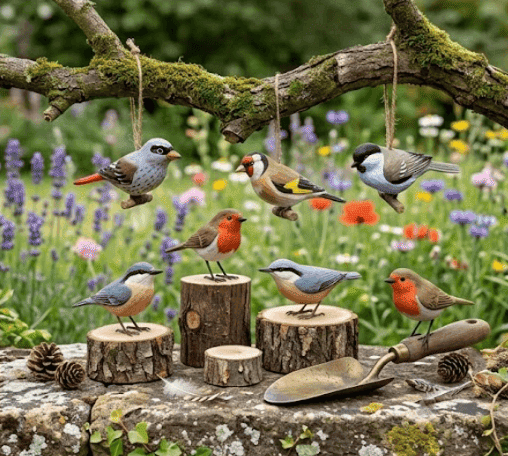
The Natural Pairing: Why Birds and Easter Belong Together
Spring retail displays that combine wooden birds with Easter decor work because they mirror what customers see outside their windows: birds returning, gardens waking up, Easter celebrations marking the season. A carved wooden robin perched next to a pastel Easter egg and a miniature wooden bunny doesn’t feel like two product categories forced together — it feels like a coherent spring story. This thematic coherence is what makes the cross-display naturally browsable rather than confusing.
Display Concept: “Spring Awakening”
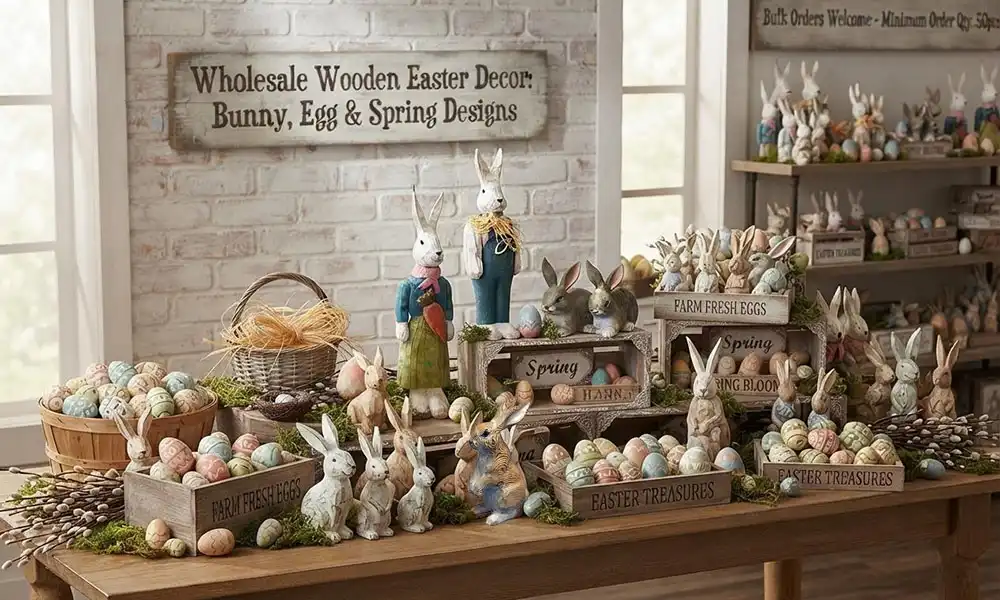
The most effective layout uses a three-tier garden theme: a base layer of artificial moss or green fabric, middle-height wooden bird perches (simple wooden dowels or branch sections), and scattered Easter miniatures at ground level among the moss. The birds occupy the visual midground — eye level for browsing adults — while the Easter items fill the foreground at hand level for children. A small sign reading “Welcome Spring” ties the theme together without over-explaining. The display reads as one environment, not two categories sharing shelf space.
| Product Pairing | Why It Works | Suggested Retail Pair |
|---|---|---|
| Robin + Pastel Eggs | Robin’s red breast echoes the pink/red tones in pastel egg assortments | $22–$28 bundle |
| Bluebird + Yellow Chick | Complementary blue-and-yellow color pairing, classic spring palette | $18–$24 bundle |
| Nesting Bird + Twig Wreath | Natural materials echo — wood bird, twig wreath, shared organic texture | $30–$40 bundle |
Garden Centers: The Highest-Potential Channel
Independent garden centers are uniquely positioned for the bird-and-Easter cross-display because their spring traffic combines two distinct shopping missions: the gardener buying soil and seeds, and the holiday shopper buying Easter basket fillers. A display that serves both missions catches both customer types in a single aisle. The garden-center customer also has higher-than-average disposable income and a demonstrated willingness to spend on decorative home and garden items — the exact profile that buys handcrafted wooden birds at $15–$40.
Timing and Inventory Planning for Garden Centers
The garden-center spring display calendar runs February (setup) through May (transition to summer). Easter items sell strongest in the four weeks before the holiday, then taper. Wooden birds maintain steady sales from March through June as garden-decor purchases. A well-planned inventory splits 60% of the display space for Easter items in February–March, shifting to 60% birds and garden decor in April–May. The same display fixtures, moss base, and branch perches serve both phases — only the product mix rotates. Order Easter inventory by September, bird inventory by November, for February delivery.

Gift Shop Application: The Boutique Spring Display
For smaller gift shops with limited floor space, the bird-and-Easter display compresses into a single 3-foot table or window ledge. The key is verticality: use tiered risers (wooden crates or acrylic steps) to create three height levels, with the tallest bird perches at the back, Easter miniatures in the middle, and a small sign or price card at the front. This vertical compression makes a 3-square-foot footprint feel like a full seasonal department.
Build Your Spring Bird & Easter Display
Selecting the Right Birds for Your Spring Display
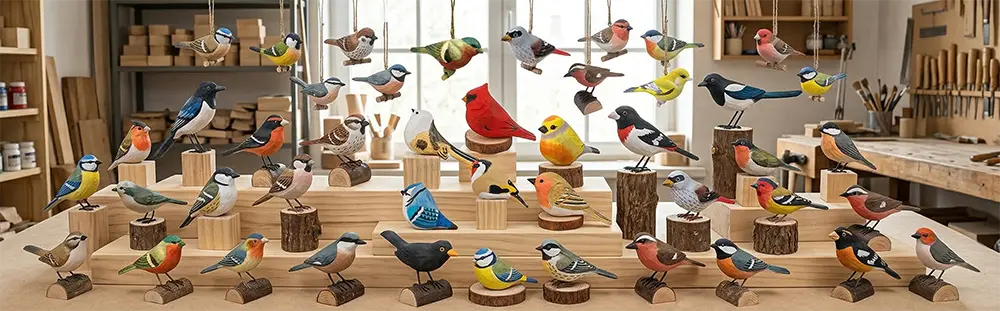
Not all wooden birds perform equally well in a spring retail display. The birds that sell best are species that customers recognize from their own gardens and neighborhoods — robins, bluebirds, cardinals, and goldfinches. Exotic tropical species may be visually striking but lack the emotional connection that drives a “this belongs in my garden” purchase decision. Regional relevance also matters: a garden center in the northeastern US should stock cardinals and chickadees; a shop in the UK should stock robins (the European robin, distinct from the American species) and blue tits.
Regional Bird Selection Guide
Ewoodarts offers region-specific bird assortments for spring retail. North American collections feature cardinals, blue jays, goldfinches, and chickadees. UK/European collections feature robins, blue tits, great tits, and wrens. Mixed collections for international gift shops include universally recognized species that appeal regardless of the customer’s home region. Retailers can order a pre-curated regional assortment or build a custom mix from our full catalog of 40+ bird species. Each species is hand-carved and painted with species-accurate coloration, down to the wing-bar markings and eye-ring details that bird enthusiasts notice and appreciate.
Cross-Merchandising with Garden Products for Higher Basket Size
The highest-value cross-sell in a garden center is pairing a wooden bird with a bird-related garden product: a robin displayed next to a bird feeder, a bluebird near a nesting box, a goldfinch beside a bag of nyjer seed. This placement triggers the associative purchase — the customer who came for a feeder sees the wooden bird and thinks “that would look perfect in my garden next to the feeder.” At $15–$25, the bird is an affordable add-on to a $30–$50 feeder purchase, and the emotional connection between the handcrafted bird and the functional feeder makes the sale feel natural rather than pushed. Garden centers that implement this cross-merchandising report bird sales increasing by 30–50% compared to standalone bird displays isolated from the garden product aisles.
For Easter-specific cross-merchandising, place a small wooden chick or bunny on the bird perch alongside a painted wooden egg at the base. The combination reads as “spring has arrived” and the customer who picks up the chick for an Easter basket is now also looking at the carved bluebird perched above it. The proximity creates a browsing loop — Easter to birds, birds to Easter — that keeps the customer in front of the display longer and increases the average item count per transaction.
Display Maintenance During the Selling Season
A spring display that runs from February through May needs maintenance. Dust accumulates on wooden birds displayed openly. Colors fade slightly if the display is near a window with direct sun. The solution is simple: rotate stock. Keep a backup set of each bird species in storage, and swap the display birds for fresh inventory every 4 weeks. The birds removed from display go into a spring collection sale section at a modest discount — they are still in perfect condition but now carry a display model price that moves inventory faster. This rotation keeps the display looking fresh throughout the season and converts display pieces into incremental sales every month.
The spring bird and Easter display is a retail format that improves with iteration. Take notes on which species sell fastest, which colors attract the most handling, and which price points drive the highest unit volume. Use that data to refine next year’s order — more of the winners, fewer of the slow movers, and one or two new species to keep the display fresh for returning customers who browse the same shop each spring.
Spring displays pull from three live lines: the wooden bird factory range, wholesale wooden birds packs and wholesale Easter decor; mixed seasonal containers consolidate through wholesale wooden crafts. Season background: Easter.

Frequently Asked Questions
Can I order wooden birds and Easter items in one combined order?
Yes. Ewoodarts produces both wooden songbirds and Easter miniatures, and you can combine them in a single order with consolidated shipping. The total minimum across both categories is 300 pieces. Specify quantities per SKU, and we pack accordingly.
What bird species are available for spring retail displays?
Our spring collection includes robins, bluebirds, cardinals, goldfinches, chickadees, and wrens — all hand-carved from basswood and hand-painted with species-accurate coloration. Custom species are available with a 500-piece minimum and 6–8 week development time.
What size birds work best for retail display?
Life-size (4–7 inch) songbirds are the most popular retail size — they read as “realistic” on a display perch and fit standard gift-shop shelving. Mini 2–3 inch birds work well as basket stuffers or impulse items near the register. We recommend a 70/30 mix of life-size to mini for most displays.
Do you provide display props like perches or moss bases?
We provide wooden display perches (simple dowel stands) as an optional add-on for orders of 200+ birds. Artificial moss mats and tiered risers are not included but can be recommended from standard retail fixture suppliers. We include a display layout guide with orders of 500+ pieces.
When is the ordering deadline for spring season delivery?
Order by November for February sea freight delivery — this covers both Easter and spring bird displays. Rush air freight orders placed by January can still arrive for a March display setup. Custom species or custom-painted birds require an additional 6–8 weeks of development time before production.
>