Skip to content

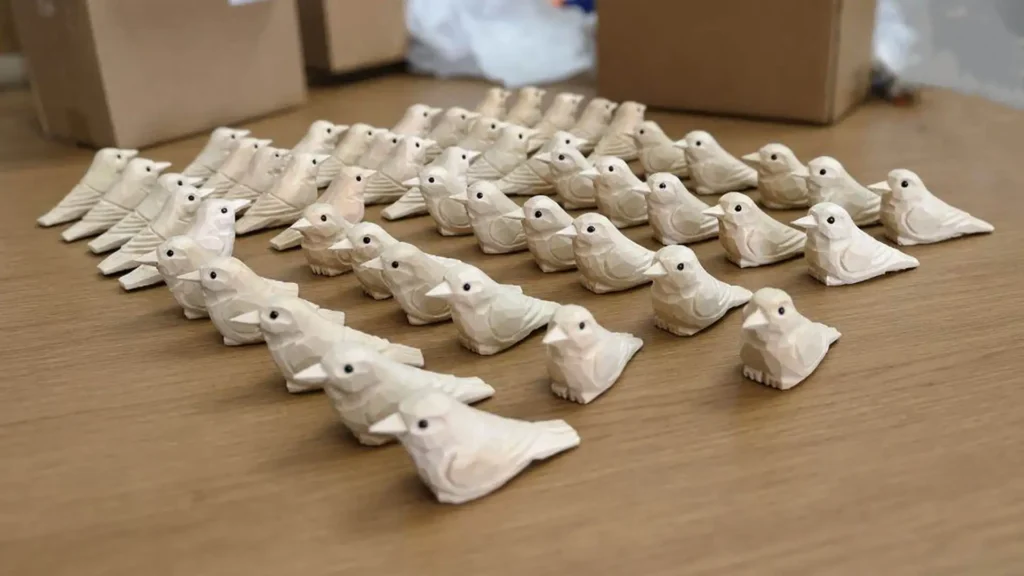
Ask three suppliers for the same decor piece and the quote that looks cheapest is usually the one that quietly changed the material. The decision between bamboo, plywood and solid wood sits upstream of almost everything a buyer cares about — carving depth, finish, weight, shipping cube, the compliance file and the price — and the phrase plywood vs solid wood alone accounts for most of the confusion, because the two behave so differently that they are barely the same product category.
This guide compares all three honestly, from the solid-wood side. We manufacture solid-wood carvings only, in basswood, pinewood, rubber wood and birch, and do not produce bamboo or plywood components. Where a job suits bamboo or plywood better than anything we make, that is stated plainly rather than argued around.
Key Takeaways
- Bamboo is an engineered grass laminate, not a timber. It is not carved the way wood is; it is cut, laminated and shaped, which suits flat and turned parts rather than deep relief.
- Plywood is a cross-laminated engineered board. It is dimensionally stable and will not split, but its faces are thin veneer, so it cannot take deep three-dimensional carving.
- Solid wood is a single timber that can be carved in the round, sanded back and refinished. It moves with moisture, so it has to be dried to 8–12% before finishing.
- Engineered boards carry adhesive. Specify the formaldehyde emission class your market requires — CARB Phase 2 or TSCA Title VI for the US, E1 for much of Europe — and get it in writing.
- We are the solid-wood option. For bamboo or plywood parts we will say so and point you to the right supply chain rather than quote a substitute.
In This Guide
- Why the Material Choice Comes First
- Bamboo: An Engineered Grass, Not a Timber
- Plywood vs Solid Wood: The Core Distinction
- Solid Wood: What We Carve and Why
- Side by Side: Bamboo, Plywood, Solid Wood, MDF
- What Material Does to Your OEM Terms
- What We Check Before a Solid-Wood Order Ships
- Best For / Not For by Material
- End to End: Choosing a Material for One Order
- Frequently Asked Questions
Why the Material Choice Comes First
Buyers often specify a look and a target price, then let the supplier pick the material. That order is backwards. Material determines what can be carved, how it finishes, how heavy it is, how it packs and what it costs to move — so a piece specified without a material is a piece whose real cost has not been calculated yet.
The three options lumped together as “wood” are structurally different. Bamboo is a grass processed into laminated board, plywood an engineered panel of glued veneer plies, solid wood a single piece of timber. They share a word and little else, which is why a quote that swaps one for another can look competitive and still be a different product.
Bamboo: An Engineered Grass, Not a Timber
Bamboo grows fast and reads as sustainable, which is why it appears in so many decor briefs. It is a grass, harvested as a hollow culm, then split, dried and laminated under adhesive into boards or turned into small solid sections. The result is hard, dense and consistent, with a fine straight grain and a pale colour that takes a light finish well.
What bamboo is not is carvable in the way a buyer usually means. It suits flat panels, cutting surfaces, turned pens and small assembled parts, and is poor for deep relief, because the laminated structure chips at the glue lines and the culm diameter limits how thick a solid section can be. Its hardness and density vary by species and layup, so any figure a supplier quotes should come with the batch it refers to. Bamboo also carries adhesive, putting it in the same emission-class conversation as plywood.

Plywood vs Solid Wood: The Core Distinction
Plywood is built by gluing thin veneers at right angles to one another, which gives it two genuine strengths: it is dimensionally stable, moving far less than solid timber with changes in humidity, and it will not split along a grain line. For large flat panels, cabinet backs, laser-cut shapes and anything that has to stay flat across a wide span, plywood is often the correct engineering answer.
The distinction that matters for decor is the face. A plywood surface is a thin veneer over a core of cheaper plies. It cannot be carved in the round, because cutting past that veneer exposes the layered core, and the edges always show the plies unless banded or filled. Solid wood is the same material all the way through, so it can be carved to depth, sanded back, repaired and refinished. Where a design has real relief — a carved animal, a sculpted face, a shaped profile — plywood vs solid wood is not a cost decision but a feasibility one.
Solid Wood: What We Carve and Why
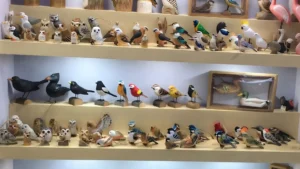
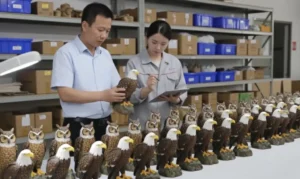
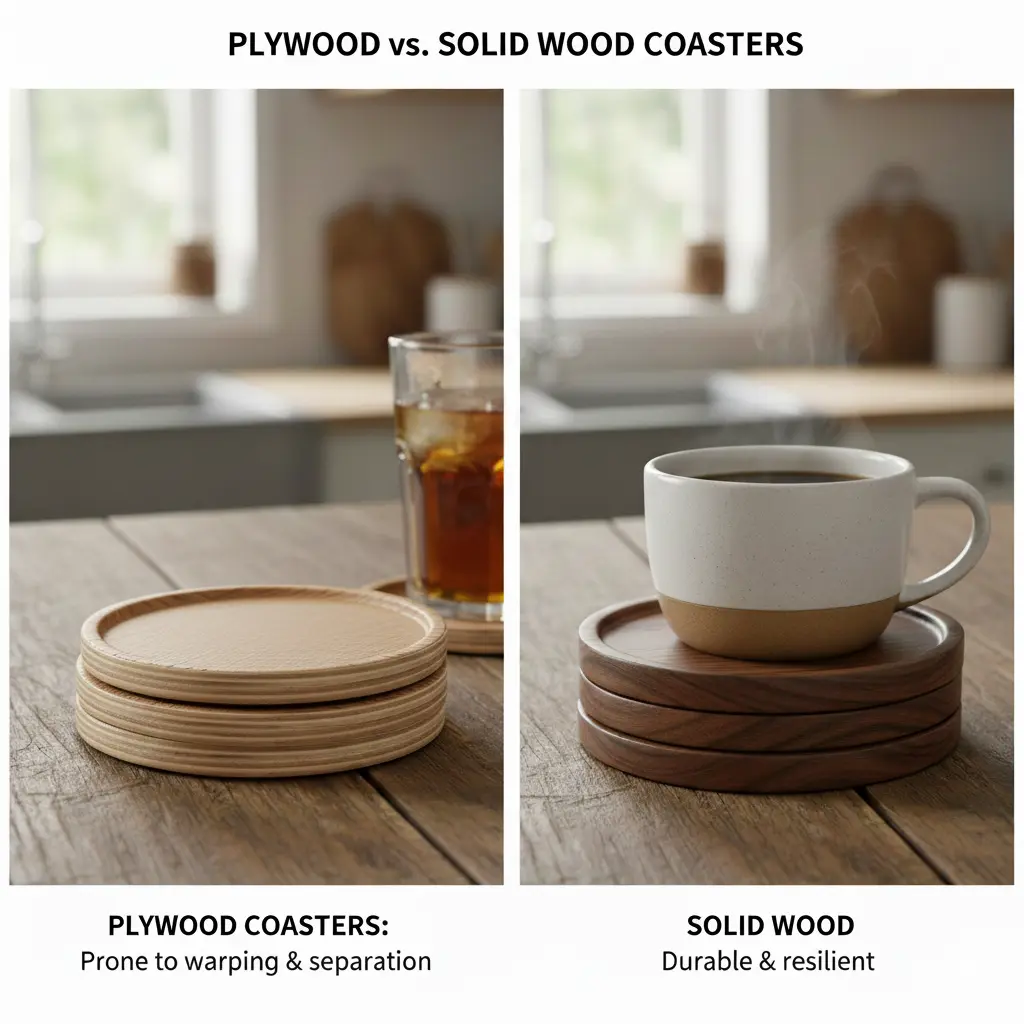
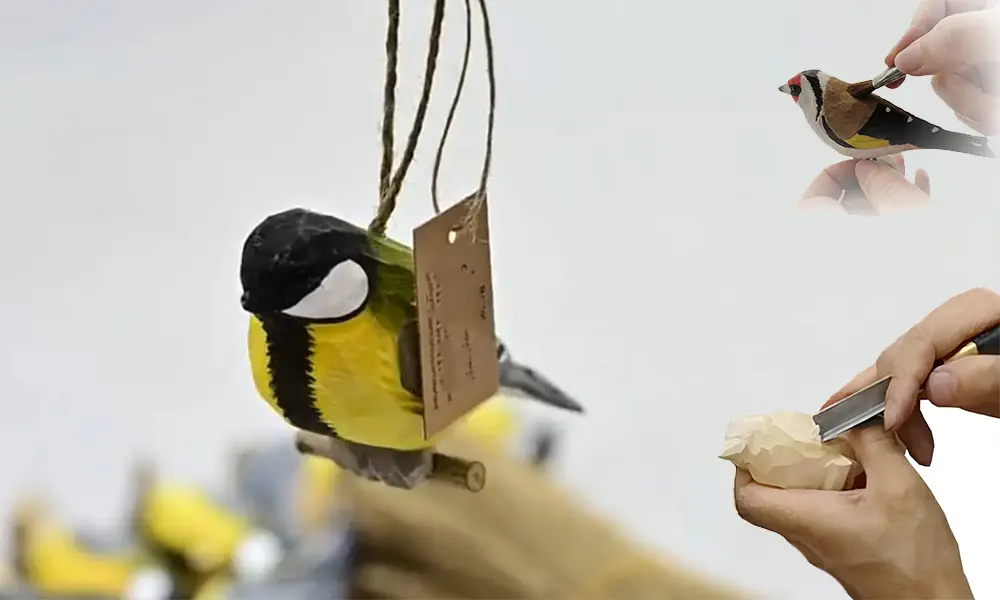
Solid wood is the only one of the three we manufacture, chosen for decor because it can be carved three-dimensionally and still be one continuous piece. We work in basswood, pinewood, rubber wood and birch, with three-dimensional carving from 5 cm to 40 cm and flat work to 80 cm, every piece carved and painted by hand. Basswood is the default for fine relief because it is soft, even-textured and holds detail; our published reference puts it at roughly 410 lbf on the Janka scale, which is why it cuts cleanly without splintering.
The trade-off is movement. Solid wood gains and loses moisture and will move if it ships wet, so it is dried to 8–12% before finishing — the standard we work to is set out in our guide to wood moisture content. On certification we are straightforward: our facility holds an FSC chain-of-custody certificate, but certified basswood is not currently available to us, so our carvings are not marketed as FSC-certified wood. We supply official timber felling and transport permits instead, and the position is described against the FSC business standards rather than claimed loosely.
Side by Side: Bamboo, Plywood, Solid Wood, MDF
| Material | What it actually is | Carving & finish | Stability & weight | Compliance note |
|---|---|---|---|---|
| Bamboo | Laminated grass culm | Cut, turned, flat-laminated; not deep relief | Hard and dense; varies by species | Adhesive — specify emission class |
| Plywood | Cross-glued veneer plies | Flat and laser-cut; faces are thin veneer | Very stable; will not split; light for its size | Adhesive — CARB Phase 2 / TSCA Title VI / E1 |
| Solid wood | Single timber (basswood, pine, rubber, birch) | Carved in the round; sanded, repaired, refinished | Moves with moisture — dry to 8–12% first | Permits supplied; EN71 / toy safety if a child article |
| MDF | Compressed fibre and resin | Homogeneous, paints evenly; no grain; edges seal | Heavy; swells if it gets wet | Resin — emission class and dust handling |
What Material Does to Your OEM Terms
Material moves the commercial terms, not just the unit price. Engineered boards are bought by the sheet and cut, so they suit large flat runs with minimal tooling. Solid carved work is labour at the bench, so its cost is driven by carving depth and paint detail rather than by raw material. Bamboo sits between the two but is limited by culm size for solid sections.
Weight and cube follow material, and they change landed cost more than the piece price does, so material should be settled before any freight quote is requested; where a design needs new tooling, that cost is worked through in our guide to tooling and mould costs for custom wooden products. Our solid-wood terms are fixed: a trial tier of 100 pieces at a USD 500 minimum order value on in-stock designs, air express DDP in 20–30 days, then wholesale and custom at 300 pieces with a USD 3,000 minimum order value by sea in 60–90 days to port, custom colour boxes from 500 pieces. Payment is T/T at 30% deposit and 70% before shipment, with photographs and video of finished goods first. Pieces are wrapped in white paper, packed 6–12 to a 3-ply inner box and 240–480 to a 5-ply master carton rated to ISTA 3A. Wooden pallets and crates must meet ISPM 15 heat-treatment marking under the International Plant Protection Convention; the packaging and labelling rules for the EU are covered in our guide to EU packaging and labelling for wooden gifts.
What We Check Before a Solid-Wood Order Ships
- Moisture before finishing. Boards are dried to 8–12% so a carved piece does not move or crack once it reaches a heated retail wall.
- Species against the brief. Basswood for fine relief, pinewood and rubber wood for structural and larger pieces, birch where a pale even grain is wanted — matched to the carving depth the design needs.
- Carving size against the file. Three-dimensional work is held within 5 cm to 40 cm and flat work to 80 cm, checked against the approved sample rather than assumed from the drawing.
- Finish consistency across the run. Judged against a retained golden sample, because a batch is seen as a group and drift across it is visible on a shelf.
- Safety testing where it applies. EN71-1/-2/-3 for articles intended for children, with the small-parts and age-grading position stated rather than implied; certification claims are limited to what we actually hold — CE, UKCA, RoHS, EN71, BSCI and ISO 9001.
Best For / Not For by Material
| Material | Best for | Not for |
|---|---|---|
| Bamboo | Flat panels, boards, turned pens, small assembled parts, a fast-growing “natural” story | Deep relief carving, thick solid sections, anything needing a continuous timber body |
| Plywood | Large flat shapes, laser-cut layers, panels that must stay flat, structural backs | Carved-in-the-round decor, visible unfinished edges, a solid timber feel |
| Solid wood | Carved animals, sculpted and shaped decor, hand-painted detail, pieces meant to be kept | Wide flat panels that must never move, the lowest possible unit cost on a flat part |
End to End: Choosing a Material for One Order
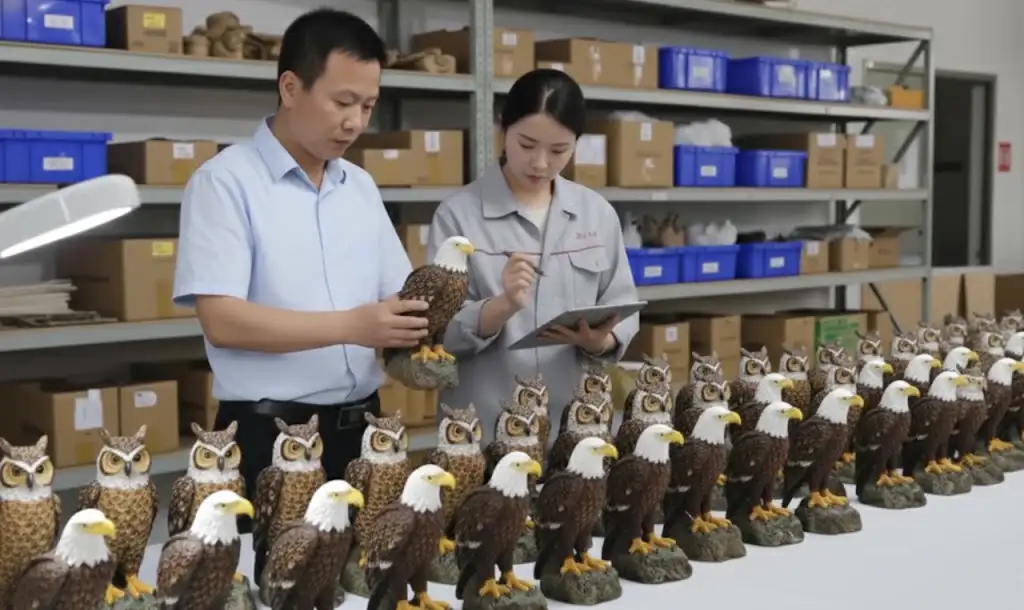
A homewares brand wants a carved-owl bookend set and sends a rendering with no material specified. The first question back is not price — it is what the piece has to do.
Test the design against each material. The owl has real relief: a rounded body, a carved face, feather detail. Bamboo cannot take that depth without chipping at the glue lines. Plywood cannot be carved past its veneer at all. Solid basswood can hold the detail, so the design itself rules out two of the three options before cost is discussed.
Fix the specification. Species, carving size within the 5–40 cm range, moisture at 8–12%, finish against a retained sample, and EN71 testing if the set is ever marketed near children. The approved sample becomes the reference the whole run is judged against.
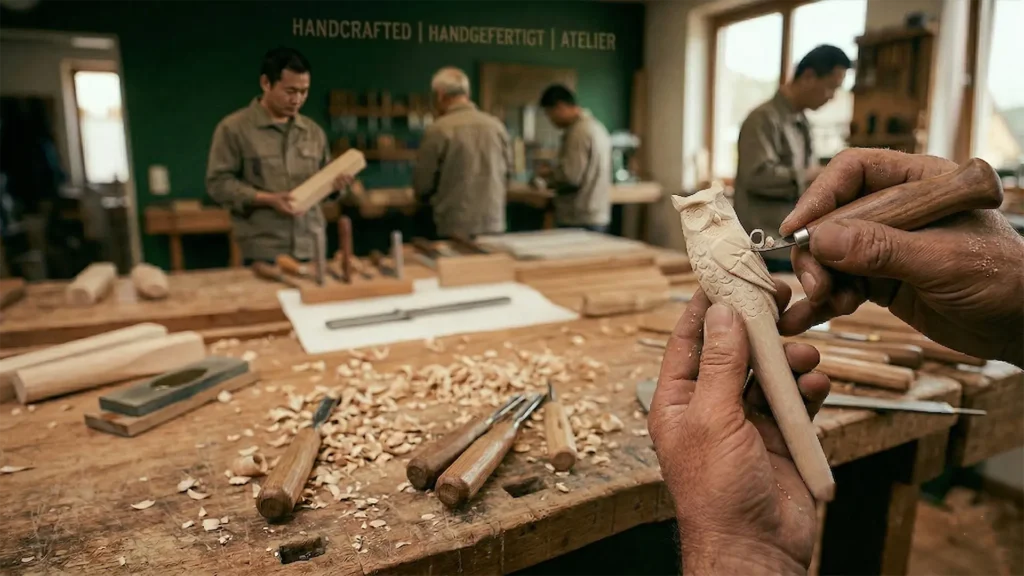
Order to the terms, then read the result. A trial of 100 pieces at a USD 500 minimum order value, air express DDP in 20–30 days, tests the market before committing to wholesale at 300 pieces with a USD 3,000 minimum order value by sea in 60–90 days to port. Landed cost is worked from cube and weight, not the unit price alone. Where a design suits bamboo or plywood better, we say so and point to the right supply chain — the full solid-wood range is in our wholesale wooden crafts guide, and custom briefs are handled through custom product manufacturing, with material behaviour for flat goods compared in our guide to coaster materials and our sourcing position in ESG sustainable sourcing.
If you have a decor design and are not sure whether it should be carved in solid wood, laminated in bamboo or cut from plywood, send us the drawing. We will tell you honestly which material it needs — including when that material is not one we make.
Frequently Asked Questions
Q: Is bamboo stronger than solid wood?
It depends on the species and how it was laminated, so there is no single answer. Bamboo is hard and dense for its weight, but strength rarely decides decor jobs — carvability does. It chips at the glue lines under deep relief, which is why it suits flat and turned parts rather than carved ones. Ask any supplier for the batch data behind a hardness claim.
Q: Why can’t plywood be carved like solid wood?
Because its face is a thin veneer over a core of cheaper cross-glued plies. Cut past it and you expose the layers, and the edges always show them. Plywood is superb for flat, laser-cut and panel work where stability matters, but any design with real relief has to be solid timber — a feasibility limit, not a cost one.
Q: Do engineered boards need a formaldehyde specification?
Yes. Plywood, bamboo laminate and MDF all use adhesive, so specify the emission class your market requires — CARB Phase 2 or TSCA Title VI for the US, E1 for much of Europe — and get it confirmed in writing. Solid wood carries no added adhesive, which is one reason it is the simpler file for a children’s article.
Q: Which material is cheapest once it is shipped?
The unit price is the wrong number. Material sets weight and cube, and freight is charged on those, so a lighter engineered part can land cheaper even at a higher piece price, while a dense solid carving can cost more to move than to make. Decide material first, then work landed cost from packed dimensions and weight, not the quote alone.
Q: Do you manufacture bamboo or plywood decor?
No. We manufacture solid-wood carvings only, in basswood, pinewood, rubber wood and birch. If your design suits bamboo or plywood better, we will say so and point you to the right supply chain rather than quote a solid-wood substitute that changes the product. Our facility holds an FSC chain-of-custody certificate, but certified basswood is not currently available to us, so our carvings are not sold as FSC-certified wood; we supply official timber felling and transport permits instead.
Sources
Authority: FSC business standards · International Plant Protection Convention
Related: Wood moisture content · ESG sustainable sourcing · Custom product manufacturing