Skip to content

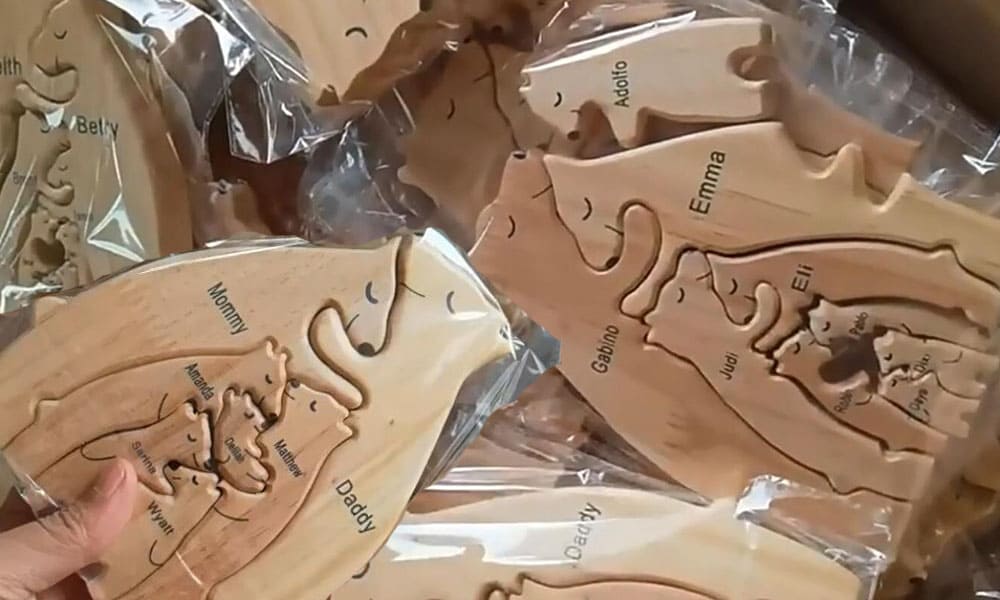
Wooden puzzle age grading is treated by most buyers as a marketing decision — a number on the box chosen to widen the audience. It is the opposite: a safety determination following from the physical properties of the piece, on which everything downstream depends — testing scope, labelling, marking, market acceptance.
This guide is for wholesalers, importers and private-label brands ranging wooden puzzles: how age grading is determined, why the under-three threshold changes the compliance picture, what testing follows from a grade, and what belongs on the pack. It is written from the manufacturer side and is explicit about where our knowledge stops and an accredited laboratory’s begins. Toy safety requirements are published by the European Commission, and EN71 routes for wooden articles in our guide to EN71 and toy safety for wooden figurines.
Key Takeaways
- Age grading is derived from the product, not chosen for the market. Piece size, small-parts behaviour, complexity and dexterity set the floor; the box follows the product.
- The under-three threshold is the one that matters. Below it, small-parts and migration requirements tighten sharply, and a puzzle passing at 3+ may not be gradeable for younger children at all.
- Small parts are judged against a physical test fixture, not by eye. In the United States the reference is a cylinder about 1.25 inches in diameter; a piece fitting entirely inside it is a small part.
- A family puzzle spanning ages is a design problem, not a labelling one: mixed piece sizes let one product serve a range, but the grade reflects the smallest piece in the box.
- Testing is per grade and per market: EN71-1, -2 and -3 in the EU, ASTM F963 in the United States, with CE or UKCA marking following the applicable route.
- We are a manufacturer, not a notified body or laboratory. Classification, testing and the Declaration of Conformity belong to an accredited lab and the importer of record.
In This Guide
- Why the Under-Three Threshold Changes Everything
- Grading a Wooden Puzzle Specifically
- Wooden Puzzle Age Grading by Piece Characteristic
- Testing, Marking and What Goes on the Pack
- Best For / Not For: Grade by Product Type
- What We Check on a Puzzle Order
- End to End: Grading a Family Puzzle Range
- Frequently Asked Questions
Why the Under-Three Threshold Changes Everything
An age grade answers two questions at once: can a child of this age do the task, and what happens if a younger child gets hold of the piece. The second binds, because regulators and retailers reason from foreseeable use rather than intended use — and a younger sibling in the same household is foreseeable. Three years is the dividing line in most toy safety regimes, and crossing it changes the requirements rather than adjusting them. Below it a product is expected to be mouthed, so coating migration limits bite harder and the mechanical requirements around small parts, sharp edges and detachable components apply strictly. At and above it, small parts are managed by a warning rather than by exclusion.
Small parts are assessed against a physical fixture rather than by eye. In the United States the reference is a test cylinder approximately 1.25 inches — about 31.7 millimetres — in diameter: an object fitting entirely inside it in any orientation is a small part and cannot appear in a product intended for children under three. The EU applies an equivalent test under EN71-1. Current dimensions and procedure must be confirmed with an accredited laboratory, because they are specified precisely and a visual estimate is not a determination.
For a wooden puzzle this has direct design consequences. Chunky pieces with a large cross-section, knobs integral to the piece rather than glued on, and a board thick enough that no component can break off all push a product toward being gradeable below three. Fine-cut jigsaw pieces, small knobs, thin plywood and appliqued decoration push it the other way. None of this is a quality judgement: a 100-piece jigsaw is a better product for an eight-year-old and an unsuitable one for a two-year-old, and both are true at once.

Grading a Wooden Puzzle Specifically
Four properties drive the grade, and they can pull in different directions on the same product.
- Smallest piece size. The binding constraint. The grade follows the smallest component in the box, spares included, measured against the small-parts fixture rather than judged by hand.
- Piece count and complexity. This sets the developmental ceiling as well as the floor. A four-piece shape sorter and a two-hundred-piece jigsaw are not the same product for a six-year-old, so a range needs distinct steps rather than one grade covering all.
- Detachable components. Knobs, handles, appliqued eyes, glued-on feet, ribbon ties. Anything pulled off in a tension or torque test becomes a small part, and the test is deliberately harsher than real use because real use is harsher than a designer expects.
- Finish and coating. Where a piece may be mouthed, the coating must meet the EN71-3 migration limits for the elements the standard covers. Our range is carved and painted by hand with eco-friendly non-toxic paint systems, and the documentation should name the finish actually used rather than a generic family.
A family puzzle — one product working across ages — is the hardest case: the grade must reflect the youngest child who can safely handle it while the difficulty suits the oldest. The usual resolution is mixed piece sizes with no component below the small-parts threshold, letting the grade come down without the task becoming trivial. That is a design decision taken before sampling, not a labelling one afterwards. Range options and piece-count structures are in our guide to wholesale wooden family puzzles, and comparable grading logic on a product with an obvious hazard profile in our article on wooden slingshot compliance and age grading.

Wooden Puzzle Age Grading by Piece Characteristic
| Product type | Piece characteristics | Typical grading direction | Main constraint |
|---|---|---|---|
| Chunky knob puzzle | Thick pieces, integral knobs, no applied parts | Can be gradeable below three if tested | Knob retention under tension and torque |
| Layered or peg puzzle | Moderate pieces, separate pegs, some depth | Usually graded at or above three | Detachable pegs becoming small parts |
| Family puzzle, mixed sizes | Deliberately varied, none below the threshold | Wide band, if the smallest piece passes | Smallest component sets the floor |
| Fine-cut jigsaw | Thin flat pieces, high count, small dimensions | Graded well above three, often 5+ or 8+ | Every piece is a small part |
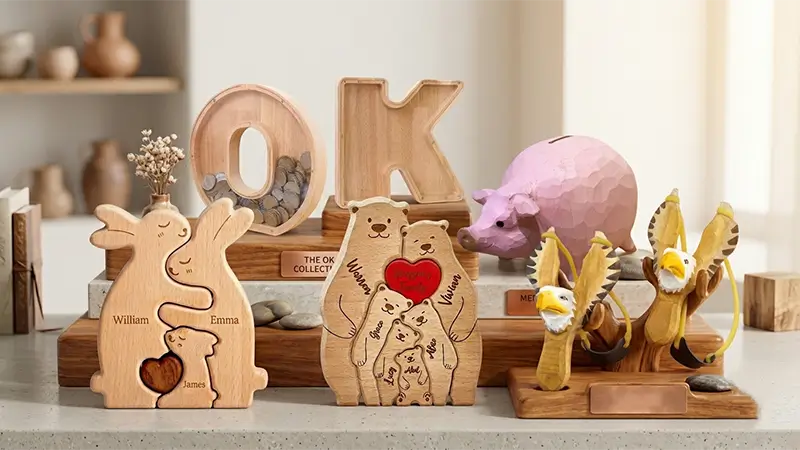
| Personalised or keepsake puzzle | Variable; often sold as a gift object | Still needs a grade if a child may use it | Being a keepsake does not remove the obligation |
Testing, Marking and What Goes on the Pack
Once the grade is set, the compliance work follows. In the EU the standards for a wooden toy are EN71-1 for mechanical and physical properties — where small parts, sharp edges, points and the strength of attached components are assessed — EN71-2 for flammability, and EN71-3 for migration of certain elements from materials and coatings a child may mouth. Conformity with the applicable legislation is what CE marking declares, with a Declaration of Conformity behind the mark; the UK route is UKCA. In the United States the standard is ASTM F963, administered through the Consumer Product Safety Commission, with its own small-parts, labelling and tracking requirements.
Testing is done by an accredited laboratory on the product as it will ship, not on a concept or a rendering: the sample must carry the actual finish, the actual adhesive on any applied part and the actual piece dimensions. A change to any of those after testing invalidates the report.
On the pack, a buyer should expect the age statement matching the tested grade, the applicable marking, required warning wording in the destination market’s language, the responsible EU economic operator’s name and address for articles in a harmonised regime, a batch or lot reference, and importer or brand details. Which are legally required varies by market and channel, and that determination belongs to the importer of record rather than the factory — our guide to labeling wooden gifts for the EU works through the sequence, and retail safety labeling shows the same logic on an age-graded wooden product.
Best For / Not For: Grade by Product Type
| Buyer situation | Sensible approach | Approach that fails |
|---|---|---|
| Ranging for a toy or child-facing channel | Grade from the smallest component, test the shipping product, keep the reports on file | Grading from the intended user and treating warnings as sufficient |
| Family or gift retail | Mixed-size designs with no component below the small-parts threshold | A single grade across a range with very different piece sizes |
| Adult or keepsake positioning | An explicit statement that it is not a toy, where that is genuinely the case | Assuming a keepsake label removes the obligation for a child-appealing object |
| Multi-market distribution | Testing to each destination regime, with market-specific label artwork | One report and one label assumed to cover every market |
What We Check on a Puzzle Order
- Species and construction matched to the grade. We produce in basswood, pinewood, rubber wood and birch, basswood being standard where fine detail and clean edges matter. Pieces are cut to a stated thickness tolerance so no component falls below the dimension the grade depends on.
- Applied components specified for retention — knobs, eyes, feet and ties designed and fixed to survive the tension and torque testing a laboratory applies, not normal use only.
- Coating documentation for the finish actually used, with EN71-3 migration routes where a piece may be mouthed, on top of our ISO 9001 and BSCI standing.
- Moisture held at 8–12% before finishing, per our published moisture standard — a piece that moves after delivery can split, and a split edge is a sharp-edge question as well as a quality one.
- Test samples supplied as the shipping product, with production finish and adhesives, so the report reflects what arrives rather than what was drawn.
- Packing and evidence confirmed — white paper wrap, 6 to 12 per three-ply inner box at 21 × 11 × 14 cm, 240 to 480 per five-ply master carton at 58 × 44 × 31 cm, 8.0 to 15.0 kg gross, rated to ISTA 3A, with photographs and video of finished goods before the 70% balance falls due under our T/T terms.
End to End: Grading a Family Puzzle Range
A wholesaler wants three wooden puzzles for a family gift range sold across the EU and the United States, and starts by asking what age to print on the box.
Design to the grade, then grade the design. The three products are defined by their smallest component rather than their difficulty: a chunky four-piece with integral knobs, a mixed-size family puzzle with no piece below the small-parts threshold, and a fine-cut jigsaw. The first is a candidate for a sub-three grade, the second for a wide band, the third for 8+ and not marketed to younger children at all.
Sample, test and label per market. A trial of 100 pieces at a USD 500 minimum order value, air express DDP in 20–30 days, produces physical samples in production finish. Those go to an accredited laboratory — EN71-1, -2 and -3 for the EU route, ASTM F963 for the United States — and the reports set the grade rather than confirming one chosen in advance. Age statement, marking, warning wording, EU economic operator details and batch reference are then agreed with the importer of record, producing two label artworks rather than one assumed to serve both markets.
Scale. The reorder moves to 300 pieces at a USD 3,000 minimum order value, sea freight, 60–90 days to port, with custom boxes at the 500-piece minimum. Any post-test change to piece size, finish or an applied component is a new sample, since it invalidates the report. Sequencing is in our guide to the wood OEM timeline from sample to first order, acceptance rules in our guide to AQL inspection levels for wooden crafts.

If you are ranging wooden puzzles and want the piece dimensions, applied-component construction and coating documentation specified so an accredited laboratory can grade them — with test samples in production finish — send us your designs and target markets.
Frequently Asked Questions
Q: How is the age grade on a wooden puzzle decided?
From the product, not the target customer. The smallest component in the box is assessed against the small-parts fixture, applied parts for retention, and the coating against migration limits where the piece may be mouthed. Complexity and dexterity set the upper end. An accredited laboratory grades the shipping product; a brand should not set the number in advance.
Q: What counts as a small part?
In the United States the reference is a test cylinder approximately 1.25 inches — about 31.7 millimetres — in diameter: an object fitting entirely inside it in any orientation is a small part and cannot appear in a product intended for children under three. EN71-1 applies an equivalent test in the EU. Current dimensions and procedure must be confirmed with a laboratory, since a visual estimate is not a determination.
Q: Can a family puzzle be graded for under-threes?
Only if every component, spares included, passes the small-parts assessment and applied parts survive retention testing. That constrains the design: mixed piece sizes with a chunky minimum, integral rather than glued knobs, no appliqued decoration. It is decided before sampling, not achieved by labelling afterwards.
Q: Which standards apply?
In the EU, EN71-1 for mechanical and physical properties, EN71-2 for flammability and EN71-3 for migration of certain elements, with CE marking declaring conformity and a Declaration of Conformity behind it; UKCA for the United Kingdom. In the United States, ASTM F963 through the CPSC route, with its own labelling and tracking requirements.
Q: Does changing the finish after testing matter?
Yes, and so does changing piece size, adhesive or any applied component. The report describes a specific physical article, so altering any of those means it no longer covers what ships. Treat a post-test change as a new sample requiring re-assessment.
Sources
EU toy safety requirements, including the EN71 standards and the scope question for child-appealing articles, are published by the European Commission; United States requirements, the small-parts test fixture and the importer route map by the Consumer Product Safety Commission. Our species list, moisture standard, hand-carved and hand-painted construction with non-toxic paint systems, carton specification and ISTA 3A rating, minimums, order values, lead times, payment terms and certifications are our own published first-party terms. No HS code is stated for a puzzle here: our published codes cover wooden crafts, and an article classified as a toy may fall under a different heading to be confirmed with your broker. We are a manufacturer, not a notified body or laboratory — classification, testing, marking and the Declaration of Conformity belong to an accredited lab and the importer of record, against the current text of each standard.