Skip to content


Key Takeaways
- A bar coaster lives or dies in the wash-down cycle: 4 lines decide it, blank density, face seal, edge seal and the venue’s wipe habit; unit price ranks fourth.
- Absorbency is a spec, not a vibe: a sealed face sheds condensation into the ring groove while an oiled face holds it, and 1 wipe habit decides which wins; the reorder cycle follows it.
- Seal depth has 2 passes: face seal for the glass ring and edge seal for the tray stack, because bar trays wet the edge first and the face second.
- Reorder cycles track traffic bands: a taproom serving 300 covers a night reorders by the inner box of 6 to 12 pieces, while a festival bar reorders by the master carton of 240 to 480.
- Branding for bars is 1-colour print or engraving: full colour loses its argument at the first wash-down, and the setup amortises over the 300-piece tier at a USD 3,000 minimum order value.
- Proof on the 100-piece trial tier at a USD 500 minimum order value, air express DDP in 20 to 30 days, so the wash test happens in the venue before the season order sails in 60 to 90 days.
Wholesale wooden coasters bars buy are chosen by the crate and judged by the ring: the wet circle a glass leaves after one humid hour, and the swollen edge a coaster shows after a month of tray stacks. Neither judgement appears in a unit price, which is why wholesale wooden coasters for bars and breweries need a specification written around wash-down life rather than around the shelf photograph. This guide sets that specification: blank density and grain orientation, the two-pass seal that protects face and edge separately, the reorder cycle each traffic band actually runs, and the tier maths that keeps a proof in the venue before a season commits to a lane.
Display and merchandising for tasting rooms is covered in our brewery tasting room coasters page; this guide stays on the durability and reorder side, where the bar’s money is actually made or lost.
In this guide
- Why Bars Judge Coasters by the Ring
- Wholesale Wooden Coasters Bars Actually Keep
- Absorbency: What the Face Has to Do
- The Two-Pass Seal: Face and Edge
- Reorder Cycles by Traffic Band
- Venue Table: Traffic, Seal, Reorder Unit
- Pack and Lane for Bar Programmes
- What We Supply Into Bar and Brewery Programmes
- Which Spec Fits Which Venue
- What We Check Before a Coaster Order Ships
- End to End: A Brewery’s Taproom Year
- FAQ
Why Bars Judge Coasters by the Ring
A retail coaster is bought for a table and judged in a photograph; a bar coaster is bought by the crate and judged at closing time, wet, stacked and wiped. The failure modes are thus different: ring marks on the face, swollen edges from tray water, and logo wear from abrasive wipes. A specification that ignores those three buys the cheapest coaster the venue will replace twice a year.
The honest framing for a buyer is cost per service night, not cost per piece: a coaster that survives two seasons at twice the piece price beats one that dies mid-season at half it, because the reorder labour and the ring complaints are the expensive lines.
Wholesale Wooden Coasters Bars Actually Keep
The keepers share four traits: dense blank stock with grain running flat under the face, a sealed face that sheds condensation into a cut ring groove rather than holding it, a sealed edge that shrugs off tray water, and a finish that survives an abrasive wipe without chalking. Thickness underpins all four traits, because a thin blank flexes under a stacked tray and opens the seal at the edge; the thickness and edge-profile trade is quantified in our coaster thickness and edge profile guide.
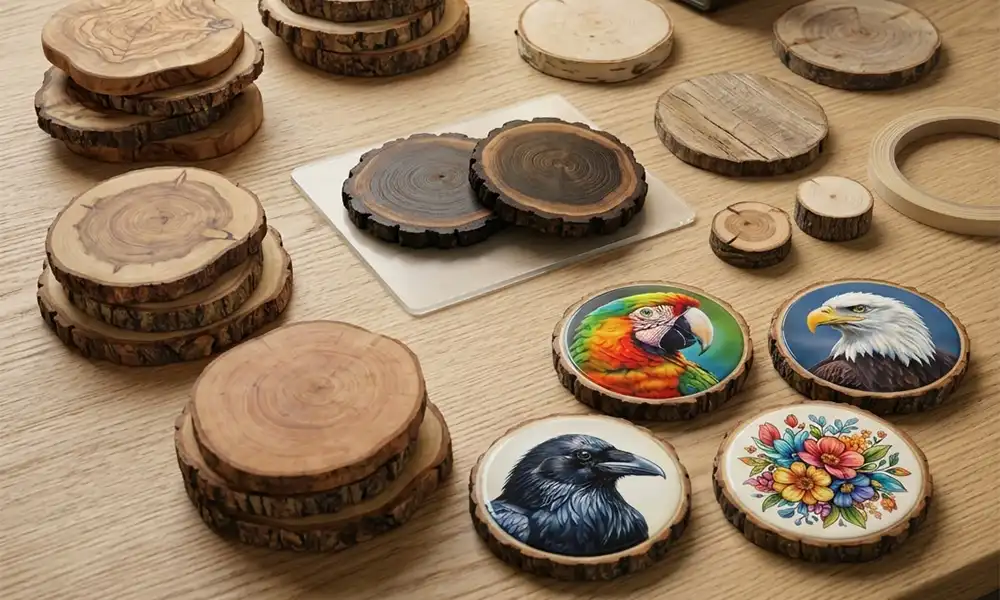
Venues should reject two looks on sight for bar duty: raw unfinished slices, which drink the first spill and stain forever, and painted decorative faces, which chip at the tray corner within a month of service.
Absorbency: What the Face Has to Do
Absorbency in a bar context is a controlled path for water, not a sponge property. The face should shed condensation into a ring groove that holds it away from the glass base and away from the table, then release it to air between services; a face that absorbs holds a wet ring against the finish and lifts it, and a face that sheds with no groove lets the ring travel across the table under the glass.
The technology behind groove geometry and top construction, including which tops shed and which hold, is documented in our absorbent coaster technology guide; this page prices the consequence of choosing wrong, which is the reorder cycle.
The Two-Pass Seal: Face and Edge
One seal pass does not protect both surfaces, because they meet water differently: the face meets condensation in a ring and wipes in a circle, while the edge meets tray water by capillary action along the end grain. The face pass thus seals for wipe resistance and ring shedding; the edge pass seals end grain specifically, and a specification that names only one pass leaves the other to chance.
Seal chemistry stays inside what we can document for bar duty: no food-contact claim, no dishwasher promise, and no outdoor or weatherproofing guarantee, because a bar tray is a wet interior environment and the specification should say exactly that.
Reorder Cycles by Traffic Band
Reorder unit follows traffic, not preference. A taproom pouring a few hundred covers a night consumes coasters slowly and reorders by the inner box of 6 to 12 pieces, keeping the crate in the back bar. A high-turn city bar reorders by the master carton of 240 to 480 pieces on a seasonal count. A festival or event bar buys single-event quantities and should price loss as a line, because event coasters leave the venue in pockets.
The lane follows the reorder unit: inner-box refills ride consolidated sea freight with the venue’s other stock, while an emergency carton before a festival weekend rides air express DDP in 20 to 30 days and pays a premium for the speed. The Incoterm definitions that assign freight and clearance between those two lanes are the ICC’s Incoterms rules, published at the ICC Incoterms rules page.
Venue Table: Traffic, Seal, Reorder Unit
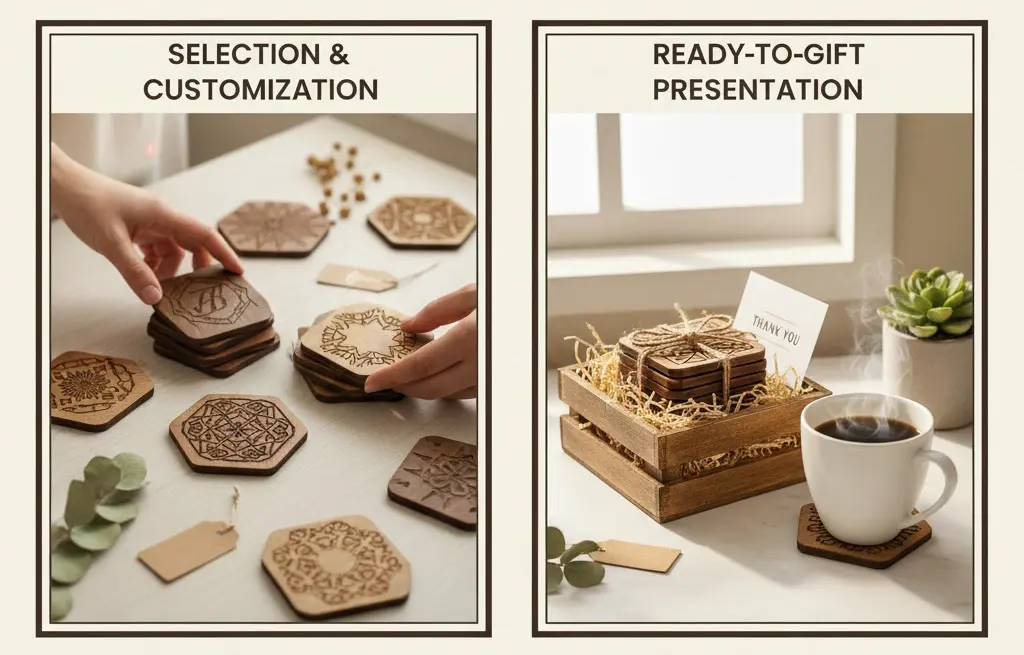
The table is the venue specification sheet we fill per programme; the seal column names both passes explicitly.
| Venue | Traffic band | Face and edge seal | Reorder unit | Branding |
|---|---|---|---|---|
| Brewery taproom | Hundreds of covers nightly | Sealed face with ring groove, edge pass | Inner box 6-12 | 1-colour print or engraving |
| City bar | High turn, late close | Hard seal both passes | Master carton 240-480 | Engraving for wear life |
| Festival or event bar | Single-event spike | Light seal, loss priced in | Event quantity, no refill | 1-colour print, shared card |
| Hotel bar | Steady, housekeeping wiped | Sealed face, abrasion-rated wipe | Par-level inner boxes | Engraving, house mark |
Pack and Lane for Bar Programmes
Bar packs are handled by staff, not shoppers: inner boxes open at the back bar and go straight into a tray, so the wrap per piece matters less than the box’s stack behaviour and the count visibility on its end. Our export standard wraps each piece in white paper with 6 to 12 per inner box and 240 to 480 per master, tested to ISTA 3A, and bar programmes keep that standard because the alternative, loose bulk in a carton, arrives with bruised edges that show their first ring within a week.
Kitted colour boxes from 500 pieces (a higher packaging setup floor) suit the retail-facing side of a brewery programme, the bottle-shop shelf beside the taproom, while the taproom itself stays on bulk inners; mixing the two packs in one carton is the classic bar-order error that puts gift boxes behind a wet till.

What We Supply Into Bar and Brewery Programmes
- We supply: dense solid wood coaster blanks in 4 species, basswood, pinewood, rubber wood and birch, with grain flat under the face and moisture recorded at 8 to 12 percent per batch.
- We supply: the two-pass seal specification per venue band, with ring-groove geometry named on the drawing rather than left to the finish line.
- We supply: 1-colour print and engraving branding with setup quoted separately, and bar-pack inners of 6 to 12 pieces plus master cartons of 240 to 480, tested to ISTA 3A.
- We do not supply: food-contact or dishwasher claims, outdoor or weatherproofing guarantees, and cork-backed certified material claims on bar stock.
The tier structure and range overview behind these specs sit in our wooden coasters wholesale programme page.
Which Spec Fits Which Venue
Breweries with a taproom and a bottle shop run two specs on one order: hard-seal bulk inners for the taproom, kitted colour boxes for the shop, separated at pack so the gift face never waits behind the till. City bars run the hardest seal and engraving, accepting a higher piece cost for wear life. Event bars run the light seal and price loss explicitly, because pretending event coasters return is how a margin disappears.
Hotel bars deserve a note of their own: housekeeping wipes are abrasive by routine, so the face seal is rated for wipe cycles rather than for condensation alone, and the par-level reorder sheet names the wipe cloth as part of the specification.
What We Check Before a Coaster Order Ships
- Moisture at 8 to 12 percent recorded per batch before wrapping, since a bar coaster meets water daily from its first night.
- Seal continuity on face and edge checked on the sampling plan after a wet-cycle test rather than as-made.
- Ring-groove geometry verified against the drawing at first article and at mid-run, because a shallow groove travels water back to the table.
- Claims limited to what we hold: CE, UKCA, RoHS, EN71 where the piece is marketed as a toy, BSCI and ISO 9001.
Every figure above is first-party and checkable against an inspection report or a certificate we hold; the venue bands and reorder units are programme design, not statistics. The company and its specification library sit at ewoodarts.com.
End to End: A Brewery’s Taproom Year
A brewery opening a taproom wants branded coasters that survive nightly wash-down and a bottle-shop gift set that photographs well, from one species and one finish family.
Proof in the venue. The taproom spec proofs on the trial tier at 100 pieces and a USD 500 minimum order value, air express DDP in 20 to 30 days, and runs four weeks of real wash-down before any season decision; the ring groove and edge seal are inspected at week two and week four, not at delivery.
Season split. The season order commits on the wholesale tier at 300 pieces and a USD 3,000 minimum order value, sea freight at 60 to 90 days to port, split at pack: hard-seal bulk inners for the taproom, kitted colour boxes at the 500-piece packaging floor for the bottle shop.
Reorder rhythm. Inner-box refills ride the next consolidation each quarter; the festival weekend each summer rides one air carton priced as marketing. Payment runs T/T with a 30 percent deposit and 70 percent before shipment against photos and video of the packed cartons.
Spec bar coasters for the wash-down, not the photograph
Seal passes, groove geometry, bar packs and tier maths from one specification library.
FAQ
Should a bar coaster absorb or shed condensation?
Shed it into a ring groove that holds water away from the glass base and the table; a face that absorbs keeps a wet ring against the finish and lifts it.
Why two seal passes instead of one?
Face and edge meet water differently: the face takes condensation and wipes, the edge takes tray water through end grain, and one pass cannot protect both.
Which branding survives bar wash-down?
One-colour print or engraving; full-colour faces lose their argument to abrasive wipes within weeks, and engraving outlives the seal itself.
What reorder unit suits a taproom?
The inner box of 6 to 12 pieces, kept at the back bar; master cartons suit high-turn city bars, and event bars should price loss instead of planning refills.
Can coasters carry dishwasher or food-contact claims?
No. A bar coaster meets condensation and wipe cycles only; any supplier offering dishwasher or food-contact claims on wood bar stock is selling a different product class.