Skip to content

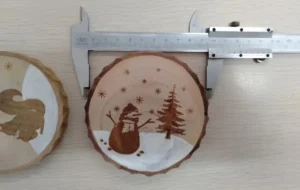
Coaster thickness is the dimension nobody specifies and everybody feels. It decides whether the piece lands with a sound that reads as quality, whether a laser mark has depth headroom, how many pieces fit the inner box, and whether a stack of four on a hotel tray looks like a product or like spare offcuts. Edge profile is its partner: the same face reads differently under a square edge, a chamfer or a round-over.
This guide treats both as drawing dimensions with consequences rather than catalogue defaults, and walks branding teams through what each choice does to the mark, the stack, the pack and the hand. We cut to specified millimetres; the specification and its trade-offs belong to the brand, and this guide is how to write it.
Key Takeaways
- Thickness is a drawing dimension, not a catalogue default: we cut to the millimetres your spec names, and the spec should name the 3 consequences it accepts, stack height, pack count and mark depth.
- Edge profile decides where a brand mark can live: of the 4 profiles, a square edge gives a full face and a printable rim, a chamfer gives a light-catching bevel that shrinks the face, and a rounded edge leaves almost no flat for a mark at all.
- Laser marks need depth headroom: a mark that reads crisp on a thick blank can break a print margin on a thin one, so mark size is set after thickness in 1 drawing line, never before.
- Pack maths follows thickness: our export pack holds 6 to 12 pieces per inner box of 21 by 11 by 14 cm, and a thicker coaster reduces pieces per carton inside the same 8.0 to 15.0 kg gross band.
- Feel is a branding decision too: a heavy thick coaster lands with 1 low knock that reads as quality in hospitality, while a thin light one clicks and reads as disposable on a conference table, and guests say neither out loud.
- Approve the spec like any custom run: a first article set of 3 thickness and edge combinations carrying the real mark, then the retained sample, then the tier maths at 100 or 300 pieces.
In This Guide
- Why the Unspecified Dimension Runs the Product
- Coaster Thickness: Three Consequences to Name
- Edge Profiles and Where the Mark Lives
- Mark Depth Headroom
- Pack Maths: The Carton Does Not Care About Your Brand
- Edge Profile Against Face Against Pack Against Setting
- Feel, Sound and the Hospitality Test
- What We Cut, and to Whose Numbers
- Best For / Not For
- What We Check on a Coaster Run
- End to End: A Hotel Group’s Branded Coaster
- Frequently Asked Questions
Why the Unspecified Dimension Runs the Product
Most coaster briefs specify diameter, artwork and quantity, and leave thickness to whoever cuts the blank. The cutter then chooses for pack efficiency, the pack chooses a thin blank, the thin blank starves the engraving, and the brand finds at delivery that its logo reads as a scratch. Every step was rational; the dimension was simply nobody’s job.
Making thickness and edge profile explicit line items on the drawing is the whole fix, and it costs nothing but a decision made early. The range this decision applies to, from wood-slice blanks to pressed and carved coasters, is described on our wooden coasters wholesale page.
Coaster Thickness: Three Consequences to Name
A thickness spec is honest only when it names what it costs. Stack height: four coasters on a tray or in a box multiply the dimension, and a hospitality tray has a lid line. Pack count: the inner box is a fixed volume, so thickness trades directly against pieces per carton and freight per piece. Mark depth: every branding method removes or displaces material, and the blank must have room beneath the mark floor to stay structurally and visually clean.
Name those three on the drawing and the number defends itself in every later conversation, including the one where procurement asks why the carton holds fewer pieces than last year’s programme. Where the brand has no preference, we quote the combinations our benches run cleanly and the consequences of each, and the choice stays documented either way.

Edge Profiles and Where the Mark Lives
Four profiles cover the market. A square edge keeps the full face and a crisp printable rim, and reads precise under a logo with fine type. A chamfer catches light along the bevel and softens handling, but eats a ring of face that a rim-running mark would have used. A round-over feels friendly in the hand and survives drops, and leaves the smallest flat face of the four. A pillow edge, rounded top and bottom, is a comfort piece first and a branding surface last.
The rule that saves rework: choose the profile from the mark, not from the mood board. A logo with a thin outer ring needs the square edge’s full face; a bold centred monogram tolerates a chamfer; a piece whose brand lives on a printed insert card rather than on the wood can take any profile, including the pillow. The material comparison behind profile behaviour, including cork backing’s effect on edge feel, is set out in our guide to coaster materials: cork, wood and slate.
Mark Depth Headroom
Laser engraving removes depth; pad and screen printing add a layer that wears at the rim; a branded insert adds nothing to the wood at all. For engraving, the blank needs material below the mark floor equal to whatever the thinnest point of the design demands, plus the sanding pass that follows, plus the tolerance the batch carries. Specify the mark after the thickness and the two numbers stop fighting.
Where a brand wants both a deep engraving and a thin coaster, the honest answers are a smaller mark, a bolder mark, or a thicker coaster; shrinking the font until it fits the depth budget produces a mark that reads as damage within a year of hospitality use. The custom route that carries these decisions from drawing to first article is our custom product manufacturing process.

Pack Maths: The Carton Does Not Care About Your Brand
Our export pack is fixed: each piece wrapped in white paper, 6 to 12 pieces per 3-ply inner box of 21 by 11 by 14 cm, then 240 to 480 pieces per 5-ply master carton of 58 by 44 by 31 cm at 8.0 to 15.0 kg gross, made up to pass an ISTA 3A drop test. Thickness changes how many pieces those volumes hold, and with that the freight cost per piece, without changing the unit price at all.
Brands regularly find this out at the landed-cost line rather than at the drawing, which is the wrong end of the process. Compute pieces per inner box from the specified thickness before the order, and where a retail unit is added on top, its dimensions enter the same arithmetic; the retail-unit options and their minimums are covered in our guide to EU packaging and labelling for wooden gifts, where label space also scales with the piece.
Edge Profile Against Face Against Pack Against Setting
| Profile | Face for a mark | Stack and pack behaviour | Best setting |
|---|---|---|---|
| Square | Full face plus rim | Stacks flush, densest pack | Fine-type logos, retail shelf |
| Chamfer | Face minus a bevel ring | Stacks flush, light catch | Bold centred monograms |
| Round-over | Small flat only | Stacks with shadow gaps | Handled hospitality use |
| Pillow | Centre only | Least dense stack | Comfort-first gift sets |
Feel, Sound and the Hospitality Test
Set a thick coaster down on stone and it lands with a low knock; set a thin one and it clicks. Guests never name the difference and always feel it, which makes it a branding channel with no logo on it. Hospitality programmes should audition candidates the way guests meet them: set down, lift, set down again, on the actual table surface, not on a desk in a meeting.
The same test exposes edge behaviour: a square edge on a polished table can skate, a round-over grips, and a chamfer sits between. Where a property’s tables are glass or polished stone, the grip question outranks the mark question, and the drawing should say so in writing rather than leaving it to the sample’s charm.

What We Cut, and to Whose Numbers
- We cut to your drawing: thickness and edge profile as specified millimetres, in 4 species, basswood, pinewood, rubber wood and birch, plus wood-slice blanks with natural edges.
- We mark to your sequence: laser engraving, painted marks and custom labels and marks, with the mark-size-against-thickness check performed at first article.
- We do not choose for you: where a brief leaves thickness open we quote the combinations our benches run cleanly and their pack consequences, and the decision returns to the brand in writing.
- We do not claim: FSC-certified wood, because certified basswood is not currently available to us despite our chain-of-custody certificate; species and origin statements with permits are what we supply instead, and the framework for credible business claims is published by the FSC business programme.
Best For / Not For
| Programme | Best for | Not for |
|---|---|---|
| Hotel and restaurant | Thicker blank, round-over or chamfer, grip first | Thin blanks chosen for carton count |
| Retail gift set | Square edge, full-face mark, dense stack | Pillow edges under a fine-type logo |
| Corporate swag at volume | Mid thickness, chamfer, bold centred mark | Deep engraving on the thinnest blank |
| Promo giveaway | Printed mark on a thin blank, insert card | Engraving promised at giveaway budget |
What We Check on a Coaster Run
- Thickness against the drawing, calipered on the sampling plan at three points per piece, because a cupped blank measures differently at centre and rim.
- Edge profile continuity, the chamfer or round-over unbroken around the full perimeter, checked under raking light.
- Mark depth and legibility against the approved first article, at the specified size, after the sanding pass.
- Moisture at 8 to 12 percent recorded per batch before wrapping, so a thin blank cannot cup in transit.
- Claims limited to what we hold: CE, UKCA, RoHS, EN71 where it applies, BSCI and ISO 9001.
Every figure above is first-party and checkable against an inspection report or a certificate we hold; the profile and feel guidance is method for your audition, not a standard. The company and its specification library sit at ewoodarts.com.

End to End: A Hotel Group’s Branded Coaster
A six-property hotel group wants one branded coaster across all properties: logo engraved, grip on polished stone tables, stack of four per room tray, and a carton count the finance team can live with.
Write the drawing with consequences. The brief arrives as diameter and logo only; the returned drawing names thickness, edge profile and mark size together, with the three consequences stated: tray stack height at four pieces, pieces per inner box at the chosen thickness, and mark depth headroom beneath the logo’s thinnest ring. Two thickness candidates and two profiles go to first article, each carrying the real logo.
Audition on the actual table. The sample set travels to one property and meets the polished stone: the square-edge candidate skates, the chamfer grips, and the knock test settles thickness in one afternoon. The approved combination becomes the retained sample and the drawing is amended in writing before any run is scheduled.
Order on the tier the count allows. Six properties at four per tray plus spares clears the wholesale and custom tier at 300 pieces and a USD 3,000 minimum order value, sea freight 60 to 90 days to port counted back from the spring refresh, with the pack count recomputed at the approved thickness so finance sees the true freight per piece. The carton label carries the drawing revision, so a top-up order two years later reproduces the knock, the grip and the mark.
Specifying a branded coaster programme?
Send us your logo, your table surfaces and your tray stack. We will return the thickness and edge combinations that carry the mark, the pack maths at each, and a first article set to audition on your own tables.
Frequently Asked Questions
Q: What thickness should a branded wooden coaster be?
The one your drawing names, chosen against three consequences: stack height in the tray or box, the mark depth your branding method needs, and the feel you want in the hand. We cut to specified millimetres rather than a house default, so the decision and its trade-offs stay yours, documented on the drawing and the carton label.
Q: Which edge profile takes a laser mark best?
A square or lightly chamfered edge, because both leave a full flat face with an uninterrupted print margin. Heavy chamfers and round-overs shrink the usable face and push the mark toward the centre, which changes the layout and often the legibility of fine type or a thin outer ring in the logo.
Q: Does thickness change the packing count?
Yes. Our inner box is fixed at 21 by 11 by 14 cm and holds 6 to 12 pieces, so a thicker coaster reduces pieces per inner box and per master carton within the same 8.0 to 15.0 kg gross band. Freight cost per piece rises with thickness even when the unit price does not, which is why the pack maths belongs on the drawing.
Q: Can a thin coaster carry an engraved logo?
It can, with a shallower mark and a smaller layout, because engraving depth headroom shrinks with blank thickness. Where the brand needs a deep crisp mark, specify the thickness that gives the mark room first and let the stack and pack consequences follow, rather than fighting them at delivery.
Q: How do we approve thickness and edge before a run?
With a first article set: 3 combinations of thickness and edge profile, each carrying the real brand mark at the real size, shipped for a hand check on your actual table surfaces. The approved combination becomes the retained sample, and the drawing is amended in writing before the production run is scheduled.