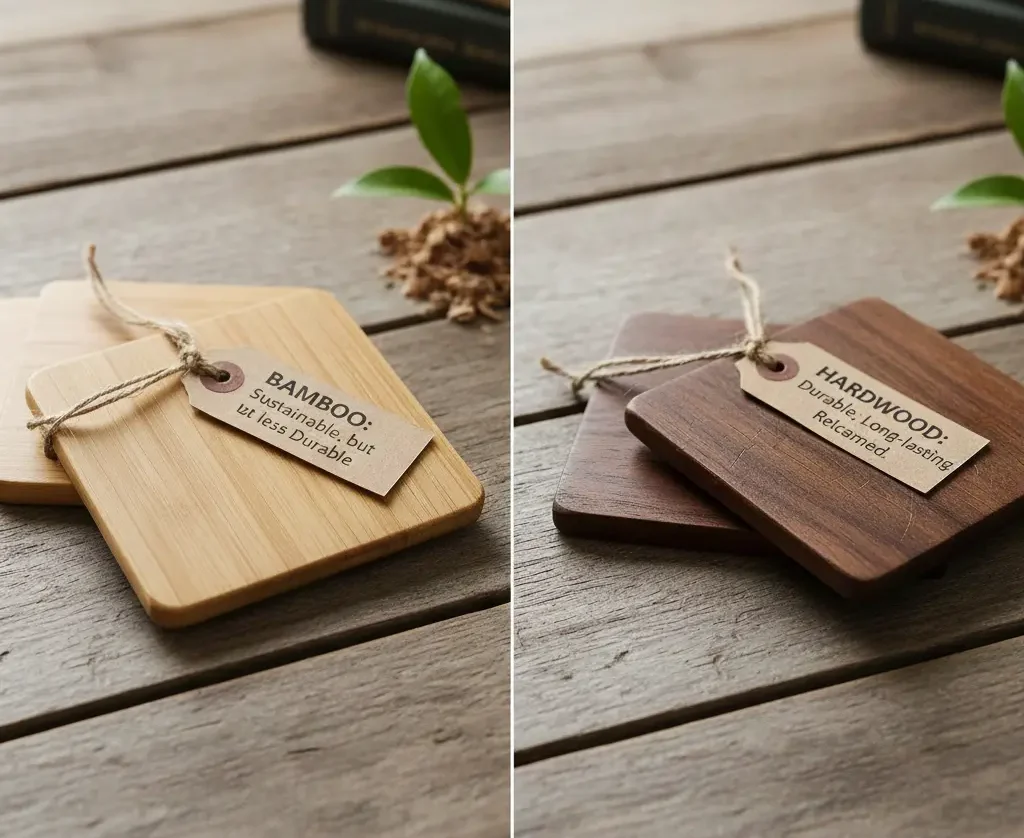
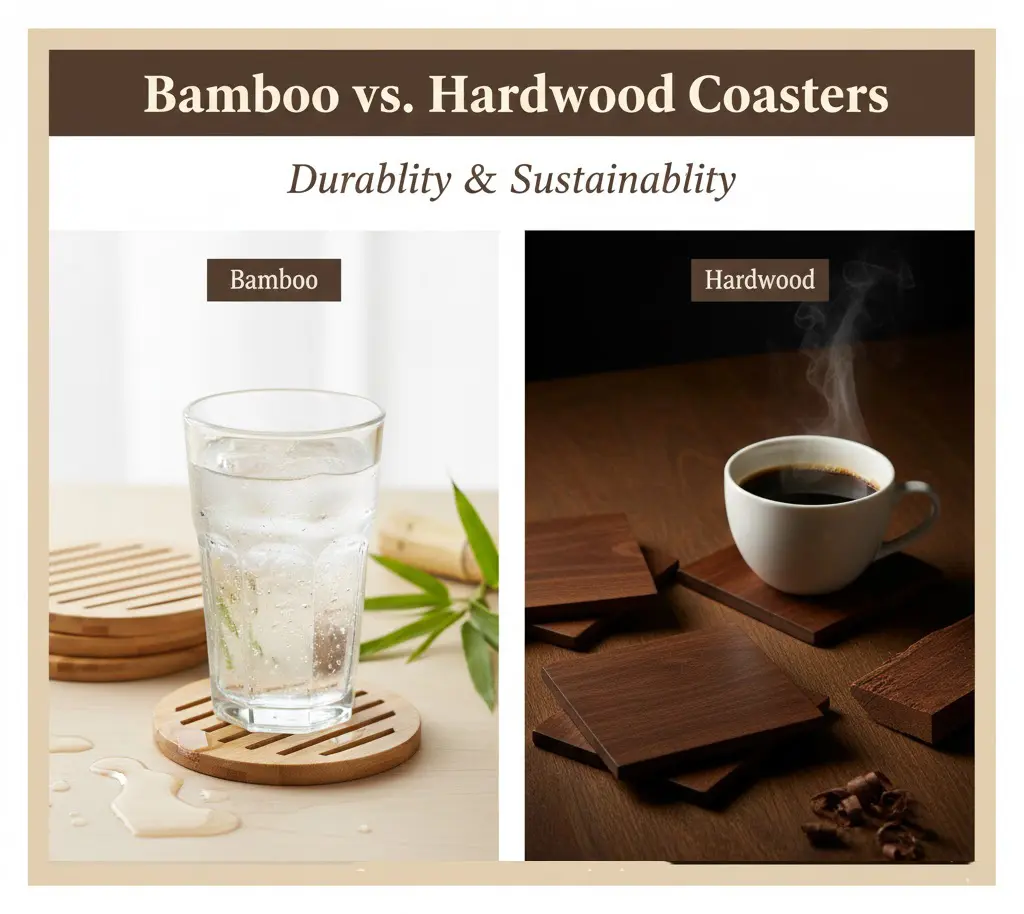
Procurement teams comparing bamboo vs. hardwood coasters often face a trade‑off between visual warmth, surface durability, and sustainability metrics. While hardwood carries traditional appeal, strand‑woven bamboo reaches Janka hardness levels of 3,000–5,000 lbf—two to three times stronger than many hardwoods—and matures in under seven years. This performance mix raises questions about which material delivers the best long‑term value for branded or high‑volume production runs.
This article breaks down the engineering and environmental differences between bamboo and hardwood coasters, including polymer‑coating requirements, pressing parameters around 400 °F (204 °C), and moisture stability under daily use. It helps sourcing managers and manufacturers weigh mechanical strength, finish clarity, and renewal rate to decide which substrate better aligns with their durability and sustainability goals.
Understanding Sublimation on Wood vs. Other Materials
Sublimation on wood relies on a polymer or laminate surface that absorbs dye gases, unlike metals or plastics where sublimation interacts with uniform coatings. The coating quality, thickness, and the wood’s natural texture determine the final color and clarity.
How Sublimation Bonds Differ Across Wood, Metal, and Polymer Surfaces
Wood requires a compatible polymer, polyacrylic, or laminate coating so gaseous dyes can bind effectively. Without this layer, the ink cannot diffuse properly into the lignocellulosic fibers, leaving muted tones, irregular absorption, or blotchy edges. Coated blanks—such as polymer‑treated bamboo coasters or MDF panels—form a semi‑amorphous matrix that opens under heat and stabilizes once cooled, allowing color to lock in.
On metals and plastics, the bonding mechanism differs. Sublimation dye penetrates the powder‑coat or thermoplastic layer, not the core substrate. The heat softens the polymer layer, enabling consistent diffusion and uniform molecular bonding. This produces a dense, UV‑resistant image that remains stable even under significant wear, something raw wood cannot achieve without an artificial polymer surface.
Process Temperatures and Results for Wood and Industrial Materials
Common craft‑scale polymer‑coated wood blanks are pressed at around 400°F (204°C) for 60 seconds at medium pressure. Laminated composites may use 375°F (190°C) for 90 seconds. The polymer layer must reach a temperature that allows gas migration but not damage the wood beneath. Surface uniformity, coating thickness, and moisture content affect the resulting clarity and gloss.
Industrial wood‑grain sublimation, where printed films transfer patterns onto powder‑coated aluminum or steel, operates on a different thermal profile. These ovens typically run between 160°C and 220°C for 5–20 minutes. The combination of heat, pressure, and sometimes vacuum forces dyes about 40–60 μm into the powder‑coat, creating a reproducible, abrasion‑resistant finish. For high‑volume operations, producers tune parameters like oven setpoints, vacuum pressure, and coating crosslink density to balance throughput and longevity.
Research Summary
Technically speaking, sublimation “on wood” is actually sublimation into a polymer film applied on wood, rather than into the wood structure itself. Suitable coatings—polymer, polyacrylic, or laminate—form the amorphous polyester-like network necessary for dye diffusion. Products sold as “sublimation-ready” bamboo or hardwood generally come pre-coated at the factory. In home workflows, creators often add an intermediate polyester or heat transfer vinyl layer pressed at about 300°F (149°C) for 20 seconds before sublimating the final image. The quality of this polymer interface dictates sharpness, saturation, and durability.
Industrial systems take a broader engineering approach. Powder-coated aluminum components wrapped in printed film are heated under vacuum at 160–220°C, forming durable coatings whose wear and UV performance depend on powder-coat chemistry rather than the dye itself. Multi‑layer stacks—metal base, pretreatment, powder coat, and sublimation overlay—produce controlled surface characteristics suitable for architectural or outdoor use. Even so, manufacturers note mild color variation and surface irregularities as normal due to the physics of dye diffusion, a variation even more pronounced when working with natural wood substrates.
Industry and Equipment Examples
Companies active in this field include Knotwood, known for powder‑coated aluminum with sublimated wood‑grain finishes and documented surface variation standards; Brightstar Aluminum Machinery, which publishes parameters for vacuum‑assisted sublimation ovens; and Chanjeou, a manufacturer providing detailed specs for industrial wood‑grain sublimation equipment, including cycle time and penetration depth performance data. Their combined technical references outline the practical distinction between decorative sublimation systems for metal coatings and small‑scale polymer surface transfer on wood products.
Essential Equipment: Heat Press, Printer, and Ink
High-quality results in wood sublimation come from using a precise heat press capable of uniform temperature control, an inkjet printer fitted with sublimation ink, and suitable transfer media designed for rigid polymer-coated surfaces.
Choosing the Right Heat Press and Printer Setup
Flatbed heat presses with 15×15 to 16×20 inch platens give consistent and even pressure for bamboo and hardwood coaster blanks. This platen area is standard for small production lines and ensures full coverage across multiple coaster zones at once.
Professional-grade presses need to maintain a temperature tolerance within ±2 °F for uniform heating. The heating elements are typically spaced within 2 inches across the platen to prevent cold spots. A platen thickness between 5/8 and 3/4 inch adds thermal stability—important when pressing onto denser hardwood surfaces that absorb heat more quickly than bamboo.
Inkjet printers equipped with sublimation ink, often using Epson or Ricoh print heads, create high-resolution transfers. These printers work with sublimation papers or films suited for rigid, polymer-coated surfaces that can bond effectively under heat and pressure.
Technical Specifications and Safety Standards
Production heat presses commonly operate at around 400 °F (≈204 °C), with warm-up times near 20 minutes to reach a steady operating state. Total power draw ranges from 800 to 1800 W at 120 V, translating to a current load between 7 and 15 A depending on model size and platen area. Operators should verify their power circuits can handle this load in addition to printers and air compressors.
Air-powered presses such as the Air Fusion IQ® automate pressure application. These units typically require a 0.5 hp compressor with a 2.5-gallon tank and a 2.3 CFM consumption rate. For continuous production, larger models like the Dual Air Fusion IQ® may need up to a 1 hp compressor and an 8-gallon tank to maintain consistent pneumatic performance through long cycles.
Certified equipment should carry UL, CE, ETL, RoHS, LVD, and EMC markings. These certifications verify compliance with electrical and environmental safety standards, confirming that the equipment meets recognized manufacturing and operational quality benchmarks for heat-based production environments.
Why You Need Polymer-Coated Wood Blanks
Polymer-coated wood blanks combine the strength and natural appeal of wood with the durability and moisture resistance of engineered polymer skins, delivering stable, smooth surfaces ideal for sublimation printing and long-term use.
The Role of Polymer Coating in Wood Protection
Polymer-coated wood blanks prevent swelling, checking, and rot even in high-moisture environments such as under drink condensation. The coating acts as a continuous barrier that keeps the wood dimensionally stable and visually consistent over time.
Elastomer-based coatings flex with the wood substrate, maintaining surface integrity when the core expands or contracts. This flexibility allows the polymer skin to resist cracking and delamination while protecting against water and abrasion during use.
Material Performance and Application Advantages
A typical polymer coating measures 35–50 mil (0.89–1.27 mm) thick, providing an excellent mechanical profile with about 3,000 psi tensile strength and 585% elongation at break. This balance yields both rigidity and stretch, preventing coating failure from thermal or moisture-driven movement.
With a hardness value near 90 Shore A and tear resistance close to 480 PLI, these coatings show impressive wear resistance and impact stability. Many polymer-coated structural wood products are engineered to meet a 25‑year decay and rot warranty, ensuring long service life for applications such as sublimation coasters or outdoor signage.
Industrial data from producers like American Pole & Timber demonstrate that the same thermoplastic elastomer technology used in structural wood components adapts well to thin substrates for decoration. The barrier performance mirrors that of waterborne polyurethane dispersions and UV‑curable coatings like Covestro’s Bayhydrol® UV systems, which are known for exceptional adhesion, flexibility, and moisture protection in wood finishes.
Technical work from companies such as Trinseo, Mallard Creek Polymers, and BASF indicates that high‑end wood coatings rely on a combination of flexibility, water resistance, and abrasion hardness. These material traits make polymer‑coated blanks a practical choice for sublimation: they hold color clarity, withstand repeated contact with liquids, and maintain surface smoothness over extended use.
Bulk Wooden Coasters, Crafted to Elevate Your Brand
Step-by-Step Sublimation Process
The sublimation process transfers printed sublimation ink from paper to a polymer-coated wooden surface using heat and pressure. It includes design preparation, printing, pre-pressing, heat pressing at around 380 °F for 30–60 s, and careful cooling before removing the transfer paper.
| Stage | Key Actions | Typical Parameters |
|---|---|---|
| Design & Alignment | Prepare in CMYK, mirror print, pre‑press coaster, tape design | Room temperature; short pre‑press (~5 s at low heat) |
| Transfer & Cooling | Press design under heat, let cool before removing paper | ~380 °F (193 °C), 30–60 s, firm/even pressure |
Preparing and Aligning the Design
Use CMYK color profiles specifically tailored for sublimation printers to keep the colors consistent through the process. These profiles help manage how the dyes behave once heated, leading to accurate color reproduction on polymer-coated wood.
Print a mirrored version of the artwork on sublimation transfer paper using disperse dye sublimation inks. This ensures the design appears in the correct orientation when transferred to the coaster’s surface.
Before attaching the printed sheet, briefly pre‑press each coaster blank. This step drives out any moisture from the polymer layer, which helps prevent uneven color patches and ghosting once the heat press is applied.
Position the printed transfer paper face-down on the coating and secure it with heat‑resistant tape. Keeping the paper still under heat and pressure eliminates unwanted blurring at the edges of your design.
Transferring and Cooling the Coaster
Place the secured coaster in a flatbed heat press set to around 380 °F (193 °C). Apply firm, even pressure for about 30–60 s, fine-tuning based on the coaster’s specific material and manufacturer recommendations. This temperature range causes the dyes to sublimate into the polymer layer, forming a permanent bond within the surface.
Maintain full contact between the transfer paper and polymer coating during pressing. Any gap or crease breaks the path of dye diffusion, creating faded areas in the print.
After pressing, allow the coaster to cool close to room temperature before peeling away the paper. Rushing this step could lead to smearing or incomplete bonding as the coating stabilizes and the dyes re‑solidify.
Inspect the cooled surface for uniform color saturation and ensure that the design is absorbed into the coating, not sitting as a visible film. A properly sublimated coaster has a smooth, durable print that withstands moisture and everyday handling without fading or lifting.
Dialing in Heat Press Settings (Temp & Time)
Heat press settings determine the balance between temperature, time, and pressure needed to achieve durable, high-quality transfers. Each material—like polymer-coated wood, cotton, or polyester—requires its own combination to avoid scorching, fading, or incomplete bonding.
How Temperature and Time Affect Transfer Quality
Temperature and exposure time define how completely sublimation dyes vaporize and bond with the coated or fabric surface. Polymer-coated wood and ceramic materials often need around 400°F (204°C) for about 60–90 seconds, creating enough energy for the dye to move into the coating instead of sitting on the surface. This produces crisp colors and strong adhesion that resist fading or peeling.
When temperature runs too high, bamboo or hardwood pieces may warp or discolor from overheating. If the press runs cool or opens too soon, insufficient heat prevents full sublimation, leaving dull or patchy areas. Accurate control of both time and temperature ensures consistent quality across batches, especially for wood coasters and fabric-based merchandise.
Recommended Settings for Common Materials
Different substrates respond best to specific thermal and pressure ranges. Cotton HTV should be pressed at 305°F (152°C) for 10–15 seconds with medium pressure (30–50 PSI) to activate the adhesive without scorching fibers. Polyester HTV responds well between 270–305°F (132–152°C) for 10–12 seconds at similar pressure, minimizing melt or distortion. Sublimation on polymer-coated hard surfaces, like coated wood or ceramic coasters, typically requires 400°F (204°C) for 60–90 seconds under medium-heavy pressure (about 40 PSI or more) to achieve complete dye transfer and surface bonding.
These settings also align with manufacturer testing ranges—modern heat presses allow fine-tuning by small increments to find the sweet spot for each batch. Pre-pressing coated pieces for a few seconds helps remove moisture that can create artifacts or uneven transfer, improving both color consistency and finish durability.
Digital control panels simplify calibration: users set the desired temperature (for example, 305°F for cotton), timer duration (10–15 seconds), and pressure via gauge or knob. Following peel recommendations—hot for sublimation, cold for HTV—reduces surface defects. Continuous testing with sample scraps helps refine these ranges further for eco-materials like bamboo composites or blended textiles used in coaster production.
Managing Pressure for Even Transfers
Even pressure ensures that heat, ink, and substrate stay in consistent contact, avoiding light or blurry patches during sublimation. Bamboo’s dense, strand‑woven structure naturally resists dents and distributes press force evenly, producing cleaner, uniform transfers compared with softer hardwoods.
Understanding Pressure Balance in Sublimation
Uneven pressure creates irregular heat flow, which leads to faded or blotchy print areas on the wood’s surface. This happens when certain zones receive more heat or contact time than others, causing inconsistent dye penetration and patchy results on coasters or decorative panels.
Strand‑woven bamboo, made under very high compressive loads during manufacturing, forms a tightly packed fiber network that resists localized indentation from the press plate. This resistance keeps the substrate flat and pressure distribution consistent, giving more uniform image clarity across the entire printed area.
Mechanical and Thermal Controls for Even Results
To achieve balanced pressure, maintain platen pressure around 90–120 psi when working on dense bamboo. This range aligns with flooring fastener pressures, strong enough to secure firm contact without crushing fibers. Keeping within this range prevents mechanical deformation while allowing the ink and heat to act evenly across the print face.
Select engineered bamboo boards with a minimum thickness of 18 mm and leave a 10 mm expansion gap to manage flex and thermal strain. Bamboo’s higher heat conductivity helps distribute warmth through the entire panel, reducing hot spots or cool edges. These measures ensure the same temperature and load reach every point for consistent sublimation color density and definition.
Research Summary
Industrial data show that transfer quality depends on how evenly mechanical and thermal forces spread through the substrate. Strand‑woven bamboo, produced by compressing moso bamboo fibers with resin under high pressure and heat, develops a dense structure with Janka hardness often between 3,000 and 5,000 lbf. This value is two to three times greater than typical hardwoods such as oak. The material’s hardness limits surface denting, maintaining planar contact under printing or clamping loads.
Installation guidelines specify an 18 mm panel thickness over joists at 16″ spacing and a 10 mm expansion gap to regulate deflection and thermal growth. These mechanical boundaries prevent warping or crowning, which could cause uneven contact and irregular heat transfer. Fastening methods, such as pneumatic nailing at 90–120 psi, represent controlled mechanical energy input levels that secure the board while preventing structural fiber damage that might appear in the top layer during sublimation.
The higher thermal conductivity of bamboo also contributes to steady temperature transfer within the panel, reducing surface gradients that could affect dye activation. Engineered bamboo systems show greater dimensional stability than most solid hardwoods, especially when exposed to heat or moisture shifts. Together, these properties make strand‑woven bamboo reliable for consistent mechanical and thermal contact, resulting in cleaner, sharper transfer images compared with many softer wood substrates.
References & Source Notes: Data compiled from Ambient Bamboo Floors, Romero Hardwood Floors Inc., BuildDirect Learning Center, and Duramagic Floor, covering bamboo hardness, installation pressures, and thermal conductivity values relevant to print and sublimation applications.
Cooling and Handling Finished Coasters
After sublimation, cooling helps stabilize pigment layers and prevent warping or finish cracking. Controlled temperature and careful manual handling protect coatings like epoxy or polyurethane for long-term performance.
Post-Press Cooling and Stabilization
Gradual cooling reduces stress on polymer-coated wood surfaces and pigments, maintaining structural and color fidelity. If coasters cool too quickly, temperature gradients between layers can lead to deformation or finish delamination.
Sensors with a range between -12°C and 58°C validate stable cooling cycles. For production testing, Peltier modules can achieve equilibrium within 10–20 minutes, helping confirm temperature control throughout the surface.
Avoid using fans or compressed air for forced cooling. Instead, allow coasters to rest on a flat, non-conductive surface such as silicone mats or untreated MDF. This reduces mechanical stress and keeps laminated layers aligned as they reach ambient temperature.
Rapid cooling can form tiny cracks in epoxy or resin coatings. These microcracks may later absorb moisture or cause irregular pigment diffusion on reheat cycles, so maintaining a gradual thermal transition is key.
Handling, Finishing, and Protection Layers
Once cooled, always handle coasters with nitrile or cotton gloves. This prevents fingerprints, oil residues, and humidity from interacting with the coating surface during quality checks.
Apply two to three thin coats of epoxy resin or high-heat polyurethane to reinforce heat tolerance and moisture resistance. Each layer should cure thoroughly to maintain durability against mug or dish heat exposure.
Perform a water bead test before packaging. If water droplets remain spherical and do not spread, the coating properly sealed the wood against moisture penetration.
Advanced coaster prototypes can incorporate pressure sensors or embedded 12V DC Peltier elements to assess load performance or simulate active heating and cooling cycles. These components verify consistent thermal conduction under real use conditions.
Testing confirms epoxy and polyurethane coatings can withstand temperatures up to around 58°C—common for hot beverages—while maintaining adhesion and gloss. Integration of Peltier systems powered through 12V DC converters allows controlled experiments for verifying thermal stability during production.
Troubleshooting Common Sublimation Issues
This section outlines common sublimation errors—like color shifts, banding, ghosting, or faded prints—and links them to factors such as heat, time, pressure, and moisture. It guides how to adjust these variables and maintain equipment for consistent, high-quality transfers.
Recognizing Common Printing and Transfer Problems
Color fading or shifts often happen when heat settings are inaccurate or when the printer lacks the correct ICC color profile. A mismatch between the print driver and the substrate coating can lead to dull or incorrect tones that misrepresent the original design.
Banding or faint horizontal lines usually point to clogged nozzles in the printer head. Running nozzle checks and performing cleaning cycles help restore consistent ink flow, especially on printers converted for sublimation use. If lines persist, printing purge sheets may help remove trapped air or dried ink.
Ghosting or double images appear when the transfer paper moves slightly during pressing. This can occur from uneven pressure, premature opening of the press, or a shift in paper placement. Secure the paper with heat-resistant tape before pressing to avoid ghost outlines.
Uneven color or dull surfaces may result from printing on the wrong side of sublimation paper or applying inconsistent pressure across the item. Always print on the bright white coated side of the paper, and ensure the press platen delivers even force across every point of contact.
Adjusting Heat, Time, and Pressure for Reliable Results
Maintaining a press temperature between 380°F and 400°F (193–204°C) for about 60 seconds under medium to high pressure ensures thorough ink transfer to polymer-coated wood products. Operating outside this range can weaken color bonding or overgas the dyes.
Pre-press each wooden blank briefly before applying the transfer. This drives out moisture that otherwise becomes steam near 200°C, pushing dye outward and causing blurred or faded patches. Removing moisture beforehand keeps detail edges sharp and colors stable.
Apply steady, even pressure across the whole press platen. Uneven compression leads to partially transferred images, especially on curved or irregular surfaces like bamboo coasters. Use a pressure gauge or test with paper shims to confirm consistent tension.
Placing Teflon or protective sheets between the product and press helps block ink bleed, prevents residue buildup on heating plates, and extends equipment longevity. Consistent cleanliness of pressing surfaces also supports repeatable results batch after batch.
Research Insights
Key data show that precise control of temperature (193–204°C), pressing time (60 seconds), and pressure (medium to high) minimizes deviations where ink fails to gasify properly. Moisture at 200°C instantly turns to steam, which displaces dye and weakens transfer quality. Printer issues such as nozzle clogs create visible banding, while missing ICC color profiles distort hues during RGB to CMYK conversion. Using proper materials is essential—only polymer-coated substrates bond effectively with sublimation dyes. Clean presses, correct paper orientation, and gradual calibration through test prints ensure vibrant, consistent outcomes on polymer-coated wooden products and other eco-conscious blanks.
Final Thoughts
Comparing bamboo and hardwood coasters reveals that each material has a unique balance of durability, texture, and sustainability. Bamboo’s dense, strand‑woven structure provides reliable hardness and even heat distribution during sublimation, ensuring consistent image transfer. Hardwood, especially when coated or laminated, offers natural warmth and grain character but can be more prone to warping or uneven dye absorption without protective polymer layers.
For sustainable production, bamboo stands out thanks to its rapid growth cycle and low environmental footprint, while polymer coatings make it just as durable as treated hardwood for everyday use. When prepared with the right coating and processed under controlled heat and pressure, both materials perform well, but bamboo’s renewability and thermal stability make it the more practical option for eco‑minded creators looking to balance longevity with environmental responsibility.
Frequently Asked Questions
Is bamboo water resistant?
Natural bamboo is not water resistant. It absorbs moisture and can swell when exposed to water. Engineered bamboo with high resin impregnation (up to 20% PF resin) and density above 1000 kg/m³ improves resistance significantly, reducing width swelling to around +0.9% after 24 hours in water.
Why are bamboo coasters so cheap?
Bamboo coasters cost less because bamboo grows fast, is harvested efficiently, and has a high material yield during manufacturing. About 1.67 tons of bamboo can produce 1 ton of panels, which makes large‑scale, low‑cost production possible, bringing single coaster prices down to roughly USD 0.40–1.00.
Is bamboo actually wood?
Bamboo is not wood botanically; it is a woody grass. Yet in engineering and trade it is now considered a wood‑equivalent material. Standards such as ISO 21625 and the revised ASTM D5456 classify bamboo with engineered wood products, since its compressive strength of about 40–80 N/mm² is 2–4 times higher than many woods.
Which is more sustainable?
Bamboo is more sustainable than hardwood. It matures in about 5–7 years, regenerates without replanting, and can sequester up to 70% more carbon per acre each year than most hardwoods. Hardwood harvest cycles, often 40–80 years long, limit rapid renewal even when managed sustainably.
Can you sand and refinish bamboo?
Yes. Bamboo flooring and similar products can be sanded and refinished like hardwood. Strand‑woven bamboo typically allows for 2–3 refinishings depending on thickness, while engineered bamboo can be refinished around 2 times.