Skip to content
Choosing the best wood for coasters is a margin decision, not an aesthetics decision: species drives engraving quality, dent resistance in hospitality use, board yield per cubic metre and finishing time. This guide compares the five species most requested in wholesale coaster programmes and maps each to the channel it actually earns its keep in.
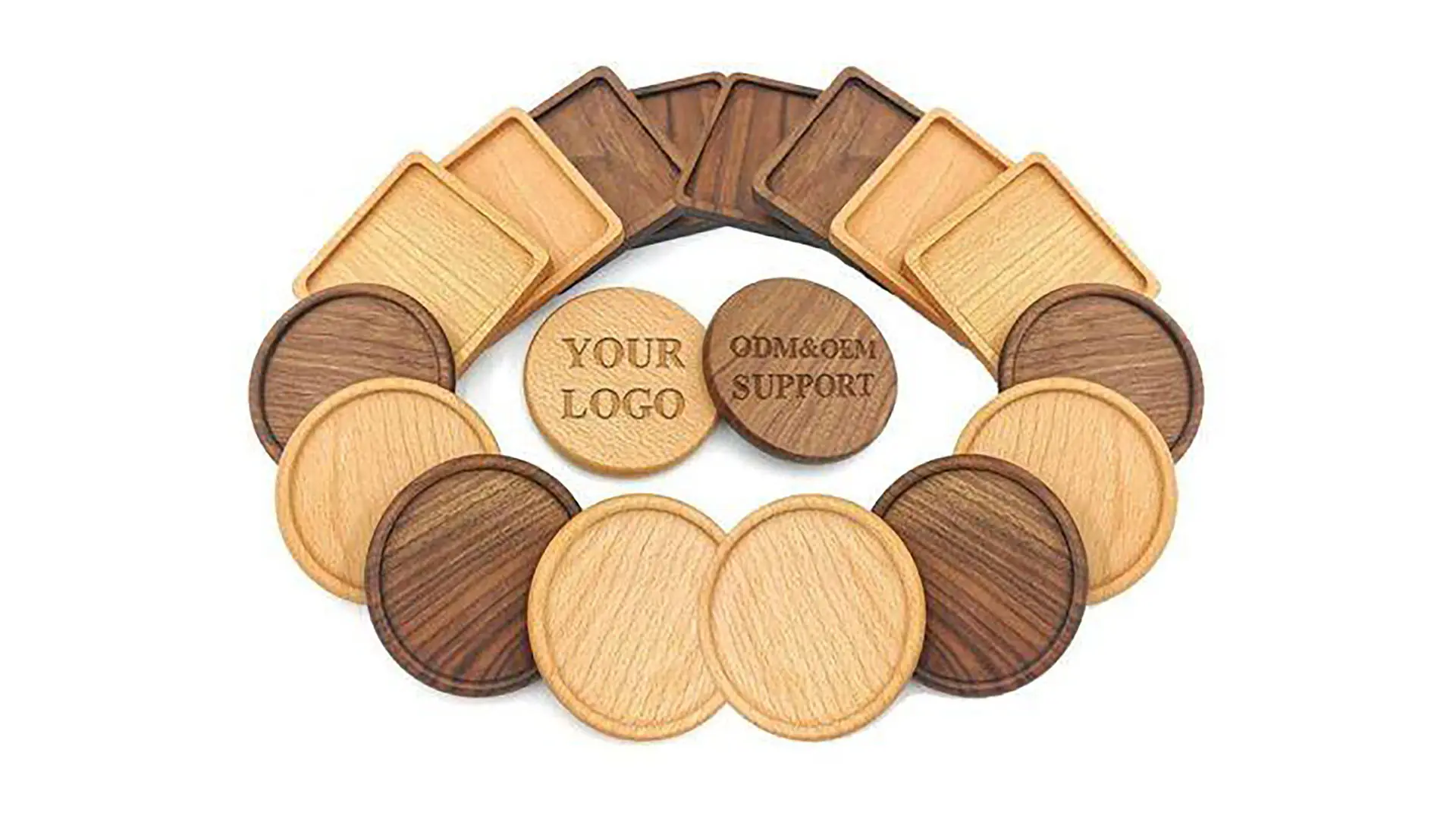
Key Takeaways
- Basswood (approx. 410 lbf Janka) is the engraving and printing workhorse: uniform grain, low tool wear, best cost per branded unit.
- Birch and beech (approx. 1,260–1,300 lbf) suit hospitality venues where dent resistance matters more than deep engraving.
- White oak and bamboo (approx. 1,360 lbf and above) anchor premium and eco-positioned lines but raise tooling and finishing time.
- Moisture content at packing (target 8–10%) matters more than species for warp-free arrival in humid markets.
- Species choice changes landed cost through board yield and finishing steps, not through raw timber price alone.
Why Wood Choice Decides Coaster Margins
A coaster is a small object with a small price, so every production minute counts. Softer, uniform species cut faster, sand faster and accept laser engraving with cleaner edges; harder species resist dents and compression rings in bar and restaurant use but consume more tool life and more sanding passes. The correct question for a buyer is not “which wood is best” but “which wood matches my channel’s abuse level and my branding method”.
Retail gift shops selling engraved keepsake coasters prioritise engraving crispness; a hotel bar prioritises survival under glassware and tray stacks; a brewery taproom prioritises stain resistance and washability. Each answer points to a different species and a different finish specification.
Hardness, Grain and Engraving Behaviour Compared
Janka figures below are standard industry reference values for the species group; individual boards vary with growth conditions. Use them for ranking, not for absolute specification.
| Species | Janka (lbf, approx.) | Grain | Engraving / print behaviour | Best channel |
|---|---|---|---|---|
| Basswood | 410 | Very uniform, fine | Cleanest laser edges; excellent print surface | Gift retail, branded keepsakes |
| Yellow birch | 1,260 | Tight, subtle figure | Good print; engraving shallower | Hotels, cafés |
| Beech | 1,300 | Even, flecked | Good print; deboss preferred over engraving | Restaurants, breweries |
| White oak | 1,360 | Open, prominent | Print good; engraving contrast low | Premium hospitality, wine trade |
| Bamboo (laminated) | 1,380+ | Linear, laminated | Laser darkens well; print needs primer | Eco-positioned retail |
Source for the hardness scale: the Janka hardness test is the standard method for comparing dent resistance across species.
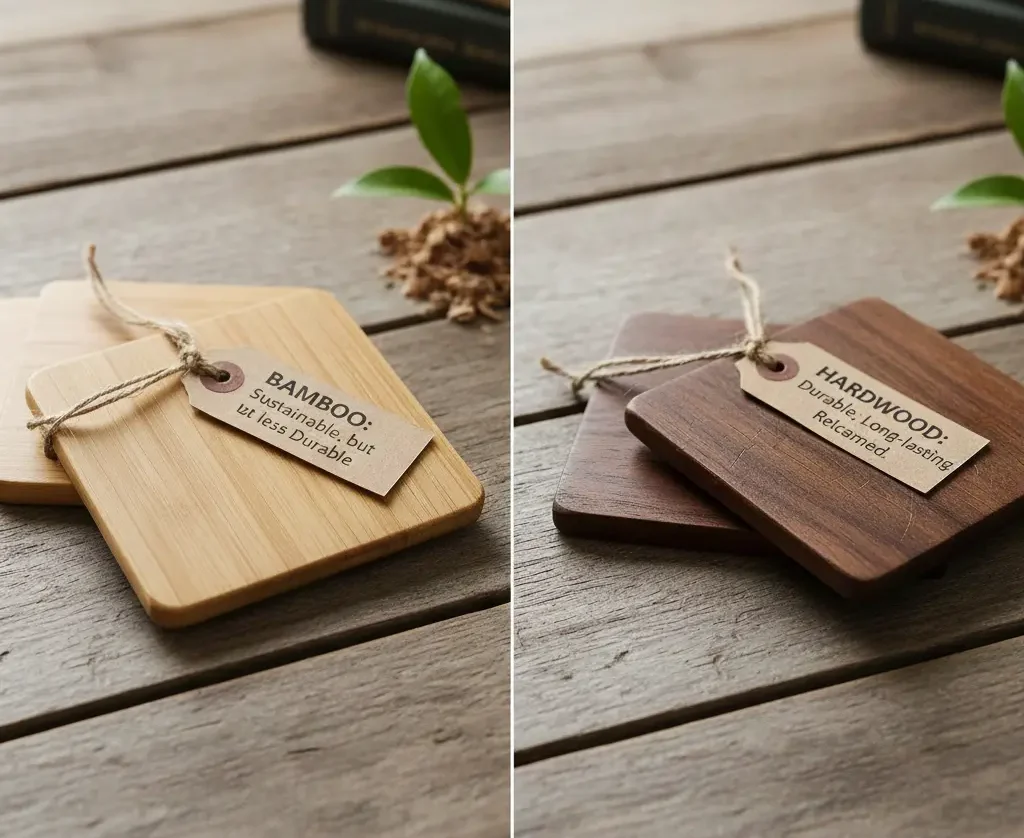
What We Check Before a Coaster Run Ships
- Moisture content: boards kiln-dried and checked at 8–10% before cutting; coasters packed with desiccant for ocean freight to humid markets.
- Flatness and warp: blanks rested after cutting, then gauged; warped blanks are culled before sanding, not after finishing.
- Grain orientation for engraving: engraving runs placed across stable grain so characters keep even depth across the batch.
- Sanding sequence: grit ladder verified on first articles; skipped grits show as visible scratches under print.
- Finish specification: food-adjacent claims only where a test report exists for the exact coating; otherwise finishes are described as decorative protective coatings.
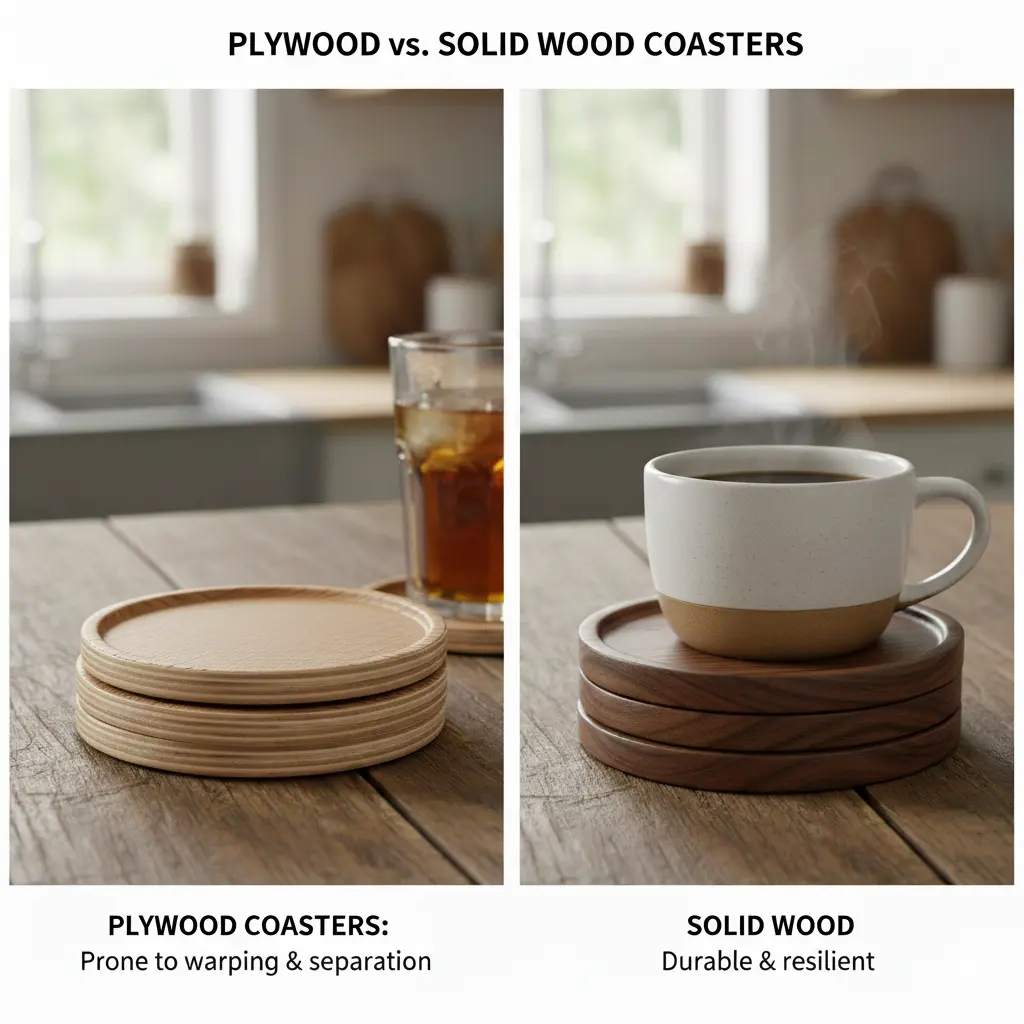
What Actually Moves Wholesale Coaster Cost
Raw timber price is the smallest lever. The large ones are board yield per cubic metre (uniform species yield more usable blanks), finishing passes (hard species need more), branding method (laser engraving is per-piece machine time; screen printing amortises over the run), and packing format (gift-boxed units cost materially more per piece than bulk-packed). Buyers who fix the channel first and the species second usually land a better landed cost than buyers who start from a species preference.
From Blank to Branded: One Order End to End
Example: a hotel group orders 1,200 beech coasters debossed with a crest, gift-boxed in sets of four. Blanks are cut, rested and gauged; first articles confirm deboss depth on beech’s even grain; the run is debossed, edge-sealed, quality-checked against the golden sample, boxed in sets of four with insert cards, cartoned with corner protection and shipped with a packing list mapped to each property’s delivery address. The same workflow scales down to trial quantities on in-stock blanks.
Finish and Care Specifications by Channel
Finish specification should follow the cleaning reality of the channel, not the lookbook. Hospitality venues wipe coasters with damp cloths and occasionally abrasive pads; retail keepsake coasters are handled gently but stored for years. For hospitality, specify a sealed surface finish that tolerates repeated wiping and verify wipe-resistance on first articles before the run. For retail gifting, a lighter natural oil or wax finish preserves the wood feel that buyers pay for, with a care line printed on the insert card: wipe dry, avoid prolonged soaking, re-oil annually for oiled finishes.
Edge sealing deserves its own line item: unsealed edges wick moisture and show tide marks after the first spill in humid climates. Sealed-edge specifications add a process step but eliminate the most common coasters complaint in hospitality replacements.
Sustainability and Compliance Notes
Wooden coasters carry a sustainability story that plastic cannot match, but the claims must stay inside what documentation supports. Species legality and chain-of-custody claims require the corresponding certificates for the specific batch; where a certificate covers the company rather than the product line, say so plainly. Paint and coating compliance follows the destination market’s consumer-goods rules; children-adjacent claims trigger toy-standard testing only when the product is marketed to children, which coasters usually are not. Keep claims channel-honest: durability and renewability are defensible; compostability and food-safety claims need test reports per coating.
Sample Evaluation Checklist for Buyers
- Face flatness: lay the sample on glass; rock or gap indicates warp risk across the batch.
- Engraving or print crispness: inspect fine lines and small type at reading distance, not arm’s length.
- Edge feel and seal: run a thumb around the edge; raw fibres or sticky sealant fail.
- Water mark test: place a wet glass for thirty minutes, then check for tide marks after drying.
- Stack behaviour: stack ten pieces; uneven thickness shows as a leaning stack and predicts packing problems.
Common Specification Mistakes We See
Three mistakes repeat across first orders. First, choosing species from a sample photo instead of the channel abuse profile, then discovering dent marks in month two of bar service. Second, specifying full-colour print on open-grained oak and losing logo edges to grain texture; print wants closed, uniform grain. Third, omitting the packing format from the quotation request, then comparing unit prices that include gift boxing against prices that do not. Fixing these three at specification time removes most post-delivery disputes before they exist.
Buyers consolidating a first container often pair coasters with complementary tabletop lines; the mixed-line approach and its documentation requirements are described in our wholesale crafts overview, and programme-level reorder modelling sits in the hospitality coaster programmes guide.
If you are planning a coaster line for retail, hospitality or corporate gifting, our team can quote species, branding and packing in one pass.

Channel Mapping: Which Species Where
| Channel | Recommended species | Branding method | Packing |
|---|---|---|---|
| Gift shop | Basswood | Laser engraving, full-colour print | Gift box, insert card |
| Hotel / café | Birch | Print or deboss | Bulk pack, sleeve option |
| Brewery / restaurant | Beech | Deboss | Bulk pack |
| Premium / wine trade | White oak | Premium box | |
| Eco retail | Bamboo | Laser | Kraft gift box |
For programme-level planning — MOQ structure, branding options and hospitality use cases — see the hotel and restaurant coaster programmes guide, and the wholesale wooden crafts overview for mixed-line containers. Custom shapes and finishes run through our OEM/ODM customization workflow, with carving capacity described on the wood carving factory page.
Coaster Care and Longevity in Commercial Use
Coaster lifespan in venue service is decided by routine, not by species alone. Wipe spills the same day: standing liquid is what raises tide marks and swells edges, particularly on unsealed rims. For oiled finishes, a thin re-oil once or twice a year restores the water-beading surface; sealed finishes need no re-oil but should be checked for micro-cracks at the print edge, where tray impact concentrates.
Storage between seasons matters as much as daily care: keep cartons off concrete floors, away from exterior walls, and with a desiccant pack per carton in humid climates. Venues that rotate coaster sets seasonally should inspect the returning set for edge swelling before it goes back into service; swollen blanks never fully recover and are the single most common reason a coaster set is retired early. A written care card inside each gift box or carton reduces warranty queries and supports the premium positioning of branded sets.
Frequently Asked Questions
Is basswood durable enough for restaurant use?
For tray stacks and daily glassware contact, harder species resist dents better. Basswood wins where engraving detail and cost per branded unit matter more than dent resistance.
Can coasters be made from reclaimed or offcut wood?
Offcut utilisation is standard practice in coaster production; reclaimed stock is possible but requires sorting for hidden fasteners and inconsistent moisture, which raises cost.
Which species engraves photos best?
Uniform, fine-grained species reproduce photographic detail most cleanly; open-grained species break fine tones into grain noise.
Do you supply food-safety documentation for coaster finishes?
Coaters are not food-contact surfaces. Where a venue requests documentation, we provide the coating specification sheet and any test report that exists for the exact coating used.
What is the minimum order per design?
Production runs start at 300 pieces per design; trial orders of 100 pieces are available on in-stock blanks only.