Skip to content
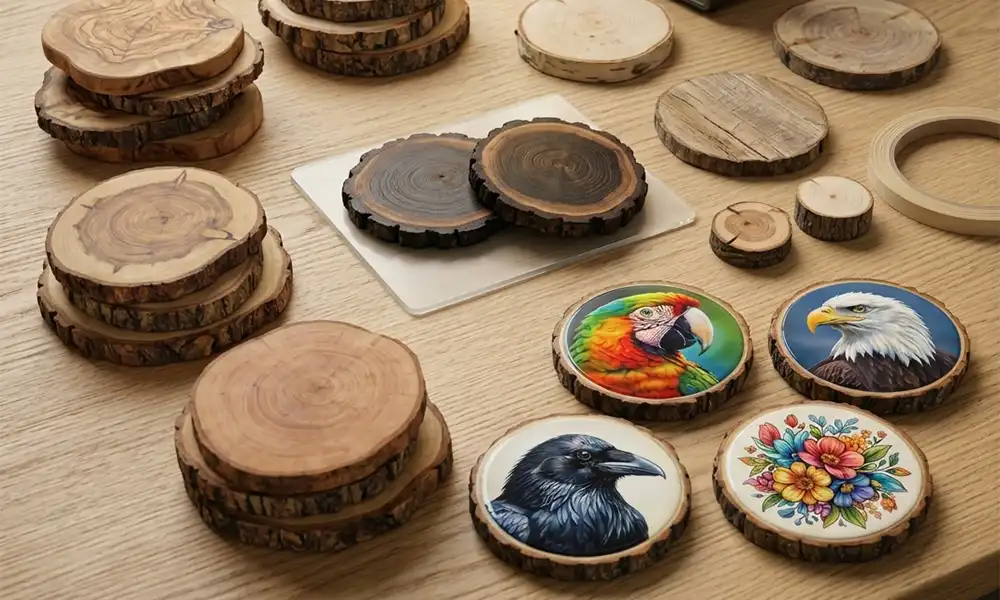
Sublimation wooden coasters fail for one reason far more often than any other: the buyer specified the artwork and the quantity but not the coating. Dye-sublimation does not print onto wood. It prints onto a polymer layer bonded to the wood, and the behaviour of that layer — its film thickness, hardness and flexibility — sets the temperature, dwell time and pressure your press actually needs.
This guide is for wholesalers, print shops, promotional agencies and retail buyers sourcing coated wooden coaster blanks in volume. It covers what the coating must be, how to treat published press numbers as a starting point rather than a recipe, the transfer sequence, the four defects behind most rejected runs, and how to write a blank specification that survives production. Material choice between bamboo and hardwood is a separate question, covered in our bamboo versus hardwood coaster comparison.
Key Takeaways
- The coating, not the wood, takes the dye. Specify the polymer system and its film thickness on the purchase order, or every press setting you inherit is guesswork.
- Published press numbers are a starting point. Coated wood and ceramic commonly run around 380–400 °F (193–204 °C) for roughly 30–90 seconds, but the correct dwell comes from the blank supplier’s coating — always run a test strip first.
- Pressure matters as much as heat. Uneven platen contact produces patchy transfers that look like a printer fault and are not; dense strand-woven substrates tolerate roughly 90–120 psi.
- Pre-press the blank for a few seconds before taping the transfer. Driving moisture out of the coating is what prevents ghosting and uneven colour.
- Cool gradually and handle with gloves. Forced cooling with fans or compressed air can microcrack the coating, and the defect only shows later as moisture ingress or dull patches.
- Most rejects trace to four causes: wrong paper side, paper shift under pressure, a mismatched print profile, or a cool press. All four are prevented before production, not during it.
In This Guide
- The Coating Decides Everything
- Heat Press Settings: Starting Point, Not Recipe
- The Transfer Sequence Step by Step
- Troubleshooting: Fading, Banding, Ghosting, Patchiness
- How to Specify Blanks When Buying Wholesale
- Best For / Not For: Which Blank Suits Which Programme
- What We Check Before a Coated Blank Order Ships
- End to End: A Branded Coaster Programme
- Frequently Asked Questions
The Coating Decides Everything
A polymer-coated blank is a composite: a stable substrate with a continuous polymer skin that receives the dye. The coating does three jobs — it stops the wood swelling or checking under repeated condensation, it flexes with the substrate so the skin does not crack as the core moves, and it holds dye below the surface, which is what makes the print survive washing.
Two properties decide whether the transfer survives the customer’s sink: film thickness and flexibility. Elastomer-based coatings flex with the wood; a typical formulation sits near 90 Shore A hardness with tear resistance around 480 PLI — tough enough to resist abrasion, elastic enough not to delaminate as the core moves. Both are set by the blank supplier, not the printer, which is why they belong on the purchase order.
Uncoated stock is not a shortcut: it will not hold dye-sublimation at all, and bare bamboo behaves differently again from bare hardwood, so a supplier who quotes “wood coasters” without naming the coating has not answered the question. Where a printed article contacts food or drink directly rather than sitting under a glass, the coating must also satisfy food-contact rules — in the United States these are administered under the FDA food-contact substance framework. A coaster is not itself a food-contact article, but a printed tumbler in the same programme may be.

Heat Press Settings: Starting Point, Not Recipe
Temperature and dwell control how completely the dyes vaporise and migrate into the coating. Too little energy leaves dye on the surface — dull, patchy, liftable; too much warps or discolours the substrate. The ranges below are what we see quoted for coated wood and ceramic, and they are a place to begin a test strip, not a production setting.
| Parameter | Typical Starting Range | What It Governs | If You Get It Wrong |
|---|---|---|---|
| Temperature | ≈380–400 °F (193–204 °C) | Whether dye vapourises and migrates into the coating | Cool press = dull, patchy, liftable print; hot press = warp and discolouration |
| Dwell time | ≈30–90 seconds | How completely the transfer finishes across the whole face | Opening too soon leaves incomplete bonding and faded edges |
| Platen pressure | ≈90–120 psi on dense strand-woven substrate | Even contact between paper, coating and platen | Uneven pressure reads as blotching, which is usually blamed on the printer |
| Pre-press | ≈5 seconds at low heat | Driving moisture out of the coating before transfer | Skipped pre-press is a leading cause of ghosting and uneven colour |
| Substrate thickness | ≥18 mm for strand-woven board | Resistance to flex and indentation under the platen | Thin board flexes, contact becomes uneven, and the transfer bands |
Run a test strip on every new coating batch: one blank, three dwell times, fixed temperature and pressure, and record which strip you keep. That habit removes most of the variance buyers blame on the blank supplier.
The Transfer Sequence Step by Step
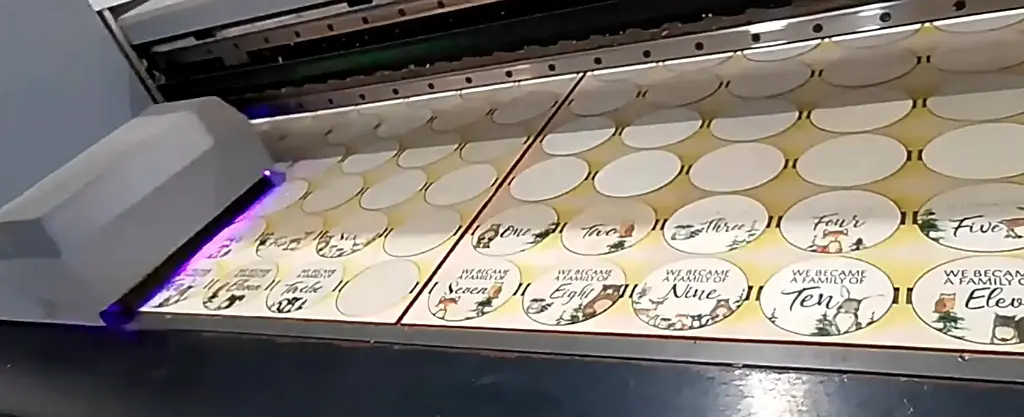
The order of operations matters as much as the numbers. This is the sequence that produces a repeatable result.
- Prepare artwork in CMYK with a sublimation profile matched to your printer and ink set. Profile mismatch is the most common cause of colour that looks right on screen and wrong on the piece.
- Print mirrored, on the bright white coated side of the sublimation paper. Printing on the reverse is a surprisingly common and total loss.
- Pre-press the blank. A few seconds at low heat drives moisture out of the coating and flattens the surface before the dye arrives.
- Tape the transfer in place. Heat-resistant tape at the edges stops the paper shifting. Any movement under pressure produces a ghost image, and no setting change will fix it afterwards.
- Press at the validated setting. Use the dwell your test strip produced, and do not open early — an incomplete transfer cannot be re-pressed on the same face.
- Cool gradually on a flat, non-conductive surface such as a silicone mat or untreated MDF. No fans or compressed air: rapid cooling sets up a gradient between layers and can microcrack the coating, showing later as moisture ingress or dull patches.
- Handle with nitrile or cotton gloves so skin oils do not interact with the coating during inspection and packing.
Troubleshooting: Fading, Banding, Ghosting, Patchiness
| Symptom | Usual Cause | Fix | Where the Fault Usually Sits |
|---|---|---|---|
| Faded or shifted colour | Inaccurate heat, or an ICC profile that does not match the coating | Re-validate dwell with a test strip; load the correct profile for the ink set | Press or print driver — rarely the blank |
| Banding or faint horizontal lines | Clogged nozzles on a converted printer | Nozzle check, cleaning cycle, purge sheets to clear trapped air or dried ink | Printer |
| Ghosting or double image | Paper shifted during pressing, or the press was opened too early | Tape all edges; hold the full dwell; lift straight up | Operator technique |
| Patchy or dull areas | Uneven platen pressure, thin or flexing board, or printing on the wrong paper side | Check platen contact, confirm substrate thickness, confirm paper side | Press setup or blank spec |
| Cracking or dulling later | Forced cooling, or a coating too rigid for the substrate’s movement | Cool gradually on a non-conductive flat surface; specify a flexible coating | Cooling discipline or blank specification |

How to Specify Blanks When Buying Wholesale
The blank specification is where a wholesale buyer controls the outcome. These fields belong on the purchase order, not in an email thread.
- Coating system and film thickness, with the supplier’s recommended temperature and dwell stated alongside it.
- Substrate and thickness — species or engineered board, and a minimum thickness so the blank does not flex under the platen.
- Dimensional tolerance and flatness, since a blank that is not flat cannot make even contact across its face.
- Moisture content, checked against our wood moisture content standard; a wet blank steams under the press and the transfer mottles.
- Edge finish and shape — round, square or die-cut, with edges broken so they do not chip in handling.
- Packaging and quantity tiers. Trial terms are 100 pieces with a USD 500 minimum order value, air express DDP, 20–30 days; wholesale and custom run 300 pieces with a USD 3,000 minimum order value, sea freight, 60–90 days to port; custom printed boxes require 500 pieces. The commercial detail is in our custom logo coaster MOQ and cost guide, and packing options in our guide to packaging wooden crafts.
Best For / Not For: Which Blank Suits Which Programme
| Programme | Best For | Not For | Specification Priority |
|---|---|---|---|
| Promotional / branded corporate | Photographic logos, full-colour artwork, large single-design runs | Buyers wanting a visible natural-grain product — the coating covers it | Colour consistency across the batch |
| Hospitality and bar service | High wet-use volume, repeated wiping, stacked storage behind the bar | Dishwasher regimes — specify the washing method before choosing the coating | Coating durability and substrate density |
| Craft-seller and Etsy retail | Small batches, personalised names and dates, frequent design changes | Price-floor competition — the coating and press time both cost more than a laser mark | Blank consistency, because each piece is printed individually |
| Gift sets and retail packaging | Boxed sets where the print carries the gift positioning | Programmes that also need a re-oilable, refinishing story | Packaging and print registration together |
For the material trade-offs behind that choice, see our wholesale wooden coaster guide.
What We Check Before a Coated Blank Order Ships
A coated blank that fails shows up on the buyer’s press, not in our carton, so the checks weight toward what a printer depends on.
- Coating continuity. The face is inspected for pinholes, thin spots and edge coverage, since an uncoated patch will not take dye and appears as a white defect after pressing.
- Flatness and thickness across the batch. Measured rather than eyeballed, because a flexing blank produces uneven platen contact that reads as a printing fault.
- Moisture content before packing. Blanks are verified against our moisture standard; shipping a wet blank guarantees a mottled transfer at the customer’s press.
- Test transfer per coating batch. A sample blank is pressed on the recommended setting and retained, so a later dispute has a physical reference rather than two opinions.
- Packing against movement. Blanks are separated so coated faces do not abrade in transit, packed to the quoted inner-box count and master-carton dimensions.
Buyers auditing a supplier rather than trusting one can work through our factory audit checklist, and the ordering mechanics sit in our procurement guide for wooden crafts.
End to End: A Branded Coaster Programme
A promotional agency has won a hospitality client’s coaster programme: 2,000 coated blanks, printed on the agency’s own sublimation line, delivered across four venue openings in one quarter.
Week 1 — specify the coating, not just the coaster. The agency confirms substrate, minimum thickness, coating system and film thickness, plus the supplier’s recommended temperature and dwell. Quantity sits on the wholesale tier — 300 pieces, USD 3,000 minimum order value, sea freight, 60–90 days to port — so the four openings are worked backwards from that lead time, not from the print date.
Week 2 — test strips on the actual blanks. A small trial batch arrives and the agency runs one blank at three dwell times at fixed temperature and pressure. The winning strip is photographed, dated and filed with the purchase order, so the production setting is a record rather than a memory.
Weeks 3 to 10 — production and inline checks. Coating continuity, flatness, thickness and moisture are verified per batch and a retained test transfer travels with the documentation. Payment runs T/T, 30% deposit and 70% before shipment, with photographs and video of finished goods supplied before the balance falls due.
Week 11 — printing and the first venue. The agency prints in CMYK with the matched profile, mirrors the artwork, pre-presses, tapes, presses at the validated dwell and cools on silicone. Any defect is diagnosed against the troubleshooting table rather than by changing settings at random.
Quarter end — the reorder. Because the coating specification and the validated press setting are both on file, the second batch is a quantity confirmation. Which party carries freight and duty on it is decided by the delivery term agreed at order stage, per the ICC Incoterms rules.
If you are sourcing sublimation-ready coaster blanks and want the coating specification, recommended press window, test-transfer record and carton quantities quoted against your volume, our team will put that sheet together with you.
Frequently Asked Questions
Q: Can you sublimate onto uncoated wood?
No. Disperse dye needs a polymer layer to migrate into; bare wood absorbs nothing and the transfer will not hold. Both bare bamboo and bare hardwood behave differently from coated blanks, so the coating has to be specified rather than assumed.
Q: What temperature and time should I press sublimation wooden coasters at?
Start around 380–400 °F (193–204 °C) for 30–90 seconds with firm, even pressure, then validate. The correct dwell comes from your blank supplier’s coating, not from a universal recipe, so run one blank at three dwell times and keep the strip that wins.
Q: Why does my transfer come out patchy even though the printer tests fine?
Patchiness is usually contact, not ink. Check platen pressure and evenness, confirm the blank is thick enough not to flex, and confirm you printed on the coated side of the paper. A blank that is not flat cannot make even contact across its face.
Q: What is the minimum order for coated wooden coaster blanks?
Trial orders start at 100 pieces with a USD 500 minimum order value on in-stock items, shipped air express on DDP terms in 20–30 days. Wholesale and custom orders run at 300 pieces with a USD 3,000 minimum order value by sea freight at 60–90 days to port, and custom printed boxes require 500 pieces.
Q: Will the print survive washing?
A properly transferred image sits inside the coating rather than on it, so it survives wiping and normal washing. Longevity depends on coating flexibility and thickness, on complete dye migration during the press, and on gradual cooling afterwards — forced cooling can microcrack the coating and let moisture in later.
Sources
Delivery terms and the point at which freight cost and risk transfer are defined by the ICC Incoterms rules. Requirements for materials that contact food or drink in the United States are administered under the FDA food-contact substance framework. Press figures above are published starting ranges for coated substrates, consistent with our own bamboo versus hardwood coaster guide; the binding value for any run is the one your test strip produces. Order minimums, lead times, payment terms and packaging specs are our published first-party terms.