Skip to content
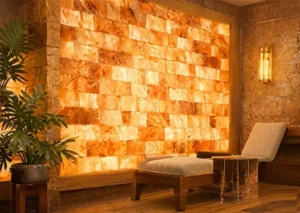
When evaluating Himalayan salt panels for commercial wellness projects—such as high-end spas and saunas—the first consideration shouldn’t be how beautiful the amber glow is. As a procurement or engineering professional, your core focus must be: Will this salt wall melt into a puddle in a high-temperature sauna environment?
I have seen too many procurement teams sign off on beautiful backlit salt walls, only to watch them “sweat,” discolor, and collapse within six months. There is a persistent myth in the industry that applying a waterproof coating or chemical sealant directly to the surface of the salt bricks will solve the moisture problem. This is absolutely wrong! Applying a surface coating not only destroys the natural crystalline translucency (ruining the backlit effect) but also completely clogs the microscopic pores. This prevents the natural release of trace minerals and negative ions, turning a therapeutic salt panel into a useless, sealed rock.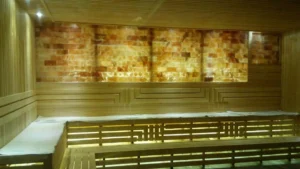
So, how do you prevent salt panels from melting in a sauna? It relies on strict physical moisture barriers behind the wall and a “reverse drying mechanism” in the environment. From moisture-reflective backer membranes to specialized high-temperature salt adhesives and daily baking routines, professional contractors rely on a systematic engineering approach. Understanding these hardcore engineering logistics is what keeps your commercial project from becoming a costly failure.
Three Golden Rules for a Non-Melting Sauna Salt Wall
Since we cannot apply surface waterproofing, we must solve the melting issue through strict “environmental control” and “base-layer moisture barriers.”
The primary reason commercial salt wall projects fail is choosing the wrong type of sauna or cutting corners during construction. To ensure a salt wall stands the test of time under high heat, you must strictly follow these conditions:
- Strictly Select the Sauna Type (The Foundation): Salt bricks can only be installed in high-temperature (65℃-85℃) and ultra-dry environments, such as dry saunas or infrared saunas. The continuous high heat evaporates any trace moisture absorbed by the salt. They are strictly prohibited in wet saunas, steam rooms, or traditional Finnish saunas where water is splashed! The humidity in a steam room approaches 100%, causing the salt bricks to absorb water rapidly, melt, and collapse.
- Wall Base Moisture Barrier (The Key): A square meter of salt panels weighs a massive 50 to 60 kilograms, meaning the wall requires severe structural reinforcement. More importantly, you must install a moisture-reflective membrane or a high-density waterproof board between the back of the salt wall and the wooden substrate. This completely isolates the salt from any moisture seeping in from the exterior wall structure.
- Mandatory Specialized Salt Adhesive: Never use standard construction glue or cement. Regular adhesives fail under high heat and humidity. You must use a dedicated, high-temperature, humidity-resistant, and flexible transparent natural salt brick adhesive. This ensures a seamless bond without dead corners, preventing water vapor from penetrating the gaps.

Daily Maintenance: The “Reverse Drying Mechanism”
Salt bricks do not fear heat; they only fear cold and dampness. Utilizing the residual heat from equipment is the most advanced way to prevent salt from sweating.
After the project is handed over, instruct your clients or facility managers to implement these daily drying operations. Doing so ensures the salt wall will last for a decade without melting:
- Delayed Baking After Use: When the sauna session ends and guests leave, do not turn off the sauna heater immediately. Let the heater run empty at high temperatures for another 20 to 30 minutes. This period of pure dry heat completely “bakes out” the human sweat and ambient moisture the salt absorbed during operating hours.
- Backlight Heating: Backlit salt walls typically feature LED strips mounted behind them. During off-hours when the sauna heater is off, try to keep the LED backlights on. The micro-heat generated by the lighting (even just 30℃-40℃) is enough to keep the surface temperature of the salt bricks slightly higher than the ambient temperature, perfectly preventing condensation.
- Humidity & Ventilation Control: During rainy seasons or long periods of non-use, indoor humidity can spike. You must place a small commercial dehumidifier inside the room to strictly maintain the humidity below 60%. Additionally, maintain slight air circulation to prevent moisture from accumulating in dead corners.
Avoid the Hype: “Medical Purification” vs. “Ultimate Ambiance”
Do not pay a premium for exaggerated medical claims; the true commercial value of a salt wall lies in its irreplaceable, high-end “emotional ambiance.”
Many salespeople boast that salt walls release massive amounts of negative ions and can cure respiratory diseases. Truthfully, while fresh, uncoated salt bricks do release trace minerals and negative ions, the volume emitted by a stationary salt wall is negligible compared to a medical-grade air purifier.
If that’s the case, why do five-star hotels and top-tier spas continue to invest heavily in salt walls? Because when 24V backlighting scatters amber warmth through natural salt crystals, it instantly creates an incredibly relaxing, healing, “biophilic” atmosphere. Data from the International Spa Association shows that environmental ambiance is the primary driver of repeat business. This is what you are truly paying for: a visual impact that makes clients gladly pay premium service rates.
Ready to Source Commercial-Grade Salt Bricks?
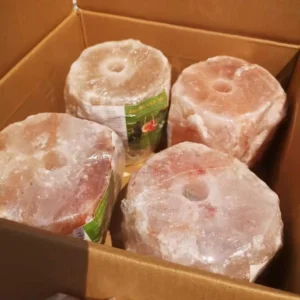
Get direct factory tiered pricing, professional engineering and installation guidance (including backer moisture barriers and specialized salt adhesives), and optimized low-breakage container shipping solutions.
View Wholesale Specs & Pricing →
How to Avoid Pitfalls: Source from an Engineering-Savvy Factory
An excellent supply chain doesn’t just sell you bricks; it provides a mature, actionable engineering solution.
Many projects fail because trading companies only care about selling the product and know nothing about moisture-proofing construction. A legitimate source factory not only provides authentic Pakistani Certificates of Origin (CO)—guaranteeing the high density and translucency of the bricks—but can also directly guide your construction team on how to prep the base, select the right adhesive, and route the LED backlight wiring.
Choose the wrong materials and construction plan, and your wall will grow mold, drip water, and face complete demolition within 18 months. Choose the right source solution, and your salt wall becomes the most eye-catching, durable centerpiece of your commercial space. Calculate your wall’s load-bearing capacity, ensure the sauna is a “dry” environment, and contact a source manufacturer to secure certified products!
Commercial Sourcing & Engineering FAQ
Can I apply a waterproof coating to the surface of the salt bricks to prevent moisture?
Absolutely not. Applying a surface coating destroys the natural translucency of the salt crystal, making the lighting effect look cheap. Furthermore, it clogs the microscopic pores, completely negating the salt’s ability to release trace minerals and negative ions. Moisture prevention must be achieved through backer moisture membranes, room humidity control, and residual heat baking.
Can salt bricks be installed in a wet sauna (steam room)?
Never. The humidity in a wet steam room approaches 100%. In this environment, salt bricks will rapidly absorb massive amounts of water, melt, and collapse. Salt bricks should only be used in dry saunas or infrared saunas with temperatures between 65℃ and 85℃ and extremely dry air.
How do we prevent the salt wall from “sweating” and melting when the sauna is idle?
This is the most overlooked aspect of maintenance. During idle periods (especially in rainy seasons), you must place a dehumidifier in the room to keep humidity strictly below 60%. Additionally, we recommend keeping the LED backlights turned on; the 30℃-40℃ micro-heat emitted by the lights effectively prevents condensation on the salt surface.
Can standard cement or tile adhesive be used to build the salt wall?
No. Regular construction glue or cement cannot withstand the extreme heat and temperature fluctuations of a sauna, nor do they possess the shear strength to hold the massive weight of the salt. You must use a specialized, high-temperature, humidity-resistant transparent natural salt adhesive to ensure seamless bonding and prevent moisture penetration through the joints.