Skip to content

A feng shui salt lamp is one of the few retail items where the customer asks where it came from before they ask what it costs. Metaphysical buyers want real stone, and a dyed piece is the fastest way to lose a collector who has shopped this category for years. This guide is for the boutique or wellness retailer who has to answer that question at the shelf, not in a marketing email.
It is also a sourcing guide. We keep a feng shui salt lamp line cut and wired in our own factory, so the checks below are the ones we run before a carton leaves: mine origin for the stone, destination-standard documentation for the cord, and a packing spec that survives the freight lane you intend to use.

Key Takeaways
- 1 origin is verifiable in this category: Khewra mine output, documented by batch rather than by listing copy.
- 2 stone formats carry the retail shelf: natural chunks for rustic and bohemian rooms, geometric spheres for minimal interiors.
- 2-3 kg is the size a boutique repeats on, small enough for a bedside display and heavy enough to read as a solid piece.
- 3 marks cover the electrical file for the lanes we ship: CE, RoHS and UKCA, matched to the destination.
- 100 pieces at a minimum order amount of USD 500 lets a boutique test a shelf before a 300-piece wholesale run at MOA USD 3,000.
- 2 freight lanes set the calendar: air in 20-30 days for a trial, sea in 60-90 days to port for wholesale volume.
In This Guide
What Metaphysical Buyers Actually Check
The salt lamp shelf in a spiritual boutique is judged on authenticity first. Unique, hand-worked stone and a verifiable origin are what justify the price on the tag.
Demand for Verifiable Origin, Not for a Trend Number
Category demand for natural, wellness-adjacent products has held across several retail cycles, and salt lamps sit inside it. We do not print a market-size figure: the number a boutique needs is not a global forecast, it is whether the piece on its shelf can be described accurately when asked.
That is the practical test of a supplier: which mine, what origin document against a batch number, what the electrical file covers for your country. A supplier who answers all 3 in one email is a source; one who answers with a brochure is a reseller. The wholesale ranges we keep live are listed on the Himalayan salt lamp wholesale page.
Authenticity as a Core Selling Point
Each lamp keeps the crystal structure and mineral veins it came out of the ground with, which is why no two pieces are identical. We sell that as “Nature’s Geometry” – a phrase the shop assistant can put on a card next to the lamp. A uniform, machine-smooth piece is the opposite signal: it says the stone was finished by a polishing line, and collectors read that quickly.
Verifiable origin builds the rest of the trust. Our stone is Khewra material, hand-selected and assembled into a lamp with a stable base, and the same origin record is what a customer can be shown when a return claim starts with “is this real?”
Natural Chunks versus Geometric Spheres
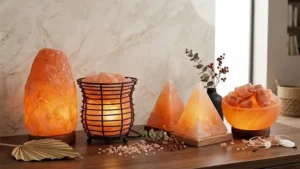
Natural chunks give a rustic, organic read. Geometric spheres give a polished, modern one. The stone is the same; the room is not.
| Feature | Natural Chunks | Geometric Spheres |
|---|---|---|
| Aesthetic | Raw, grounding, organic | Polished, sleek, contemporary |
| Ideal interior | Rustic, bohemian and natural schemes | Minimalist rooms and office spaces |
| Selling point | Every piece is completely unique | Consistent, uniform symmetry across a display |
| Restocking | Colour and shape vary between cartons | Cut to a repeatable diameter band |
Choosing a Shape for the Shelf
The difference between a natural chunk and a geometric salt lamp is mostly which room it reads as belonging to. Natural pieces fit rustic and bohemian interiors and feel connected to the earth. Spheres and cubes fit minimalist and professional settings where clean lines carry the display. The practical split: the natural piece sells on the story, the geometric piece on the shelf set.

The Value of “Nature’s Geometry”
Every natural lamp is hand-selected rock, so no two are identical. That variation – crystal texture, mineral vein, colour band – is a certificate of authenticity built into the product rather than printed on one. It is why a moulded piece cannot match a hand-worked one, and why a replacement will never look exactly like the lamp that sold.

Premium Factory-Direct Salt Lamps for Retailers
Khewra-origin stone, cords documented to CE, RoHS or UKCA for the destination lane, and OEM packaging from 300 pieces. A trial shelf starts at 100 pieces with a minimum order amount of USD 500.
View wholesale catalog and pricing →

Orange and Red Hues, and Where They Come From
Warm orange reads as sociability in feng shui practice; deeper red reads as grounding. The colour is not dyed – it follows the mineral content of the stone.
The Energetic Role of Warm Tones
In feng shui practice orange is treated as a social colour, tied to conversation and ease in a shared room; deeper reds read as grounding, chosen for spaces meant for focus. These are traditional readings, not measured properties, and a shop assistant who says so earns more trust than one who over-claims.
For a buyer, a boutique range needs both ends of the band. A shelf of only pale orange reads as one product; a shelf running pale to deep red reads as a graded natural material, which is what justifies a spread of price points.

How Material Authenticity Creates the Signature Glow
Colour here is a property of the stone, not an additive: density and mineral content decide how light moves through the piece, which is why genuine rock gives an uneven amber glow while dyed stock glows flat and bright. The checks that separate real salt from dyed stock take about an afternoon on a sample carton, and they are worth running before a shelf is designed around the product.
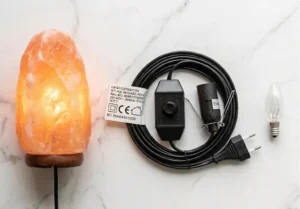
The same honesty has to hold on the electrical side. We document cords and bulbs against CE, RoHS or UKCA depending on the destination; we do not hold UL or ETL marks and will not print them on a file.
What Feng Shui Salt Lamps Are For
In feng shui, salt is treated as an absorbent of stagnant energy. A lamp combines that traditional role with a low, warm light source.
Using Salt Where the Room Stalls
Traditional practice places salt in corners and low-traffic areas where energy is said to collect. Whether a buyer reads that as metaphysics or as interior habit, the retail behaviour is the same: the lamp is bought for a specific corner of a specific room, and it is displayed glowing rather than boxed.
What the Amber Glow Is Doing for the Sale
A lit lamp sells because it changes the room it stands in. Solid rock diffuses bulb light unevenly through its veins, producing a soft wash no plastic shade repeats. The display instruction worth printing on the carton insert: keep it lit in the corner it was bought for, and keep it out of humid rooms – salt is hygroscopic and will show it.
For sizing, the authenticity points a customer checks on a larger lamp are easier to read on a big piece: the veins, the colour band and the way the light breaks are all more visible above the 2-3 kg class.
Sourcing Ethically Mined Salt
Ethical sourcing in this category is a documentation question: which mine, which batch, which labour and transport record travels with the carton.
Price is not the interesting variable in salt sourcing. Authenticity, working conditions at the extraction end, and a chain you can actually trace are. The market is full of loose claims, so the discipline is to look past the surface and ask what a document proves.
- Extraction record: mine output has a batch trail. Surface or industrial salt repacked under a decorative name does not, and the difference shows in the paperwork rather than in the rock.
- Working conditions: dust exposure, physical hazard and wage practice are the honest questions for any extraction site. Our own facility runs under BSCI social compliance and ISO 9001 quality management, which is what we can speak for directly.
- Chain transparency: the product should be traceable from extraction to the packed carton, with documentation at each step rather than at the last one only.

What We Can Put in Writing
We work Khewra material and provide the origin documentation behind it on request, batch by batch, so a retail customer query can be answered with a file instead of a slogan. Rock salt production and trade data are published independently in the USGS mineral commodity summary on salt, which is a better reference to hand a broker than a supplier brochure.
What we do not claim matters as much. We are not selling a health effect: no lamp in this line is offered as an air purifier or a treatment, and the traditional feng shui framing above is exactly that – traditional. Retail language copied from a supplier sheet is the fastest way to a marketplace takedown.
Order Tiers and Freight Lanes
A boutique can test the line at 100 pieces with a minimum order amount of USD 500, shipped by air in 20-30 days. Wholesale and custom work runs from 300 pieces at MOA USD 3,000 by sea, 60-90 days to port, with full catalogue access and OEM options including colour boxes from 500 pieces.
Payment terms are the same at both tiers: 30% deposit, balance before shipment, with photographs and video of the finished goods released before that balance. Carton inserts, plug type and label artwork are set at the sample stage, because changing them after a pallet is booked changes the lead time.
Pairing Salt with Crystals and Gemstones
In energy work salt is treated as the purifier and the crystal as the projector. Sold as a pair, the two cover different questions at the counter.
Why the Two Are Merchandised Together
Practitioners use salt to clear a space or object first, then place a stone for a specific intention. On a shelf that becomes a natural bundle: the lamp is the room-level purchase, the crystal the intention-level one. Present it as practice and belief language, not a measured effect.
What Makes the Base Piece Credible
The lamp carrying the bundle has to be real material, because the pairing only holds if the origin story does. Solid hand-selected rock with visible veins gives both the physical evidence and the reason to place it beside a stone display; bundles built on a price point instead invite uncomfortable questions about the second item on the shelf.
Shelf Language for Spiritual Boutiques
Sell the atmosphere first and the specification second. The customer is buying a mood a lamp can actually create, and a story the shop assistant can repeat.
Highlighting Symbolic and Experiential Benefits
Move the conversation from a light source to what the room does when it is lit. That is the language a wellness customer is shopping for, and it is where a solid stone beats a decorated fixture.

- Lead with the glow. Describe the warm, uneven light and what it does to a meditation corner or a bedside table. Specific beats poetic on a shelf card.
- Frame each piece as unique. One hand-selected rock, one vein pattern, one colour band. That turns a commodity lamp into an object with a reason for its price.
- Use harmony language honestly. Calm, balance, a cleared room. Say what the owner experiences, not what the stone is claimed to do to the air.
Backing the Story with Verifiable Detail
- Name the origin. Khewra material, with a document behind the batch it was cut from.
- Explain the variation. Mineral veins and colour bands are the authenticity marker, not a defect, and a card that says so reduces returns.
- State the electrical file. Which marks cover the cord set, and for which markets – the answer a compliance-minded buyer asks for before the second order.
Final Thoughts for Boutique Buyers
A feng shui salt lamp earns shelf space on two things a customer can check: whether the stone is what it is called, and whether the room changes when it is lit. The first is a paperwork question answered before ordering; the second a display question answered after. Talk to our team with the size band, plug type and label artwork you need, and we will quote the tier that fits rather than a generic catalogue.
Order thresholds and carton specifications sit on the Ewoodarts homepage, and the wired lamp line is set out on the wholesale page linked above.
Frequently Asked Questions
Which shape of salt lamp sells best in a metaphysical shop?
Shape is mostly a decor question, so the honest answer is both, in proportion. Natural chunks carry the rustic and bohemian customer on the uniqueness story; geometric spheres carry minimalist and office displays and restock to a repeatable size band – the 2-3 kg class is what boutiques reorder most often.
Does a room need a large lamp to feel the difference?
No. A piece in the 2-3 kg class is enough for a bedside or a meditation corner, and what the customer is buying is the warm, uneven glow rather than a measured effect on the air. Bigger lamps sell as statement pieces for a living room or a shop counter, where the vein pattern and colour band are visible from further away.
Where should a feng shui salt lamp be placed?
Traditional practice puts salt in the corners a room uses least, on a stable surface off the floor. Keep it out of bathrooms and kitchens: salt is hygroscopic, so a humid room makes the surface damp and the piece bleeds colour. Our lamps ship film-wrapped with a desiccant for exactly that reason.
Is a natural chunk better than a carved one?
The material is the same, so the difference is how the piece is finished. A natural chunk keeps the raw fracture and reads as geology; a carved or turned form reads as design and shows the colour band more evenly. Neither is a stronger claim about the stone, and neither can be judged from a photograph alone.
What should I verify before reordering a wholesale batch?
Two things: the origin document, matched to the batch number of the carton you received rather than a template file, and the electrical documentation for the cord and bulb set in your market. Also check colour spread on arrival – a natural line varies, and a suspiciously uniform carton was sorted like a factory product.