Skip to content
Buying Himalayan salt lamps at wholesale is less about finding another supplier listing than about reaching the production stage where the crystal is cut, the cord is fitted, and the export carton is sealed. That distinction decides whether the units you receive match the grade you quoted, whether they clear customs and retail safety audits, and whether your landed cost leaves real margin. This guide is the sourcing layer of our salt lamp library: factory verification, crystal and hardware quality control, electrical compliance by market, and the order sequence from sample to container. Pricing structure and container economics sit in a separate guide, so nothing is repeated twice.

Key Takeaways
- Wholesale Himalayan salt lamps are sourced by grade, weight band and fitting — not by catalogue photo. Specify all three or every quote you receive is incomparable.
- Authenticity starts at the mine: our crystal is cut from Khewra region rock salt, and timber traceability is documented through official felling and transport permits.
- Electrical compliance is the real liability line. Cords must carry UL marks for North America and CE/RoHS documentation for the EU and UK, verified on the physical part rather than a supplier statement.
- Trial orders run from 100 pieces against a USD 500 minimum order amount; wholesale and custom production starts at 300 pieces and USD 3,000.
- Payment is 30% deposit with the 70% balance before shipment, supported by high-resolution pre-shipment inspection of the packed cartons.
- Hygroscopic salt needs engineered transit protection: sealed units, desiccant, reinforced multi-ply cartons, built to ISTA transit standards where required.
- If a supplier cannot show the carving bay, the fitting station and the packing line, you are buying a middleman’s margin.
What “Wholesale” Actually Means at the Factory
A wholesale quotation is only comparable with another wholesale quotation when grade, weight band and fitting specification are identical. Everything else is marketing copy.
The word “wholesale” is used loosely across this category. Marketplaces apply it to a lot of ten lamps, distributors to pallets of mixed stock, and factories to a production run cut to your specification. Those three have little in common, and confusing them is the most expensive mistake in salt lamp procurement, because it produces quotations that look comparable and are not.
At the production level a salt lamp is defined by four variables you should state in every enquiry: the crystal grade (translucency and iron-oxide saturation), the raw weight band (1-2kg, 2-3kg, 3-5kg and above, quoted as a range because natural forms vary), the base and fitting (turned hardwood, onyx or marble, plus cord, switch and socket), and the packaging specification (retail box, inner, master carton). Change any one and the unit price moves independently of the others.

Geography is the second thing “wholesale” hides. Rock salt is mined in the Khewra region of Pakistan; the carving, drilling, fitting and export packing of most Western retail supply happens in China. That is not a defect in the chain, but it means a supplier claiming to be “the mine” is describing a sourcing relationship, not a production site. Ask where the block is cut, where the hole is drilled, and where the carton is sealed — those three questions resolve more supplier claims than any certificate on a wall.
Verifying Authenticity and Origin Before You Commit a Container
Authentic Himalayan salt is geological, not manufactured. It varies in colour, fractures along mineral planes, and dissolves rather than melts. Counterfeits are usually dyed rock, compressed salt, or alabaster sold under a Himalayan label.
Retail buyers are challenged on provenance in a predictable order: is this genuine Himalayan rock salt, where was it cut, and can the importer prove it. A programme that cannot answer those three in writing will eventually produce returns and marketplace takedowns.

Practical verification at sample stage is straightforward. Genuine material is translucent at thin edges with visible internal fractures and mineral banding; colour runs from pale pink through orange to deep red and is never perfectly uniform across a batch. It scratches with a steel knife, dissolves completely in water leaving no binder residue, and will not melt or smell plastic under heat. Dyed or compressed product looks consistent across units, which in this category is precisely the warning sign. Our guide to spotting fake Himalayan salt covers each test in retail-facing detail.
Timber traceability is the other half of the origin story, and in the EU and UK it is a documented requirement rather than a courtesy. We supply bases machined from hardwood with official timber felling and transport permits, provided with the shipment file. If a buyer needs chain-of-custody certification for a specific retail programme, raise it at quotation stage, because it changes which stock we can allocate.
Sourcing Strategy: Factory Direct vs. Trading Company
Direct sourcing buys specification control and accountability; trading companies sell low-volume convenience at an intermediary margin.
| Feature for Buyers | Direct Manufacturer (Audited Factory) | Trading Intermediary (Aggregator) |
|---|---|---|
| Unit Pricing Basis (FOB) | Production cost plus factory margin | Factory price plus intermediary mark-up |
| OEM Customization | Full (custom shapes, retail packaging) | Limited (pre-packaged stock only) |
| Quality & Compliance | ISO 9001 process, BSCI social audit | Varies by batch and by hidden source |
| Ideal Buyer Profile | Importers, distributors, brand owners | Drop-shippers, small boutiques |
Why Direct Manufacturing Wins on Total Cost, Not Just Unit Price
Once volume exceeds the 300-piece threshold, an intermediary costs you in three places at once: the mark-up, the specification drift that follows from not controlling the cutting stage, and the rework when a batch misses the weight band you sold onward. Manufacturers also hold raw block inventory, so a weight band is quoted honestly rather than matched to whatever is on a shelf, and a facility under ISO 9001 with BSCI social audit coverage gives your brand a documented answer when a retailer’s compliance team asks who actually made the product.
The Supplier Vetting Checklist
Ten questions, asked in writing, will classify any salt lamp supplier in one exchange. Vague answers on three of them end the negotiation.
Verification is cheaper than a returned container. Run this list before requesting a formal quotation, because each answer changes what the quotation should contain.
- Where is the block cut, drilled and polished? Ask for the city and the workshop, not the country.
- Which weight bands do you actually stock? A factory quotes ranges; a reseller quotes whatever the photo shows.
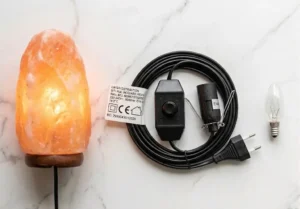
- Who makes the cord set, and what mark is moulded into it? The mark must be on the physical part.
- What is the base material and finish spec? Hardwood versus MDF changes both rot resistance and price.
- What moisture protection goes inside the export carton? Shrink sealing and desiccant, or nothing.
- What is the breakage allowance and claim process? Get the percentage and the evidence requirement in writing.
- Which audits cover the site, and what is the certificate scope? Scope and date matter more than the logo.
- What is the MOQ for a custom box versus stock packaging? These are different numbers.
- Which Incoterms do you quote, and can you handle a DDP trial? A supplier who can only quote FOB cannot run your pilot.
A shortcut for the first three: judge the factory, not the listing. Our guide to choosing a reliable salt lamp factory covers the production evidence to demand.
Strict QC Checkpoints: Crystal, Base and Fitting
Electrical salt lamps carry product liability that decorative wood crafts do not. Standard toy certifications such as EN71 are not sufficient for a mains-powered lamp.
| Component | Export Quality Standard | Red Flags (Avoid) |
|---|---|---|
| Crystal Clarity | A+ grade: translucent at thin edges, saturated iron-oxide tone | Opaque, pale, chalky, or artificially uniform colour |
| Weight Accuracy | Declared band with tolerance agreed per order | “2-3kg” quoted with no tolerance, mixed with 1.5kg stock |
| Wood Base | Sustainable hardwood (e.g. neem), rot resistant, sealed finish | MDF or particle board, which absorbs moisture and warps |
| Electrical Cords | Marked assembly: UL for NA, CE/RoHS documentation for EU and UK | Unmarked wire, no insulation seal, socket without strain relief |
| Drilling & Fit | Clean bore, secure fitting, no hairline fracture at the mount | Loose socket, chipped opening, visible repair or filler |
Salt is hygroscopic, and that behaviour attacks the weakest component first: particle bases warp through damp cycles and sockets corrode. Our guide to salt lamp bulbs and electrical parts covers socket types, bulb matching and the failure modes that generate RMA claims.
Electrical Compliance by Market
Electrical safety is your primary liability risk and your most common customs obstacle. Verify certification stamps physically present on the cord and plug, not a supplier’s written assurance, and require the same evidence in the pre-shipment inspection photographs.

- United States and Canada: Cords and fittings should carry a recognised UL mark. Retail buyers and their insurers increasingly ask for the listing number, not just the logo.
- European Union: CE marking with RoHS documentation for all electrical parts, held in the technical file and available on request.
- United Kingdom: UKCA marking plus BS 1363 fused plugs. We hold the full UKCA documentation set; see our UK wholesale salt lamp page for the compliance detail.
- Australia and New Zealand: RCM registration is mandatory on the electrical assembly.
A toy safety certificate is not an electrical certificate. EN71 testing covers material toxicity in children’s products and is relevant to our carved wooden ranges, but says nothing about a mains cord — if a supplier offers EN71 as proof of electrical safety, that tells you how they read their own compliance file. Fire risk and the audit questions behind it are covered in Are Salt Lamps Safe?.
Building the Assortment: Shapes, Sizes and Colourways
Assortment is a merchandising decision made at the factory, not a pricing decision made afterwards. Choose forms by shelf role: volume driver, premium anchor, or impulse add-on.
Natural shapes are the volume driver of the category. They require the least processing, so they carry the most crystal per dollar of landed cost, and the 1.5-2.0kg and 2.0-3.0kg bands sit at the intersection of consumer price sensitivity and parcel shipping thresholds for most e-commerce channels. Every salt lamp programme should be anchored on them.
Carved geometric forms — spheres, pyramids, cubes — are the premium anchor. They consume artisan time and belong at a higher shelf position, where their clean modern silhouette justifies it in gift and design-led retail. Specialty forms (rose and flower carvings, animals, iron baskets, fire bowls, aromatherapy fittings) are assortment depth: low volume each, high differentiation on the shelf, and useful where a plain natural lamp will not fit the room.


Colour is a specification, not a preference. Pink and orange dominate Western retail; white and grey occupy premium and design-led niches and grade differently because the material is rarer. Fix the expectation at sample stage, and use the size and weight chart rather than photographs.
The Salt Lamp Buying Map: Every Scenario in One Place
This page is the entry point to our salt lamp sourcing library. Each link answers one buying question in the depth a procurement decision requires, so you can go straight to the constraint that applies to your channel.
By product form:
- Mini and USB lamps (1-2kg) for impulse placement · giant floor lamps, 30kg+ for hospitality
- Geometric pyramids and spheres · rose carvings · animal carvings
- White · grey and black lamps for premium and industrial decor
- Iron basket · fire bowl · aromatherapy fittings · statement designs
By component and after-sale risk:
- Bases in wood, onyx and marble · bulbs and electrical parts · retail-ready packaging
- Why lamps leak or “cry” — the support answer for your retail buyers
By channel and commercial model:
- Spa and wellness · hotel and resort · feng shui retail
- Safety and UL certification · spotting counterfeit salt · landed-cost structure
OEM, Private Label and Custom Salt Products
Branding is where a factory relationship pays back most of what it costs. Once you clear the custom packaging threshold, we produce your retail box with brand artwork, barcode and safety text printed, and place the same branding on the 5-ply export master carton — removing a repacking step from your warehouse, which for most importers is worth more than a small unit-price concession would have been.
Three routes exist depending on how far you want to go. Private label salt products covers branded packaging against our existing moulds and shapes. Custom Himalayan salt products covers bespoke shapes, sizes, bases and fittings cut to your specification, including molds. General OEM and ODM customization covers the wider carved-decor programme if salt is one line among several.
MOQ, Sampling and the Actual Order Sequence
Scaling a category should not require a blind bet on a 40-foot container. This is the sequence worth demanding from any factory you evaluate.
- Step 1 — Samples. Physical units from the actual production grade, not a curated showcase piece. Check weight band, colour distribution and the cord mark at this stage.
- Step 2 — Trial order. From 100 pieces against a USD 500 minimum order amount. DDP terms are available so you can test retail reception without arranging freight yourself.
- Step 3 — Wholesale or custom production. Standard MOQ is 300 pieces with a USD 3,000 minimum order amount; custom packaging and bespoke moulds sit at or above this threshold.
- Step 4 — Payment. 30% deposit to open production, 70% balance before shipment.
- Step 5 — Pre-shipment verification. High-resolution inspection of the packed cartons and the actual units, released before the balance is paid.
- Step 6 — Reorder. Volume bands are renegotiated on repeat order history.

Weighing a trial order against low-volume drop-shipping instead? The trade-off differs from what most comparison pages assume: bulk wholesale versus dropshipping salt lamps.
Export Packaging and Transit Control
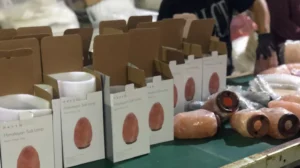
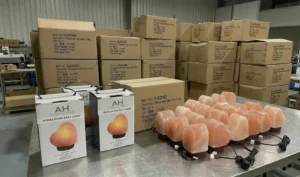
Shipping geological material requires engineering rather than cardboard: without moisture management, consignments degrade inside humid ocean containers and arrive as rejected stock. Export production seals each unit in POF shrink film with desiccant, packs into multi-ply inner boxes, and secures those in 5-ply reinforced export master cartons rated for stacking. Where documented transit performance is required we build to ISTA packaging testing standards; breakage allowance and packing density are covered in the retail-ready packaging guide.
Import Paperwork and Classification
An electric salt lamp is a mixed-material, mains-powered article, so classification questions follow it. These products are commonly declared under HS heading 9405 for electric lighting fittings; the exact subheading differs by destination tariff schedule and by how the base material is treated, so confirm the code with your customs broker against a physical sample rather than accepting a code copied from a previous supplier’s paperwork.
The shipment file we provide covers commercial invoice, packing list, certificate of origin, and the electrical compliance documentation for the destination market, plus timber felling and transport permits for the wooden components. Documentation obligations on the EU and UK side are expanding rather than relaxing; our importing Himalayan salt compliance guide covers what to demand before the goods move.
After Arrival: Sweating, Storage and Return Reduction
Most salt lamp returns are not defects but customers reacting to normal hygroscopic behaviour: a lamp stored in an unheated or coastal room will bead water and sometimes stain its base. That is physics, not a fault, yet it reads as one on a returns form. The fix is a care instruction inside the retail box plus a shelf script for your buyers, both supplied with the packaging artwork. Operationally: keep cartons sealed until sale, store off cold floors, and run display lamps long enough to drive off surface moisture. Our customer-facing version is published at Why is My Salt Lamp Leaking? and may be linked from your own product pages.
Where the Margin Math Lives
This guide stops at the sourcing decision. The remaining questions are commercial and deserve more numbers than a verification article can carry: which weight band earns the best per-kilogram return, how base material moves cost of goods, what container fill and breakage do to landed cost, and how bundling lifts basket value. Those are answered in the commercial companion, Himalayan Salt Lamps Wholesale: Profit Margin Guide. Verify the source first, then model the margin.
What We Check Before Anything Ships
Ewoodarts is the export brand of Jilin Ever Creation, producing carved salt and wooden decor for wholesale and private-label buyers. These are the checks we run on every salt lamp consignment, stated plainly so you can demand the same list from any other supplier:
- Grade, colour band and weight confirmed against the approved sample, with per-unit weigh-in against the declared band and tolerance agreed before production opens.
- Cord and socket mark verified physically present, with the destination-market documentation in the file.
- Bore, fitting and stability checked on the assembled unit — a lamp that rocks on its base will crack at the mount in transit.
- Seal integrity of the shrink wrap and desiccant, plus carton marking of gross and net weight for your receiving team.
- Pre-shipment photographs of the actual packed goods, released before the balance falls due.
Process documentation behind these checks runs under ISO 9001 quality management with BSCI social audit coverage, and our material certifications cover CE, UKCA, RoHS and EN71 where the product type applies. If you are building a compliance file for a specific retail programme, tell us which retailer at quotation stage and we will align the documentation to their audit format.
Start With a Verified Trial Order, Not a Price List

Frequently Asked Questions
Where can I buy authentic Himalayan salt lamps wholesale?
From a production facility rather than a listing. Authentic material is cut from Khewra region rock salt, and the carving, drilling and fitting stages determine most of the quality you will actually receive. Buy direct from the factory that performs those stages so you can specify grade, weight band and electrical compliance, and so the pre-shipment inspection covers the goods you are paying for. Our wholesale programme is set out at Wholesale Salt Lamps.
How do I know if a Himalayan salt lamp is authentic?
Check four things on a physical sample. Genuine crystal is translucent at thin edges with visible internal fractures and mineral banding; colour varies across a batch rather than matching perfectly; it scratches with a steel knife and dissolves completely in water without leaving binder residue; and it will not melt or give off a plastic smell under heat. Dyed or compressed product looks uniform, which in this category is the warning sign rather than the quality signal.
What electrical certification is required to import salt lamps?
It depends on the destination market, and the mark must be physically present on the cord and plug. North American retail and their insurers expect a recognised UL mark on the assembly. The EU requires CE marking with RoHS documentation held in the technical file; the UK requires UKCA plus BS 1363 fused plugs; Australia and New Zealand require RCM. A toy safety certificate such as EN71 does not satisfy any of these, because it addresses material toxicity rather than mains electricity.
Can I place a trial order before committing to a container?
Yes, and you should. Trial orders start at 100 pieces against a USD 500 minimum order amount, and DDP shipping is available so you can test your market without arranging freight. This stage exists to let you verify crystal colour, packaging durability and hardware safety on the production grade before scaling to the 300-piece wholesale threshold, where standard and custom production begins.
How does a factory stop salt lamps sweating in ocean freight?
By controlling the microclimate inside the carton. Each unit is sealed in POF shrink film with desiccant so relative humidity around the crystal stays low through the transit cycle, then packed into multi-ply inner boxes inside a reinforced 5-ply export master carton that also resists stacking damage. Where a retail programme requires documented transit performance, the construction is built to ISTA testing standards and the specification travels with the shipment file.