Skip to content
Sourcing the correct salt lamp bulbs determines whether a retail shipment thrives or fails due to moisture damage. Generic, low-heat alternatives cause salt crystals to sweat, creating liquid runoff that destroys wooden bases and triggers expensive customer returns (RMAs). This technical mismatch compromises product durability and erodes wholesale margins through preventable warranty claims.
At Jilin Ever Creation, we standardize 15W and 25W heat-resistant bulbs to ensure the necessary hygroscopic evaporation. Every assembly features UL, CE, or SAA certified holders engineered for global distribution. This procurement guide evaluates wattage-to-mass selection, component compliance, and our 5-ply export packaging strategy to help you secure inventory integrity and reduce transit breakage.
Key Takeaways
- Standardise on 15W and 25W heat-resistant incandescent bulbs; LED conversions stop moisture evaporation and drive returns.
- Two socket families cover the range: E12 candelabra (7W and 15W) for compact lamps, E14 small Edison screw (15W and 25W) for larger blocks.
- Cavity depth is the constraint: about 47mm suits 15W bulbs and about 55mm is needed for 25W, which melts down if fitted to a 2-5kg lamp.
- Every assembly is certified for its destination market: UL/ETL, CE/RoHS, UKCA and SAA, on 100-240V 50/60Hz mains with the native plug.
- Spare bulbs ship in 5-Ply BC Flute export cartons with corrugated cell dividers, the same board grade that clears ISTA 3A drop testing.
- Plan around a 100-piece trial (USD 500 minimum order amount) or a 300-piece wholesale run (USD 3,000), with 20-30 days for samples and 60-90 days for container production.
Table of Contents
- Why electrical components dictate retail success
- Wattage guide for salt lamp bulbs
- E12 and E14 socket standards explained
- The commercial risk of LED integration
- Zero-damage logistics and master cartons
- MOQ and lead time for bulb orders
- Customs paperwork and HS codes
- Securing your supply chain
- Frequently asked questions
Why Electrical Components Dictate Retail Success
For wholesale distributors, the electrical assembly is not merely a light source; it is a critical moisture-management system. Certified wiring ensures global customs clearance, while the correct bulb wattage prevents structural degradation of the salt.
Certified Components for Borderless Market Access
For any international distributor, getting products through customs without compliance friction is paramount. We build our salt lamps with globally certified, market-specific electrical components to eliminate import barriers and protect your brand liability.
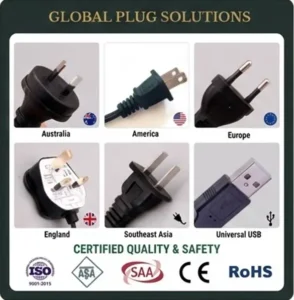
- Strict Certification: Our electrical systems hold valid certifications for major regulatory markets: UL/ETL for North America, CE/RoHS for Europe, UKCA for the UK, and SAA for Australia.
- Market-Ready Plugs: We manufacture native plugs tailored for each region (Types A/B, C/F, G, I), eliminating the need for aftermarket adapters and ensuring immediate shelf-readiness.
- Control Mechanisms: We supply both Rotary Dimmer Switches for premium SKUs and standard Rocker Switches for entry-level price points, allowing you to segment your retail offerings.
Wattage Guide for Salt Lamp Bulbs
Specifying the correct wattage is not a one-size-fits-all approach; it is a strict thermal calculation based on the salt block’s weight and cavity size. A 15W incandescent bulb is the engineering standard for standard 2-5kg salt lamps. However, for large-format decorative lamps (10kg to 20kg+), a 15W bulb fails to provide sufficient light penetration and moisture-evaporating heat, making the 25W bulb essential.
| Specification | 15W Incandescent Bulb | 25W Incandescent Bulb |
|---|---|---|
| Physical Cavity Fit | Compact (approx. 47mm) – Fits small bases | Extended (approx. 55mm) – Requires deep cavities |
| Thermal Output | Controlled heat for small mineral mass | High heat to penetrate dense, thick salt walls |
| B2B Size Application | Ideal for 2-5kg retail units | Essential for 10kg – 20kg+ commercial lamps |
| Safety Warning | Too dim/cold for massive blocks | Melting hazard if installed in 2-5kg small lamps |


E12 and E14 Socket Standards Explained
Socket choice is where most first-time bulb orders go wrong, because the two families are not interchangeable at retail. Our salt lamp accessories line ships E12 candelabra bases in 7W and 15W for compact lamps, and E14 small Edison screw bases in 15W and 25W for mid-size and large blocks. A buyer who specifies “15W salt lamp bulb” without the socket letter receives hardware that will not seat.
The practical consequence lands after the sale. When a filament fails two months into retail ownership, your customer walks to a hardware store looking for a replacement, and shelf stock of appliance-shaped candelabra bulbs is thin. Two mitigations work: tape a spare bulb inside every retail box, and keep one socket family per product line so your after-sales stock is not split across two formats. Importers who standardise on E14 across a whole collection carry fewer orphan spare parts than those who mix E12 and E14 in one programme.
Bulb shape matters as much as the base. A long-tube filament sitting proud of a shallow cavity heats the wooden collar it passes through, which is why we match bulb length to drilled cavity depth before quoting. The same discipline drives our salt lamp size chart wholesale reference, where each diameter band carries a recommended wattage and base.
The Commercial Risk of LED Integration
Himalayan salt is inherently hygroscopic. In ocean freight or humid warehouse conditions, a salt lamp will constantly draw in moisture. The gentle thermal output from a traditional incandescent bulb evaporates this moisture, keeping the unit dry.
While retail buyers often ask for LED bulbs due to energy-efficiency trends, LEDs produce negligible heat. Substituting incandescent bulbs with LEDs completely disables the lamp’s ability to evaporate water. This results in severe “weeping,” liquid pooling, damaged furniture, and inevitably, a massive spike in customer return rates for the importer.
Retail staff should be briefed on one operating rule buyers rarely pass on: a salt lamp is a product that wants to stay switched on. Continuous low-level heat is what keeps the crystal dry, so a unit a customer displays for an hour a week will weep regardless of which bulb we shipped. Printing that instruction on the colour box, next to the certification marks, is the cheapest return-rate reduction available to an importer, and it is why we treat bulb, switch and artwork as one system rather than three purchase orders. The same reasoning shapes how we brief buyers on the wider programme in our Himalayan salt lamp manufacturers guide.
Zero-Damage Logistics and Master Carton Packaging
Shipping fragile glass bulbs alongside heavy mineral blocks requires aggressive logistics planning. To ensure your bulk order arrives intact, we utilize export-engineered packaging protocols.
- Individual Cell Isolation: Spare bulbs are housed in customized trays with heavy-duty cardboard dividers, eliminating glass-on-glass vibrations during ocean freight.
- 5-Ply Export Cartons: We bypass standard packaging in favor of 5-Ply BC Flute Export Cartons. This high-compression corrugated board withstands container stacking pressure and protects internal electrical components from pallet moisture.
Our carton standard for electrical accessories mirrors what we run for carved product: items paper-wrapped individually, six to twelve pieces in a 3-Ply BC Flute inner box, and 240-480 pieces in a 5-Ply BC Flute export outer that clears ISTA 3A drop testing. That stack-strength margin is what lets a distributor fill a container to the roof without crushing the bottom tier of bulb cartons. Custom labels and shipping marks are printed on request, so your internal SKU coding survives the trip from port to distribution centre legible.

MOQ and Lead Time for Bulb Orders
Electrical spares follow the same two-track ordering structure as our lamps and carvings, and it is deliberately shallow at the entry point. A trial order starts at 100 pieces with a USD 500 minimum order amount, drawn from in-stock items and shipped by air express under DDP terms, which means we handle the freight and the customs clearance to your door. A wholesale or custom order starts at 300 pieces and USD 3,000, opens the full catalogue plus OEM/ODM work, and moves by sea freight because that is where the landed margin lives.
| Order Track | MOQ and Minimum Amount | Lead Time and Freight |
|---|---|---|
| Trial order | 100 pieces / USD 500 | 20-30 days, air express DDP |
| Wholesale or custom | 300 pieces / USD 3,000 | 60-90 days to port, sea freight |
| Custom colour box | 500 pieces | Runs with the production order |
Payment runs on T/T with a 30% deposit and the 70% balance due before shipment, and we send photographs and video of the finished goods before that balance is requested, so nobody pays out against an unseen container. For a distributor assembling a Himalayan salt products wholesale programme, the practical read is simple: bulbs and cords are the cheapest line item in the shipment and the one most able to erase the margin on everything else, so specify them on the same purchase order as the lamps instead of sourcing them locally after arrival.
Customs Paperwork and HS Codes
Salt lamps clear customs under HS code 9405.49.90, while salt bricks and cooking blocks fall under 2501.0019 or 2501.0020. Getting the code right at quotation stage matters more than most first-time importers expect, because a lighting-classified shipment and a mineral-classified shipment attract different duty treatment and different document demands. The live US tariff line is searchable on the US International Trade Commission HTS schedule, and we quote against it rather than guessing at a broker’s convenience.
For the European Union a salt lamp is an electrical appliance, which means CE marking carries obligations under the low-voltage and RoHS framework rather than being a symbol a factory prints on a carton. The European Commission guidance on CE marking sets out who issues the declaration of conformity and what an importer must be able to produce on request. Our compliance pack ships with each order: market certificates, a declaration of conformity, and packing lists keyed to the carton marks. When a receiving broker queries classification, that pack is what turns a two-week bonded-storage bill into a one-hour phone call.
Securing Your Supply Chain
Selecting the correct electrical assembly is the most critical step in reducing liabilities for your retail brand. At Jilin Ever Creation, we integrate these quality benchmarks into every container, sourcing only certified E12/E14 holders and long-life bulbs that meet rigorous international safety standards.
To explore how these components fit into a reliable procurement strategy, view our Wholesale Catalog or Contact our manufacturing team today to discuss your target market’s specific voltage and compliance requirements.
Certified Bulb and Cord Assemblies, Factory-Direct
Match 15W or 25W lamps to your salt volume with UL, CE, UKCA and SAA components, then start with a 100-piece trial before you commit a container.
Frequently Asked Questions
Can we request LED bulbs for our wholesale orders to meet local energy regulations?
While we can source CE/UL compliant LED bulbs, we advise against them for natural salt lamps. The lack of heat from LEDs prevents moisture evaporation, causing the salt to sweat and damage the electrical housing, which drives retail returns. Our 15W incandescent appliance bulbs remain the standard.
Do you supply spare electrical assemblies for our retail after-sales support?
Yes. We recommend that importers add a 2% to 3% spare parts allocation (extra cords and bulbs) to every container order. That gives your local customer service team immediate replacement stock and sharply reduces the cost of honouring warranties.
What is the expected transit failure rate of your incandescent bulbs?
Thanks to our 5-Ply export cartons and individual corrugated cell dividers, our historical breakage rate for bulbs during international sea freight is less than 0.1%. Your inventory arrives shelf-ready.
Which socket should I specify for a salt lamp bulb, E12 or E14?
Specify E12 candelabra for compact 2-5kg lamps running 7W or 15W, and E14 small Edison screw where the cavity accepts a 15W or 25W bulb. Confirm drilled cavity depth first, because about 55mm is needed for the longer 25W format.
What are the minimum order quantity and lead time for bulb and cord assemblies?
Trial orders start at 100 pieces with a USD 500 minimum and ship in 20-30 days by air under DDP terms. Wholesale and custom orders start at 300 pieces and USD 3,000, with 60-90 days to port for sea freight production.