Skip to content
When sourcing <strong>food grade Himalayan salt wholesale</strong>, importers must understand one critical fact: it is not a different mineral. It is the same crystal, from the same Khewra mine in Pakistan, as the decorative salt lamp sitting two aisles away. The difference between the two grades is documentation — testing, certificates, and who carries the liability when someone eats the product. Buy the crystal right, buy the paperwork wrong, and a shipment of food salt is legally nothing but expensive lamps.
This guide exists because the wholesale market for food grade Himalayan salt does not explain that distinction. Search results are supplier listings, and supplier listings do not teach you which certificates to demand. Everything below is grounded in published standards and lab data — the EU’s lead limits, the Codex food-salt standard, a peer-reviewed analysis of pink salt mineral content — plus one factory’s actual QC for food-grade blocks, licks, and bricks.
Key Takeaways
- Food-grade status is documentation, not geology: same mine, different testing burden.
- The EU caps lead in food salt at 1.0 mg/kg; FSANZ caps it at 2 mg/kg; fleur de sel gets a 2.0 mg/kg carve-out in Europe.
- Published lab analysis of 31 pink salts found mean lead of 0.13 mg/kg — low, but one sample exceeded the limit, which is why testing exists.
- Codex Standard 150-1985 governs food-grade salt; ask for it by name.
- Decorative lamps skip food testing and carry CE, RoHS, and UKCA for their electrical parts instead.
- Factory QC for food grade covers density, cutting tolerance, surface flatness, and vacuum-sealed moisture-proof packaging.
Table of Contents
- What Food-Grade Actually Means for Himalayan Salt
- Food-Grade Versus Decorative-Grade Salt Compared
- The Five Documents Importers Should Demand
- Heavy Metals and Why Grades Exist
- When Decorative Grade Is the Right Choice
- How a Factory Proves Food-Grade Status
- An Importer’s Verification Checklist
- Frequently Asked Questions
What Food-Grade Actually Means for Himalayan Salt
“Food-grade” is a compliance status, not a marketing word — and that is the first thing to fix in the sourcing conversation. A food-grade product meets the standards that apply to food salt in its destination market, and the supplier can prove it with test reports and certificates tied to the batch you are buying. “Natural,” “pure,” and “hand-mined” are adjectives; they appear on decorative lamps too, and they do not move a product one millimeter closer to being legal to sell for food.
The geological context makes this concrete. Himalayan salt is mined from the Khewra salt range in Pakistan, and the same extracted crystal feeds three very different product families: food-grade cooking blocks and serving platters, animal salt licks for livestock, and decorative pieces like lamps and wall bricks. The crystal does not change at the sorting table. What changes is which standards the batch must clear and which documents follow it into your warehouse.
There is a useful discipline behind the grade split: the end use decides the regulatory path. If a human ingests it, food law applies. If an animal licks it, feed or veterinary rules apply. If it sits on a shelf glowing, general product-safety and electrical rules apply. An importer who knows the three paths can never be sold the wrong paperwork twice.
Food-Grade Versus Decorative-Grade Salt Compared
The side-by-side view is the fastest way to see where the money goes — not into a different crystal, but into testing, packaging, and traceability.
| Attribute | Food-Grade | Decorative-Grade |
|---|---|---|
| Heavy-metal testing | Required; lead limits apply (1.0–2.0 mg/kg) | Not required for non-food use |
| Documentation | CoA, test reports, facility hygiene, origin | Product safety and electrical certs only |
| Packaging | Food-contact safe, vacuum-sealed shrink-wrap | Standard export packaging |
| Typical products | Cooking blocks, serving platters, food licks | Lamps, night lights, spa decor, wall bricks |
| Liability owner | You, the food importer — documents are your defense | Lower; electrical certs cover the lamp parts |
Read the liability row twice. A decorative lamp that arrives chipped is a quality complaint. A food-grade block with undocumented heavy-metal levels is a recall risk, and the importer stands first in line. That asymmetry is the entire business case for demanding paperwork, and it is why professional kitchens buying Himalayan salt blocks for cooking and serving ask for the file before they ask for the price.
The Five Documents Importers Should Demand
Five documents separate a defensible food-grade purchase from a gamble. Ask for all five before the deposit, and make each one batch-specific.
The certificate of analysis (CoA) is the core: a lab report stating what was tested, against which method, and the results for the batch you are buying. The heavy-metal test report is its sharpest line — lead and cadmium numbers against your market’s limits. The food facility registration or hygiene certificate proves the processing site operates to food-safety standards rather than decorative-product standards. The granulation and moisture specification pins down the physical form, which matters because moisture ruins salt blocks in transit. And the country-of-origin and mining documentation ties the batch to Khewra — the difference between genuine Himalayan salt and a story.
A supplier that answers “we can send certificates after the deposit” is describing decorative-grade service for a food-grade invoice. Documents before deposit, tied to the batch, every time.
One verification habit upgrades all five documents at once: check the lab. A certificate of analysis is only as strong as the laboratory that issued it — ask whether the testing house is accredited, and match the batch number on the CoA to the lot markings on the goods. Suppliers that use an independent lab for food-grade testing will say so immediately, because it costs them money and they are proud of it. Suppliers that test “in-house” deserve a closer look, not necessarily a rejection, but a closer look.

Heavy Metals and Why Grades Exist
Grades exist because of lead. Salt is a mined mineral, and mined minerals pick up what the geology contains. The EU caps lead in food salt at 1.0 mg/kg, with a 2.0 mg/kg carve-out for fleur de sel and hand-harvested grey salt. Australia and New Zealand cap it at 2 mg/kg under FSANZ limits. Those numbers are the entire wall between edible and decorative.
The data says the wall works. A peer-reviewed study of 31 pink salt samples published in the journal Foods found mean lead of 0.13 mg/kg, well under both limits — but one sample — a non-Himalayan pink salt — measured 2.59 mg/kg, above them. That single outlier is the argument for testing: most pink salt is fine, some is not, and the only way to know which batch you hold is a lab report, not a claim. The same study measured 25 minerals across samples and found sodium around 394.7 g/kg on average — pink salt is essentially sodium chloride with trace minerals, and those trace levels are not clinically significant as a nutrient source. The full dataset is open access at PMC7603209. Buy it for the cooking surface and the story, not as a supplement.
Decorative-grade skips this testing because the product is not ingested — the regulatory path for a lamp runs through general product safety, and in our catalog the electrical components carry CE, RoHS, and UKCA certification instead of food testing. The right documents for the right path: that is the rule, and mixing the two paths is the classic importer mistake.
When Decorative Grade Is the Right Choice
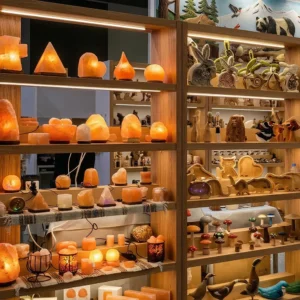
Decorative grade is not the cheap option; it is the correct option for a different product. Salt lamps and night lights belong to the wellness and lighting channel — our rock salt lighting line — and their compliance story is electrical: CE, RoHS, and UKCA on the fittings, wiring, and switches. Spa decor, wall bricks, and interior salt features serve contractors and designers who never let anyone eat the material. For those buyers, paying for food-grade testing would be paying for paperwork nobody asked for.
The one hard rule: never mix grades in one shipment. A container holding food-grade cooking blocks and decorative bricks in the same carton range contaminates the documentation trail — if the food authority audits the lot, the presence of untested material in the same consignment raises the question for everything. Importers who buy both grades order them separately, and keep the paperwork separated the same way.
Animal licks sit on a third path. They are feed-adjacent rather than food, and buyers in that channel — livestock distributors — need feed-safety documentation rather than human food certificates. It is the same discipline applied to a different species: match the document to the mouth.
If the grade question is still open, this is the short decision table:
| Buyer Type | Grade to Buy | Why |
|---|---|---|
| Culinary retail and restaurants | Food-grade, documented | Ingested products carry the liability |
| Spa and wellness chains | Decorative, with electrical certs | Lamps need CE, RoHS, UKCA instead |
| Livestock distributors | Feed-safety documented licks | Animal licks follow feed rules |
How a Factory Proves Food-Grade Status
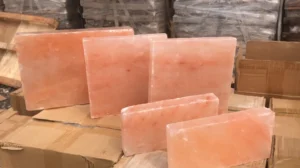
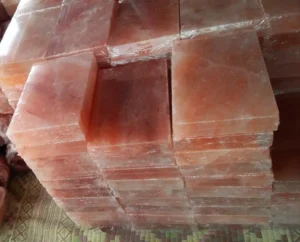
A factory that sells food-grade salt should be able to describe its QC in physical terms. Ours runs four concrete checks on the salt line. Source purity control first: raw material comes directly from Khewra mines, and the extraction batches stay separated by intended use. Then dimensional QC: cutting size tolerance and surface flatness on every cooking block, because a block that wobbles on a grill is a service failure for a chef. Then the density indicators — including the density yield rate, a spec almost nobody asks for, but the one that predicts whether a cooking block survives heating cycles or cracks on first use. Then packaging: vacuum-sealed shrink-wrap for food products, because a salt block that absorbs humidity in transit arrives smaller, duller, and visibly aged.
Batch traceability wraps around all four. Every food-grade lot carries a batch identity that links the physical goods to their test reports, so an audit can walk from a block on a shelf back to a lab result without a gap. A supplier who cannot do that walk, in writing, is selling crystals, not food-grade product.
The same physical discipline extends to the salt lines themselves — wholesale Himalayan salt products from this factory cover cooking blocks, licks, and interlocking bricks, each with the QC that matches its end use.
An Importer’s Verification Checklist
The verification routine fits in a single page and runs in order. Request the five documents before the deposit on any food grade Himalayan salt wholesale order — CoA, heavy-metal report, facility hygiene, granulation and moisture spec, origin documentation. Check that the lead number on the report sits under your market’s limit: 1.0 mg/kg in the EU, 2 mg/kg under FSANZ. Confirm the electrical certs separately if the same order includes lamps. Then test the supplier’s own claim: order samples, run or commission a spot check, and compare the sample against the batch documents.
Then the commercial terms. Food-grade and decorative lines share our ordering structure — stocked items from 100 pieces, custom product runs from 300 pieces, and custom OEM packaging requires 1000 pieces. Payment is 30% T/T deposit and 70% before shipment with DDP delivery to the US, Europe, and Australia. What changes between grades is not the price sheet; it is the file that travels with the goods. The risk reminder to close on: every food grade Himalayan salt wholesale shipment you accept without documents converts you from importer to test laboratory, and your customer’s kitchen is the lab bench.
Get Food-Grade Salt Specs & Test Reports
Food-grade cooking blocks and salt products sourced from Khewra, with QC on density, tolerance, and moisture-proof packaging.
Request Salt Specifications →Frequently Asked Questions
What is the difference between food-grade and decorative Himalayan salt?
The crystal is the same; the documentation is not. Food-grade means the batch passed food-safety testing with certificates tied to it. Decorative means it skipped food testing and is sold for non-edible uses.
Is Himalayan salt safe to cook on?
Yes, when the batch is documented. Published lab data shows mean lead of 0.13 mg/kg across 31 pink salts — under EU and FSANZ limits — but individual samples can exceed them, so demand the test report.
What certificates should I ask a salt supplier for?
Five: certificate of analysis, heavy-metal test report, food facility registration or hygiene certificate, granulation and moisture spec, and country-of-origin and mining documentation. Ask before the deposit, tied to your batch.
Do decorative salt lamps need food-grade certificates?
No. Lamps follow general product-safety rules instead; the electrical parts carry CE, RoHS, and UKCA certification. Never mix food-grade and decorative material in one shipment.
What is the MOQ for food-grade salt products?
Stocked items start at 100 pieces, custom product runs at 300 pieces, and custom OEM packaging requires 1000 pieces. Payment is 30% T/T deposit and 70% before shipment. Delivery runs DDP to the US, Europe, and Australia.