Skip to content
Rock salt lamps give a room a low, warm amber glow and a decorative focal point cut from a single block of pink rock salt. That is the benefit a buyer can defend. The wider claims attached to them, that a lamp cleans the air, floods a bedroom with negative ions, or eases respiratory conditions, have never been demonstrated at room scale, and putting that language on a retail listing is how a wholesaler collects an advertising complaint instead of a reorder. This guide separates what a salt lamp actually does from what it is said to do, then covers the specifications that decide whether the product sells twice: wattage and cavity fit, sweating, plug certification, size, and order minimums.
Key Takeaways
- A salt lamp sells on warm, low-glare ambience, not on measured air purification.
- Salt is hygroscopic, so an unlit lamp in a damp room pulls moisture to its surface and weeps; a lit bulb drives that moisture back off.
- Two bulb families cover wholesale stock: E12 candelabra in 7W and 15W for compact lamps, E14 small Edison screw in 15W and 25W.
- A 2-5kg shell should run a 15W bulb, because a 25W element in a shallow cavity overheats the fitting and melts the holder.
- The 2-3kg natural rock shape is the UK and EU shelf workhorse, the best trade-off between retail price and sea-freight weight.
- Trial orders open at 100 pieces with a USD 500 minimum order amount, while wholesale and custom runs start at 300 pieces under a USD 3,000 minimum.
- Air DDP lands in 20-30 days and sea freight in 60-90 days to port, so a Q4 gifting plan has to be booked against those two numbers.
Table of Contents
- What the salt actually does in a room
- What the ion and air-quality claims do not prove
- The benefits you can sell without overpromising
- Wattage, cavity fit and electrical safety
- Sizing a lamp for a retail shelf
- Care and safety notes for end customers
- MOQ, lead time and order math
- Final word: sell the light, not a cure
- Frequently asked questions

What The Salt Actually Does In A Room
Halite, the mineral a salt lamp is carved from, is hygroscopic: it attracts water vapor from the air touching it. That behaviour is real and visible. Leave an unlit lamp in a humid room overnight and the surface turns damp, then crusty, because the salt has pulled moisture out of the air and left the dissolved minerals behind on the crystal. Our pink salt origins page covers where that halite comes from and why the veining differs by seam.
The commercial consequence is the one every importer meets: a weeping lamp marks a shelf, stains a tabletop, and returns as damaged goods. Switching the bulb on reverses it, since warmth pushes the moisture back out of the crystal, which is why a lamp that runs a few hours a day sweats far less than one kept in a box in a damp bedroom. Runners-up problems, dust and a chalky film, are cosmetic and wipe off. For the full sequence, our guide to salt lamps that leak or sweat walks through the fixes in order.
What The Ion And Air-Quality Claims Do Not Prove
The standard sales story goes like this: a warm salt crystal releases negative ions, those ions bind to pollutants, and the room air cleans itself. There is no published measurement showing that a decorative lamp releases ions in quantities that change a room. A salt crystal also cannot pull meaningful volume out of still air; the water it attracts is a surface film, not an air stream, so dust and pollen in the middle of the room never reach it. WebMD’s review of salt lamp claims lands in the same place, noting the evidence is thin while the folklore keeps spreading.
Two further claims deserve naming because they appear on supplier listings constantly. The first is that a lamp reduces electromagnetic radiation from screens; there is no mechanism for that, and a salt block cannot shield anything at the power it draws. The second is that the crystal emits far-infrared energy that improves circulation; a bulb warming a rock to slightly above room temperature is ordinary heat, and describing it as a health effect invites a challenge from a trading-standards officer rather than a margin. We do not print either claim on our cartons, and we ask buyers to keep them off their own product pages.
The graphic below is one of the ion-generation diagrams that circulate on supplier listings for this category. It is drawn to sell the claim, not to document it, and we keep it here as the thing under examination rather than as evidence.

The Benefits You Can Sell Without Overpromising
What a salt lamp genuinely delivers is light quality. A 15W incandescent element behind a pink crystal outputs a low, diffuse amber glow with almost no glare and almost no blue content, which is the same direction of travel as the evening-light advice in the NHS guidance on sleep and tiredness: dim, warm light in the hours before bed instead of a bright screen. A retailer can honestly say a salt lamp makes a bedroom feel calmer at night. Saying it treats insomnia would be a different claim entirely.
The second honest selling point is the object itself. Each lamp is cut from one block, so no two shells share a vein pattern, and the colour runs from pale blush to deep orange along the seam. That natural variation is a gifting story, and it is why the format keeps its place in spa receptions, hotel lobbies and yoga studios, where staff want a warm low-level light that a ceiling fitting cannot produce. A damp surface can even be sold as useful: a lamp that weeps is telling you the room needs ventilation.
The board below is a typical health-benefit infographic for salt lamps. Each line on it is a claim a UK or EU listing would be asked to substantiate, so none of that language appears on the cartons or product pages we supply.

Wattage, Cavity Fit And Electrical Safety
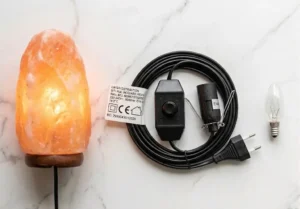
Heat is where salt lamp programmes fail quietly. Two socket families carry the range: E12 candelabra bases in 7W and 15W for compact lamps, and E14 small Edison screw bases in 15W and 25W. Cavity depth is the binding constraint. Roughly 47mm suits a 15W bulb, while a 25W element needs about 55mm of clearance; drop a 25W into a 2-5kg shell and the fitting overheats, the plastic holder softens, and the batch comes back with melted sockets. Our wholesale salt lamp bulb page carries the full wattage and cavity matrix.
Beyond the bulb, three electrical details decide whether a shipment clears retail. First the cord: H03VV-F flex with a moulded plug, not a loose lead with a push-on adapter. Second the plug: a fused BS 1363 three-pin unit for Great Britain, where UK wholesale salt lamp buyers should also expect a written UKCA declaration of conformity; a US order needs UL or ETL components instead. Third the dimmer: a switch rated above the fitted bulb’s load, because an under-rated inline dimmer is the most common cause of a lamp failing inside its first winter.
Sizing A Lamp For A Retail Shelf
Weight drives price, freight and bulb spec at the same time, so size is the first decision on a salt lamp line. The four bands below are our own size-chart and packing figures, which means the row a buyer quotes is the row that ships. The full tier list, including cavity depths per shape, is on our salt lamp size chart page.
| Weight Band | Diameter And Height | Bulb And Cavity | Packed Per Carton |
|---|---|---|---|
| 1-2kg | 10cm across, 16cm tall | 7W E12, shallow cavity | 8 pieces, about 16kg gross |
| 2-3kg | 12cm across, 18cm tall | 15W E12 or E14, roughly 47mm clearance | 6 pieces, about 18kg gross |
| 3-5kg | 14cm across, 20cm tall | 15W E14, roughly 47mm clearance | 4 pieces, about 20kg gross |
| 5-7kg | 16cm across, 24cm tall | 15W E14, deeper cavity | 3 pieces, about 21kg gross |
Above those bands the chart continues with a 10-15kg lamp at 20cm across and 30cm tall, a 20-25kg piece at 28cm by 38cm, and a 25-30kg block at 31cm by 42cm. Anything at 10kg and up wants a 25W E14 with roughly 55mm of cavity clearance, and it sells as a statement piece rather than a shelf SKU.
The same chart prints a suggested coverage figure per band, from 2-3 square metres on the smallest lamp to 30-40 square metres on the largest. Read that column the way a display planner reads it: how large the lamp presents in a room. It is not a purification radius, for the reason set out earlier, since a salt crystal does not draw air through itself.
A mixed container usually works best weighted toward the 2-3kg band, with enough 5-7kg stock to anchor the display and a small statement allocation. Freight maths matters more than it looks: salt is dense, so a container fills on weight long before it fills on volume, and every kilogram you add to the average unit costs real margin on the sea leg.
Care And Safety Notes For End Customers
Four instructions cut returns on this category. Wipe the crystal with a dry or barely damp cloth only, and never soak it, since the salt dissolves. Keep the lamp switched on for a couple of hours most days in humid rooms so the crystal stays dry. Sit it on a coaster or a ceramic plate if the surface below is bare wood, because a weeping crystal will leave a ring. Then keep the cord short and the lamp out of reach: the block is heavy, and a pulled cord drops several kilograms onto a foot.
One caution deserves printing on the carton rather than hiding in a listing. A salt lamp is not a toy, and a household that includes small children or pets should treat the block as something to look at, not lick. Excess salt intake is a genuine problem for dogs, and a child who tastes a crystal will keep going back. Retailers who sell into family markets should carry that line on the packaging, and buyers sourcing for the UK should expect the same wording we use on our own retail boxes.

MOQ, Lead Time And Order Math
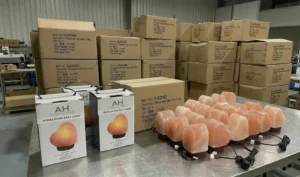
Our minimums are built around whether the stock already exists. A first-time buyer opens with a 100-piece trial under a USD 500 minimum order amount, which is the cheapest honest way to test a shelf before committing a pallet. Wholesale and custom programmes both start at 300 pieces under a USD 3,000 minimum order amount, and a printed colour box, the SKU most gift retailers need, starts at 500 pieces because that is the shortest run the box supplier will commit.
Lead times split by mode, not by season. Air DDP arrives in 20-30 days and suits a trial or a top-up. Sea freight runs 60-90 days to port, so Christmas stock has to be booked by the end of June to sit on a UK shelf before the gifting window. The wholesale salt lamp range lists the open-stock shapes, and custom Himalayan salt products covers engraving, private-label cartons and bespoke bases against the same minimums.

Final Word: Sell The Light, Not A Cure
Salt lamps are a durable category precisely because they are honest objects: a mined crystal, a warm bulb, a wooden base. The wellness language bolted onto them is what makes the category fragile, because it promises a health result the product cannot deliver and cannot document. Sell the glow, the craftsmanship, the natural variation, and the packaging that survives a six-week sea crossing, and the reorder comes on its own.
For buyers, the practical version of that advice is a short checklist: confirm bulb wattage against cavity depth in writing, lock the plug and certification for the destination market, spec moisture-proof inner wrapping so the crystal arrives dry, and keep the listing copy inside what the product can prove.
Buy The Lamp, Not The Legend
Start with a 100-piece trial under air DDP, or build a 300-piece wholesale programme with E14 15W bulbs, fused plugs and moisture-proof inner wrap already fitted.
Frequently Asked Questions
Do rock salt lamps clean the air?
No published measurement shows a decorative salt lamp changing room air quality. Salt is hygroscopic, so it attracts a thin film of moisture onto its own surface, but it does not move air through itself or capture dust and pollen from across a room. Listings that claim purification are repeating folklore, not evidence.
Why is my salt lamp wet and what should I do about it?
The crystal has pulled moisture from a humid room and it now sits on the surface. Run the lamp with its bulb for a couple of hours to drive that moisture back off, wipe the shell with a dry cloth, move it away from damp walls, and place a coaster underneath so the salt cannot ring a wooden table.
Which bulb does a rock salt lamp need?
Lamps in the 2-5kg bands use an E12 candelabra or E14 small Edison screw bulb at 15W, which needs about 47mm of cavity clearance, while the smallest 1-2kg shells run a 7W E12. Larger pieces from 10kg up use a 25W E14 bulb and roughly 55mm of clearance. Fitting a 25W element into a small shell overheats the holder and melts the fitting.
Are salt lamps safe around children and pets?
The lamp is safe as a fixed light, but the block itself is not a toy. A child or a dog that licks the crystal is taking in salt, and the several kilograms of weight mean a pulled cord can drop the lamp onto a foot. Keep it out of reach, out of chew range, and state that on the carton.
What is the smallest wholesale order you accept?
A 100-piece trial at a USD 500 minimum order amount lets a new stockist test the shelf. Wholesale and custom programmes start at 300 pieces with a USD 3,000 minimum order amount, and printed colour boxes require 500 pieces. Air DDP takes 20-30 days and sea freight 60-90 days to port.