Skip to content
For a food brand, a distributor or a hospitality buyer, the choice between Himalayan pink salt and sea salt is not a flavour argument. It is a sourcing argument: where the crystal came from, what it can be tested for, which grain cuts are available in volume, and what story the packaging is allowed to tell. Both are unrefined sodium chloride products that sit at the same shelf position; only one of them comes out of the ground.
This guide is written from the factory side of the transaction. It covers origin and what each origin implies for testing, what the pink colour actually is, the grain cuts you can order, which applications suit which salt, the documentation a serious buyer should demand, and the logistics that decide landed cost.
Key Takeaways
- Pink salt is mined as halite from inland deposits in Pakistan; sea salt is evaporated from current ocean water in coastal pans.
- The pink colour comes from trace iron in the crystal, not from a nutrient payload — both salts are overwhelmingly sodium chloride.
- WHO dietary guidance caps salt at under 5 grams per day for adults, which is the number your label claims must respect, whichever salt you pack.
- Ask for a per-batch certificate of analysis covering moisture, insolubles and heavy metals before you commit to a retail line.
- Six grain cuts move in wholesale: fine, medium, coarse, finger, grinder refill and block or slab grade.
- Trial orders start at 100 pieces with a USD 500 minimum order value; wholesale and private-label runs start at 300 pieces with a USD 3,000 minimum.
- Sea freight takes 60 to 90 days to port and air freight 20 to 30 days, which is usually the difference between a seasonal launch and a steady replenishment programme.
Table of Contents
Pink Salt vs Sea Salt at a Glance
| Core feature | Himalayan pink salt | Sea salt |
|---|---|---|
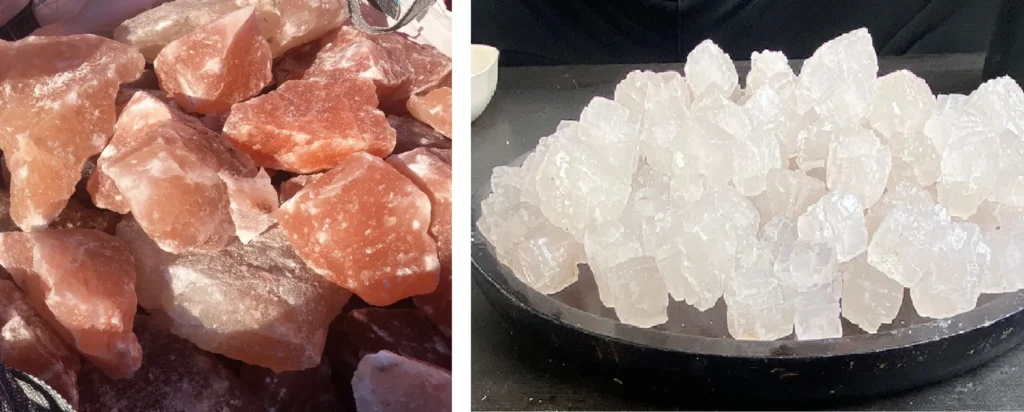
| Where it comes from | Mined as rock halite from inland deposits in Pakistan’s Salt Range, worked through long-established underground mines. | Evaporated from seawater in coastal salt pans, then washed and dried. |
| Exposure to modern pollution | Sealed underground, so the deposit is not in contact with present-day seawater or river runoff. | Directly dependent on the water quality of the harvesting coast; batch testing is the control. |
| Colour driver | Trace iron in the crystal lattice, giving pink through to deep rust streaks. | Clay and mineral films from the pan; grey, red or off-white finishes are normal. |
| Flavour behaviour | Even, rounded salinity; dissolves predictably in a rub or a brine. | Sharper initial burst; flake grades deliver texture that mined grades cannot. |
| Typical commercial use | Premium retail shakers, bath and spa lines, cooking slabs, grinders, wellness gift ranges. | Bulk food processing, bakery and snack seasoning, restaurant finishing salts. |
Origin: Ancient Deposit vs Today’s Ocean
Pink salt is mined, not farmed. The Pakistani deposits are relic seabeds — salt that evaporated and was buried long before the modern ocean existed, capped by rock that keeps today’s water out of it. The commercial consequence is a supply story you can defend: the material never met the current sea, and the impurity profile is geological rather than environmental. Our own origin explainer is here.
Sea salt is a weather-dependent crop. Pans along a clean coast with fast evaporation and a controlled wash produce an excellent, consistent product; pans downstream of population or industry produce whatever the water carries, and the buyer only learns that from a test report. This is the single most important difference for procurement: with mined salt you verify the mine and the processor, with sea salt you verify every batch.
Neither origin makes a salt healthy on its own. Salt is salt, and public-health guidance is the same whichever crystal you pack: the WHO healthy diet guidance puts adult intake below 5 grams of salt per day, roughly 2 grams of sodium. Position your product around flavour, texture and presentation, and leave the health claims to the nutritionist who signs off your label.
What the Pink Colour Actually Is
The pink is iron. Minute quantities of iron-bearing material inside the crystal reflect the salmon and rust tones that make the product photograph well, and the same mineral trace is what makes a single seam look grey or white. That is a defensible claim. The claim to avoid is the one that circulates in consumer marketing: a precise count of trace minerals, presented as a nutritional advantage. Trace elements in rock salt exist at levels far too low to matter nutritionally, and a buyer who prints a number on a shaker owns that number when a regulator asks for the test method behind it.
What you can honestly say about pink salt is visual and sensory: it is unrefined, it is not free-flow-agent treated in its natural grades, it carries a mild even salinity, and the colour variation across a batch is evidence of minimal processing rather than a defect. Sea salt can say most of the same things about itself. The differentiator is origin and format, not mineral content.

Grain Cuts and Product Formats
Grain size, not origin, decides which SKU a salt fits. These are the cuts that move in wholesale volume, and each behaves differently on a production line:
- Fine: table shakers, seasoning blends, rub formulations, and any line where dosing must be repeatable gram for gram.
- Medium (grade): the workhorse for grinders, food service tubs and meat processing; dissolves slower than fine but predictably.
- Coarse: milling boxes, bath and spa formulations, and curing operations where the crystal must survive contact time.
- Finger salt: irregular chunks sold as a gift and home-grinding item, high visual value per unit weight.
- Grinder refill: blended loads sold to top up retail grinders — a repeat-purchase SKU rather than a one-off.
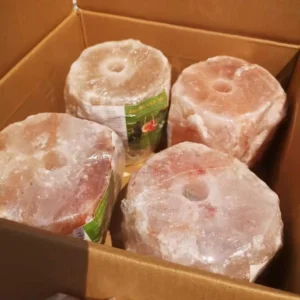
- Block and slab grade: solid cut blocks for cooking, serving and chilling; the highest-margin format in the category, and the one where density and drying matter most. Our cooking-slab line is here.
Sea salt competes on one format that mined salt cannot copy: thin flakes. A flake delivers texture and a quick burst that a chef values on a finished plate, and no cut of rock halite reproduces it. If your line depends on finishing salts, buy sea salt for that SKU and pink salt for the rest, and stop treating the two as rivals across the whole catalogue.

Matching Salt to Your Business
A short decision framework, based on what the shelf has to do:
- Wellness and gift retail: pink salt. The origin story fits the aisle, the colour photographs, and block formats give you a second SKU from the same supply.
- Food manufacturing and snack seasoning: sea salt or fine mined salt on cost and flow behaviour. Decide on price per pallet and caking performance, not on the label.
- Restaurants and hotels: both — coarse mined salt in the kitchen, flake sea salt at the pass, and a slab on the table for the interactive serve.
- Bath and spa: coarse and mined grades, where the sales pitch is the mineral story and the origin is the credibility.
- Private-label grocery: pick the salt that your packaging can sell in three seconds, then hold the other as a second line rather than switching suppliers for a novelty SKU.
Documentation a Buyer Should Demand
Whatever the origin, your compliance file is built from documents, not adjectives. Before a first wholesale order, request:
- Certificate of analysis per batch: moisture, water-insoluble matter, and the heavy-metals panel your market requires.
- Food-contact and food-grade declaration: naming the product and the standard it is declared against.
- Origin documentation: mine or pan reference, packing site, and export paperwork that matches the invoice.
- Contaminant testing appropriate to the source: for sea salt, ask specifically what the pan’s catchment is and whether particulate screening is performed; for mined salt, ask about the processing water and screening.
- Packaging specification: inner liner, sachet, carton rating and pallet pattern, with the moisture-protection logic written down.
- Label-review support: a supplier who will reword a claim you cannot substantiate is worth more than one who prints anything you ask for.
A supplier who cannot produce these quickly is not a source factory — treat that as the answer. The same documentation discipline we apply to wooden craft compliance files is described in our wholesale lamp range notes, because humidity-sensitive salt products need it even more.
Packaging, Freight and Landed Cost
Salt is cheap to buy and expensive to mishandle. It is dense, it is hygroscopic, and it corrodes whatever it touches when it gets wet. Landed cost is therefore driven by four levers, not by the crystal price:
- Payload density: block and slab grades ship a lot of weight per cubic metre, so freight per unit rises and pallet pattern matters more than box art.
- Moisture protection: sealed inner poly and desiccant are the difference between a clean first carton and a caked one; the same brine mechanics that make a lamp sweat will cake your fine grade.
- Freight mode: ocean at 60 to 90 days to port suits replenishment; air at 20 to 30 days suits a launch window or a top-up after a sell-out.
- Private-label minimums: printed film, grinders and blocks each carry their own run-size economics, which is why entry quantities are set per channel.

For a first programme we recommend 100 pieces against a USD 500 minimum order value as a trial sell, then a wholesale or private-label run from 300 pieces with a USD 3,000 minimum, colour-box lines from 500 pieces. That sequence lets you test which grain cut your customers actually reorder before you commit to a printed sleeve. Cut-to-size blocks, engraved packaging and branded shakers are covered under our custom salt product line.
Source Pink Salt by Grain Cut, Direct
Fine to slab grades with per-batch documentation, OEM sizing for blocks, private-label packaging and freight-ready cartons. Trial orders from 100 pieces with a USD 500 minimum.
Frequently Asked Questions
Is Himalayan pink salt healthier than sea salt?
Neither. Both are sodium chloride, and the trace elements in either exist at levels too small to influence nutrition. Choose on origin, grain cut, testing and how the label reads, and keep intake within the guidance your market applies.
Do the two salts taste different in food?
Yes, mostly because of grain size. Pink salt gives an even, rounded salinity that dissolves predictably. Sea salt flakes arrive sharper and textural, which is why chefs use them at the pass rather than in a rub.
Can pink salt be substituted for sea salt in recipes?
By weight, one for one. By volume you must adjust for crystal size, because coarse mined salt packs differently from fine sea salt, and a teaspoon of each is not the same dose of sodium.
Which salt should a new retail brand launch with?
Pink salt in fine and coarse cuts, plus one high-margin format such as a slab or finger salt. The origin story carries the shelf talker, and one supplier covers the whole line.
What paperwork should a salt supplier send before an order?
A per-batch certificate of analysis covering moisture, insolubles and heavy metals, a food-grade declaration, origin documentation matching the invoice, and the packaging specification with its moisture-protection logic.