Skip to content

For executive chefs, hotel banquet managers, and hospitality procurement teams, a Himalayan salt block presentation is no longer a novelty—it is a high-return visual asset. In the competitive restaurant industry, presentation drives menu pricing. Serving food on a dense, naturally mineralized pink salt slab instantly transforms a standard dish into a premium dining experience.
Beyond aesthetics, these commercial-grade blocks conduct heat and cold exceptionally well, giving back-of-house teams a functional tool that keeps cold foods chilled and hot foods sizzling at the table. That dual behaviour is why wholesale Himalayan salt blocks now appear on omakase counters, banquet lines, and wine-bar boards that never carried stone tableware five years ago. Below are five high-margin plating applications, the selection criteria behind them, and the procurement basics that keep a rollout from turning into a freight claim.
Key Takeaways
- Chilled service holds temperature for 30 to 45 minutes at the table, which covers 1 full seating cycle in most fine-dining turns.
- High-density blocks in the 4 cm range survive repeated heating cycles; decorative-grade stone is the usual source of breakage claims.
- 5 plating formats—sushi, banquet boards, tableside searing, charcuterie, and desserts—cover the 5 service formats a commercial kitchen actually rotates through.
- 3 controls protect the surface during service: pat proteins dry, oil the block, and keep wet or acidic items off bare salt.
- 2 shipping lanes drive landed cost: air freight arrives in 20 to 30 days, ocean freight in 60 to 90 days to port.
- 1 trial order is enough to validate density: 100 pieces with a USD 500 minimum order value before any wholesale commitment.
Table of Contents
- Premium sushi and sashimi service
- Banquet and catering displays
- Tableside searing as an upsell
- Charcuterie and wine bar boards
- High-margin dessert presentations
- Choosing the right Himalayan salt block format
- Back-of-house service standards
- Procurement, MOQ, and freight basics
- Sourcing for profit
- Frequently asked questions
1. Premium Sushi and Sashimi Service
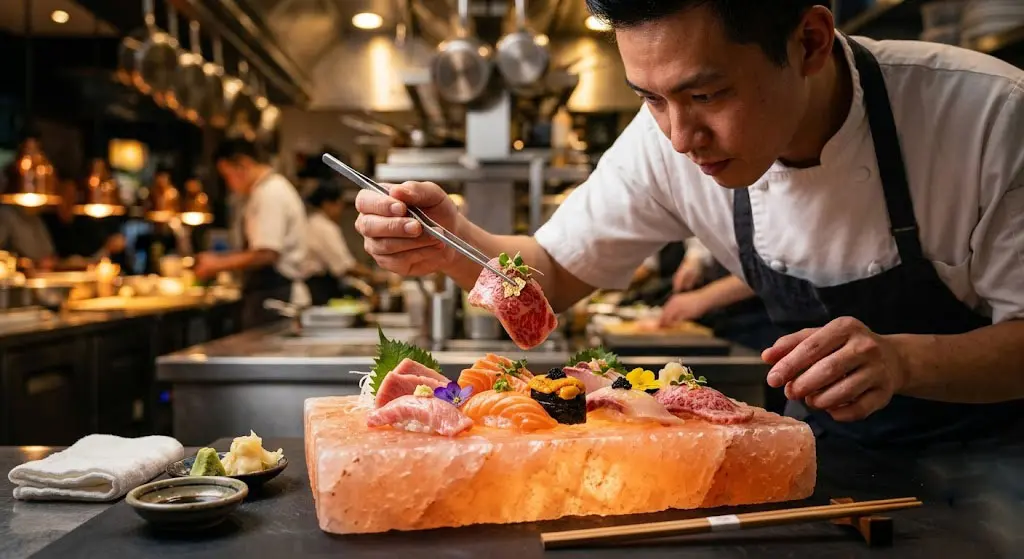
Raw seafood requires strict temperature control, especially in slow-paced fine dining. By storing slabs in the commercial freezer prior to service, sushi restaurants can guarantee that sashimi stays perfectly chilled at the guest’s table for over 30 minutes.
Visually, the warm pink tones of the salt create a striking contrast against the deep reds of tuna and the bright greens of seaweed. The chilled surface also imparts a very subtle, clean salinity to the fish, enhancing its natural ocean flavor without overwhelming it.
Operationally, a chilled slab shortens the expo window. Sushi can be dressed and set on stone at the pass, then carried out while the block—not the plate—absorbs the temperature risk. Restaurants running 2 seatings per night typically rotate 3 sizes of slab so that a fully frozen board is always staged, which is the main reason frozen-service volume scales better than hot-service volume.
2. Banquet and Catering Displays (Salads & Cold Cuts)
For hotel buffets and wedding catering, visual appeal is everything. Replacing standard stainless-steel trays with large salt slabs immediately upgrades the perceived value of the event. They are highly effective for serving Caprese salads or fresh vegetable displays.
Chef’s Tip: To prevent foods from drawing out too much salt during a long banquet service, lightly brush the block with olive oil. This creates a thin moisture barrier, gives the stone a high-end polished sheen, and keeps the seasoning perfectly balanced.
Banquet teams should treat the slab as reusable cold-service furniture rather than a plate. A large format board carries 4 to 6 portions of cured meat at a time and resets in under a minute with a dry scraper and a cloth, which matters when 300 covers move through one line. The practical limit is ambient humidity: buffets held near open doors or humid live-cooking stations will show surface weeping long before the food runs out.
3. Tableside Searing (The Ultimate Upsell)
If you want to justify a premium appetizer position on the menu, cook it in front of the customer. High-density salt blocks can be heated to 500°F (260°C) in the kitchen and brought to the dining table on custom metal carriers.
Waitstaff can sear scallops, Wagyu beef slices, or shrimp directly at the table. The dramatic sizzle, the smoke, and the immediate aroma create an interactive dining moment that guests film and share, generating organic marketing for the restaurant.

4. Charcuterie & Wine Bar Boards
Wine bars are moving away from porous wooden boards that are hard to sanitize and degrade over time. A chilled salt slab stays firm under bar lighting, keeps expensive cheeses from weeping fat, and stops cured meat fats from melting in a busy, warm dining room.
Because the surface is smooth and non-porous once oiled, it is quick for staff to wipe down and reset for the next table, speeding up turnover during peak hours. Where a porous wooden board has to be retired every season, a dense salt slab resets to a clean surface in one wipe, which is the argument bar managers actually use when the purchase order is challenged.
5. High-Margin Dessert Presentations
The sweet-and-salty flavor profile is a proven best-seller. Pastry chefs use chilled slabs as the literal foundation for their desserts. Serving dark chocolate truffles, salted caramel treats, or artisan sorbets directly on the frozen pink stone keeps the desserts from melting quickly.
The block imparts a micro-dose of salt to the base of the chocolate, highlighting the sweetness and depth of the cocoa. It is an unforgettable finale that encourages guests to order dessert rather than just asking for the check.

Choosing the Right Himalayan Salt Block Format
Presentation quality is decided before service, at the purchasing step. Density, thickness, and surface flatness determine whether a Himalayan salt block survives a hot line or becomes a breakage credit. The table below maps the five service applications above to the specification that actually holds up in each.
| Service format | What matters most | Failure mode to avoid |
|---|---|---|
| Frozen sushi and sashimi | Uniform thickness so the whole face chills evenly; low porosity so condensation does not dissolve the serving side. | Thin, low-density stone pulled straight from freezer to warm room, which cracks along a fault line. |
| Banquet cold displays | Large surface area and a flat, level base so boards sit stable on a buffet riser. | Over-wetting from dressings and cut vegetables left sitting on bare salt for hours. |
| Tableside searing | High-density crystal and a heavy gauge, paired with a metal carrier that insulates the table. | Rapid heating from a cold start, which is the most common cause of thermal shock. |
| Charcuterie and cheese | Sealed, oiled surface that wipes clean between covers and resists fat staining. | Cross-contamination of flavor when one board runs from cured meat to fruit without reset. |
| Dessert service | Smaller chilled format with clean color and minimal veining for photographic plating. | Sugar syrups and acidic fruit placed directly on the face, which etch the surface. |
Color consistency deserves separate attention on plated dishes. Restaurant buyers routinely reject mixed-grade lots because a pale grey slab beside a deep rose one reads as inconsistent service on the same table. Specify the color band and the grade up front, request a packed photo of the actual production lot before shipping, and treat that image as the acceptance reference for the container.
Surface finish is the second decision. A fully polished face photographs beautifully and releases food cleanly, while a lightly brushed face grips oils better for high-heat searing. Most operations end up running 2 finishes rather than compromising on one, and the cleaning sequence behind both is covered in our commercial salt block cleaning guide.
A Back-of-House Standard for Consistent Presentation
Plating on stone fails in service when it depends on one experienced cook. Written handling standards keep the presentation repeatable across shifts and protect the asset itself.
- Temperature change is gradual. Heat and cool in stages. A block moved from freezer to a hot grill, or from oven to cold water, fails from thermal shock rather than from wear.
- Moisture is the enemy of the face. Proteins and seafood are patted dry before they touch the surface; wet dressings, citrus, and vinegar-based components go on top of an edible barrier instead of directly on salt.
- Oil is a working finish, not a garnish. A thin wipe before service seals pores, sharpens color, and reduces the amount of salt that transfers to the dish.
- Cleaning is mechanical. After the slab cools to room temperature, carbonized residue comes off with a metal scraper and nothing else.
- Carriers are part of the specification. Every hot block needs a trivet or metal stand sized to the slab, and service staff should be trained to carry by the carrier, never the stone.
Food-contact compliance is the last line of the standard. Salt is a food itself, and buyers in regulated markets ask for documentation on the material in contact with their plates. The U.S. FDA’s published position on food contact substances is the reference most hospitality procurement teams start from when they evaluate a new stone tableware supplier.
Bulk Sourcing for the Hospitality Industry
Partner with Jilin Ever Creation to source authentic, ISO9001-certified salt blocks from Pakistan’s Khewra Mine. We supply high-density, culinary-grade slabs designed for commercial kitchen durability. Whether you need custom sizes for your restaurant tables or bulk OEM packaging for retail distribution, we ensure secure, shatter-proof ocean freight.

Procurement, MOQ, and Freight Basics
Salt is heavy and brittle, which makes freight the largest hidden line in a stone tableware program. Order quantities should be planned around container economics rather than around how many boards one restaurant needs this month. At Jilin Ever Creation, the trial path starts at 100 pieces with a minimum order value of USD 500; wholesale and customized programs run from 300 pieces with a USD 3,000 minimum order value; and custom color gift boxes for retail packaging start at 500 pieces.
Lead time follows the lane. Air freight for a validation batch reaches most destinations in 20 to 30 days, while ocean freight for full programs runs 60 to 90 days to port. Hospitality buyers launching a seasonal menu usually need the trial batch on air and the volume order on water, which means the two POs are placed in the same week even though they arrive months apart.
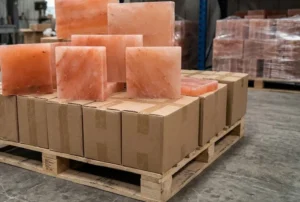
Packaging is where breakage claims are won or lost. Blocks ship individually shrink-wrapped with desiccant to control hygroscopic moisture, then suspended in fitted foam within a export-grade carton. Distributors who resell to restaurant supply houses should confirm the inner-pack format before production, because a retail-ready carton and a foodservice bulk carton need different stacking strengths. Our factory capability overview lists the finishing and packing lines available for both channels.
Final Thoughts: Sourcing for Profit
Whether you are running a high-end steakhouse, a boutique catering business, or distributing to the hospitality sector, culinary salt blocks offer a unique way to command higher menu prices and generate buzz.
The key to a successful roll-out is sourcing the right density. Cheap, decorative stone will crack in a commercial oven. At Jilin Ever Creation, we specialize in high-density, culinary-grade blocks packed to withstand international ocean freight without breaking.
Want to test our factory quality before committing to a full container? We offer a low-risk USD 500 trial order so you can evaluate the durability and presentation value firsthand. Contact our sales team today to set up your trial shipment!
Frequently Asked Questions About Commercial Salt Block Plating
Will wet or acidic foods ruin the block during service?
Yes, prolonged contact with lemon juice, vinegar, or very wet foods will dissolve the salt faster. Kitchen staff should use a small edible barrier, such as a shiso leaf for sushi, or brush the block with oil to protect the surface and extend its commercial lifespan.
How long does the block hold its temperature at the table?
A high-density commercial block preheated in a 500 degree oven will retain active searing heat for 20 to 30 minutes. A block stored in a deep freezer will hold a safe, chilled temperature for roughly 45 minutes, which is plenty of time for standard table turnover.
How do we prevent the food from getting too salty?
Moisture is what draws the salt out. Instruct the prep line to pat meats and seafood dry before plating. A thin coat of oil on the face slows transfer, and a cold block releases far less salt than a hot one.
How do we protect restaurant tables from heated blocks?
Never place a hot block directly on a wooden table or cloth. We recommend sourcing metal carriers or heavy duty trivets sized to the slab. This protects the furniture and makes it safe for servers to carry the stone from the kitchen.
What is the smallest order a restaurant group can start with?
A validation batch starts at 100 pieces with a USD 500 minimum order value, which is enough to test 2 or 3 formats across a small group. Wholesale programs and custom sizes begin at 300 pieces with a USD 3,000 minimum order value.