Skip to content

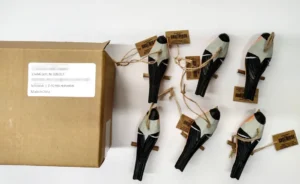
Product storytelling tags are the smallest marketing surface a brand owns and the most read: four lines of type on a piece of board, held at arm’s length by a stranger deciding whether your object is worth its price. Done well, the tag carries the maker, the material and the keeping instructions in language a shopper trusts. Done badly, it carries adjectives nobody can prove and claims nobody should make.
This guide sets out the four lines a tag may carry, the document behind each, the claims that must stay off artisan tags entirely, and the revision discipline that keeps a tag honest across seasons. Every production figure is our own first-party number; the line budgets are recommendations from our own tag stack.
Key Takeaways
- A tag carries 4 lines at most: what it is, what it is made of, who made it, and how to keep it; a 5th line turns a tag into a leaflet and nobody reads past the fold.
- Every line must be provable from 1 document: species and origin from permits, finish from safety sheets, maker from the bench record, care from the pack spec; unprovable lines are lawsuits with better typography.
- The story is true or it is nothing: our tags name the province, the species and the hand process, then stop at 4 lines, because an invented village or a fictional artisan name collapses at the first journalist or regulator.
- Claims with a ceiling stay off the tag: no FSC-certified wood wording while certified basswood is unavailable, no food-contact, no lifetime warranty, and 0 recycled percentages for virgin or offcut timber.
- Refresh cycles differ per line: the what and who lines change never, the made-of line moves with the permit batch, and the care line moves only when the finish system changes; date the tag revision like 1 drawing revision.
- Order tags with the range, not after: custom labels and marks are part of our standard offering and custom colour boxes run from 500 pieces, and a tag arriving a week after the goods is a week of unlabelled shelf.
In This Guide
- Why the Tag Is the Most Read Surface
- Product Storytelling Tags: The 4 Lines
- Voice: Plain Sentences Outsell Adjectives
- The Claims a Tag Must Not Carry
- Keeping Every Line Provable
- Tag Line Against Source Against Refresh Cycle
- Placement: Where the Hand Goes Last
- What We Print, and What We Refuse To
- Best For / Not For
- What We Check on a Tag Run
- End to End: An Artisan Brand’s Retail Onboarding
- Frequently Asked Questions
Why the Tag Is the Most Read Surface
A shopper will not read your product page in store, will not scan the QR code on a busy Saturday, and will not ask staff about a piece priced under the conversation threshold. What they will do is lift the piece, turn it over, and read the tag. Four lines, six seconds, and the object is either a made thing with a maker or a commodity with a price.
That is also why the tag is a compliance surface: every line printed on it is a published claim, repeated at scale, in the shopper’s hand. The discipline this guide proposes is simple enough to audit: four lines, one document each, and a revision date. The retail context the tag lives in, shelf strips and bay stories, is covered in our guide to rustic wooden decor merchandising in boutiques.
Product Storytelling Tags: The 4 Lines
Line 1, what it is: the object name and its job, in the shopper’s words rather than the catalogue’s. Line 2, what it is made of: species and finish, plus origin where the permit stack supports it. Line 3, who made it: the bench, the province, the hand process, named plainly. Line 4, how to keep it: one care sentence that matches the finish system, because a care line the owner cannot follow is a return with a story.
The fifth line is where tags go to die: a brand manifesto, a sustainability paragraph, a second language squeezed at 6 point. If the story needs more room, it belongs on an insert card in the box or on the product page behind the QR, both of which the shopper chooses to read rather than stumbles into.

Voice: Plain Sentences Outsell Adjectives
Artisan tags fail most often on voice rather than content: “exquisite handcrafted heirloom quality” says nothing a shopper can check, and says it in the register of every mass product’s packaging. Plain sentences carry proof inside them: “carved from one piece of basswood in Jilin, finished with non-toxic paint, wipe with a dry cloth” gives the hand, the place, the finish and the care in one breath.
The test we apply to our own tag drafts is whether a sentence survives being read aloud by a sceptical teenager; adjectives do not, verbs and nouns do. Where a brand wants warmth, it belongs in the object name and the maker line, not in stacked modifiers around the material claim.
The Claims a Tag Must Not Carry
Four claims stay off artisan wood tags regardless of how well they sell. FSC-certified wood, unless the specific batch carries certified stock: our facility holds a chain-of-custody certificate, but certified basswood is not currently available to us, so our tags carry species, origin and permits instead, and the framework for credible forest claims is published by the FSC business programme. Food-contact, because a coaster or tray is tableware-adjacent, not tableware. Lifetime warranty, because wood in a pocket or a dishwasher is outside any warranty a maker can honour. Recycled-content percentages for virgin or offcut timber, because offcut-fed is a feedstock statement, not a recycled percentage.
A fifth belongs to the retailer rather than the maker: price-comparison language, “worth twice this”, which converts a tag into an advertising claim with its own evidentiary burden. The tag’s job is identity and care; persuasion belongs to the shelf story and the object itself.
Keeping Every Line Provable
Each tag line gets a document owner at design time: species and origin sit with the permit file, finish with the safety sheets, maker with the bench and batch record, care with the pack specification. When a retailer onboarding desk or a marketplace compliance queue asks “prove line 2”, the answer is a file reference, not a phone call to the workshop.
The proof stack also decides what a tag can say about destination markets: a line that is true at home can be unlawful abroad if the local labelling rule requires different wording, which is why export programmes keep a market column on the tag specification. The EU layer for wooden gifts is set out in our guide to EU packaging and labelling for wooden gifts, and the tag spec travels with it.
Tag Line Against Source Against Refresh Cycle
| Tag line | Source document | Refresh cycle | Failure mode when skipped |
|---|---|---|---|
| What it is | Range sheet | Never | Catalogue jargon, no job named |
| Made of | Permits plus finish sheets | Per permit batch | Unprovable species or origin line |
| Who made it | Bench and batch record | Never | Invented artisan or village |
| How to keep it | Pack and finish spec | Per finish system change | Care line that causes the damage |
Placement: Where the Hand Goes Last
A tag belongs where the hand goes last: the hanging loop for ornaments, the base edge for standing pieces, the back plane for wall work. A tag across a carved face hides the product it describes; a tag on a painted detail guarantees a scratch complaint; a tag that swings in front of the object in a breeze becomes the only thing the shopper sees.
Fixing method matters as much as position: a cotton loop through a drilled point survives years, a plastic barb yellows and snaps, and an adhesive dot lifts at the first humid season and leaves the mark on the finish. The loop and the drill point belong on the drawing with the tag dimensions, because retrofitting a hanging point on finished stock is how paint gets chipped at scale. The pack layer that carries tags and inserts is covered in our guide to ornament retail packaging.

What We Print, and What We Refuse To
- We print: custom labels, marks and hang tags to the four-line specification, with the revision date and the document references on the tag artwork file rather than on the tag face.
- We print: market variants where an export programme needs different wording per destination, kept as columns on one specification sheet.
- We refuse: the four ceiling claims above on any tag we produce, including for private-label programmes, because the print run carries our bench record too.
- We refuse: tag copy written by anyone who cannot name the document behind each line; the fix is a one-hour proof session, not a negotiation.
Best For / Not For
| Brand situation | Best for | Not for |
|---|---|---|
| Artisan brand entering retail | Four-line tag plus insert card | Manifesto on the tag face |
| Private label programme | Retailer voice on lines 1 and 4, maker truth on 2 and 3 | Erasing the maker line entirely |
| Export multi-market | Market columns on one spec sheet | One global tag with smallest-denominator copy |
| Promo giveaway line | Two lines: what and care | Origin claims without the permit file |
What We Check on a Tag Run
- Line-by-line document match, each printed line checked against its source reference before the run, sampled per batch after.
- Revision date on the artwork file and the market column named on the purchase order, so a tag reprint cannot resurrect a superseded claim.
- Legibility at arm’s length, photographed at 60 cm under store-like light, because a 6 point care line is an unread care line.
- Attachment method on the drawing, loop and drill point specified, adhesive methods refused for finished faces.
- Claims limited to what we hold: CE, UKCA, RoHS, EN71 where it applies, BSCI and ISO 9001, with the FSC position stated in the same breath.
Every figure above is first-party and checkable against an inspection report or a certificate we hold; the four-line budget and voice test are our method, offered for adaptation. The company and its specification library sit at ewoodarts.com.
End to End: An Artisan Brand’s Retail Onboarding
A small artisan brand with a beautiful website and a six-paragraph hang tag fails a retail chain’s onboarding review: three of the six paragraphs carry claims with no document behind them, and the tag’s care line contradicts the finish system.
Cut to four lines in one session. The brand and its maker sit with the chain’s compliance buyer and rewrite: what it is in the shopper’s words; made of, species and finish with the permit and sheet references; who made it, bench and province, no invented village; how to keep it, one sentence matching the finish. The six paragraphs move to an insert card and the product page, where the shopper chooses them.
Add the market column. The chain sells in two markets with different labelling wording, so the tag specification gains a column per market and a revision date, and the purchase order names both. The proof session produces the document index the onboarding desk asked for, one reference per line.
Print with the range. Tags and custom colour boxes order with the goods on the wholesale and custom tier at 300 pieces and a USD 3,000 minimum order value, boxes from 500 pieces, sea freight 60 to 90 days to port, so the first delivery arrives labelled. At the chain’s first seasonal review the tag passes re-audit unchanged, which is the only compliment a compliance surface can earn.
Rewriting your tags for retail onboarding?
Send us your current tag copy and your claim list. We will return the four-line rewrite with a document reference per line, the market columns your exports need, and the ceiling claims removed before a buyer removes them for you.
Frequently Asked Questions
Q: How many lines should a product tag carry?
Four at most: what it is, what it is made of, who made it, how to keep it. Shoppers read a tag for seconds at the shelf, and every line beyond the fourth pushes the first line off the fold. The longer story belongs on an insert card in the box or on the product page, where reading is a choice rather than a stumble.
Q: What makes a tag line provable?
One document behind it: species and origin from felling and transport permits, finish from safety sheets, maker from bench and batch records, care from the pack specification. If a line needs two documents or an adjective to stand, it is marketing copy wearing a compliance costume, and the onboarding desk will find it first.
Q: May a tag say the wood is sustainable?
Only with the papers named beside it. Our facility holds an FSC chain-of-custody certificate but certified basswood is not currently available, so our tags carry species, origin and permits instead of an FSC-certified wood claim, and we state that position in writing to every retail partner rather than letting an adjective imply otherwise.
Q: Where should the tag sit on the piece?
Where the hand goes last: the hanging loop for ornaments, the base edge for standing pieces, the back plane for wall work. A tag across a carved face hides the product it describes, and adhesive attachments lift in humidity and mark the finish, so the loop and its drill point belong on the drawing with the tag dimensions.
Q: How often should tag copy be revised?
By line, not by season: the what and who lines are permanent, the made-of line moves with the permit batch, and the care line moves only when the finish system changes. Date every revision like a drawing revision and keep the superseded tag in the product file, because a claims history is what an audit actually asks for.