Skip to content

Salt lamp accessories are the line item that decides whether a Himalayan salt lamp survives its first year in a customer’s home. Importers spend real money on crystal grade, photography, and listing copy, then ship the lamp with a thin cord, a bare bulb, and no care card. That combination is what turns a well-reviewed product into a 2-star listing within six months.
For wholesale buyers, the accessory set is not decoration. It controls return rates, compliance questions, and reorder behavior. This guide walks through the Himalayan salt lamp components that matter in a B2B program, how to spec them, how to maintain them, and how to package them so the accessory pile becomes margin instead of overhead.

Key Takeaways
- 5 accessory items carry most of the after-sales risk: bulb, cord and dimmer, base, drip tray or mat, and a cleaning cloth.
- 2 electrical failures account for the bulk of lamp returns: wattage mismatch and a cord that runs hot at the socket.
- Replace bulbs on a 6 to 8 month cycle for units that run daily, and inspect cords every 3 months.
- Keep storage humidity between 30 and 50 percent, because salt is hygroscopic and sweats before it visibly damages.
- 1 printed care card in the carton is the cheapest control on sweating, bulb handling, and base staining complaints.
- Trial orders start at 100 pieces with a USD 500 minimum order value; accessory and custom packaging programs run from 300 pieces.
Table of Contents
- The 5 accessories every salt lamp program ships with
- Bulbs, cords, and dimmers: what to specify
- Bases, drip trays, and moisture control
- Care and maintenance schedule for retail and hospitality
- Troubleshooting the 4 complaints that reach support
- Purchasing, compliance, and OEM packaging
- Closing notes on accessory margin
- Frequently asked questions
The 5 Accessories Every Salt Lamp Program Ships With
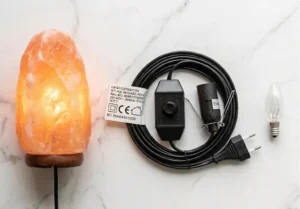
What accessories do you need for a Himalayan salt lamp to function properly and last longer? The working list is short: replacement bulbs, a dimmer cord, a sturdy base, a protective drip tray or mat, and a cloth for routine cleaning. Each one maps to a specific failure mode, which is why cutting the list is a false economy.
- Replacement bulbs. The lamp is sold as ambient lighting, and the bulb is the only consumable in the assembly. A listing that includes 1 spare bulb generates fewer support tickets than one that does not.
- Dimmer cord. Brightness control lets a buyer place the lamp on a desk or a bedside table instead of abandoning it because it overpowers a small room.
- Base. Salt crystals are irregular, so the base carries both the weight and the stability. A narrow or warped base is the most common cause of a tipped lamp.
- Drip tray or protective mat. Hygroscopic salt releases moisture onto furniture. The tray protects the customer’s surface, which protects your review page.
- Cleaning cloth. A dry, lint-free cloth keeps dust from being rubbed into the crystal face during the first wipe.
Buyers frequently ask whether the crystal itself counts as an accessory. It does not, but the authenticity of the crystal does affect how the accessories perform. A compressed or dyed imitation sweats differently and tolerates heat poorly, which is why we keep a separate buying guide on verifying genuine Himalayan salt.
Bulbs, Cords, and Dimmers: What to Specify
Salt lamps run on low-wattage incandescent or filament bulbs, commonly in the 15 to 25 watt range, because the warmth of the bulb is what gives the crystal its glow. That low wattage does not make the electrical path forgiving. The socket, the cord, and the switch carry the load continuously, often overnight.
Specify wattage, socket type, and cord length on the purchase order rather than accepting a standard build. A retailer selling into a 230V market with a cordset sourced for a 120V market will see failures in the first quarter, and the fault will be logged against the lamp, not the cord. Similarly, a rotary dimmer matched to a resistive filament load behaves differently from an electronic dimmer; when a customer reports buzzing at low setting, the mismatch is usually the cause.
Certification questions land here too. Lamp cordsets and bulbs are usually certified as components, separately from the salt body, so ask your supplier which certificates exist for the electrical parts in your target market instead of assuming the product carries one mark. Our own production runs under an ISO9001 quality system, and CE or UKCA documentation for the finished goods we hold certificates for is provided with the shipment file.
Bases, Drip Trays, and Moisture Control
Stability and moisture are the two physical jobs an accessory has to do. Reinforced bases and mounting hardware prevent accidental tipping, while drip trays collect the moisture that salt releases in humid rooms. Choose tray material for the environment: a non-corrosive finish matters in coastal or spa-adjacent retail where humidity runs high year-round.
The commercial reality is that a lamp shipped to a dry inland market and the same lamp shipped to a coastal one behave differently. Distributors covering both should pack a tray as standard rather than as an upsell, because the returns cost of wet furniture is not comparable to the unit cost of the tray. Where a customer reports persistent weeping even with the lamp switched on, the fix is placement and humidity rather than the accessory, and that diagnosis is written up in our guide to why a salt lamp sweats.
Indoor air conditions are the variable retailers control least, and public health guidance on humidity and indoor air quality is the reference buyers cite when they ask why a product behaves differently by region. The U.S. Environmental Protection Agency’s indoor air quality programme is a practical starting point for that conversation with a retail account.
Care and Maintenance Schedule for Retail and Hospitality
How do you maintain salt lamp accessories so the lamp keeps working? A written schedule beats best intentions, and the same table works for a hotel housekeeping team and for a consumer care card. The intervals below are what we print for hospitality accounts that run lamps continuously.
| Component | Maintenance interval | What the check covers |
|---|---|---|
| Bulb replacement | Every 6 to 8 months of daily use | Loss of glow, darkened filament, and reduced warmth at the crystal face. |
| Base and tray cleaning | Monthly | Salt residue buildup, staining rings, and grit that scratches furniture. |
| Cord and socket inspection | Quarterly | Fraying, discoloration at the plug, and a switch that feels loose. |
| Dimmer function test | Twice a year | Flicker through the range, sticking, and audible buzz at low setting. |
Cleaning itself is mechanical, not chemical. Wipe the crystal with a dry or barely damp cloth and dry it immediately; never spray a cleaner onto the lamp, since the salt absorbs liquid. Electrical parts take a dry lint-free cloth only, and harsh chemicals corrode the metal contacts on bases and cord plugs.
Storage conditions decide more of the outcome than cleaning does. Keep spares and display stock between 30 and 50 percent relative humidity, away from direct sunlight, and in a container that closes. Replacement bulbs stay in their original packaging until use, because a bulb boxed loose fails in transit at a rate that no warranty clause recovers.

Troubleshooting the 4 Complaints That Reach Support
Most accessory complaints collapse into 4 patterns, and each has a diagnostic sequence a support agent can run in one message.
- Flickering or intermittent light. Check the socket connection first, then confirm the bulb wattage matches the specification. A frayed cord is not a repair item; it is a replacement.
- Dimmer that buzzes, sticks, or drops out. Usually a dimmer and load mismatch or a switch worn from continuous use. Replace the cordset rather than the lamp.
- Base that rocks or leaves rings on furniture. Re-seat the crystal, check base alignment, and add felt or rubber feet. If the tray is the source of the ring, switch to a non-corrosive material.
- Surface weeping and damp patches. Humidity, not defect. Run the lamp longer, move it away from external walls, and put a tray under it. The same logic drives our custom salt product builds, where the accessory set is specified by destination climate.
Escalate to a professional or replace the unit when electrical faults persist after a cord and bulb change, when safety features fail, or when the crystal body itself has cracked. Those 3 cases are not troubleshooting items, and asking a customer to work through them costs the account.

Purchasing, Compliance, and OEM Packaging
When a buyer evaluates a supplier for accessories, the useful checks are concrete: stated wattage and socket type rather than “fits all lamps”, a component certificate list for the destination market, a warranty term written against the cordset and not only the crystal, and a packing format that survives retail handling. Vague product descriptions and missing certification references are the 2 signals that predict an after-sales argument.
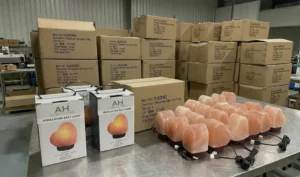
Order economics follow the same logic as the lamps themselves. A validation batch of accessories starts at 100 pieces with a USD 500 minimum order value. Wholesale and customized programs begin at 300 pieces with a USD 3,000 minimum order value, and a custom color gift box for retail shelf presentation begins at 500 pieces. Air freight lands a replenishment order in 20 to 30 days; ocean freight for a full program runs 60 to 90 days to port, which is the lane where accessory stock is planned rather than rescued.
Bundling is where accessory spend pays back. A lamp sold with a spare bulb, a care card, and a tray costs a supplier little and supports a higher retail position, while the same lamp sold bare invites the buyer to source parts elsewhere. Retail accounts that carry 2 or 3 size grades usually keep one universal accessory kit rather than a kit per SKU, which is the decision we recommend in our factory sourcing overview.
Wholesale Himalayan Salt Lamps and Accessory Sets
Jilin Ever Creation supplies whole-rock Himalayan salt lamps with matched bases, cordsets, dimmers, trays, and printed care cards. Specify wattage, socket type, and packing format for your market, or run a private-label accessory kit under your own artwork. Start with a USD 500 trial order before committing to a container.

Closing Notes on Accessory Margin
Accessories are the cheapest part of a salt lamp program and the most visible part of the ownership experience. Bulbs, cords, bases, trays, and a printed card determine whether the first year of use ends in a reorder or a refund, and the same five items decide how much of your listing’s rating is written by people who never opened the box.
Buy them to a specification, pack them with the lamp, and publish the maintenance interval instead of leaving it to guesswork. Wholesale salt lamp programs that do this carry fewer damage claims, and the difference shows up in the second order rather than the first review.
Frequently Asked Questions About Salt Lamp Accessories
What are the essential salt lamp accessories?
Replacement bulbs, a cord with or without a dimmer, a stable base, a drip tray or protective mat, and a dry cleaning cloth. These five cover the consumable part, the electrical part, the stability risk, the moisture risk, and routine upkeep.
Can I use any bulb in a salt lamp?
No. Match the wattage and socket type in the product specification, typically a 15 to 25 watt bulb. Higher wattage overheats the assembly and dries the crystal unevenly, while a lower wattage produces little glow and reads as a defect to the buyer.
How do I stop a salt lamp from sweating?
Run the lamp long enough to keep the crystal warm, move it away from external walls and humid rooms, and place a tray underneath. Sweating is absorbed moisture releasing onto the surface, so the fix is environment and run time rather than cleaning.
Are dimmer cords worth the extra unit cost?
For most retail channels, yes. A dimmer widens the rooms a lamp can sit in, from bedside to desk to display shelf, and it removes the common complaint that a single-brightness lamp is too strong for a small space. Specify the dimmer for a resistive load to avoid buzz.
What is the minimum order for accessory restocks?
A trial or validation order starts at 100 pieces with a USD 500 minimum order value. Wholesale and customized accessory programs begin at 300 pieces with a USD 3,000 minimum order value, and custom retail packaging starts at 500 pieces.