Skip to content


Private label and white label wooden gifts are talked about interchangeably in sourcing conversations, and the confusion is expensive. They describe different amounts of work, different timelines, different risk — and different answers to the question a brand must be able to answer: why would a customer buy this from me rather than the shop next door?
This guide separates the two, shows where the line blurs, and sets out what each route costs in time and commitment rather than in invented percentages. Our published terms are given against each option so the trade-offs are concrete. For the wider OEM and ODM route, see our private label, OEM and ODM guide.
Key Takeaways
- White label means an existing manufacturer-designed product sold under your brand. Your involvement is the logo, the packaging and the specification you choose from.
- Private label means a product developed to your specification. Your involvement starts before the first sample and continues through a retained master and written tolerances.
- The real difference is defensibility. A white-label product can be bought by a competitor from the same catalogue; a private-label product cannot, provided exclusivity is written down.
- Exclusivity is a contract term, never a default. Ask for it in writing, state its scope and duration, and expect it to be priced or volume-committed.
- Putting your brand on a product makes you responsible for it. Labelling, safety documentation and market compliance follow the brand, not the factory.
- Most programmes should start white label and move to private label. The trial tier at 100 pieces with a USD 500 minimum order value tests the subject before development is committed.
In This Guide
- What the Two Terms Actually Mean
- It Is a Spectrum, Not a Switch
- White Label Wooden Gifts vs Private Label
- Which Route Fits: Six Decision Factors
- Exclusivity, Design Ownership and Brand Risk
- Best For / Not For: Route by Brand Situation
- What We Provide on Each Route
- End to End: From White Label to Private Label
- Frequently Asked Questions
What the Two Terms Actually Mean
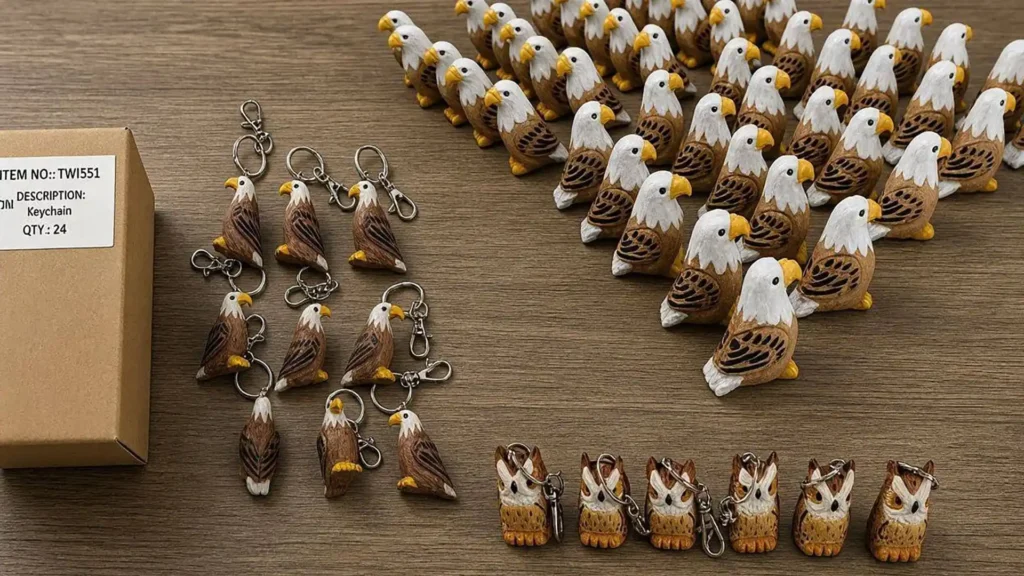
White label. The manufacturer designs and produces an existing product; the buyer applies their brand. In wooden gifts this means choosing from a catalogue of carvings — a bird, an owl, a coaster, a keychain — and adding an engraved logo, insert card or branded box. The product exists before the buyer arrives, is usually non-exclusive, and reaches market quickly because nothing is being developed.
Private label. The product is developed to the buyer’s specification and produced under their brand — in wooden gifts, a new carving, or an existing subject re-proportioned, re-sized, re-finished or re-mounted to a brief. It requires artwork, a master sample retained by both sides, and written tolerances. It costs more to start, and in exchange the buyer gets something a competitor cannot order from the same page.

It Is a Spectrum, Not a Switch
Almost nobody sits at either end. Four steps cover most wooden gift programmes, and knowing which you are buying prevents a quotation being misread.
- Step one — branded stock. An existing design, your logo engraved or printed, stock packaging. Fastest route, no development, no exclusivity.
- Step two — specified stock. An existing design with your species, size, finish or hardware applied. Usually no new tooling or fixtures, but the piece is no longer identical to the catalogue version.
- Step three — branded packaging system. Custom box, insert card, hang tag and barcode artwork — where most visible brand work happens, and where a die and print plates are committed at our 500-piece custom box minimum.
- Step four — developed product. A new carving from your references, or an existing subject substantially re-worked. Requires artwork, a master sample, fixtures for repeat operations, and a written specification.
Steps one to three are usually called white label and step four private label, which is where most white label wooden gifts actually sit. The useful question is which of the four you are buying, what it commits you to, and whether anyone else can order the same thing. Sequencing is set out in our guide to the wood OEM timeline from sample to first order.
White Label Wooden Gifts vs Private Label
| Factor | White label | Private label |
|---|---|---|
| Who designs the product | The manufacturer; you select | You specify; the manufacturer develops |
| Development needed | None beyond artwork and packaging | Artwork, master sample, fixtures |
| Time to first order | Trial tier, 20–30 days air express DDP | Sample approval first, then 60–90 days to port |
| Exclusivity | Normally none; the design is in the catalogue | Available as a written term, not a default |
| Design ownership | Manufacturer’s; you own your artwork only | Must be agreed in writing before development |
| Minimums | 100 pieces with a USD 500 minimum order value on in-stock designs | 300 pieces with a USD 3,000 minimum order value; custom boxes 500 |
| Competitor can buy it | Yes, from the same catalogue | Only if exclusivity was not secured |
| Best used to | Test a subject, fill a gap, launch fast | Build a defensible range around a proven subject |
Which Route Fits: Six Decision Factors
The choice is rarely about budget alone. Six factors decide it, and they often point in different directions — which is why most programmes use both.
- How differentiated the range must be. If you compete on curation and service, white label is enough; if you compete on product, it is not.
- Channel conflict risk. If your competitors shop the same catalogues, a white-label piece will appear in their shops under their brand — survivable in gift retail, serious in a niche.
- Time to market. A seasonal window can decide this alone. White label on the trial tier lands in 20–30 days; a developed product needs sample approval before a 60–90 day run.
- Volume you can commit to. Development is only worth amortising if the design runs more than once; a single seasonal order rarely justifies step four.
- Evidence you already have. If you have not sold the subject you are paying to develop a guess. Sell it white label first, then develop what worked.
- Who will own what. Design ownership, artwork, fixtures and the retained sample all have an owner, and the answer must be in writing before development rather than negotiated after a relationship ends.
Where volume is the constraint, the low-minimum route is in our guide to low MOQ hand-carved wood crafts, and the levers around minimums in MOQ negotiation for wooden gifts.

Exclusivity, Design Ownership and Brand Risk
Three points here are routinely assumed rather than agreed, and all three are contract terms, not courtesies.
Exclusivity has a scope and a price. It can cover a design, a territory, a channel or a period, and each is different. A supplier asked for exclusivity without a volume commitment is being asked to stop selling a design, so the request is usually answered with a minimum annual quantity or a price adjustment — and it should be. Settle which, in writing, before development.
Ownership of a jointly developed design needs a stated answer. A carving developed from your references and the manufacturer’s experience has two contributors. Settle who owns the design, who holds the artwork files and fixtures, and what either party may do afterwards — easier to agree before a sample exists than after a range is selling.
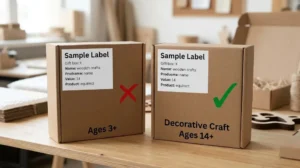
Your brand carries the compliance obligation. Once a product sells under your name, labelling, safety documentation and market compliance attach to you as brand and importer, not only to the factory — including the designation and age statement on the pack, which our guide to labeling wooden gifts for the EU works through, and coating documentation where a child may handle the piece — requirements published by the European Commission. United States importers should check marking and entry requirements with Customs and Border Protection.
Best For / Not For: Route by Brand Situation
| Brand situation | Route that fits | Route to avoid |
|---|---|---|
| New brand, unproven subject | White label on the trial tier; develop only what sells | Commissioning a developed design before any sell-through exists |
| Established range, gap to fill | Specified stock — your species, size and finish on an existing design | Full development for a gap that a finish change would close |
| Competing on product, not curation | Private label with written exclusivity scoped to your channel | White label, which a competitor can buy from the same catalogue |
| Tight seasonal window | White label air express, or branded packaging on an existing design | Development that cannot clear sample approval before the cut-off |
| Marketplace or platform seller | Specified stock plus strong packaging, which is what photographs | Exclusivity spend on a design a platform search will duplicate anyway |
What We Provide on Each Route
- On the white label route: an in-stock catalogue to select from, logo marking options and their limits on a carved surface, packaging tiers from stock to custom at the 500-piece minimum, and trial terms at 100 pieces with a USD 500 minimum order value, air express DDP in 20–30 days.
- On the private label route: development from multi-angle references stating target size, species, finish and personalisation; a master sample approved and retained by both sides; fixtures archived against the order number; and wholesale terms at 300 pieces with a USD 3,000 minimum order value, sea freight, 60–90 days to port. Sample mechanics are in our guide to refundable samples for wholesalers, and the retained reference in our guide to golden sample approval.
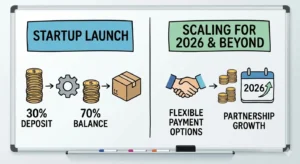
- On both: basswood, pinewood, rubber wood and birch; three-dimensional carving from 5 cm to 40 cm and flat carving to 80 cm; every piece carved and painted by hand; T/T at 30% deposit and 70% before shipment with photographs and video of finished goods first; and export packing to our carton specification rated to ISTA 3A. Packaging options are in our guides to ornament retail packaging and custom retail packaging for wooden crafts.
- Documentation on both: our facility operates under ISO 9001 and BSCI with CE, RoHS and UKCA protocols on electrical lines and EN71 coating routes for painted articles children may handle. On provenance: we hold FSC chain-of-custody certification, but certified basswood is not currently available to us, so our carvings are not marketed as FSC-certified wood; official timber felling and transport permits are what we supply — a distinction a branded range must get right, since the claim carries your name. Provenance frameworks are in our guide to ESG and sustainable sourcing for wooden decor.
End to End: From White Label to Private Label
A homeware brand wants a carved gift line under its own name and has one season to prove it.
Season one, white label. Three in-stock subjects are taken at the trial tier — 100 pieces with a USD 500 minimum order value, air express DDP, 20–30 days — with the logo engraved on the base and a printed insert card. No development is commissioned. The point is to learn which subject sells, and to whom, which cannot be known from a catalogue.
Read the season. One subject outsells the other two combined, and sells mainly as a gift at a higher price step than expected — the finding worth paying to develop against.
Season two, specified stock. The winner is re-ordered at the wholesale tier — 300 pieces with a USD 3,000 minimum order value, sea freight, 60–90 days to port — in a different species and larger size, with a custom box at the 500-piece minimum. No new design, but no longer identical to the catalogue version.
Season three, private label. With two seasons of evidence a developed version is commissioned: new proportions, a second size in the family, and exclusivity agreed in writing with a stated scope and annual volume. A master sample is approved and retained by both sides, fixtures are archived against the order number, and payment runs T/T at 30% and 70% before shipment with photographs and video first. Range options are in our custom product manufacturing and wholesale wooden crafts guides, supplier verification in our factory audit checklist.

If you are deciding between branding an existing design and developing your own — and want the timeline, minimums, marking options and exclusivity question answered against your volume — send us your brief and we will set out both routes in writing.
Frequently Asked Questions
Q: What is the difference between white label and private label wooden gifts?
White label is an existing manufacturer-designed product sold under your brand, with your involvement limited to logo, packaging and specification choices. Private label is developed to your specification. The practical difference is defensibility: a competitor can order a white-label item from the same catalogue; a private-label item they cannot, if exclusivity is written down.
Q: Is a private label product automatically exclusive to me?
No. Exclusivity is a contract term with a scope — design, territory, channel, period — normally exchanged for a volume commitment or price adjustment. Ask for it in writing before development. Assuming it because you paid for the sample is the costliest misunderstanding in this category.
Q: Which route is faster to market?
White label, by a wide margin. An in-stock design with your logo and an insert card can ship on the trial tier at 100 pieces with a USD 500 minimum order value, air express DDP, in 20–30 days. A developed product needs artwork, a master sample approved by both sides, then 60–90 days to port by sea.
Q: Who owns a design developed from my references?
Whoever the agreement says, which is why it must be agreed before development. A carving produced from your references and the manufacturer’s carving experience has two contributors, so ownership of the design, artwork files and fixtures should be stated in writing along with what each party may do afterwards.
Q: Does putting my brand on the product make me responsible for compliance?
Yes. Labelling, the designation and age statement on the pack, safety documentation and market compliance attach to the brand and importer, not only the factory — including coating documentation where a child may handle the piece, and provenance claims, which must match the material supplied rather than the story the range wants to tell.
Sources
Toy safety requirements, including the EN71 coating migration limits applying where a branded article may be handled by a child, are published by the European Commission, and United States marking and entry requirements by Customs and Border Protection. Our minimums and order values, lead times by tier, species list, carving size range, hand-carved and hand-painted construction, packaging specification and ISTA 3A rating, payment terms, certifications and sample route are our own published first-party terms. No cost-difference percentage between white label and private label is quoted here: the gap depends on design, species, finish, marking method and packaging tier, so a general percentage would be wrong for most briefs. Exclusivity, design ownership and territory are contract terms to settle in writing with your adviser.