Skip to content

A quoted unit price is not your landed cost, and treating it as one is the most common arithmetic error in importing wooden decor. Between the factory door and your shelf sit freight, insurance, terminal charges, duty, broker fees, inland haulage, testing and a loss allowance — and on a light but bulky product the freight line is usually larger than a first-time importer expects.
This guide gives the calculation rather than a set of numbers. No duty rate, freight rate or fee percentage is quoted, because those vary by corridor, carrier, broker, season and classification, and any figure in a general article is already wrong. What it gives instead is the structure, the lines to request from each party, and the arithmetic derivable exactly from our own published carton data. Freight terms are in our guide to incoterms for wooden decor imports.
Key Takeaways
- Landed cost is per unit received, not per unit ordered. Divide the total by what arrives, with a loss allowance so the denominator is honest.
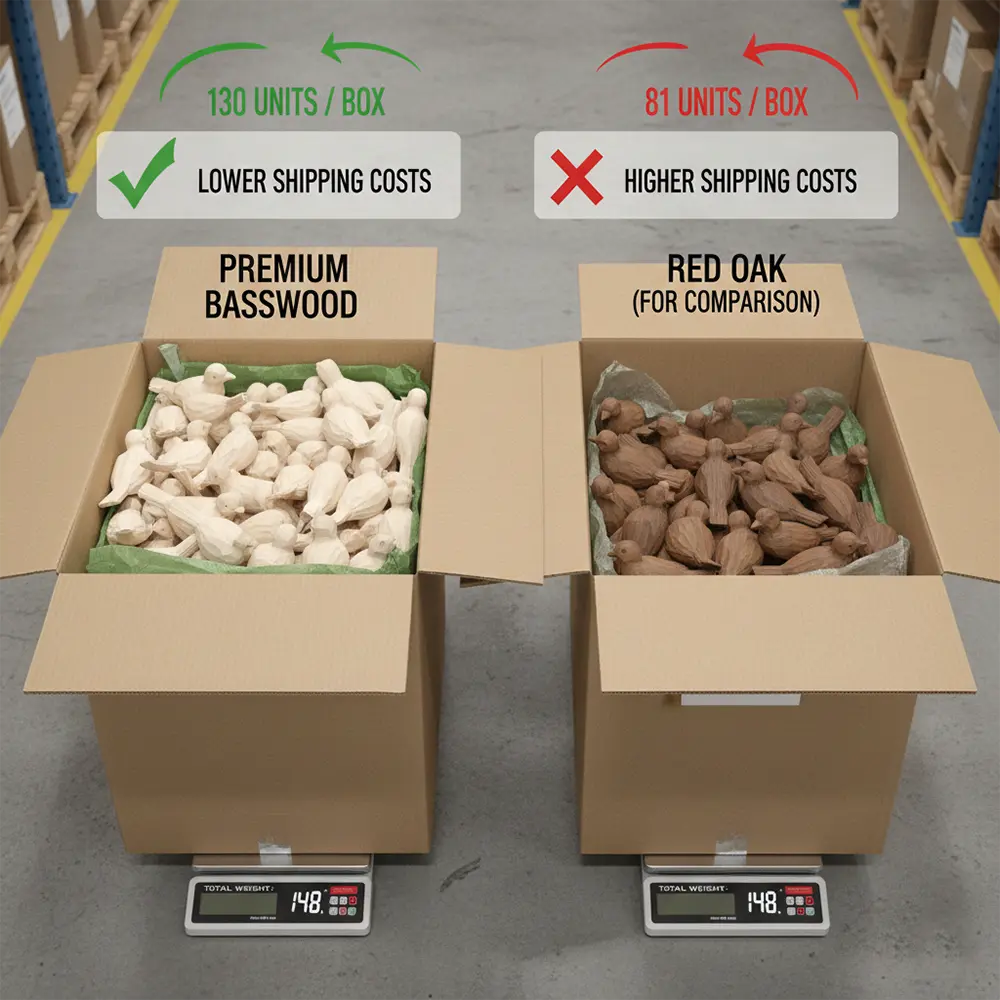
- Wooden decor is volumetric cargo. On our published master carton the density works out at roughly 101 to 190 kg per cubic metre, far below the 1,000 kg revenue ton, so freight is charged on cube rather than weight.
- Packaging decisions move your freight line: a carton gaining a few millimetres, or an inner box shipping half empty, costs money on every unit.
- The incoterm decides which lines are already inside the quote. One number means different things on EXW, FOB, CIF and DDP, so a price without a term is not comparable to another.
- One-off costs must be amortised, not absorbed. Compliance testing, box dies and print plates belong in the unit cost of the run they serve.
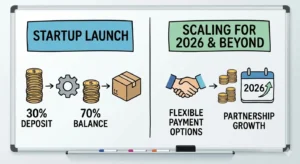
- Financing is a cost line too. A 30% deposit tied up across a 60–90 day sea transit is working capital, and belongs in the calculation even when it carries no explicit fee.
In This Guide
- The Landed Cost Formula, Line by Line
- Why Wooden Decor Is Charged on Cube, Not Weight
- What the Incoterm Already Includes
- Duty, Compliance and the Amortised Lines
- Every Landed Cost Line and Who Supplies It
- What We Provide So You Can Compute It
- End to End: Costing One Container of Decor
- Frequently Asked Questions
The Landed Cost Formula, Line by Line
Landed unit cost is every cost between the supplier’s door and your shelf, divided by the units that actually arrive. The divisor matters: units received is not units ordered, and using the order quantity understates cost by whatever the loss allowance proves to be.
Ten lines cover almost every wooden decor import, running from goods at the stated incoterm through origin charges, main carriage, insurance, terminal and broker fees, duty, any non-recoverable import tax and inland haulage, to a loss allowance covering transit damage, stockroom handling, shrink and markdown. The table below lists each with the party who supplies the number.
Two lines are omitted most often, and both are real. Compliance and testing, amortised across the run rather than treated as a one-off outside the calculation. And the financing cost of the deposit: our terms are T/T at 30% deposit and 70% before shipment, so on a sea order at 60–90 days to port that deposit is committed across production plus transit. Whether or not your bank charges explicitly for it, the capital was unavailable elsewhere.
Why Wooden Decor Is Charged on Cube, Not Weight
This part of the calculation can be worked out exactly rather than estimated, because it derives from published carton data rather than a carrier’s rate card. Our standard export packing is 6 to 12 pieces per three-ply inner box at 21 × 11 × 14 cm, and 240 to 480 per five-ply master carton at 58 × 44 × 31 cm, gross weight 8.0 to 15.0 kg, rated to pass an ISTA 3A drop test.
A master carton at those dimensions occupies 0.58 × 0.44 × 0.31 metres, approximately 0.079 cubic metres, giving roughly 12.6 master cartons per cubic metre. Depending on pack pattern, a cubic metre holds between about 3,000 and 6,000 pieces. Against 8.0 to 15.0 kg gross per carton, cargo density works out at approximately 101 to 190 kg per cubic metre.
Sea carriers price on a revenue ton, conventionally the greater of one cubic metre or 1,000 kg. At 101 to 190 kg per cubic metre, wooden decor sits far below that threshold and is volumetric cargo: you pay for space, not mass. Three consequences follow, all within a buyer’s control. Freight per piece falls as pack density rises, so pieces per carton is a commercial variable rather than a packing detail. Packaging adding volume without adding pieces raises freight per unit. And a design that nests, stacks flat or ships unassembled can move the freight line more than a price negotiation moves the goods line.

What the Incoterm Already Includes
One unit price means different things on different terms, so a quotation without a term cannot be compared to another. The progression is worth knowing even though the detail belongs in the term definitions: on EXW every line after the factory door is yours, on FOB the supplier carries origin charges and loading, on CIF carriage and insurance are inside the price but risk transfers earlier than cost does — which surprises buyers — and on DDP everything to your door is inside the price, duty included. The International Chamber of Commerce publishes the definitions, and our incoterms guide works through what each means for a wooden decor import.
Our trial tier ships air express DDP, which is why it produces a reliable landed-cost figure quickly: with duty, carriage and delivery inside the term there are no open lines to estimate. Wholesale and custom move by sea at 60–90 days to port, where the term decides how many of the ten lines you quote yourself. Payment terms and their cost interaction are in our guide to payment terms with wood suppliers.

Duty, Compliance and the Amortised Lines
Duty. Duty applies to the customs value at the rate for the declared classification and origin, and is the line most often guessed at. Our wooden crafts are declared under 4420.1990, 9505.1000 or 9608.1000 depending on the article, but the rate depends on destination market, origin and any agreement in force, so it must come from your broker against the specific classification rather than a comparable product’s rate. A mixed set is generally classified by the component giving it its essential character.
Compliance and testing. Coating reports, market-specific testing, labelling artwork and any declaration regime are one-off costs belonging in the unit cost of the run they serve. Across a hundred pieces they are significant; across ten thousand they are not — an argument about order size rather than testing. United States importers of wood products should also expect plant-protection and legality declaration requirements; entry rules are published by Customs and Border Protection, and the EU documentation position in our EUDR checklist for wooden decor imports.
Packaging tooling and loss. Box dies and print plates amortise the same way, at a 500-piece minimum for custom boxes. The loss allowance is the line buyers most often set to zero and then find: transit breakage, stockroom handling damage, shrink and markdown on whatever does not clear. Set it from your own history rather than optimism — an ISTA 3A rated carton reduces it and does not remove it. Claim mechanics are in our guide to quality claims and defect resolution, and carton performance in our ISTA protocol guide.

Every Landed Cost Line and Who Supplies It
| Cost line | Who gives you the number | Notes for wooden decor |
|---|---|---|
| Goods | Supplier, against a stated incoterm | Record the term with the price or the figure is unusable |
| Origin charges | Supplier or forwarder, depending on term | Inside the price on FOB and above |
| Main carriage | Forwarder, quoted per cubic metre | Volumetric at our carton density, so quote on cube |
| Insurance | Insurer or forwarder | Inside CIF and DDP; arranged separately on FOB |
| Destination terminal, broker and entry | Terminal, forwarder and customs broker | Terminal charges inside DDP only; broker fee is flat per entry, so it falls per unit at volume |
| Duty | Broker, against the declared classification | Our HS codes are 4420.1990, 9505.1000 or 9608.1000 by article |
| Non-recoverable import tax | Your accountant | Recoverable tax is a cash-flow line, not a cost line |
| Inland haulage | Forwarder or haulier | Inside DDP; otherwise a separate quote per container |
| Compliance, tooling, loss, financing | You, amortised across the run | The four lines most often left out entirely |
What We Provide So You Can Compute It
- A price against a stated incoterm, never a bare number, so the quote is comparable.
- Carton quantity, dimensions and gross weight — 240 to 480 pieces per five-ply master carton at 58 × 44 × 31 cm, 8.0 to 15.0 kg gross — letting a forwarder quote on cube and letting you compute freight per piece yourself.
- HS code for the article, from our published 4420.1990, 9505.1000 and 9608.1000 by product, so your broker can classify rather than guess.
- Lead time by tier — 20–30 days air express DDP at the 100-piece trial tier with a USD 500 minimum order value; 60–90 days to port by sea at the 300-piece wholesale and custom tier with a USD 3,000 minimum order value. This is what a financing cost is calculated against.
- Payment terms and evidence: T/T at 30% deposit and 70% before shipment, with photographs and video of finished goods supplied before the balance falls due.
- Compliance documentation for the amortisation line: our facility operates under ISO 9001 and BSCI, holds FSC chain-of-custody certification, and applies CE, RoHS and UKCA protocols on electrical lines with EN71 coating routes for painted articles children may handle. On provenance, certified basswood is not currently available to us, so our carvings are not marketed as FSC-certified wood; timber felling and transport permits are supplied. Labelling obligations that carry cost are in our guide to labeling wooden gifts for the EU.
End to End: Costing One Container of Decor
A European importer is placing a first full order of carved decor and needs a shelf price before committing volume.
Calibrate on the trial tier. 100 pieces at a USD 500 minimum order value, air express DDP, 20–30 days. With duty, carriage and delivery inside the term, the trial yields an actual delivered figure with no open lines — the calibration point for everything estimated later.
Build the sea quotation. The supplier provides carton quantity, dimensions, gross weight and HS code; the forwarder quotes carriage per cubic metre against that cube; the broker gives the duty rate for the declared classification; the haulier quotes inland delivery. Ten lines, four sources, one spreadsheet.
Optimise the cube before negotiating the price. At 101 to 190 kg per cubic metre the shipment is volumetric, so pack pattern is the lever: maximising fill within the 240 to 480 range and the ISTA 3A rating moves freight per piece more than a goods-price conversation of equal length usually does. See our guide to B2B export packaging for wood carvings.
Amortise, then divide by what arrives. Coating reports, box dies and print plates are spread across the run, a loss allowance is added from the shop’s own history, and the total is divided by units received rather than ordered — giving a landed unit cost that can carry a margin and a promotion without collapsing. Turning it into a shelf price is in our guide to ornament retail pricing, and cost drivers for a branded run in our guide to custom logo coasters, MOQ and cost factors.
If you want to compute a real landed cost rather than estimate one — with carton quantity, dimensions, gross weight, HS code and lead time for your tier, quoted against a stated incoterm — send us your design and target quantity and we will return the data.
Frequently Asked Questions
Q: What is included in landed cost?
Everything between the supplier’s door and your shelf: goods at the stated incoterm, origin charges, main carriage, insurance, destination terminal charges, broker and entry fees, duty, non-recoverable import tax, inland haulage, amortised compliance and packaging tooling, a loss allowance and the deposit’s financing cost. Divided by units received, not ordered.
Q: Why is freight on wooden decor higher than expected?
Because it is volumetric cargo. Our master cartons are 58 × 44 × 31 cm at 8.0 to 15.0 kg gross, working out at roughly 101 to 190 kg per cubic metre — far below the 1,000 kg revenue ton carriers price against. You pay for space, so pack density and carton fill matter more than weight.
Q: Which incoterm makes landed cost easiest to calculate?
DDP, because duty, carriage and delivery are inside the term and no lines are left to estimate — which is why our trial tier ships air express DDP in 20–30 days, giving an actual delivered figure to calibrate later sea estimates against. On EXW or FOB you obtain every downstream line yourself.
Q: What HS code applies to wooden decor?
Our wooden crafts are declared under 4420.1990, 9505.1000 or 9608.1000 depending on the article. The duty rate depends on destination market, origin and any agreement in force, and must come from your broker against the specific classification — never a comparable product’s rate. A mixed set is generally classified by the component giving it its essential character.
Q: Should the deposit count as a cost?
Yes, as a financing line. On T/T at 30% deposit and 70% before shipment, a sea order at 60–90 days to port commits that deposit across production plus transit. Whether or not your bank charges explicitly for it, the capital was unavailable elsewhere, and two suppliers on different terms are not comparable until it is counted.
Sources
Incoterms definitions are published by the International Chamber of Commerce, and United States entry and valuation requirements by Customs and Border Protection. Our carton dimensions and quantities, gross weight range, ISTA 3A rating, HS codes, minimums and order values, lead times by tier and payment terms are our own published first-party terms; the cubic-metre, cartons-per-cube and density figures here are arithmetic derived from those carton dimensions, not estimates. No duty rate, freight rate, insurance premium, broker fee, terminal charge, haulage rate, tax rate or loss percentage is quoted: each varies by corridor, carrier, broker, season and classification and must be obtained as a current quotation from the party charging it. We are a manufacturer, not a customs broker or freight forwarder.