Skip to content


Wooden home decor margin is decided long before the price tag is printed. It is decided by the order tier, the carton cube, the classification line and the reject allowance — four inputs a retailer controls or negotiates at sourcing time, and none of which can be recovered later by discounting more cleverly. A range that looks profitable on unit price can be unprofitable on landed cost, and the reverse is equally true.
This guide is a method, not a set of answers. We are a manufacturer, so the numbers we can give you are our own published first-party terms — carton dimensions and weights, minimum order tiers, lead times and packaging thresholds. Everything downstream of those is yours: your freight rate, your duty line, your rent, your sell-through. The model below shows where each number comes from, and it labels every slot as ours or yours so nobody mistakes a manufacturer’s term for a retailer’s margin.
Key Takeaways
- Margin is computed on landed cost, not unit price. Our master carton holds 240–480 pieces at 8.0–15.0 kg gross, so cube and weight are margin inputs before the first sale.
- The tier changes the cost base: 100 pieces at a USD 500 minimum order value by air express DDP in 20–30 days, against 300 pieces at USD 3,000 by sea in 60–90 days to port.
- Packaging is a margin line, not an afterthought: 6–12 pieces per 3-ply inner box of 21×11×14 cm, white-paper wrapped, in ISTA 3A rated cartons.
- Hand-carved product carries artisanal variance, so a reject allowance belongs in the model — set from your own receiving data across the first 100-piece trial, not quoted by us.
- A carved range spanning 5 cm to 40 cm can be re-priced across occasions and seasons, which is a markdown lever a single-size product does not have.
- No margin percentage appears anywhere in this guide. All 5 inputs in the model are labelled ours or yours; every figure is either our published first-party term or a slot for your own number.
In This Guide
- Why Margin Is a Sourcing Decision
- Wooden Home Decor Margin: The Model to Build
- Landed Cost: The Number Most Models Get Wrong
- Cube, Weight and the Carton
- The Levers, and Whose Number Each One Is
- Variance, Rejects and Markdown
- Best For / Not For
- What We Supply Into the Model
- End to End: Building the Model for One Range
- Frequently Asked Questions
Why Margin Is a Sourcing Decision
Retailers usually treat margin as the gap between a wholesale price and a retail price, then find that freight, duty, damage and markdowns ate it. For carved wooden decor the gap between those two views is wider than for most categories, because the product is light but bulky, hand-finished, and seasonal in demand even when it is evergreen on the shelf.
That combination means the sourcing decisions — which tier, which carton configuration, which classification line, which size mix — move the margin more than the negotiation on unit price does. A buyer who squeezes a few cents per piece and then ships air freight on a bulky carton has paid far more for the saving than it was worth.
Wooden Home Decor Margin: The Model to Build
The model is one line of arithmetic with five inputs, and the discipline is knowing who owns each input. Margin per piece equals the retail price minus the landed cost per piece, divided by the retail price. Landed cost per piece is the sum of the unit price, freight per piece, duty per piece, handling and packaging per piece, and a reject allowance per piece.
- Unit price — ours to quote, yours to negotiate. Set by the order tier and the design.
- Freight per piece — mostly yours. Derived from cube and weight, which are ours, applied to your freight rate, which is not.
- Duty per piece — your broker’s. Driven by the classification line; we supply the HS code we declare, the rate comes from your entry.
- Handling and packaging per piece — shared. Our carton and inner-box configuration sets the labour; your receiving and shelving sets the rest.
- Reject allowance per piece — yours. A percentage of received pieces you expect to write off, set from your own receiving history.
Worked in symbols, the model reads: margin per piece equals retail minus landed cost, divided by retail, where landed cost is the sum of unit price, freight per piece, duty per piece, handling per piece and reject allowance per piece. Each of those five addends has an owner, and the owner is the person who can change it. That ownership map is the point of the exercise, because a margin argument is usually two people disputing a number neither of them owns.
Landed Cost: The Number Most Models Get Wrong
The most common error is building the model on the unit price and adding freight as a flat percentage. Freight on a bulky light product is not a percentage of anything; it is a function of volume. Two ranges with identical unit prices can land at very different costs because one cubes efficiently and the other does not.
The second error is treating the delivery term as neutral. On our trial tier the shipment moves air express on DDP terms, which means shipping and clearance are handled and the goods arrive at your door — the landed cost is close to the invoice. On the wholesale and custom tier the goods move by sea to port in 60–90 days, and everything after the port is your cost and your risk. The same product has two genuinely different landed costs depending on the tier, and a model that ignores that will misprice the reorder. Delivery terms are defined by the ICC Incoterms rules, and naming the term in the model is what keeps the two cases separate.
Cube, Weight and the Carton
Our published carton specification is the input your freight calculation starts from: each piece wrapped in white paper, 6–12 pieces per 3-ply inner box measuring 21×11×14 cm, and 240–480 pieces per 5-ply master carton measuring 58×44×31 cm at 8.0–15.0 kg gross, with cartons rated to pass an ISTA 3A drop test. From those figures your forwarder can produce a per-piece freight cost against your own rate.
Two consequences follow for margin. First, the pieces-per-carton figure is a range, not a constant, because it depends on the piece size — a 5 cm figurine and a 40 cm carving do not pack alike, so the cube per piece has to be computed for the actual mix being ordered rather than assumed from the carton. Second, wasted cube is pure margin loss: an inner box sized for a larger piece and filled with a smaller one ships air or sea volume that carries no product. Carton configuration for a mixed order is worth specifying at order stage, and the packaging options that affect it are covered in our guide to ornament retail packaging.

The Levers, and Whose Number Each One Is
| Lever | What it moves | Whose number it is |
|---|---|---|
| Order tier (air DDP vs sea to port) | Freight per piece and who clears customs | Our terms; your freight rate |
| Pieces per master carton | Cube per piece, hence freight per piece | Our carton spec, computed for your mix |
| Classification line | Duty per piece | Your broker, from our declared HS code |
| Size ladder mix (good–better–best) | Average unit price and average margin | Yours — a ranging decision |
| Reject allowance | Effective unit cost | Yours — from your receiving data |
| Season length and markdown depth | Realized price, not list price | Yours — from your sell-through |
| Packaging tier (inner box vs custom colour box) | Unit packaging cost and shelf readiness | Our 500-piece threshold; your choice |
Variance, Rejects and Markdown
Hand-carved product is not uniform, and a margin model that assumes zero rejects will overstate margin by exactly the write-off rate. The honest treatment is to carry a reject allowance as a line in the model and to set it from your own receiving history once you have one. What we can tell you is what variance means on our side: grain, posture and hand-painted detail differ piece to piece by design, while dimensions, finish standard and moisture at 8–12% are held against a retained sample.
Markdown is the other side of the same coin. A carved range that spans 5 cm to 40 cm can be re-positioned across occasions — a piece that does not sell as decor at full price may sell as a gift at a step down, or move to a different bay entirely — which softens the markdown a single-purpose seasonal item would take. How that re-positioning is done on the shelf is worked through in our guide to rustic wooden decor merchandising.

Best For / Not For
| A carved wooden decor range suits | It does not suit |
|---|---|
| Retailers who model landed cost per piece, not unit price | Buyers pricing off a flat freight percentage |
| Stores with a gift bay to absorb slow movers at a step down | Single-season, single-use product with no second occasion |
| Ranges ordered on the sea tier with cube specified per mix | Bulky mixes shipped air because the tier was not planned |
What We Supply Into the Model
- The carton and inner-box specification. 21×11×14 cm inner at 6–12 pieces, 58×44×31 cm master at 240–480 pieces, 8.0–15.0 kg gross, ISTA 3A rated — the cube inputs your forwarder needs.
- The tier terms. 100 pieces at a USD 500 minimum order value on in-stock designs, air express DDP in 20–30 days; 300 pieces at a USD 3,000 minimum order value by sea in 60–90 days to port; custom colour boxes from 500 pieces.
- The declared HS code per line. From our first-party set of 4420.1990, 9505.1000 and 9608.1000, applied per product. The rate against it is your broker’s number, not ours.
- Payment and documentation terms. T/T at 30% deposit and 70% before shipment, with photographs and video of finished goods supplied before the balance falls due.
- The capability behind the range. Hand-carved animal and plant ornament work in basswood, pinewood, rubber wood and birch, three-dimensional from 5 cm to 40 cm and flat to 80 cm, described on our wood carving factory page and across ewoodarts.com.
End to End: Building the Model for One Range
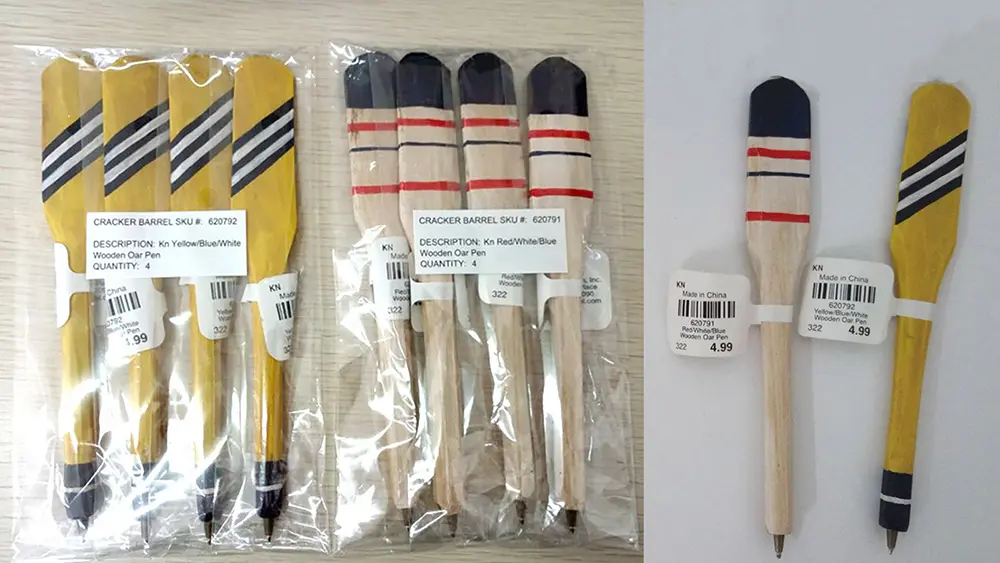
A home and gift retailer wants a carved bird range across three price steps and asks whether the margin works before committing to a reorder.
Build the model on the trial tier first, knowing what it proves. The first order is 100 pieces at a USD 500 minimum order value from in-stock designs, air express DDP in 20–30 days. Because clearance is handled and goods arrive at the door, the landed cost on this order is close to the invoice — which makes it a clean read on sell-through and price acceptance, but a poor read on sea-freight economics.
Rebuild the model on the sea tier before the reorder. The reorder runs at 300 pieces with a USD 3,000 minimum order value, 60–90 days to port. Now cube per piece is computed for the actual size mix, the broker returns the duty line against the declared HS code, and the reject allowance is set from the first order’s receiving data. The margin that matters is this one, not the trial’s.
Stress it with markdown before ordering, not after. The model is run a second time with the slowest size step marked down to the gift-bay price, so the retailer sees the margin floor rather than the margin hope. Only then is the reorder placed, with carton configuration specified for the mix and the size ladder set across the 5–40 cm range. Where a design needs new tooling, that cost enters the model as its own line via our guide to tooling and mould costs for custom wooden products.
The wider range behind the size ladder — the pieces that fill the good, better and best steps — is set out in our wholesale wooden crafts guide.

Want the inputs for your own margin model?
Send us the range and the size mix you are considering. We will return the carton configuration, the cube and weight per piece, the tier terms and the declared HS code per line — the numbers that are ours — so your model only has to supply the ones that are yours.
Frequently Asked Questions
Q: What margin should I expect on wooden home decor?
We are not going to quote a percentage, and you should distrust anyone who does: the answer is built from your freight rate, duty line, rent and sell-through, none of which a manufacturer can see. We give every input on our side — carton cube and weight, tier terms, packaging thresholds, HS code per line — and you supply the rest; the result is then yours and defensible.
Q: Why does the order tier change my margin so much?
Because it changes the freight mode and who clears customs. The trial tier moves air express on DDP terms in 20–30 days with clearance handled, so landed cost sits close to the invoice. The wholesale tier moves by sea in 60–90 days to port, after which onward freight, clearance and handling are yours. On a bulky light product the gap is large.
Q: How do I handle rejects on hand-carved product?
Carry a reject allowance as an explicit line rather than assuming zero, set from your own receiving history once you have one; until then treat the first order’s write-offs as data collection. The specification should not vary: dimensions, finish and moisture at 8–12% are held against a retained sample, while grain and posture are expected to differ.
Q: Does cube really matter more than unit price?
On a bulky light product, often yes. Freight is charged on volume and weight, and our master cartons hold 240 to 480 pieces at 8.0 to 15.0 kg gross on a 58 by 44 by 31 cm footprint, so pieces-per-carton for your size mix drives freight per piece. Cents saved on unit price can be outweighed by shipping empty volume.
Q: Can a slow carved piece be rescued instead of marked down?
Sometimes — the lever a carved range has and a single-season item lacks. A piece spanning 5 cm to 40 cm can be re-positioned: moved to a gift bay at a step down, regrouped under another subject, or paired into a set, before it is discounted. Re-positioning preserves margin because it changes the occasion, not the price.