Skip to content


Wooden signage is the cheapest merchandising tool a store owns and the most abused. A carved or painted board costs little, lasts years and carries the store’s voice, yet most displays stack three jobs onto one sign until it performs none of them: direction, claim and price fighting for the same eight words.
This guide gives retail teams six sign types that earn their place, the word budgets and finishes each needs, and the claims that must stay off a sign entirely. Every production figure is our own first-party number; the word counts and heights are recommendations for your floor to test.
Key Takeaways
- A store sign has 1 job at a time: direct, claim, price or welcome; a sign carrying 2 jobs fails at both, and the fix is a second sign, not a second line of text.
- Keep sign text under 8 words at arm’s length and under 5 words across a room; carved letters lose legibility faster than printed ones as distance grows, because shadows fill the counters.
- Match finish to reach: signs at child reach need the same eco-friendly non-toxic paint and edge rounding as any handled piece, while overhead signs 2 m and above can carry deeper carve and darker stain.
- Price on a separate, swappable piece: a carved sign with a painted price becomes waste at the 1st markdown, so carve the frame and paint the number on an insert card or slate slip.
- Hold claims to documents: species and origin on a sign are fine with the permits behind them, but no FSC-certified wood claim survives an audit today, because certified basswood is not currently available and 1 chain-of-custody certificate covers custody only.
- Order signage with the range, not after it: signs cut from the same offcut batch as the display pieces match tone, and a 300-piece wholesale and custom run can carry the sign blanks at almost no added harvest.
In This Guide
- Why Signs Fail in Threes
- Wooden Signage: Six Ideas That Earn Their Place
- Word Budgets and the Shadow Problem
- What to Print, Paint or Slot
- The Claims That Stay Off a Sign
- Six Sign Types Compared
- Placement, Height and Reach Rules
- What We Carve, and What We Do Not
- Best For / Not For
- What We Check on a Signage Run
- End to End: A Three-Bay Refresh With Signage
- Frequently Asked Questions
Why Signs Fail in Threes
A sign fails when it carries three jobs: welcome the customer, claim the material story, and price the shelf. Each job needs a different word budget, a different height and a different change cycle, and a single board cannot honour any of them. Welcome changes never, claims change rarely, prices change monthly.
Separating the jobs also separates the costs: the welcome and claim boards are carved once and live for years, while the price layer stays on swappable slips that cost nothing to reprint. The bay structure those signs label is the same structure a planogram defines, and the shelf-level mechanics are covered in our guide to gift shop planogram basics.
Wooden Signage: Six Ideas That Earn Their Place
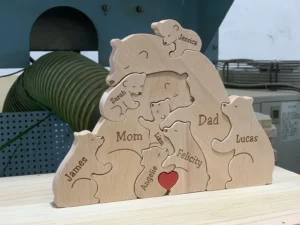
Six sign types cover almost every store need. The entrance welcome board, carved once with the store’s name and never re-priced. The bay header, naming the bay’s one job in under 5 words. The claim card frame, holding a printed insert that carries the species and care story in full sentences. The price frame, carved border with a slotted slip. The direction finger, a carved arrow or animal pointing the way to checkout or wrapping. And the seasonal topper, a shaped board that crowns a bay for one window and stores flat for the rest of the year.
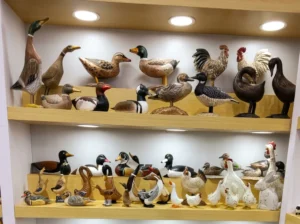
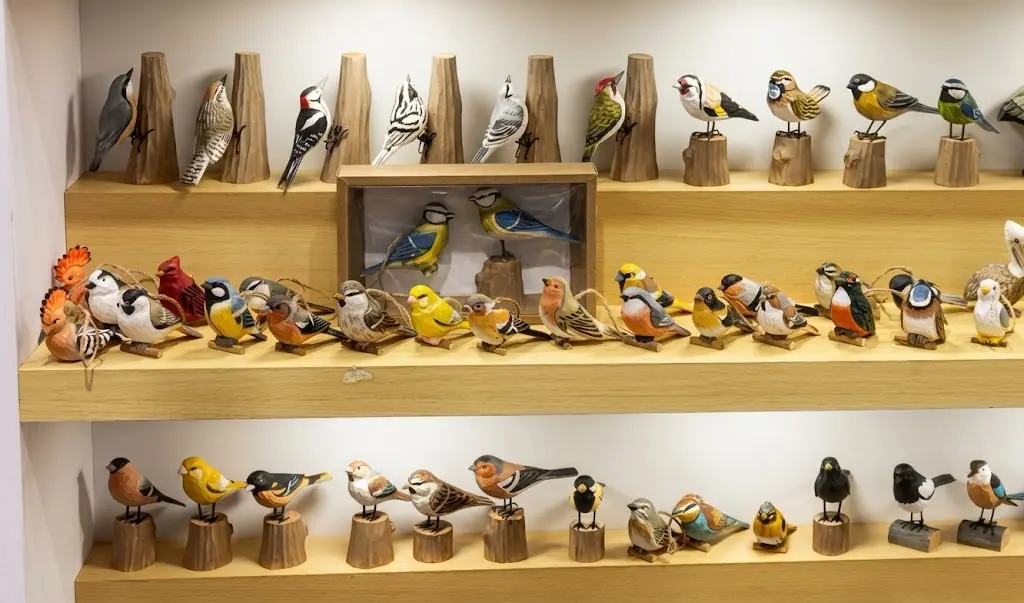
Each type has one change cycle, which is the test for whether a sign idea is real: if you cannot say how often it changes, it is two signs arguing inside one board. Grouped carved pieces beside a sign reinforce it without adding words, which is why a bay of graded figurines under a 4-word header outperforms a bay of singletons under a paragraph, as set out in wooden animal figurines in retail display.
Word Budgets and the Shadow Problem
Carved letters behave differently from printed ones: the counters of a carved letter fill with shadow as the viewing angle shifts, so legibility dies at distance long before a printed equivalent blurs. The working budgets are under 8 words at arm’s length and under 5 words across a room, with letter depth kept shallow enough that overhead light does not black out the counters.
Where a story needs more than 8 words, it belongs on a printed insert inside a carved frame, which keeps the carved board permanent and the story swappable. Painted signs tolerate more words than carved ones, but the same budgets apply across a room, because paint cannot rescue a word count that the distance has already eaten. The company and its specification library sit at ewoodarts.com.
What to Print, Paint or Slot
Three layers, three methods. Carve what never changes: store name, bay job, direction. Paint what changes yearly: seasonal toppers, campaign lines. Slot or clip what changes monthly: prices, promo lines, care cards. A store that respects the three methods stops repainting carved boards and stops carving prices.
The slot layer is also where destination-market label rules bite for stores selling labelled goods, because a shelf-edge sign that repeats a claim becomes part of the labelling story; the rules for wooden gifts entering the EU are set out in our guide to EU packaging and labelling for wooden gifts, and a sign should never say more than the box can prove.

The Claims That Stay Off a Sign
A sign is a published claim, and publication is exactly what turns a loose adjective into a liability. Species and origin statements are fine where permits back them; finish safety wording is fine where the safety sheets exist; handmade and hand-carved are fine where the benches are real. Four claims stay off: FSC-certified wood, because our facility holds a chain-of-custody certificate but certified basswood is not currently available to us; food-contact wording; lifetime warranties; and any recycled-content percentage for virgin or offcut timber.
The wider framework for credible forest and sourcing claims in decor is published by the FAO forestry programme, and the practical rule for a sign board is shorter: if the claim cannot survive an audit, it cannot survive being carved at 40 mm high above a door.
Six Sign Types Compared
| Sign type | One job | Finish | Change cycle |
|---|---|---|---|
| Entrance welcome | Welcome and name | Deep carve, stain | Never |
| Bay header | Name the bay job | Painted, high contrast | Per reset |
| Claim card frame | Hold the story insert | Carved frame, print insert | Insert per campaign |
| Price frame | Hold the price slip | Carved frame, slotted slip | Slip per markdown |
| Direction finger | Point the way | Painted arrow or animal | Per layout change |
| Seasonal topper | Crown one window | Shaped board, painted | Per season, stores flat |
Placement, Height and Reach Rules
Height follows job: welcome boards at door eye line, bay headers above the top shelf but below the ceiling line where light rakes across the carve, price frames at the shelf edge within the reach band of the goods they price. Signs at child reach carry the same rules as handled pieces: rounded edges, eco-friendly non-toxic paint, and fixings that survive a pull test.
Light is the silent partner: a carved board under a downlight reads crisply, while the same board in shadowed racking loses every counter. Walk the floor at the dimmest hour the store trades before fixing a carved sign, because the shadow problem is a lighting decision wearing a signage costume. Boutique merchandising logic for grouped wood under signage is covered in rustic wooden decor merchandising.

What We Carve, and What We Do Not
- We carve: wall and shelf signage in 4 species, basswood, pinewood, rubber wood and birch, from small shelf-edge frames to door-height welcome boards, painted or stained.
- We carve: shaped seasonal toppers and direction pieces as part of a display range, cut from the same offcut batch so tone matches the goods below.
- We do not make: illuminated signs, electrical elements, metal stands or acrylic faces; a programme needing light should bolt our carved face to a separately sourced fixture.
- We do not print: the insert cards themselves at volume; we supply the frame and the dimension, and the store or its print partner supplies the paper.
Best For / Not For
| Setting | Best for | Not for |
|---|---|---|
| Independent gift shop | Welcome board plus bay headers | Carved prices at markdown pace |
| Garden centre | Direction fingers and zone toppers | Painted boards in uncovered lanes |
| Chain concession | Claim frames with central inserts | Door-by-door carved variation |
| Fair booth or pop-up | Overhead maker board, flat-packing | Heavy deep-carve at height limits |
What We Check on a Signage Run
- Legibility at distance, photographed at 3 m and 6 m under store-like light, because the shadow problem shows in photos before it shows in store.
- Edge rounding and fixing strength on any sign specified at child reach, pull-tested on the sampling plan.
- Moisture at 8 to 12 percent before finishing, so a door-height board does not cup under heating.
- Insert and slip fit, gauged per frame size, because a swappable layer that needs force stops being swapped.
- Claims limited to what we hold: CE, UKCA, RoHS, EN71 where it applies, BSCI and ISO 9001.
Every figure above is first-party and checkable against an inspection report or a certificate we hold; the word budgets and heights are recommendations, not standards. The carving capability behind a signage run is described on our wood carving factory page.

End to End: A Three-Bay Refresh With Signage
A gift shop refreshing three bays for the winter window wants signage that survives the reset, and its first draft is one large board per bay carrying welcome, claim and price together.
Split the boards before carving them. The draft becomes per bay: one painted header with the bay job in 4 words, one carved claim frame holding a printed insert, and one price frame with slotted slips per shelf edge. The entrance keeps its existing welcome board, re-stained rather than recarved.
Cut the signs with the range. The winter range order runs on the wholesale and custom tier at 300 pieces and a USD 3,000 minimum order value, and the sign blanks are cut from the same offcut batch so header tone matches the goods below; sea freight at 60 to 90 days to port is counted back from the set-in date for goods and signs together.
Fix heights at the dimmest hour. The team walks the floor at evening light before drilling, moves two headers out of shadow, and pull-tests the child-reach price frames. At the January strip the toppers and inserts store flat, the slips are binned, and the carved frames wait for spring with nothing repainted.
Planning signage with your next range?
Send us your bay plan and your word lists. We will return the sign types each bay needs, the carve-paint-slot split per line, and the order date that lands signs with the goods.
Frequently Asked Questions
Q: What wood suits a carved store sign?
Birch and basswood for painted signs because they take paint evenly, pine where a rustic grain should show through a stain, and rubber wood for high-traffic edge pieces that need hardness. All are held at 8 to 12 percent moisture before finishing so a sign does not cup under store lighting.
Q: How much text can a carved sign carry?
Less than a printed one: under 8 words at arm’s length and under 5 across a room, because carved counters fill with shadow and distance closes them first. Longer stories belong on a printed insert inside a carved frame, which can also be swapped when the story changes.
Q: Should prices be carved into signage?
No. Carve the frame and the claim, then paint or slot the price on an insert card or slate slip, because the first markdown turns a carved price into waste. Swappable slips also let a store re-price a bay during a reset without recarving or reprinting the board itself.
Q: Can signage carry our sustainability claims?
Only the ones with documents behind them: species and origin statements supported by permits, and finish safety wording where the sheets exist. No FSC-certified wood wording, because our facility holds a chain-of-custody certificate but certified basswood is not currently available, so the claim would fail at the first audit.
Q: Do you make illuminated or standing signs?
No. We carve and paint wooden signage as wall and shelf pieces: hanging signs, bay headers, price frames and welcome boards. Electrical illumination, metal stands and acrylic faces sit outside our line, and a programme needing them should source those elements separately and fix our carved face to them.