Skip to content

Bringing a custom wood or Himalayan salt design to market means reconciling hand-carved aesthetics with export-grade production control. We work that gap from the factory floor, with more than 20 years of carving, drying and finishing behind a written development file, so each consignment leaves with documented material, coating and electrical compliance rather than a verbal promise.
Below is our concept-to-production workflow: what we need to open a project, what drawing package we return, how a Golden Sample locks the specification, and where the minimum-order and lead-time lines sit.

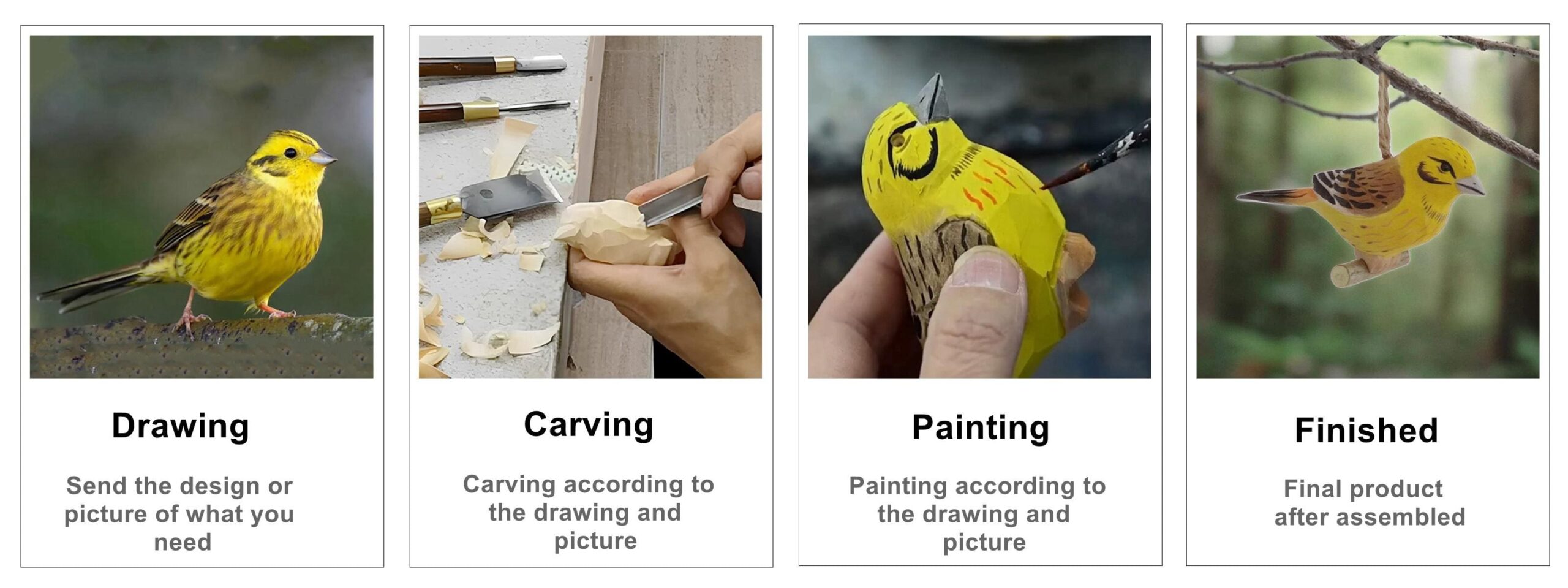
- Three inputs open a project: multi-angle reference photos or a CAD file, a target size, and the finish you want. Basswood, pine, rubber wood and birch are what we carve; 3D work from 5 cm to 40 cm, flat relief up to 80 cm.
- The Golden Sample is the real contract. Size, carving depth, paint match and packing lock on one labeled physical piece before a purchase order is issued.
- Trial order: 100 pieces at a USD 500 minimum order value, air express DDP, 20 to 30 days.
- Wholesale and custom programme: 300 pieces at a USD 3,000 minimum order value, sea freight 60 to 90 days to port, full OEM and ODM service.
- Custom colour boxes start at 500 pieces; custom labels and shipping marks are available on every tier.
- Compliance file per consignment: CE, RoHS and UKCA on salt-lamp electricals, EN71-1/-2/-3 on painted ornament, ISO 9001 process control and a BSCI social audit, with timber documented by official felling and transport permits.
Your Design, Our Craftsmanship
We put hand-carving experience behind a technical file. A sketch becomes a CAD model, the model becomes a tolerance-checked sample, and the approved sample becomes the reference every production piece is measured against.
Technical Concept-to-Production Conversion
We translate artwork, photographs and digital files into a formal specification with explicit tolerance notes rather than an artist’s impression. Before anything is cut, a Design for Manufacturability review checks the three factors that decide whether a wooden design survives production: tool access to every undercut, grain direction in thin projecting elements such as wings and beaks, and even wall thickness that will dry without checking.
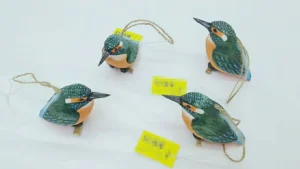
Material selection is part of that review. Fine-grained basswood takes paint cleanly and holds the smallest detail, which is why it carries our bird and animal carvings. Resilient pine brings visible grain and impact resistance for rustic and seasonal lines. Rubber wood is the volume option for turned and block forms, and birch ply holds large flat relief stable across a container.
Quality Compliance Standards
The facility runs under ISO 9001 process control with a BSCI social compliance audit, and each production step is recorded against a signed sample rather than an inspector’s memory. Painted pieces use eco-friendly, non-toxic paint and are tested to EN71-1/-2/-3, what European and UK buyers ask for on shelf-facing ornament. Salt lamp holders, cords and switches follow a CE, RoHS and UKCA protocol, with test reports and declarations of conformity per consignment.
On timber traceability we state the position plainly. Certified basswood is currently unavailable in our supply region, so we do not market our carvings as FSC-certified wood. What we provide is legal-harvest documentation: official felling permits and transport permits per batch, held on file and citable at customs. That is a narrower claim, and we would rather carry an accurate one than a decorative certificate.
The OEM Process (Step-by-Step)
Our OEM process is stage-gated: nothing advances until the previous gate has a signed deliverable. Design review and DFM closure come first, the Golden Sample locks the physical reference, and production runs against AQL sampling plans so quality does not depend on who is on the line.
| Manufacturing Phase | Critical Deliverable | Quality Objective |
|---|---|---|
| Design Validation | DFM notes and Bill of Materials | Resolve carving, drying and assembly risk before any wood is cut. |
| Prototyping | Labeled Golden Sample | Lock one physical reference for size, detail and paint. |
| Execution and QC | AQL and final inspection reports | Confirm production against ISO 9001 records and the signed sample. |
Design Validation and Sample Approval
The DFM pass happens before blanks are cut, because that is the moment changes are still free. It surfaces thin sections that will snap in transit, relief that will not cure evenly, and assembly steps that fight the carving. Fixing those on a drawing costs an afternoon; fixing them on 3,000 finished pieces costs a container.
Our first written deliverable is the drawing set with a complete Bill of Materials: species, blank size, hardware, coating system, paint colours and packing configuration. We then cut a labeled Golden Sample as the single source of truth. Once you approve and retain that piece it becomes the benchmark the line is measured against, which keeps change orders off the calendar after the purchase order is signed. The inspection stages are mapped in our manufacturing process page.
Production Logistics and Quality Assurance
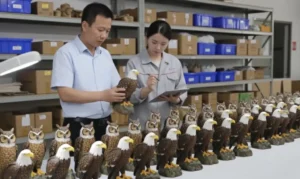
Raw material comes in through an approved supplier list, and each timber and salt batch keeps a lot number through to the packing sheet. Before the full run, a pilot batch is built on the production line and compared against the retained Golden Sample, so blank sourcing, drying, paint stages and packing are validated at real output speed.
During production and before booking the vessel we apply AQL sampling plans plus a final quality assurance checklist, photographed and documented pass or fail against the sample. Inspectors work from the signed reference rather than interpretation, which is how a hand-painted range stays consistent across 300 pieces and across reorders in different seasons.
Providing Drawings vs. Samples
A sample shows what you want; a drawing states what we are both accountable for, with tolerances, material calls and finish notes a sample cannot carry. Where you only have a sample, we reverse-engineer it into a drawing and send it back for sign-off.
| Drawing Type | Primary Focus | Key Technical Data |
|---|---|---|
| Fabrication Drawing | Part production | Blank size, cut list, tool paths, hole positions, sanding stages. |
| Assembly Drawing | Final configuration | Bill of Materials, exploded view, fastening sequence. |
| Electrical Drawing | Lamp and salt assemblies | Holder rating, cord and switch spec, wiring route, plug type. |
File Formats and Tolerance Discipline
We accept DWG, DXF and STEP files, and we also work from multi-angle photographs plus a target size when no CAD exists. The package we return is drawn to ISO and ANSI dimensioning conventions, so a partner in another country reads the same tolerance the carver in ours does. DXF geometry feeds CNC roughing for flat relief and repeatable bases, and hand carving follows the same file. Specification notes record surface finish, coating system and hardware list, because those items cause the costliest rework when assumed instead of written. On a tolerance dispute the approved drawing outranks the sample: it gives a verifiable measurement, while wood moves slightly with humidity. Both stay on file for the programme.
Sampling, MOQ & Lead Times
We do not publish a sample price list, because a five-centimetre basswood songbird and an 80-centimetre flat relief are not the same piece of work. What we publish is the order structure: 100 pieces at a USD 500 minimum for a trial, 300 pieces at a USD 3,000 minimum for a wholesale or custom programme, 20 to 30 days by air and 60 to 90 days by sea to port.
What Drives the Cost of a Sample
Five variables set the effort, and we quote against them instead of a generic band. Size decides blank cost and drying time. Carving depth and undercut count decide how much is hand work rather than machine roughing. Paint stage count decides finish time, since a two-colour body is not the same job as a feather-by-feather gradient. New fixturing is charged once and reused across reorder seasons. Packaging adds the fifth line, because a custom colour box with foam support is a tooling decision, not a carton one.
Order Tiers We Actually Run
A trial order is 100 pieces at a USD 500 minimum order value, selected from in-stock items on air express DDP, 20 to 30 days door to door with clearance handled by us. A wholesale or custom order is 300 pieces at a USD 3,000 minimum order value, opens the full catalogue plus OEM and ODM service, and runs on sea freight at 60 to 90 days to port. Custom colour boxes start at 500 pieces. Payment is T/T with a 30 percent deposit and the balance before shipment, against photographs and video of the finished goods.
Schedule risk lives in three places: timber moisture, paint cure and seasonal capacity. Blanks are dried against the destination climate before carving, which is why our anti-cracking treatment is a production step rather than a coating. Hand-painted pieces need drying time between stages that cannot be compressed without lifting colour. A Christmas or Easter programme needs sign-off early enough to clear the pre-holiday queue.
Private Label & Branding
Two routes carry your name. Private label puts an existing catalogue product under your brand and packing, the fast route. Custom OEM develops your own design, the exclusive one. The branding layer is the same on both: logo, colour box, insert card, labels and shipping marks.
Branding on the Product and the Package
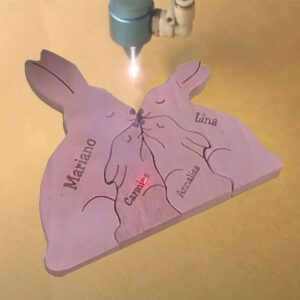
On wood, a logo goes on by laser engraving, screen print or a branded tag depending on the surface; engraved marks sit in the grain and do not peel the way a printed sticker does. On salt lamps the branding lives on the base, fitting and box rather than the crystal, since the stone is hygroscopic and will not hold a print. Vector artwork lets us cut the engraving file and prove it on a real blank.
Packing is a shelf decision. Standard configuration wraps each piece in white paper, packs 6 to 12 pieces into a 3-ply BC-flute inner box at 21 x 11 x 14 cm, and nests 240 to 480 pieces into a 5-ply reinforced master carton at 58 x 44 x 31 cm, adjusted to product size. Gross carton weight runs 8.0 to 15.0 kg on a build that passes an ISTA 3A drop test. Read how buyers specify this in our procurement guide and our private label programme.
Declaration Paperwork by Product Family
Clearance is easier when the tariff line is fixed before production instead of discovered at the port. Carved wooden ornaments and animals ship under HS 4420.1990; seasonal pieces such as Christmas and Easter ornament fall under 9505.1000; hand-carved wooden pens sit on 9608.1000. Salt lamps declare under 9405.4990, and salt brick or block under 2501.0019 or 2501.0020 by form. Tell us the destination market at quotation stage and the paperwork is prepared against that single line.

Intellectual Property Protection
Protection runs on three layers: a signed agreement before files move, restricted data access during production, and a written record of who owns the model and its derivatives. Ownership is settled at quotation stage, not after the first sample is photographed.
Confidentiality Frameworks and Ownership Agreements
A non-disclosure agreement is executed while the request for quotation is open, before sketches, CAD files or a benchmark sample change hands. Where a project transfers our development work into your product, a technology transfer agreement defines who owns improvements discovered during production. The same obligations extend to any outside finishing shop, so a sub-supplier never receives the complete design. A model you develop with us is not listed in our catalogue, offered to another buyer, or photographed for marketing without written release.
Operational Safeguards and Information Control
Supply chain segmentation means outside vendors receive only the data their stage requires: a shop cutting generic blanks never sees the finished painting specification. CAD and specification documents move over controlled transfer with access limited to a need-to-know list. Our hand-carving quality control records document the process standard while keeping the specific drying and finishing methods inside the factory.
Start a Custom Wood or Salt Programme
Send your reference images, target size and finish, and we return a DFM review, a drawing set with a Bill of Materials, and a Golden Sample before anything goes to production. One ISO 9001 factory covers both sides of your range: hand-carved wood and CE, RoHS and UKCA compliant Himalayan salt lighting.

Frequently Asked Questions
What files do you need to open a custom project?
CAD in DWG, DXF or STEP is ideal. Multi-angle photographs plus a target size, wood species and finish direction are enough to start. If you hold only a physical sample, courier it to us and we reverse-engineer it into a drawing for your sign-off.
What is the minimum order for a custom shape?
300 pieces at a USD 3,000 minimum order value, which includes full OEM and ODM service and sea freight at 60 to 90 days to port. Below that, a 100-piece trial at a USD 500 minimum order value runs from in-stock items on air express. Custom colour boxes start at 500 pieces.
Can you match a specific paint colour on hand-painted pieces?
Yes. The formula is mixed to your reference and locked on the Golden Sample, and every run is checked against that retained piece. Because each item is painted by hand, small variation between pieces is inherent; we control the range, not identical repetition.
Do your salt lamp electricals meet European requirements?
Holders, cords and switches are built to a CE and RoHS protocol, with UKCA for the UK market. Test reports and declarations of conformity are issued per consignment, and the plug type is specified for the destination at quotation stage rather than swapped at shipment.
Is my custom design kept off your catalogue?
Yes. A model you develop with us is not offered to another buyer and is not photographed for marketing without written release. Sub-suppliers receive only their own stage of the file, and CAD access stays on a need-to-know list.
Final Thoughts
Choosing a manufacturing partner is not a search for a factory; it is a search for a team that turns a creative idea into a repeatable product without quality sliding between the sample and the container. Two habits carry most of the value: lock the Golden Sample before the purchase order, and fix the tariff line and packing spec before the first blank is cut.
For the workshop stages behind a carved range, see our wood carving factory page, and wholesale wooden crafts for the catalogue we brand for retailers. On the sourcing vocabulary side, this overview of OEM and ODM arrangements is the distinction most buyers repeat to their own retail customers. Send reference images, target size and finish, and our export team will return a DFM review and a sample plan.